Master '짜증나' in Korean — The Most Honest Way to Vent Your Stress
Intro: A Word That Pops Out Several Times a Day
When the bus pulls away right in front of you, when the report you just finished vanishes because it didn’t save, when your internet keeps cutting out — there’s a word Koreans blurt out on reflex. It’s 짜증나 (jjajeungna). If you watch K-dramas, you’ll run into scenes where the lead furrows their brow and lets this word slip out all the time. Today we’ll take a deep dive into this expression, which captures everyday Korean emotion in its most honest form.
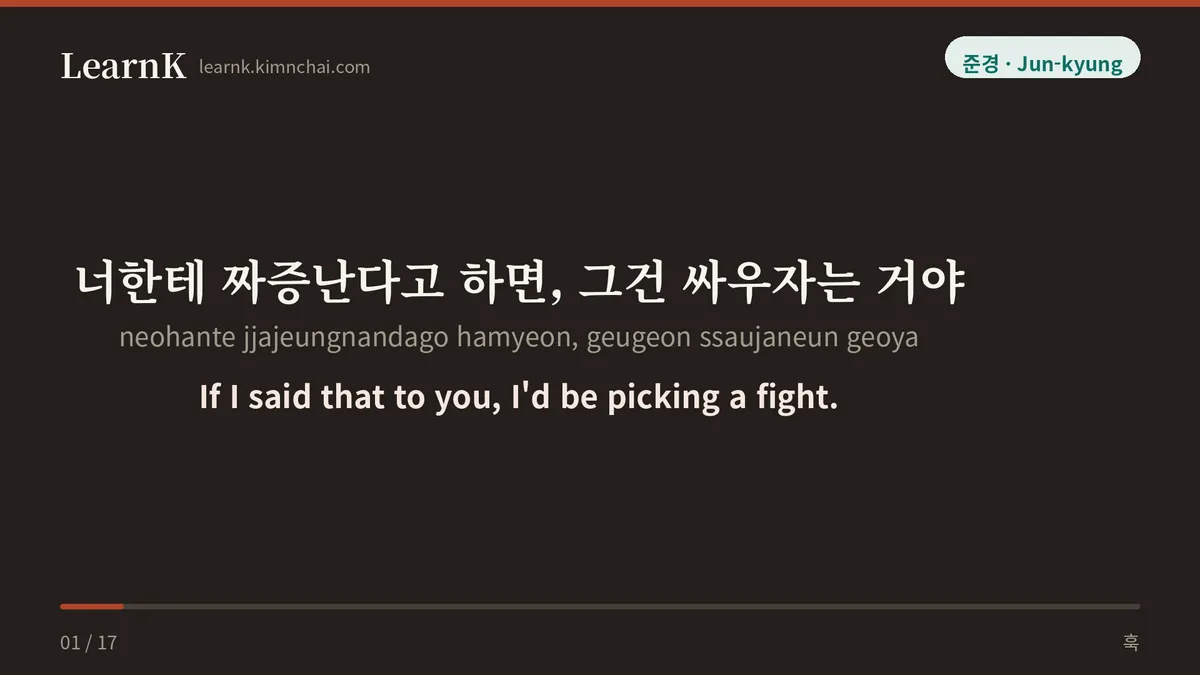
짜증나
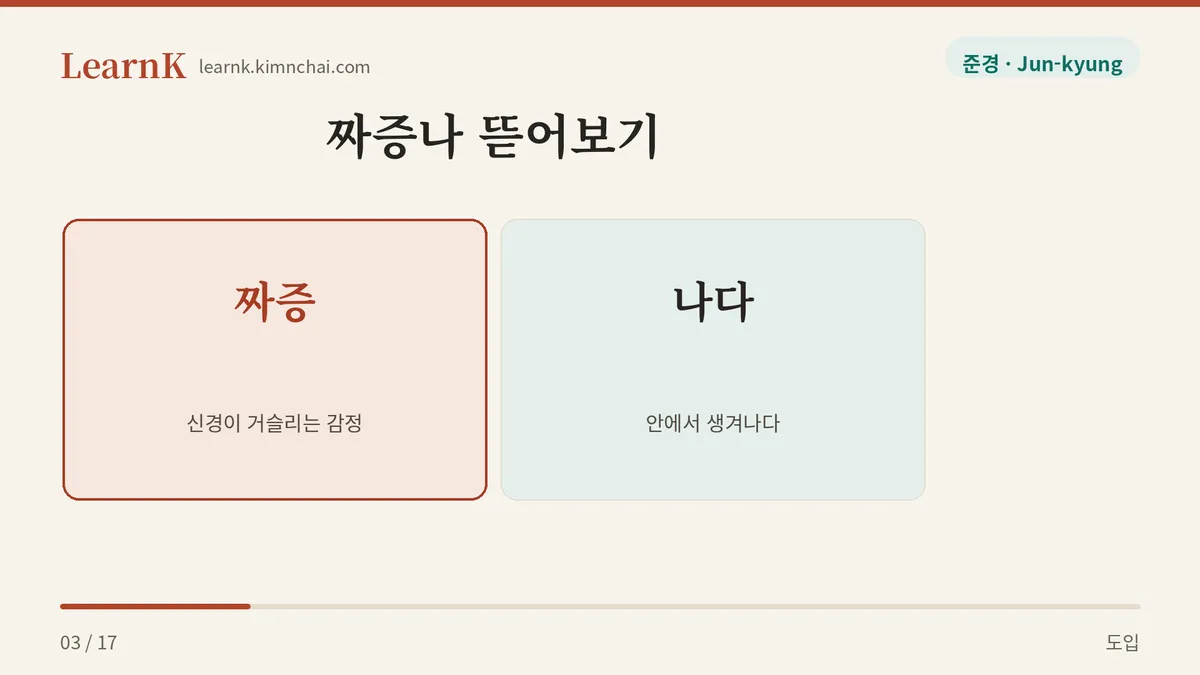
짜증나 (jjajeungna) combines the noun ‘짜증’ (irritation) with the verb ‘나다’ (to arise/come up). Translated literally, it means ‘짜증이 난다’ — that is, ‘the feeling of irritation is rising up inside me.’ In English, it’s close to “It’s annoying” or “I’m irritated.”
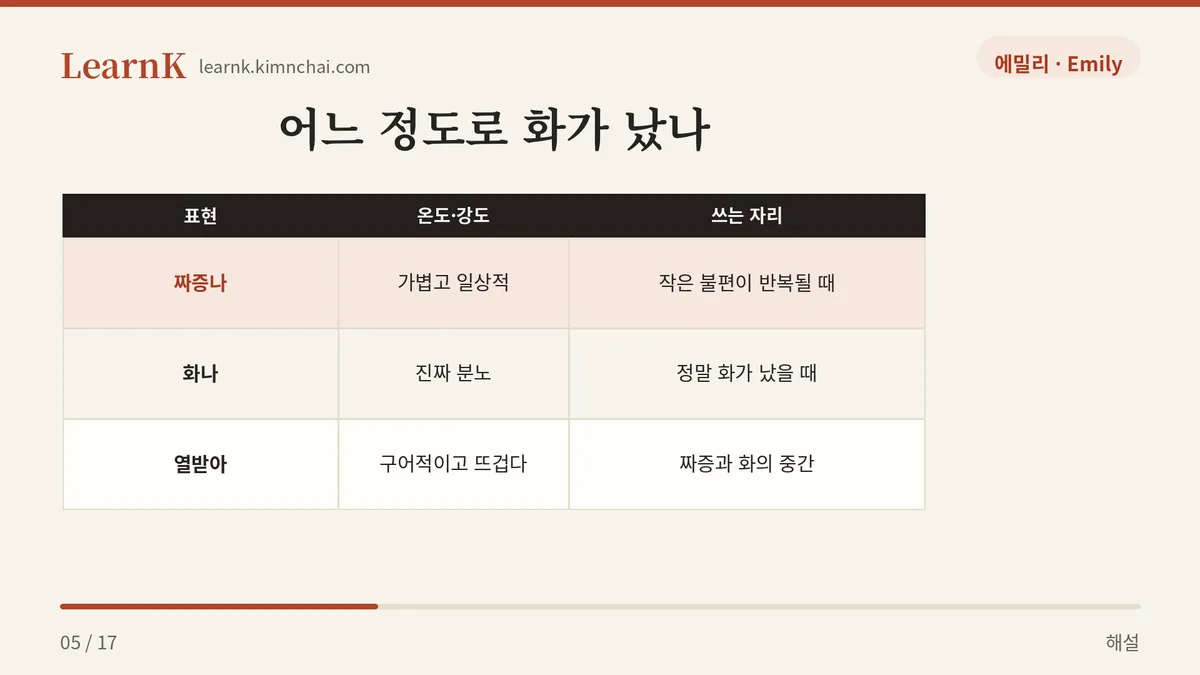
The key here is nuance. ‘짜증’ is a little different from a big, exploding rage (화). Rather, it points to a state where something minor — but repeated or not going your way — grates on your nerves. It’s not an emotion that erupts because of some major event; it’s the feeling of your mind turning prickly, like a thorn, as small annoyances pile up. That’s why it’s used far more often for the little everyday stresses than for serious situations.
Example Sentences by Situation
① When things don’t go your way
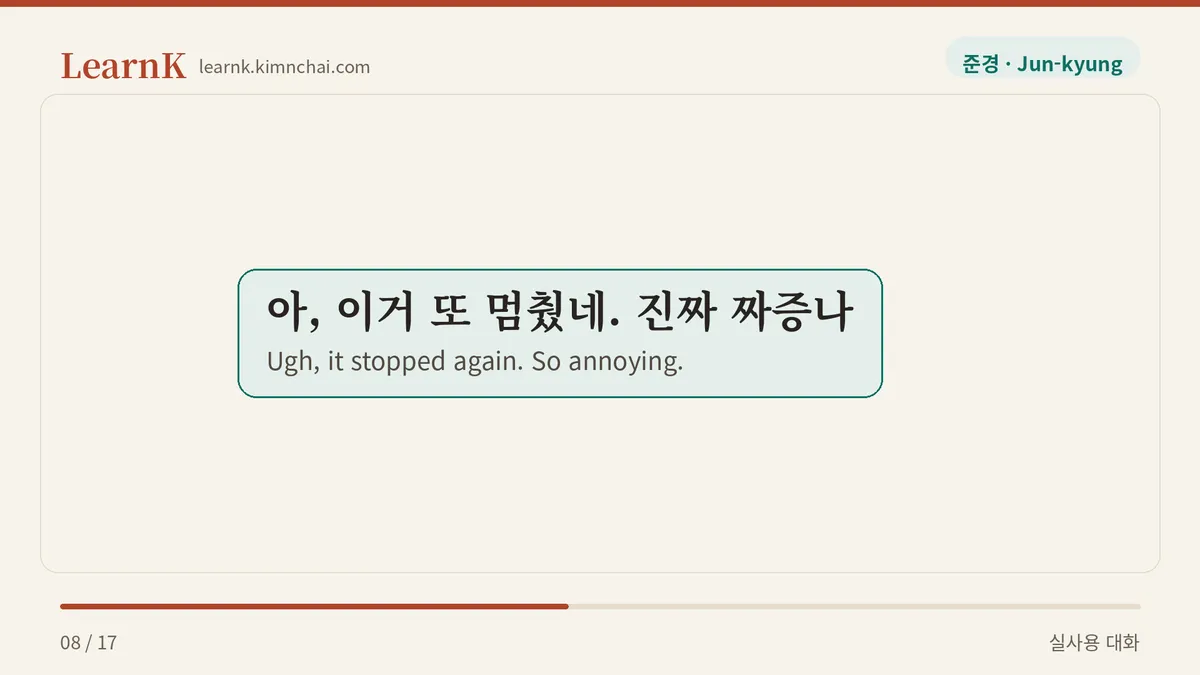
아, 컴퓨터가 자꾸 멈춰서 짜증나 (jjajeungna). (Ugh, my computer keeps freezing — so annoying.)
This is what you mutter, almost to yourself, when the computer you’re working on keeps slowing down or freezing. You’re not blaming a specific person; you’re expressing frustration at the situation.
② For a repeated inconvenience
옆집 공사 소리 때문에 하루 종일 짜증났어 (jjajeungnasseo). (The construction noise next door irritated me all day long.)
You use this when looking back on something that kept grating on your nerves, like noise. Adding ‘-았/었어’ lets you express irritation that happened in the past.
③ When you show your feelings to someone
너 자꾸 그렇게 놀리면 진짜 짜증나 (jjajeungna)! (If you keep teasing me like that, it’s really annoying!)
This is what you say when a close friend keeps messing with you and you’re slowly starting to get mad. That said, aimed directly at someone it can sound fairly aggressive, so it’s best used carefully and only between people who are very close.
Formal vs. Casual Speech and Similar Expressions
짜증나 is basically casual speech (반말). You use it with friends and close people, or when talking to yourself. In situations that call for politeness, you change it like this:
- Casual: 짜증나 (jjajeungna)
- Polite: 짜증나요 (jjajeungnayo) / More formal: 짜증납니다 (jjajeungnamnida)
Here are some expressions that are similar but have a slightly different feel — worth knowing too.
- 화나 (hwana): A bigger, stronger ‘anger’ than 짜증. For when you’re genuinely mad, not over trivial things.
- 열받아 (yeolbada): Literally ‘to receive heat.’ Somewhere between 짜증 and 화 — very colloquial and strong.
- 신경질나 (singyeongjilna): A state of sharp irritation from being on edge.
Of the four, 짜증나 is the lightest and most everyday, so it’s the most versatile.
Cultural Background — ‘짜증나’ in K-Dramas
In K-dramas, this expression is often used as a device to reveal a character’s personality. For example, when a prickly city-woman lead is stuck in a frustrating situation, just tossing out a short “짜증나” instead of a full line lets the audience instantly grasp that character’s weariness and edginess. Even in works with delicate emotional arcs — like the drama Goblin (도깨비) (tvN, 2016) — characters bring a sense of realism through these small emotional expressions rather than big outbursts of anger. In real Koreans’ KakaoTalk chats, vlogs, and variety shows, “아 짜증나~” shows up almost like a verbal tic. That’s just how alive and everyday this word is.
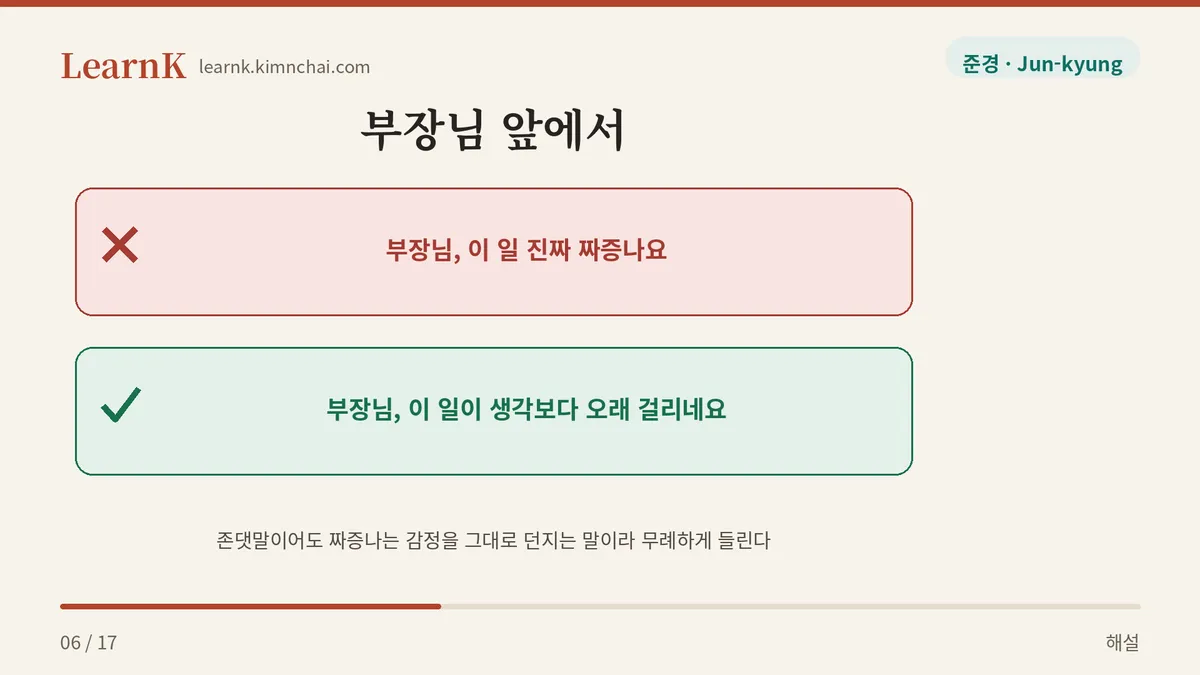
One tip: since this phrase is a very honest expression of emotion, using it carelessly in front of someone you’ve just met or someone senior to you comes across as rude. It’s most natural to use it among friends, or to let off steam when talking to yourself.
Closing Quiz
Which of the following is the most polite and formal expression?
- 짜증나 (jjajeungna)
- 짜증나요 (jjajeungnayo)
- 짜증납니다 (jjajeungnamnida)
The answer is number 3, 짜증납니다 (jjajeungnamnida). Choosing between casual and polite speech to fit the situation — that’s exactly the first step toward natural Korean. May your day be a good one, free of anything to feel 짜증나 about!