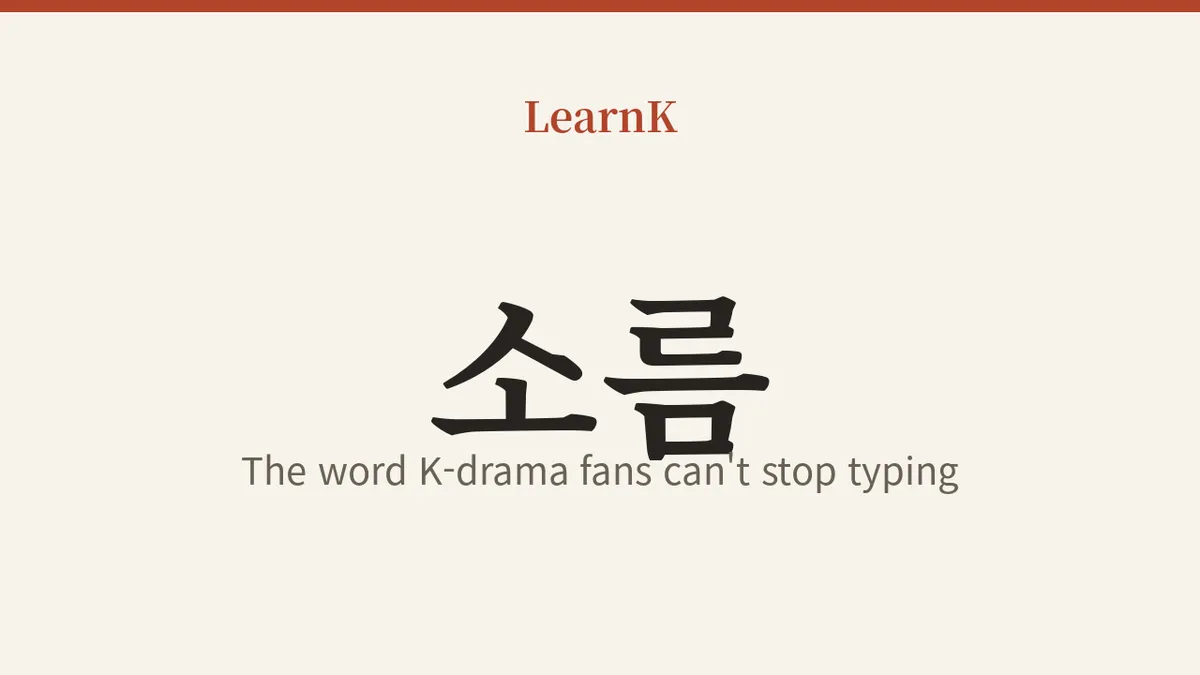
소름 (soreum): Putting That Full-Body Chill Into Korean Words
소름
When a plot twist explodes in the middle of a Korean drama, or when an idol nails a flawless high note on stage, there’s one word fans flood the chat with more than any other. It’s 소름 (soreum). Whether they’re spine-chillingly scared or so moved their whole body tingles, Koreans compress that feeling into this single word. Today, let’s take a deep dive into 소름 (soreum) — an expression every K-drama fan absolutely needs to know.
Meaning and Nuance
소름 (soreum) originally refers to the little bumps that rise on your skin — like tiny millet grains — as it tightens up when you’re scared, cold, or grossed out. In other words, it’s the noun for the English goosebumps. But these days, Koreans use the word far more broadly. When something is so amazing and moving that it gives you goosebumps, they express their awe with a single word: “소름!” That’s what makes it such a fun word — depending on context, it can signal fear, or it can be the highest of compliments.
Checking the National Institute of Korean Language Dictionary
The authoritative Basic Korean Dictionary from the National Institute of Korean Language defines 소름 (soreum) like this:
소름 (noun): A millet-like thing that comes up on one’s skin as it retracts when one is scared, cold or disgusted. [en] goosebump — A millet-like thing that comes up on one’s skin as it retracts when one is scared, cold or disgusted. [es] carne de gallina [zh] 鸡皮疙瘩 — National Institute of Korean Language, Basic Korean Dictionary (krdict.korean.go.kr)
Let’s also look at the real usage examples the dictionary provides.
영화에서 나오는 핵전쟁이 실제라고 가상하면 소름이 끼친다. — National Institute of Korean Language, Basic Korean Dictionary (krdict.korean.go.kr)
This describes the chill you feel when you imagine that the nuclear war in a movie were actually real. Here we meet the idiomatic expression 소름이 끼치다 (soreumi kkichida).
그 가수는 무대만 생각하면 소름이 돋고 털이 곤두선다고 한다. — National Institute of Korean Language, Basic Korean Dictionary (krdict.korean.go.kr)
This captures the on-stage emotion of tension and excitement so intense that every hair on your body stands on end. The form 소름이 돋다 (soreumi dotda) is used here.
나는 공포 영화에서 들리는 섬뜩한 귀곡성에 소름이 돋았다. — National Institute of Korean Language, Basic Korean Dictionary (krdict.korean.go.kr)
This is a classic horror scene — getting goosebumps from the eerie wailing of a ghost.
매서운 겨울바람이 불자 추워서 온몸에 소름이 끼쳤다. — National Institute of Korean Language, Basic Korean Dictionary (krdict.korean.go.kr)
This example shows that goosebumps can come not from fear but from the cold.
(There’s no Portuguese translation in the dictionary, so we’re adding our own — [pt] pele de galinha / arrepios.)
Example Sentences by Situation
Let’s get a feel for the word with some examples we made ourselves.
- A drama plot-twist scene — the moment the culprit is revealed, to a friend: “방금 봤어? 완전 소름 돋았어. (Banggeum bwasseo? Wanjeon soreum dodwasseo.)” — “방금 봤어? 완전 소름 돋았어” means “Did you just see that? I totally got goosebumps,” showing that your emotions have surged.
- A post-concert review — writing this on social media: “라이브 고음에 소름이 쫙 끼쳤어요. (Laibeu goeume soreumi jjwak kkichyeosseoyo.)” — Adding the adverb 쫙 (jjwak) emphasizes the feeling of goosebumps spreading all over your body at once.
- Venting after a blind date — about the other person’s cheesy way of talking: “그 사람 말투 진짜 소름이었어. (Geu saram maltu jinjja soreumieosseo.)” — Here it means not awe but aversion and displeasure. Tell the nuances apart through tone of voice and facial expression.
Comparing Formal/Casual Speech and Similar Expressions
With a friend you’d use casual speech, “소름 돋아! (Soreum doda!)”, and with an elder or a stranger you’d use formal speech, “소름 돋네요. (Soreum donneyo.)” Similar expressions include 오싹하다 (ossakhada), meaning to feel a chill run down your spine, and 섬뜩하다 (seomtteukhada), meaning to suddenly feel a scary sensation. While 소름 (soreum) focuses on a physical reaction (the skin), 오싹하다 (ossakhada) is closer to a psychological chill.
Cultural Background
In the subtitles of Korean dramas and variety shows, 소름 is used almost like an exclamation. When an actor makes a chilling expression during a plot-twist scene, if you were to put the situation into words, a “spine-tingling silence” often fills the screen.
이런 표정, 정말 소름 끼친다. — Drama Kingdom (Netflix, 2019)
The true power of this word shines in works dealing with horror and tension, like the zombie period drama Kingdom.
Today’s Quiz
A friend, moved by an idol’s flawless live performance, pointed at the ones that had popped up on their arm and shouted a single word. What did they say? (Hint: the expression we learned today!)
Answer: 소름 (soreum)!
Definitions and example sentences are from the National Institute of Korean Language’s Basic Korean Dictionary (krdict.korean.go.kr); that portion of this post, including our translations, is licensed under CC BY-SA 2.0 KR.