The Word You'll Always Hear Outside a Popular Korean Restaurant: '웨이팅' — Everything About Waiting in Line
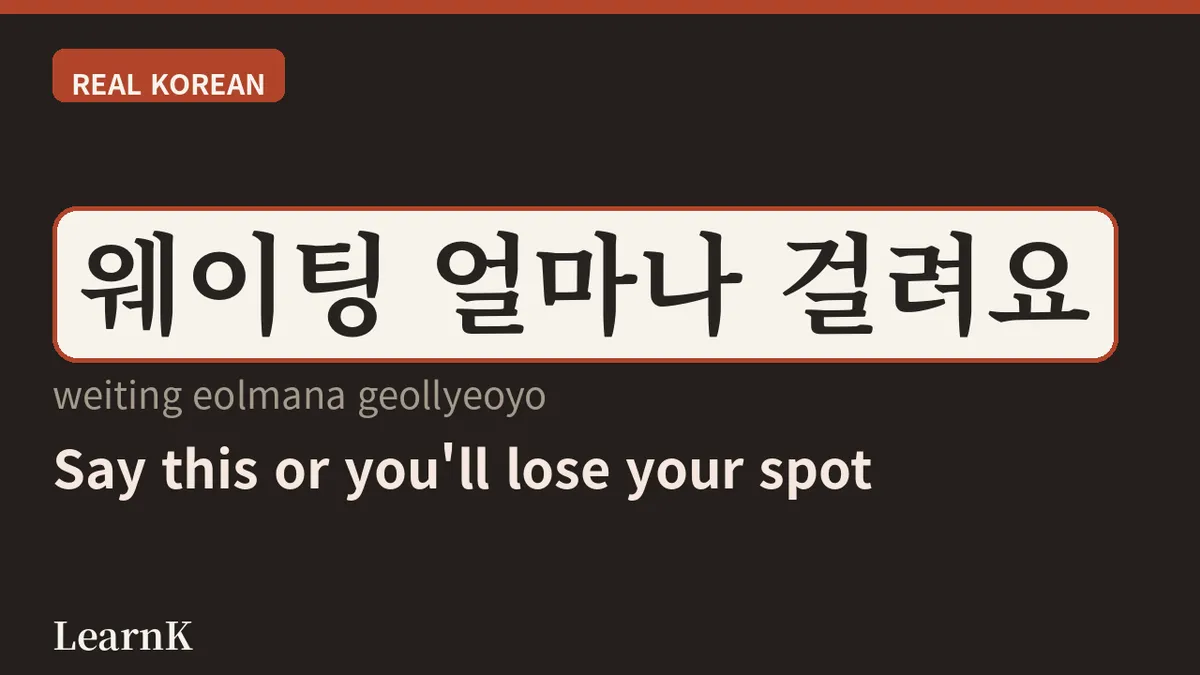
웨이팅
A weekend afternoon, in front of a famous restaurant in Seoul. A long line of people stretches out from the door, and a staff member steps out holding a tablet and asks: “How many in your party? Would you like me to put you on the waitlist?” If you’re a fan of Korean culture traveling in Korea, there’s one word you’re guaranteed to run into outside popular restaurants and cafés — and that’s 웨이팅 (weiting). Today, let’s use this one expression to learn all about Korea’s “culture of waiting.”
Meaning and Nuance
웨이팅 (weiting) is a loanword from the English “waiting,” but in Korea it has taken on a settled meaning: standing in line or putting your name on a waitlist and waiting for a table to open up at a restaurant or café. More than just the act of “waiting,” it carries a strong sense of being registered on a waitlist (in a queue with a number).
That’s why Koreans use this word almost like a verb.
- 웨이팅이 있다 (weitingi itda): there’s a wait / a line to wait in
- 웨이팅을 걸다 (weitingeul geolda): to put your name on the waitlist
- 웨이팅을 하다 (weitingeul hada): to (personally) stand in line and wait
- 웨이팅이 빠지다 (weitingi ppajida): for the queue to move up / for your number to get closer
These days, 원격 웨이팅 (wongyeok weiting) — remote waiting — is also common, where you take a number from a tablet outside the store or through a smartphone app. You just register your name and party size, and you’ll get a text when it’s your turn.
Example Sentences by Situation
Situation 1 — Asking when you arrive at a restaurant
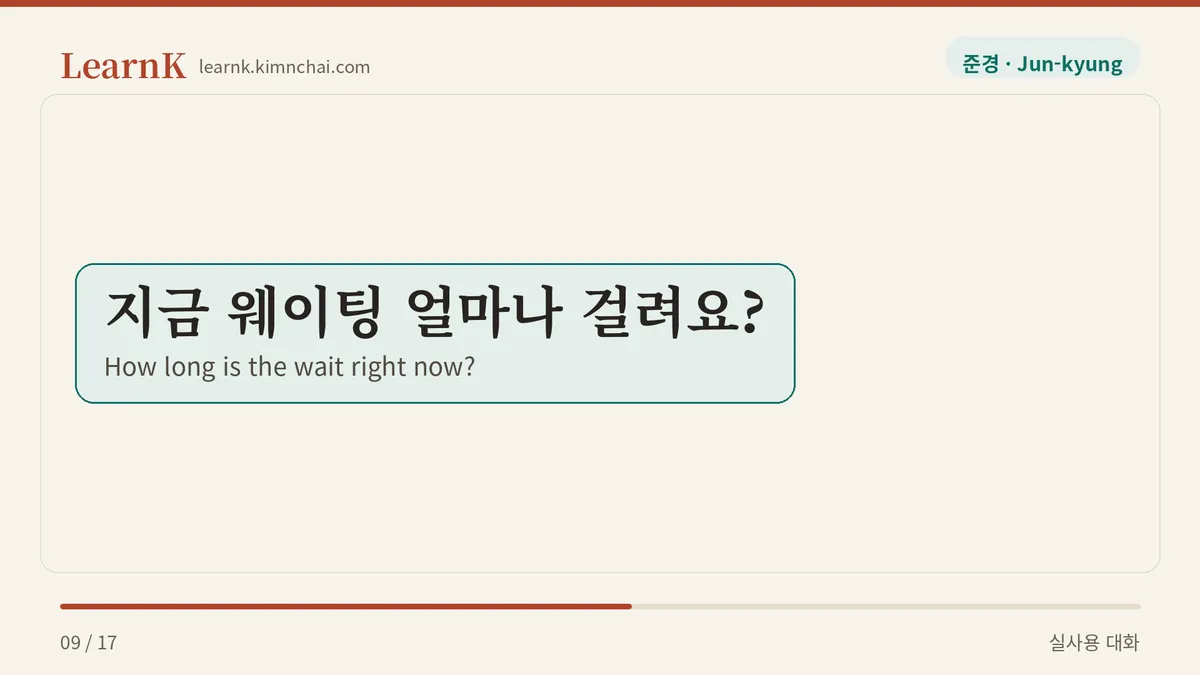
지금 웨이팅 얼마나 걸려요?
(jigeum weiting eolmana geollyeoyo?)
This means “How long is the wait right now?” It’s the very first sentence you’ll end up using the moment you step into a popular restaurant. If the staff answers “About 30 minutes,” you can then decide whether to wait or not.
Situation 2 — Putting your name on the waitlist
두 명인데 웨이팅 걸어 주세요.
(du myeonginde weiting georeo juseyo)
“There are two of us — please put us on the waitlist.” You state the party size (two people) first and then ask to be put on the list. It’s a very practical, real-life expression.
Situation 3 — Talking it over with a friend (casual speech)
여기 웨이팅 너무 길다. 우리 다른 데 갈까?
(yeogi weiting neomu gilda. uri dareun de galkka?)
“The wait here is way too long. Should we go somewhere else?” This is a relaxed conversation between friends. It nicely captures that little pang of disappointment when the line is just too long.
Situation 4 — When it’s your turn
웨이팅 다 됐어요? 이제 들어가도 돼요?
(weiting da dwaesseoyo? ije deureogado dwaeyo?)
This sentence checks whether your turn has come up. It’s handy when you’ve gotten the text and come back to the store.
Comparing Polite vs. Casual Speech and Similar Expressions
Even with the same meaning, your tone changes depending on who you’re talking to.
- Polite: 웨이팅 걸어 주세요 (weiting georeo juseyo) — to staff, or to someone you’ve just met
- Casual: 웨이팅 걸자 (weiting geolja) — to friends or family
Also, since ‘웨이팅’ is a loanword, it has a somewhat casual feel. In more polite or formal settings, it’s better to use native Korean or Sino-Korean expressions.
- 기다리다 (gidarida): the most basic word for “to wait.” It’s used broadly, in any situation.
- 대기 (daegi): a Sino-Korean word used in phrases like ‘대기 명단’ (waitlist) and ‘대기 번호’ (waiting number). “대기해 주세요 (daegihae juseyo)” is a formal expression you’ll also hear at hospitals and government offices.
- 줄을 서다 (jureul seoda): to physically “stand in line.” If ‘웨이팅’ is closer to registering on a list, this emphasizes the actual act of standing there.
In other words, use 웨이팅 in front of a restaurant, 대기 at a hospital reception desk, and 줄을 서다 at a bus stop — choosing based on the place like this sounds very natural.
Cultural Background — Why Are Koreans Willing to Put Up With Waiting?
In Korea, ‘웨이팅’ has become not just an inconvenience but a kind of entertainment. The more a restaurant or café blows up on social media, the longer the wait — and people even treat that wait itself as proof that “this place is worth it.” They’ll wait an hour or two just to snap that must-have photo. Dramas often feature scenes where the main characters take a number outside a popular restaurant, wait anxiously, and end up bickering — and you can think of these situations as lifted straight from the weekend scenery of Korean cities.
So here’s a tip for travelers: if there’s a restaurant you really want to visit, it’s smart to go early, right when they open (오픈런, “open run”), or set up remote waiting in advance through an app. During peak lunch and dinner hours, hearing “The wait is an hour” is far from unusual.
Closing Quiz
You’ve arrived at a restaurant and want to politely tell the staff, “There are four of us — please put us on the waitlist.” Fill in the blank using the expression you learned today.
“네 명인데 ____ 걸어 주세요.”
The answer is 웨이팅 (weiting). If you say “네 명인데 웨이팅 걸어 주세요 (ne myeonginde weiting georeo juseyo),” you’ll never be flustered in front of a Korean restaurant again. Enjoy a delicious meal — and savor the 웨이팅 along the way!