개꿀 (gaekkul) — The Exclamation Korean Youth Shout When They Score a Total Win
When you watch Korean variety shows or gaming streams, you’ll often catch a moment where a contestant suddenly throws both arms up in the air and shouts “개꿀! (gaekkul!)” It bursts out when someone gets a great result without any effort, or lands an unexpected windfall — and it’s one of the buzzwords that most compactly captures how young Koreans feel these days. Today we’re going to dig deep into an expression you won’t find in any textbook but that has completely taken over everyday conversation and the internet: 개꿀 (gaekkul).
개꿀
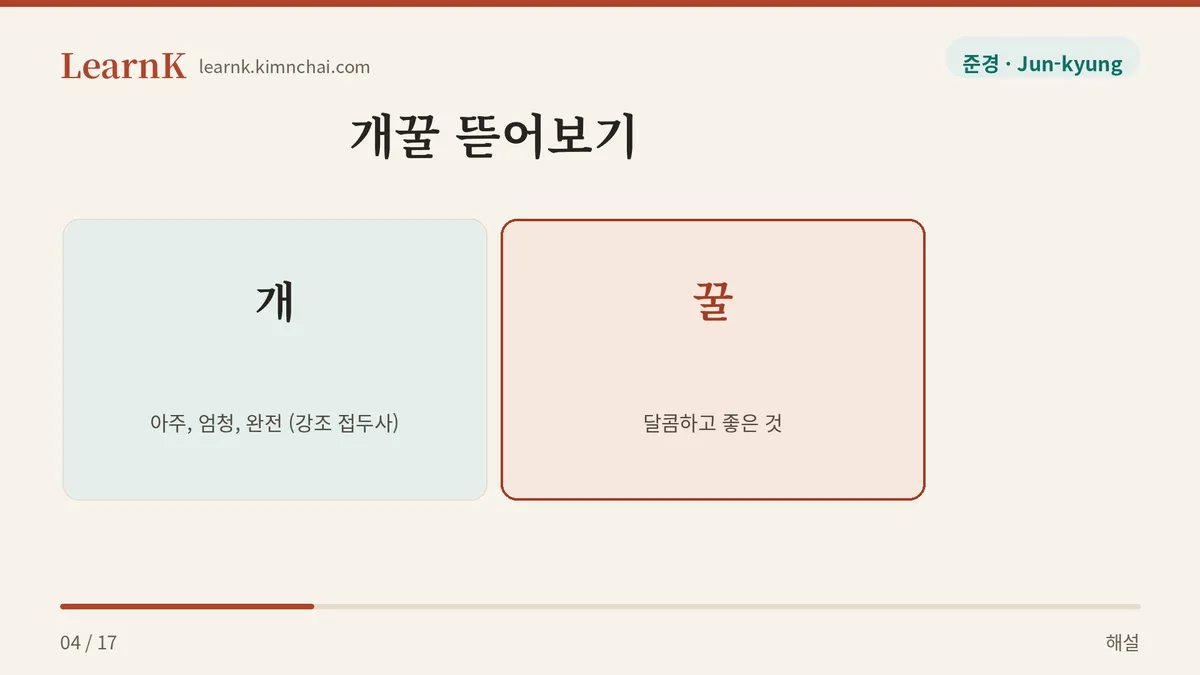
개꿀 (gaekkul) is a coined compound made of two pieces. The first part, 개 (gae), originally means the animal ‘dog,’ but here it works as an intensifying prefix adding the sense of ‘super, really, totally.’ The second part, 꿀 (kkul), literally means ‘honey’ — the kind bees make — and figuratively points to something sweet and good. So put together, 개꿀 (gaekkul) literally means ‘super honey-like,’ and more loosely translates to ‘a total win,’ ‘the best possible situation, gotten without breaking a sweat.’
The key nuance is that ‘the result is way too good for the effort put in.’ It’s not just something good — there’s a strong sense of getting it more easily than expected, almost for free. For example, if you’d braced yourself for working overtime but then the meeting suddenly got canceled and you got to leave right on time, that moment is exactly 개꿀 (gaekkul).
⚠️ Hold on — a usage warning! Intensifying expressions with 개 (gae) attached are only used with very close friends or when talking to yourself. Be sure to remember this is a classic piece of slang (비속어) that you should never, ever use in front of elders or someone you’ve just met.
Examples for Different Situations
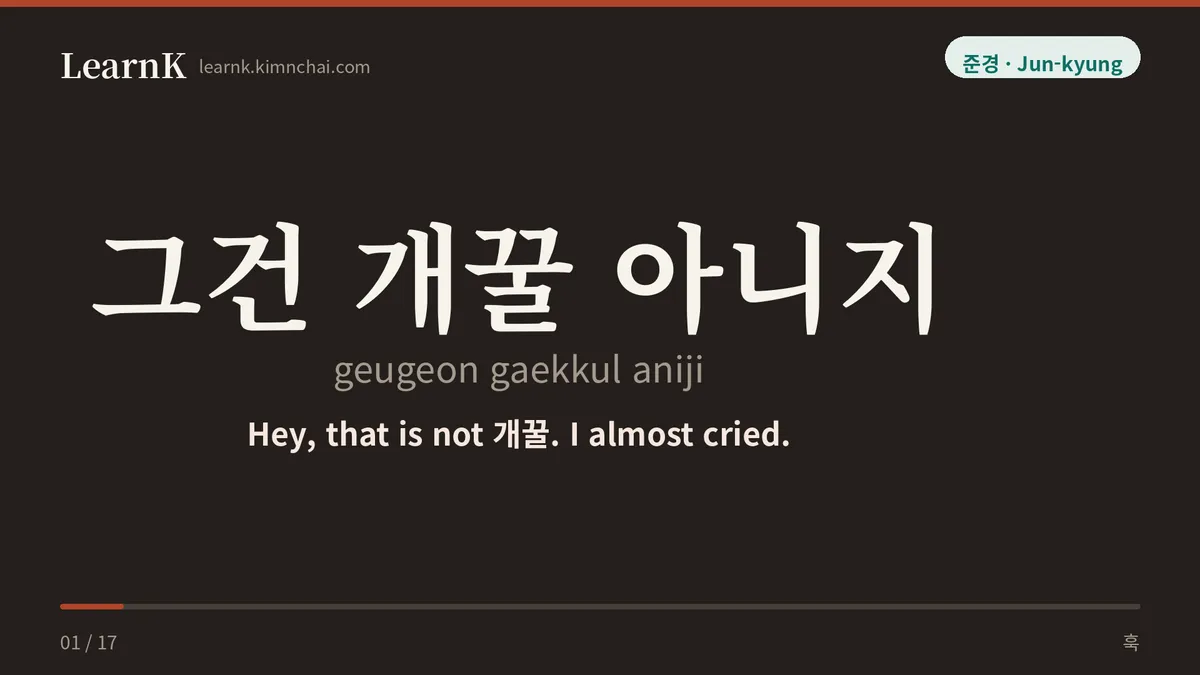
Let’s look at three situations to see how 개꿀 (gaekkul) really comes alive in actual conversation.
Situation 1 — An unexpected freebie When you buy one drink at a convenience store, but it’s a ‘buy-one-get-one-free’ deal and you get two.
A: 어? 이거 원 플러스 원이었어? 개꿀 (gaekkul) 이네! (Eo? Igeo won peulleoseu won-ieosseo? Gaekkul-ine!) Huh? This was buy-one-get-one? That’s totally 개꿀 (gaekkul)! B: 대박, 몰랐는데 완전 이득이다. (Daebak, mollatneunde wanjeon ideuk-ida.) No way, I had no idea — total score.
Here, 개꿀 expresses the pure joy of a windfall: ‘I didn’t even expect it, and I got an extra one for free.’
Situation 2 — An easy test, a cushy situation When a test you walked into worried turns out to be far easier than you expected.
시험 범위가 절반으로 줄었대. 이번 시험 개꿀 (gaekkul) 이다, 진짜. (Siheom beomwi-ga jeolban-euro jureotdae. Ibeon siheom gaekkul-ida, jinjja.) They say the test’s scope got cut in half. This exam is seriously 개꿀 (gaekkul).
This carries both relief and satisfaction at once: ‘I thought it’d be hard, but it turns out it’s easy — total win.’
Situation 3 — Using it like a noun 개꿀 fits not only as an exclamation but also in the noun slot.
재택근무는 진짜 개꿀 (gaekkul) 이야. 출퇴근 시간 아끼는 게 어디야. (Jaetaek-geunmu-neun jinjja gaekkul-iya. Chultoegeun sigan akkineun ge eodiya.) Working from home is seriously 개꿀 (gaekkul). Saving all that commute time is huge.
Here it refers to the whole ‘situation or condition that is 개꿀,’ functioning like a noun meaning ‘a really sweet setup.‘
Comparing Polite Speech, Casual Speech, and Similar Expressions

As mentioned earlier, 개꿀 (gaekkul) is casual speech and slang, so you can’t use it in formal settings. If you want to convey the same feeling politely, you’d have to switch it up like this.
- Slang (among friends): 이거 완전 개꿀이다! (igeo wanjeon gaekkul-ida!)
- Polite form (to someone senior): 정말 운이 좋았네요. / 뜻밖의 이득이었어요. (jeongmal un-i joasseoyo.) — ‘I was really lucky. / It was an unexpected gain.’
It’s also good to learn some expressions with a similar vibe.
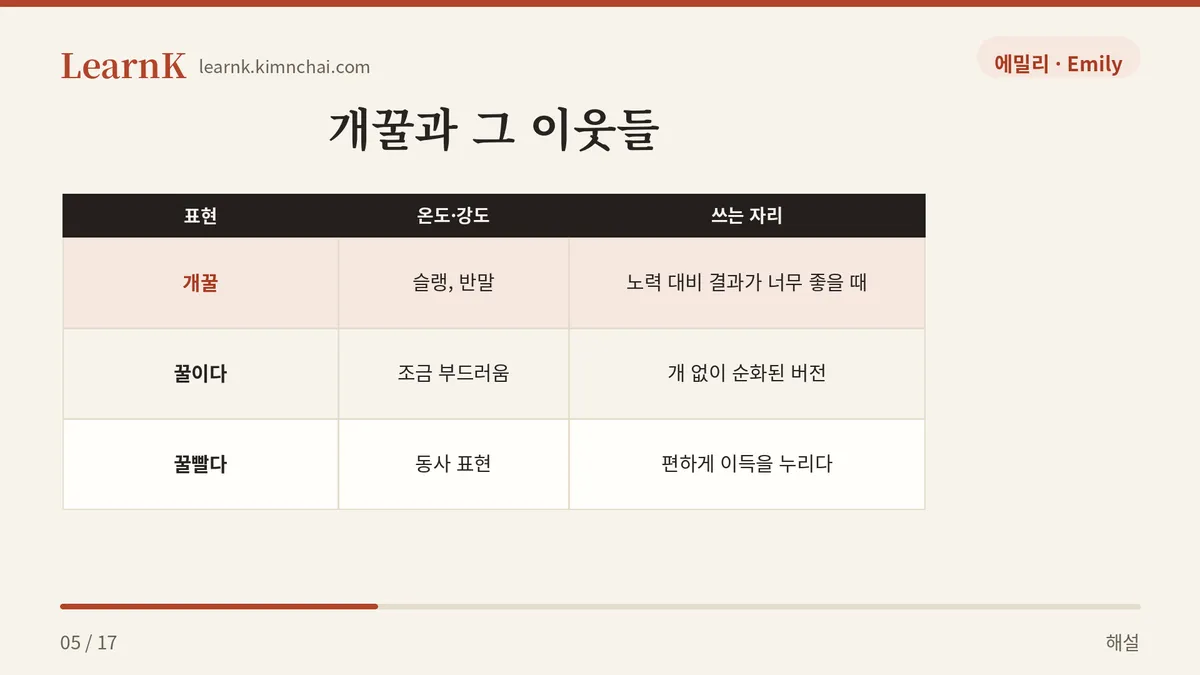
- 꿀이다 (kkul-ida): The toned-down version without ‘개.’ A little softer.
- 개이득 (gaeideuk): ‘개 + 이득 (gain).’ Almost identical in meaning to 개꿀, and interchangeable with it.
- 꿀빨다 (kkul-ppalda): ‘to suck honey’ — a verb expression meaning ‘to comfortably enjoy an easy gain.‘
A Bit of Cultural Background
‘개꿀’ spread explosively within the internet broadcasting and game-streaming culture of the 2010s. Streamers who cleared a tough stage easily or scored a great item would shout it over and over, and it caught on with their viewers. New words in this ‘개-’ intensifying-prefix family also occasionally flash by in the lines of young characters in Korean dramas, used as a device to compactly show the younger generation’s honest, immediate emotional expression. That said, it’s now grown close to everyday language — even broadcast subtitles will show expressions like ‘완전 좋다 (totally great)’ or ‘개이득’ right on screen.
The important thing is that this word is exclusively for positive, cheerful feelings. If you say 개꿀 about someone else’s misfortune, it takes on a sarcastic nuance, so you have to read the situation carefully for it to sound natural.
Closing Quiz
In the situations below, who could most naturally use 개꿀 (gaekkul)?
- A new employee reporting project results to the company CEO
- A college friend who bought something at half price because a discount coupon accidentally stacked twice
- An office worker greeting a business partner they’re meeting for the first time
👉 The answer is number 2! That’s because 개꿀 is slang used among people who are close, to marvel at a gain that came without any effort. In settings that call for formality, like numbers 1 and 3, swap it out for a polite expression like “운이 좋았습니다 (I was lucky).”
So the next time you hit a ‘개꿀’ moment in your daily life, try shouting today’s expression out loud!