Heol! The Exclamation Koreans Shout Several Times a Day
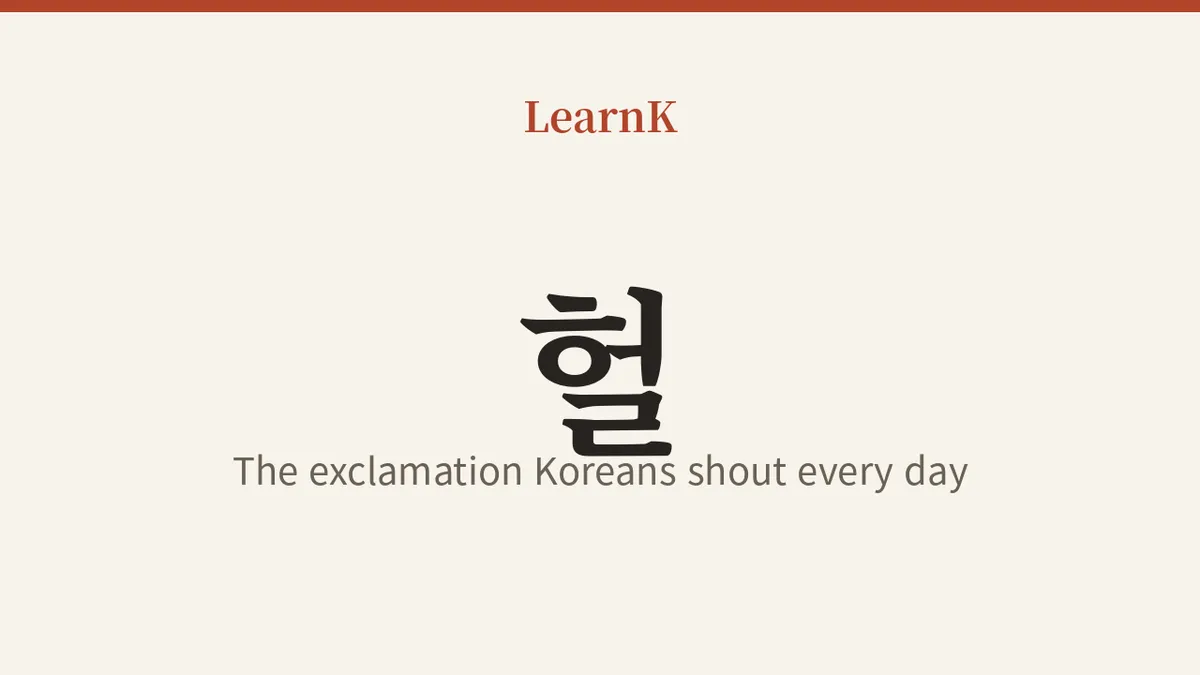
When you watch Korean dramas or text back and forth with a Korean friend, there’s one short word that shows up without fail every time some surprising news comes up. That word is 헐 (heol). When your exam score comes out way lower than expected, when a friend suddenly announces they’re getting married, when your favorite café closes down — the situations are all different, but the reaction that jumps out of your mouth is exactly the same: “헐…” Today, let’s take a deep look at this exclamation — one that rarely shows up in textbooks, yet is absolutely indispensable in real Korean conversation.
헐
헐 (heol) is an exclamation that bursts out when you come across something unexpected. It’s hard to pin its meaning down to a single word, but think of it as capturing the feeling of English “What?”, “No way!”, “OMG,” and “Seriously?” all at once.
The key thing is that 헐 is used for both good surprises and bad ones. Shock, fluster, disappointment, disbelief, and sometimes even admiration — its color changes completely depending on context. So even the very same “헐” has its meaning decided by your intonation and facial expression. A short, clipped “헐?” is mild surprise, while a long, drawn-out “허어얼…” is shock so big it leaves you speechless.
This expression spread out of the internet and youth culture of the 2000s, and today it’s widely used across generations — a piece of slang (신조어). It isn’t an official standard word listed in the dictionary, so it’s best to avoid it in formal writing or formal settings.
Example Sentences by Situation
The example sentences below were all written by us, imagining real conversation situations.
Situation 1 — When you hear surprising news
A: 나 다음 달에 한국으로 이민 가. (I’m immigrating to Korea next month.) B: 헐, 진짜? (heol, jinjja?) — Really?
This is the classic use — reacting with surprise and asking back at some big, unexpected news. If you attach 진짜? (jinjja?) after “헐,” it flows naturally into something like “헐, 진짜야? (Heol, is it for real?)”
Situation 2 — When something is absurd and ridiculous
헐, 지금 그걸 말이라고 해? (heol, jigeum geugeol marirago hae?) — You call that talking sense right now?
This is the negative “헐,” used when someone’s words are so absurd you’re left dumbfounded. It mixes disappointment with disbelief.
Situation 3 — When you’re impressed and amazed
헐, 대박! (heol, daebak!) — Wow, amazing!
Here it’s surprise in a good sense. 대박 (daebak) is another popular slang word meaning “awesome, the best,” and it’s often paired up and used together with “헐.”
Seeing It in a Real Conversation
Situation: The subway on the way home from work. Squeezed in among the crowd, they happen to run into each other in front of a handrail.
준경: 야, 너 그거 들었어? 민수 다음 달에 결혼한대. Hey, did you hear? Minsu’s getting married next month.
Emily: 헐, 진짜? 걔 얼마 전까지 연애 안 한다고 노래를 불렀잖아. What?! For real? He was going on and on about not dating just a while ago.
준경: 그니까. 회사 동기랑 만난 지 반년 만에 간대. Right? He’s marrying a coworker after only six months of dating.
Emily: 헐, 반년? 완전 대박이다 진짜. Whoa, six months? That’s honestly insane.
준경: 근데 더 웃긴 게, 청첩장을 단톡방에 사진으로 툭 올렸어. But the funnier part is, he just dumped the invitation as a photo in the group chat.
Emily: 헐, 단톡방에? 지금 그걸 청첩장이라고 돌린 거야? Seriously? In the group chat? And he calls that sending out an invitation?
Comparing Polite/Casual Speech and Similar Expressions
헐 is basically a casual-speech (반말) exclamation used among friends or people you’re comfortable with. Be careful — saying “헐” to someone older than you or in a formal setting can come across as rude. To express surprise politely, it’s safer to use softer expressions like 정말요? (jeongmaryo?) or 세상에 (sesange).
It’s good to learn the similar exclamations too. 대박 (daebak) is mainly for positive surprise, 어머 (eomeo) is a soft expression of surprise often used by women, and 와 (wa) is for pure admiration. Among these, what makes 헐 special is that it can be used the most broadly — for both positive and negative reactions alike.
Cultural Background
Watch any Korean variety show or drama and you’ll easily spot scenes where a big “헐” pops up in the on-screen captions the moment the cast members are surprised. That’s how well this single syllable compresses a split-second emotion. In young people’s chats especially, they’ll spell it out letter by letter as “ㅎㅓㄹ,” or repeat it as “헐헐헐” to convey the size of the shock. In other words, 헐 is more than just a word — it’s a window that shows exactly how Korean online culture expresses emotion.
Today’s Quiz
A friend says, “나 로또 1등 당첨됐어! (I won first prize in the lottery!)” To react naturally with a mix of surprise and envy, which of the following fits best?
- 헐, 대박! (heol, daebak!)
- 헐, 지금 그걸 말이라고 해? (heol, jigeum geugeol marirago hae?)
- 정말 유감이에요. (jeongmal yugamieyo.)
The answer is number 1. Since it’s a positive surprise at good news, “헐, 대박!” is the most natural. From today on, when a surprising moment comes your way, don’t hesitate to shout it out — 헐!