Mastering the Korean Slang '짱 (jjang)': One Syllable to Shout "The Best!"
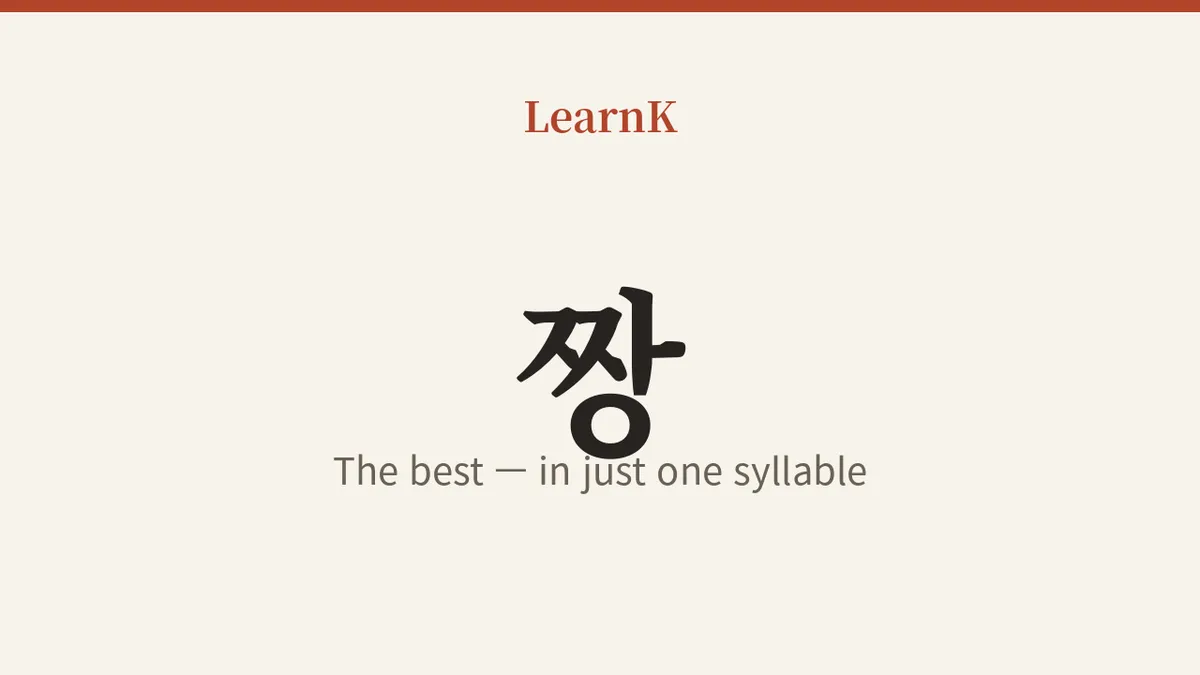
K-culture fans around the world — have you ever watched your favorite idol’s stage and wanted to burst out with your amazement in just a single syllable? Instead of a long sentence like “정말 최고야! (jeongmal choego-ya!, That’s really the best!)”, Koreans love to fire off a short, punchy exclamation in one shot. It pops up everywhere — in K-drama comment sections, idol fan communities, and school playgrounds. Let’s learn that one syllable properly today.
짱
짱 (jjang) is one of Korea’s most iconic slang words, meaning “the best” or “the person or thing that’s the greatest or most outstanding.” Originally it was a word imitating the sound of ice cracking, but at some point it took root among students as a word pointing to “number one,” as in “우리 반 짱 (uri ban jjang, the best in our class).”
The nuance is very casual and full of excited energy. You can use it like a noun — “넌 짱이야! (neon jjang-iya!, You’re the best!)” — or attach it before or after other words to coin new ones, like “얼짱 (eoljjang, best face)” and “몸짱 (momjjang, best body).” It’s short and rhythmic, making it perfect to toss out as an exclamation.
Checking with the National Institute of Korean Language’s dictionary
The National Institute of Korean Language’s Basic Korean Dictionary defines the headword ‘짱’ as follows.
짱 (adverb): The cracking sound made when a sheet of ice or a hard, solid object suddenly splits; or such a motion. [en] with a crack — A word used to describe the cracking sound made when ice, a hard object, etc., splits suddenly, or such a motion. [es] rompiéndose con ruidos — Sonido que se produce al romperse repentinamente algo muy duro como una capa de hielo. [zh] 啪 — 冰块或硬结的东西等突然开裂的声音;或指其模样。 — National Institute of Korean Language, Basic Korean Dictionary (krdict.korean.go.kr)
※ The dictionary has no Portuguese translation, so to help learners we add our own: [pt] com um estalo — som que algo muito duro, como uma camada de gelo, faz ao se partir de repente. (This translation is our own creation, not dictionary material.)
Interestingly, the dictionary’s official definition is a “sound,” but the slang usage meaning “the best” shows up in the example sentence below.
학생들 사이에서 최고를 가리키는 ‘짱’이란 말이 유행하기 시작했다. — National Institute of Korean Language, Basic Korean Dictionary (krdict.korean.go.kr)
This sentence shows exactly how the meaning “the best” — the one we’re learning today — spread. It clearly reveals that the word was born within school peer culture and became a trendy buzzword.
On the other hand, be careful: there are words that contain the syllable ‘짱’ but mean something completely different.
팔짱을 끼다. / 저 부부는 한시도 안 떨어지고 계속 팔짱을 끼고 다녀. — National Institute of Korean Language, Basic Korean Dictionary (krdict.korean.go.kr)
Here, 팔짱 (paljjang) means folding your arms across your chest, or a couple linking arms. It has nothing to do with “the best.”
말짱 꽝. — National Institute of Korean Language, Basic Korean Dictionary (krdict.korean.go.kr)
말짱 (maljjang) means “entirely, completely,” and “말짱 꽝 (maljjang kkwang)” is an idiomatic expression for “a complete waste of effort.” Even with the same ‘짱’ sound, if the whole word changes the meaning changes completely, so always look at the surrounding context.
Example sentences by situation (our own creations)
- To a friend after a concert ends: “오늘 무대 진짜 짱이었어! (oneul mudae jinjja jjang-ieosseo!)” — Tonight’s stage was really the best!
- Taking your first bite at a great restaurant: “여기 떡볶이 맛 짱! (yeogi tteokbokki mat jjang!)” — The tteokbokki here tastes the best!
- Praising a friend: “넌 역시 요리 짱이야. (neon yeoksi yori jjang-iya.)” — You really are the best at cooking.
Seeing it in a real conversation
Situation: A neighborhood gym. Just finished working out, drinking water in front of the mirror.
Jun-kyung: 야, 너 요즘 어깨 완전 달라졌다. 몇 달 만에 이렇게 늘어? Whoa, your shoulders look totally different lately. You got this built up in just a few months?
Emily: 그치? 나 요즘 좀 늘었지? 헤헤. Right? I’ve leveled up a bit lately, haven’t I? Hehe.
Jun-kyung: 이러다 진짜 몸짱 되겠는데? 트레이너보다 폼 좋아. Keep this up and you’ll actually have a killer body. Your form’s better than the trainer’s.
Emily: 오, 방금 그 칭찬 짱이다. 나 오늘 하루 종일 기분 좋을 듯. Oh, that compliment just now was the best. I’m gonna be in a good mood all day.
Jun-kyung: 아까 데드리프트 자세도 짱이었어. 나 그거 보고 배웠잖아. Your deadlift form earlier was awesome too. I actually learned it off you.
Emily: 야, 그거 유튜브에서 일주일 내내 연습한 거야. 짱은 그냥 되는 거 아니거든? Hey, I practiced that on YouTube all week. Being the best doesn’t just happen, you know?
Comparing formal/informal speech and similar expressions
‘짱’ is 반말 (banmal, informal speech) slang used between friends and peers. It’s best not to use it with people older than you or in formal settings. To say it politely, switch to “최고예요 (choego-yeyo)” or “정말 훌륭해요 (jeongmal hullyunghaeyo)”.
A similar slang word is 대박 (daebak, amazing/incredible), which carries both surprise and admiration. There are also playful variations that emphasize ‘짱’ even more, like 완전 짱 (wanjeon jjang, totally the best) and 킹왕짱 (kingwangjjang, the best of the best).
Cultural background
‘짱’ is a word that spread explosively through 1990s–2000s school culture and internet message boards. It’s quick to grasp if you picture a scene in a youth school drama where the main character is called “이 학교 짱 (i hakgyo jjang, the best in this school).” These days, K-pop fans shout “짱! (jjang!)” over and over at their favorite’s stage, and it shows up in big letters in variety-show subtitles too. Short and intense, it fits perfectly into video subtitle and comment culture.
Closing quiz
After eating gimbap a friend made, you’re impressed and want to shout “정말 최고야! (jeongmal choego-ya!)” in informal slang. Which single syllable fits the blank?
“이 김밥 완전 ___! (i gimbap wanjeon ___!)”
See the answer
Answer: **짱 (jjang)** — Saying "이 김밥 완전 짱! (i gimbap wanjeon jjang!)" means "This gimbap is really the best!"Definitions and example sentences are from the National Institute of Korean Language’s Basic Korean Dictionary (krdict.korean.go.kr); that portion of this post, including our translations, is licensed under CC BY-SA 2.0 KR.