TMI: Meaning and How to Use It — The Slang Koreans Can't Stop Saying
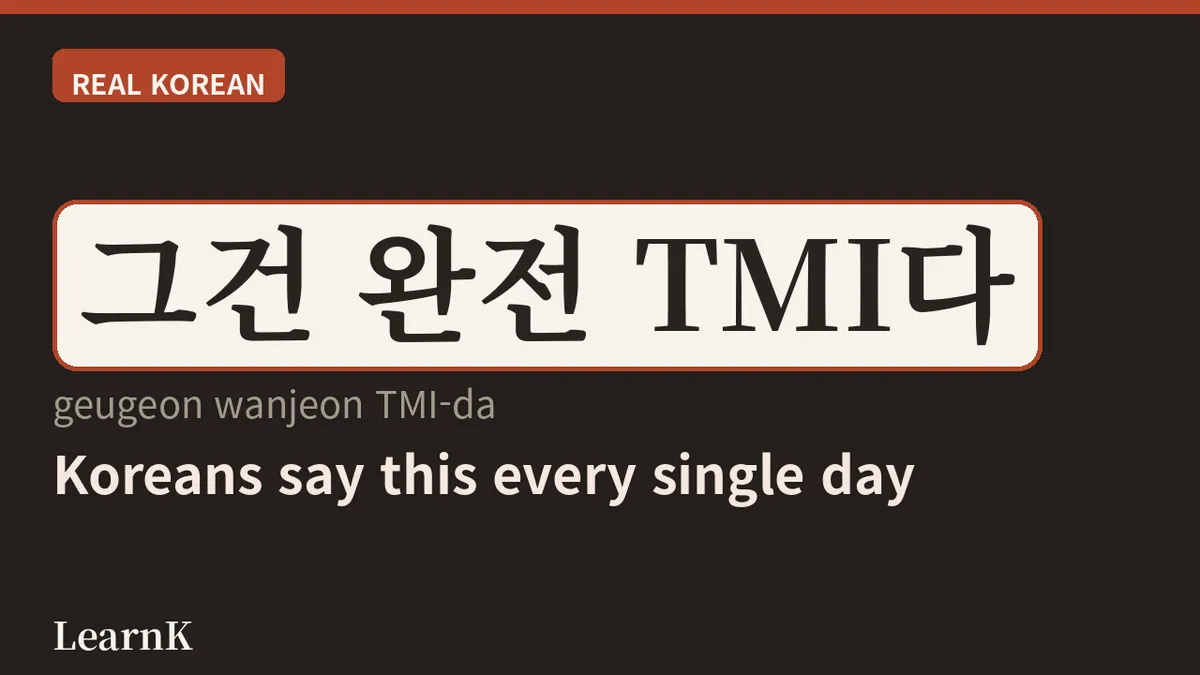
When a friend starts rattling off a story nobody asked for — “Hey, do you know what I ate this morning? Two eggs and some toast, oh, and I couldn’t sleep last night either” — Koreans laugh and say, “Dude, that’s kind of TMI.” This expression pops up everywhere: in dramas, variety shows, YouTube comments, KakaoTalk chats. Today, let’s take a deep dive into TMI, one of the most popular slang terms among Korea’s younger generation.
TMI
TMI is an acronym taken from the first letters of the English phrase “Too Much Information.” Translated literally, it means “너무 많은 정보 (too much information)” — in other words, details you didn’t really want to know, more information than you needed. It’s pronounced just like the English letters: 티엠아이 (ti-em-ai).
Here’s the interesting part: in Korea, this expression is used far more broadly and warmly than in English-speaking countries. In English, TMI often carries a strongly negative nuance, like “I didn’t want to hear something that personal or embarrassing.” But in Korea, it’s used much more often as a light, playful joke. When someone goes on and on about the little details of their life, you laugh and shoot back, “그건 TMI야~ (That’s TMI~).” People even bring up trivial info about themselves first, saying, “이건 좀 TMI인데… (This is kind of TMI, but…).”
Meaning and Nuance at a Glance
- Basic meaning: Sharing too much detail no one asked for, or that kind of information itself
- Nuance: Usually a light joke. Depending on the situation, it can also be a gentle signal to “stop talking.”
- How it works grammatically: “TMI다 (used like a noun),” “TMI인데 (as a connector),” “TMI 방출 (an idiomatic set phrase)“
Example Sentences by Situation
Situation 1 — Cutting off a friend’s overflowing chatter
A: 나 어제 화장실 몇 번 갔는지 세어봤는데 무려 일곱 번… (I counted how many times I went to the bathroom yesterday — a whopping seven times…) B: 그건 진짜 TMI다 (TMI-da). (That’s seriously TMI.)
This is the classic use: cheerfully cutting off overly personal information no one needed.
Situation 2 — Bringing up a trivial detail about yourself
TMI인데 (TMI-inde), 나 사실 오늘 양말 짝짝이로 신고 왔어. (TMI, but I actually came out wearing mismatched socks today.)
A humble, cute way to lead in with “this isn’t really important, but…”
Situation 3 — In a self-introduction or profile
저의 TMI 방출 (TMI bangchul) 하자면, 민트초코를 세상에서 제일 싫어합니다. (If I’m going to drop a TMI about myself, I hate mint chocolate more than anything in the world.)
This is often used on variety shows or social media bios, when someone reveals a “pointless but fun little fact about myself” just for laughs.
Comparing Polite vs. Casual Speech and Similar Expressions
TMI itself is a borrowed acronym with no built-in distinction between polite and casual speech, so you adjust the formality with the words attached to it.
- Casual: TMI다 / TMI야 (TMI-ya)
- Polite: TMI네요 (TMI-neyo) / TMI인데요 (TMI-indeyo)
As for similar Korean expressions, it has a different flavor from 오지랖 (ojirap, butting into other people’s business). Instead, it pairs naturally with reactions like “안 궁금해 (an gunggeumhae, I’m not curious)” or “그래서 뭐 어쩌라고 (so what am I supposed to do about it)”. The charm of TMI, though, is that while those phrases come across as somewhat blunt, TMI is much softer and friendlier.
Cultural Background — Why Is It So Beloved?
In Korea’s variety show and idol culture, fans go wild over the little everyday details of their favorite stars — their “TMI.” There are even segments dedicated to asking and answering “오늘의 TMI (today’s TMI).” It reflects a feeling that when it comes to someone you love, even the tiniest bit of information is welcome. That’s why TMI has grown beyond simple “excess information” into a game of sharing intimacy. Picture the scenes in dramas where characters grow closer by trading trivial little stories, and you’ll understand why this word is used so fondly.
Today’s Quiz
A friend starts in on a story nobody asked for: “So, my right pinky toe is kind of itchy right now…” What’s the one line you’d toss back with a laugh?
Sample answer: “야, 그건 완전 TMI다! (Dude, that’s totally TMI!)” 😆