Korean of the Day: '국밥 (gukbap)' — A Spoonful of Rice in Steaming Soup, Korea's Soul Food
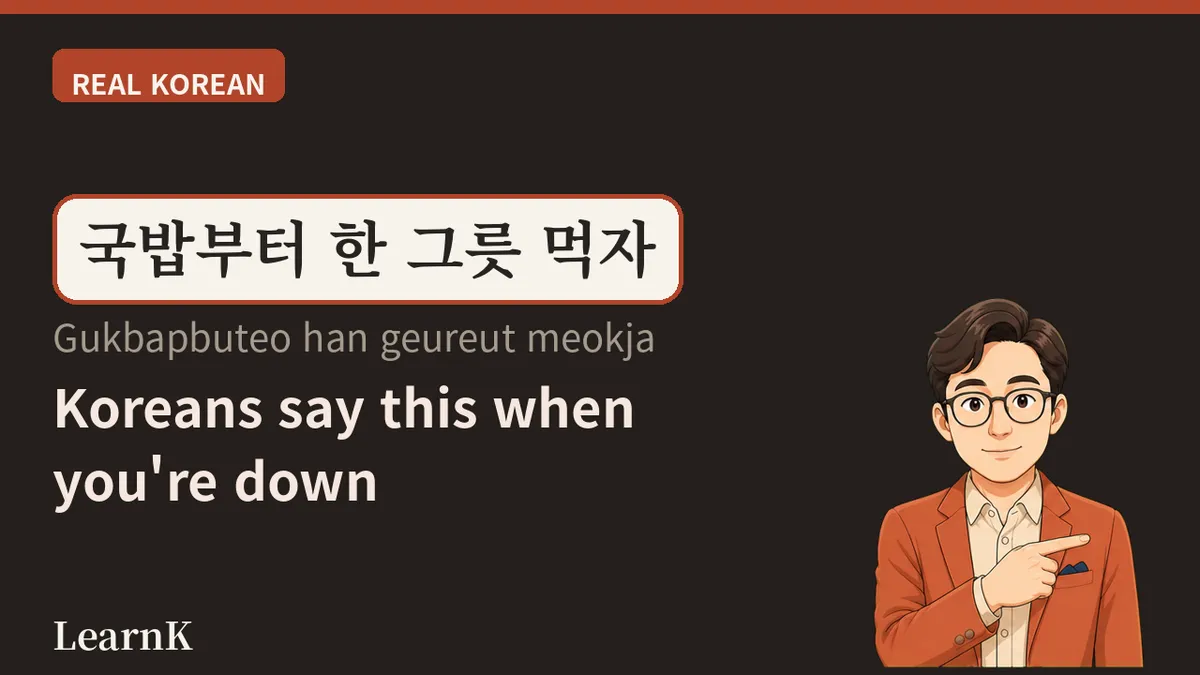
국밥
On a cold winter day, walking through the alleys of a traditional market, you’ll often see people lined up in front of steaming cauldrons with clouds of vapor rising into the air. That hot bowl served in an earthenware pot is exactly 국밥 (gukbap). Instead of eating rice and soup separately, you put the rice right into the soup and slurp it all down — this dish is a classic Korean ‘soul food’ that warms your body and fills your stomach in the middle of a busy day. Today, let’s take a deep dive into this heartwarming expression.
Meaning and Nuance
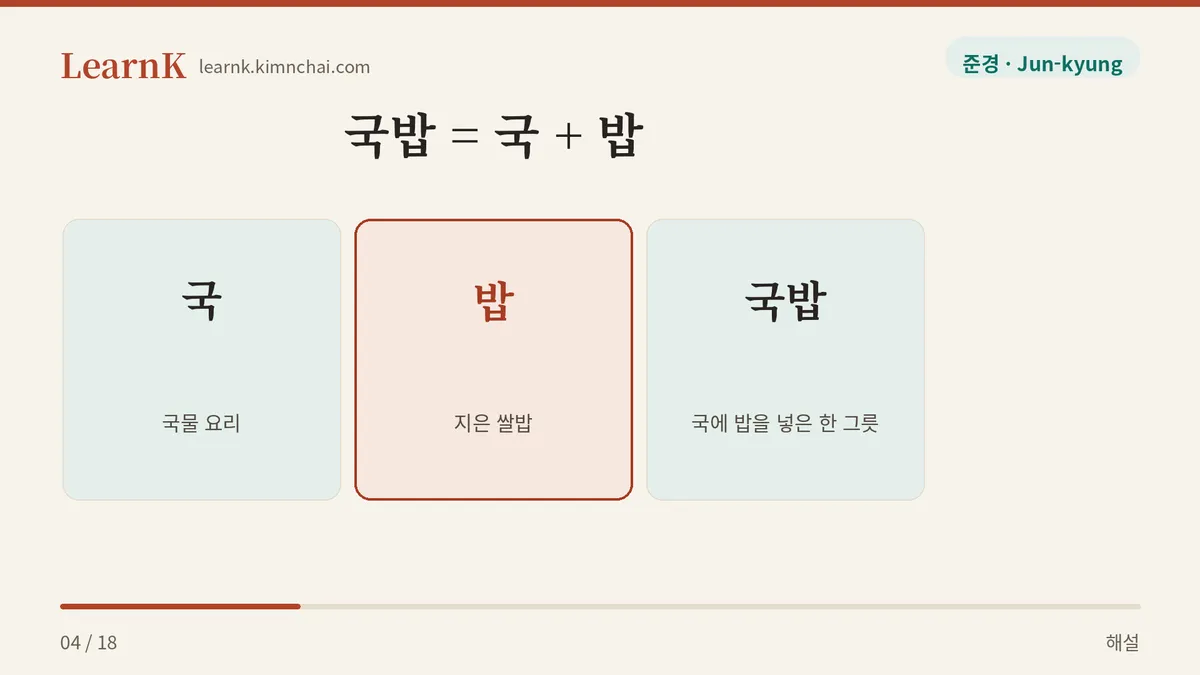
Broken down literally, 국밥 (gukbap) is a combination of ‘국 (guk, a soup or broth dish)’ and ‘밥 (bap, cooked rice).’ It refers broadly to any food made by putting rice into hot broth. Types are distinguished by attaching an ingredient name in front, as in 돼지국밥 (dwaejigukbap, pork gukbap), 소머리국밥 (someorigukbap, ox-head gukbap), and 콩나물국밥 (kongnamulgukbap, bean sprout gukbap).
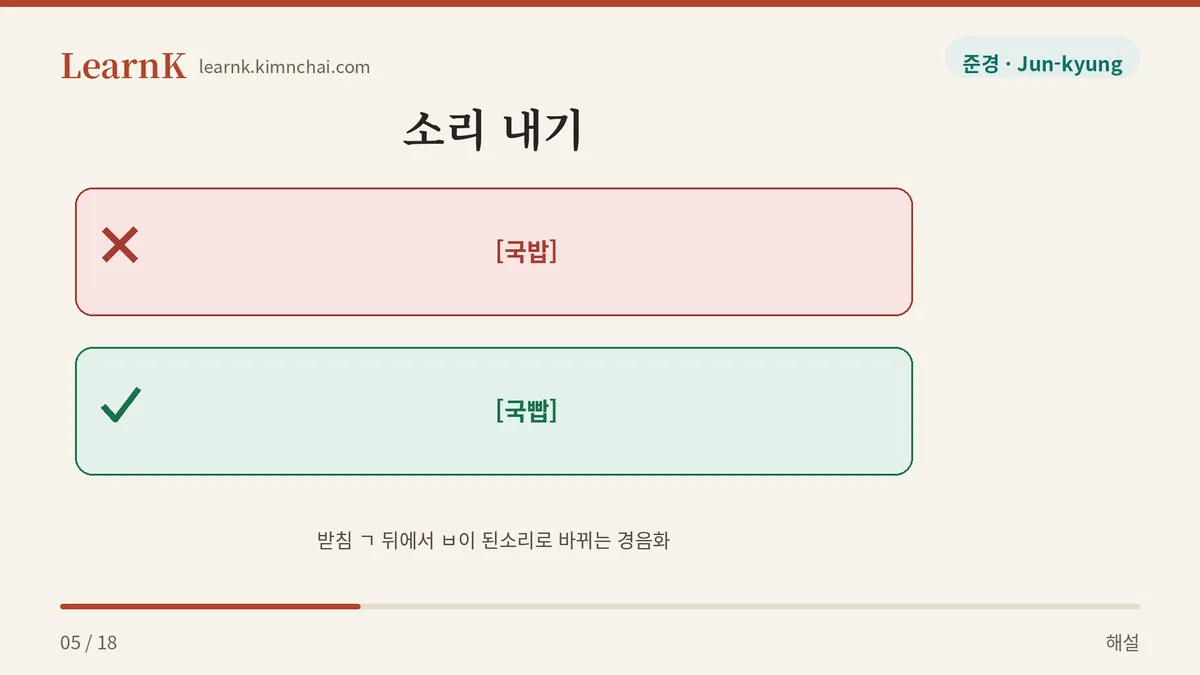
There’s one thing to watch out for in pronunciation. When you say 국밥 out loud, the following consonant changes to a tense sound, so it’s pronounced [국빱] (gukppap). This is called ‘경음화 (gyeongeumhwa, tensification).’
The nuance is interesting, too. Rather than a formal, high-end dish, 국밥 carries a warm, humble feeling of being ‘a common person’s food you grab quickly for a hearty meal.‘
Checking with the National Institute of Korean Language Dictionary
The authoritative Basic Korean Dictionary from the National Institute of Korean Language defines ‘국밥’ like this:
국밥 (noun): A food made by putting rice into hot soup, or a food made by boiling rice in soup. [en] gukbap; rice hot soup [ja] クッパ [es] gukbap, sopa con arroz [zh] 汤饭,汤泡饭 — National Institute of Korean Language, Basic Korean Dictionary (krdict.korean.go.kr)
The dictionary has no Portuguese translation, so for reference we’ve added our own: [pt] sopa quente com arroz (our own translation, not listed in the dictionary).
Let’s also look at some real usage examples from the dictionary.
네. 시골 고향에서 어머니가 끓여 주시던 얼큰한 국밥이 먹고 싶네요. (Ne. Sigol gohyangeseo eomeoniga kkeuryeo jusideon eolkeunhan gukbabi meokgo simneyo.) — National Institute of Korean Language, Basic Korean Dictionary (krdict.korean.go.kr)
This is a situation of longing for one’s hometown and a mother’s home cooking. It nicely shows the emotion of 국밥 being connected to ‘memories’ beyond just being food.
‘국밥’, ‘역도’를 발음할 때는 경음화 현상이 일어나서 [국빱], [역또]가 된다. (‘Gukbap’, ‘yeokdo’-reul bareumhal ttaeneun gyeongeumhwa hyeonsangi ireonaseo [gukppap], [yeoktto]-ga doenda.) — National Institute of Korean Language, Basic Korean Dictionary (krdict.korean.go.kr)
This is an example in which the dictionary itself points out the tense-sound pronunciation explained above.
국밥에 건건이를 많이 풀었더니 음식이 너무 짰다. (Gukbabe geongeonireul mani pureotdeoni eumsigi neomu jjatda.) — National Institute of Korean Language, Basic Korean Dictionary (krdict.korean.go.kr)
‘건건이 (geongeoni)’ is an old word meaning side dishes, so this is a little tale of failure — the seasoning got too strong and the 국밥 turned out salty.
국밥으로 때우다. / 국밥을 말다. / 국밥을 시키다. (Gukbabeuro ttaeuda. / Gukbabeul malda. / Gukbabeul sikida.) — National Institute of Korean Language, Basic Korean Dictionary (krdict.korean.go.kr)
These are verbs that often pair up with 국밥. ‘때우다 (ttaeuda)’ means to take care of a meal simply, ‘말다 (malda)’ is the action of putting rice into broth and mixing it, and ‘시키다 (sikida)’ means to order at a restaurant.
Example Sentences by Situation
Let’s build a real-world feel for it with some sentences we made ourselves.
-
When ordering at a restaurant 가 (A): 여기 국밥 두 그릇 주세요. (Yeogi gukbap du geureut juseyo.) → “여기 국밥 두 그릇 주세요.” is a common ordering expression used at restaurants.
-
When suggesting it to a friend 날씨도 추운데 뜨끈한 국밥 한 그릇 어때? (Nalssido chuunde tteukkeunhan gukbap han geureut eottae?) → This is a casual, informal way to suggest 국밥.
-
Grabbing a meal when you’re busy 시간이 없어서 점심은 국밥으로 대충 때웠어요. (Sigani eopseoseo jeomsimeun gukbabeuro daechung ttaewosseoyo.) → This clearly shows 국밥’s character as a ‘hearty, quick meal.‘
Comparing Formal/Informal Speech and Similar Expressions
Even with the same meaning, the feeling changes depending on your tone.
- Formal (존댓말): 국밥 드셨어요? (Gukbap deusyeosseoyo?) — to an elder or someone you’re meeting for the first time.
- Informal (반말): 국밥 먹었어? (Gukbap meogeosseo?) — to a friend or someone close to you.
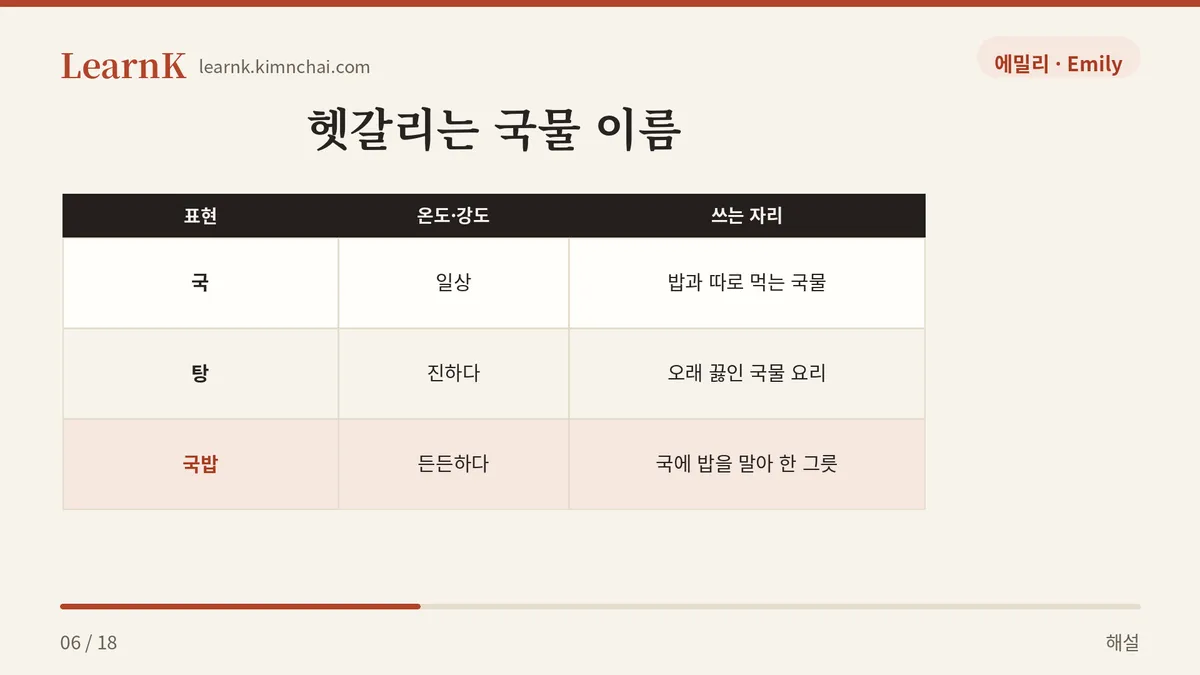
Let’s also get to know some similar food expressions. 국 (guk) refers to the soup or broth dish itself, and 탕 (tang) refers to a rich soup that’s been simmered for a long time. 말이 (mari), which is easy to confuse with 국밥, is a word that emphasizes the form of rice having been ‘put into (만, mal)’ the soup.
Cultural Background
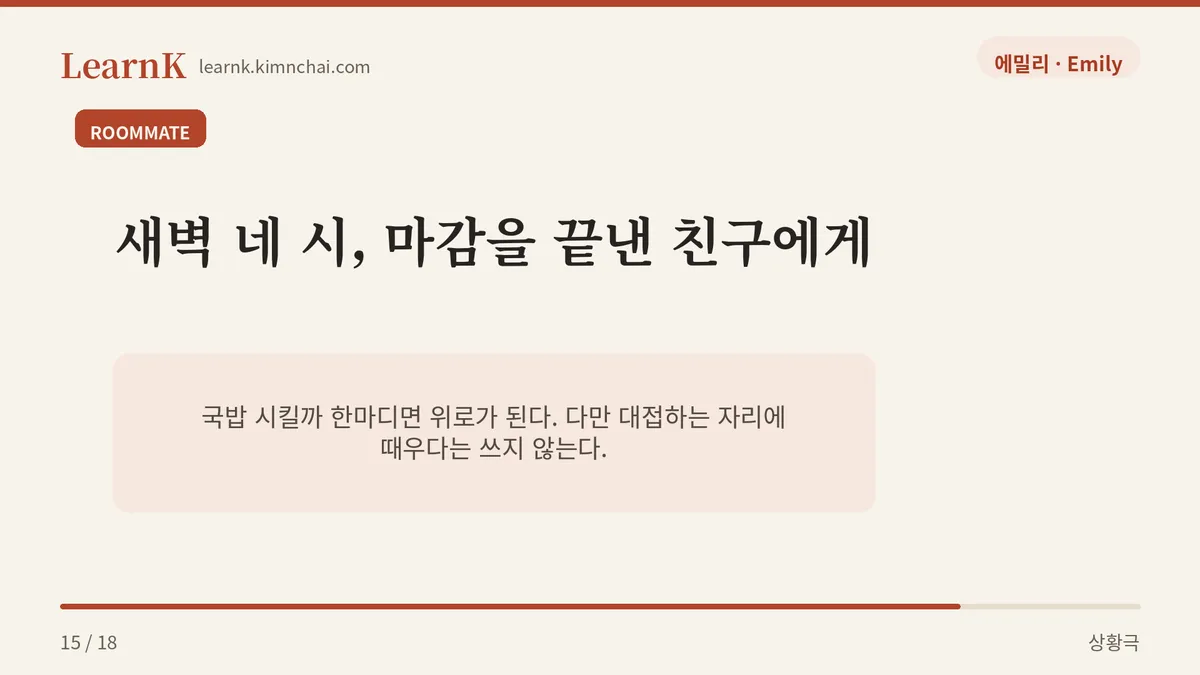
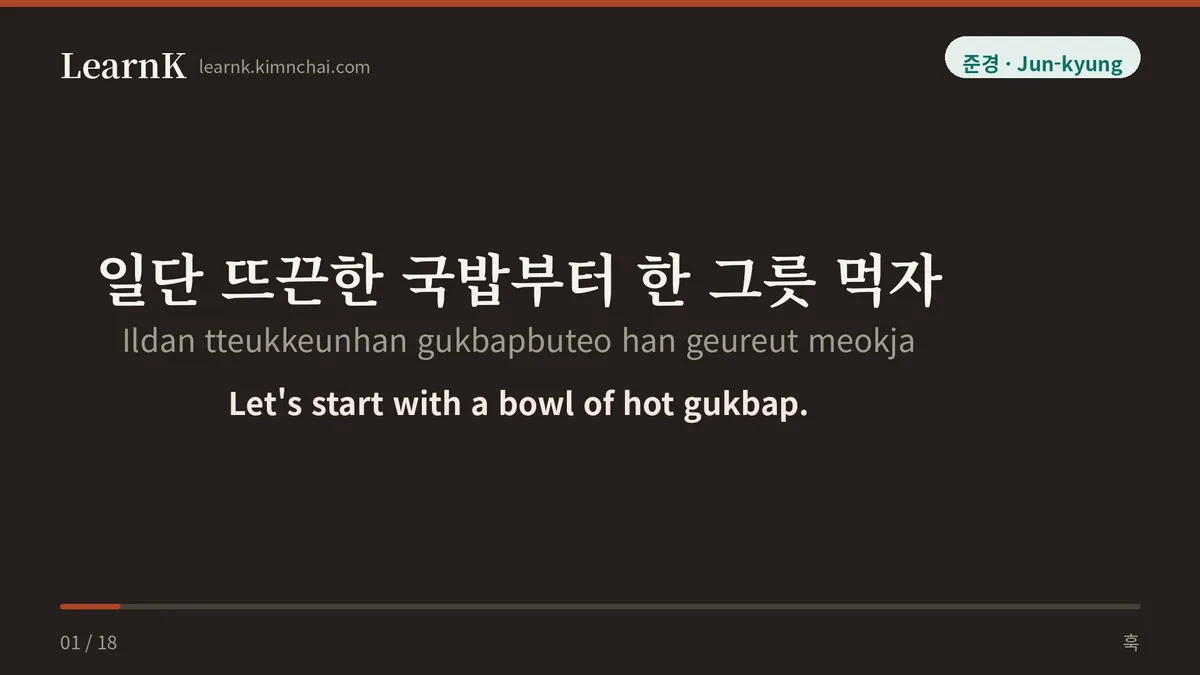
국밥 shows up often in Korean dramas, too. A scene where a character who’s had a grueling day finds comfort while emptying a bowl of 국밥 at a street food tent or a shabby little diner is so familiar it’s practically become a cliché. When someone is having a hard time, the line “일단 뜨끈한 국밥부터 한 그릇 먹자 (Ildan tteukkeunhan gukbapbuteo han geureut meokja)” — “Let’s start by having a bowl of hot gukbap” — is also an expression of Korean-style 정 (情, jeong): quietly staying by someone’s side without saying much.
Today’s Quiz
Which is correct for the standard pronunciation of ‘국밥’?
① [국밥] ② [국빱] ③ [굿밥]
(Answer: ② [국빱] — through tensification (경음화), the following consonant changes to a tense sound.)
Definitions and example sentences are from the National Institute of Korean Language’s Basic Korean Dictionary (krdict.korean.go.kr); that portion of this post, including our translations, is licensed under CC BY-SA 2.0 KR.