맥주 (maekju) — Foam Brewed from Barley, and What “한잔하자 (hanjanhaja)” Really Means

맥주
맥주 (maekju) means a foamy alcoholic drink made mainly from fermented barley, with water, bitterness, and carbonation added. In Korea, the place this word pops up most often isn’t a bar, surprisingly — it’s “the point where the day ends.” In front of the convenience-store fridge on the way home from work, right after the shower at the end of a workout, when the last box has been hauled in and you’ve slumped onto the bare floor — that’s when someone says, “맥주 한잔할까? (maekju hanjanhalkka?)”
맥주 is the name of a thing, so the word itself carries no politeness level, neither raised nor lowered. It’s “맥주” to a baby and to your boss alike. And yet in Korean this word travels around with “한 잔 (han jan, one glass)” and ends up doing more than just naming an object. If 소주 (soju) is the heavy, serious drink, 맥주 is the light one. A first meeting, a drink in the daytime, the bleachers at a baseball game, a summer evening you rode your bike out into — when people want to lower the stakes, they choose 맥주 instead of 소주. In “맥주나 한잔하자 (maekjuna hanjanhaja),” the particle ‘나 (na)’ captures that lightness precisely. No big decision, just on the way, just because.
Checking the National Institute of Korean Language dictionary
맥주 「명사」 (noun) 주로 발효시킨 보리에 물과 쓴 맛과 탄산을 더하여 만든 거품이 나는 술. A foamy alcoholic drink made by adding water, bitterness, and carbonation to — most commonly — fermented barley. — National Institute of Korean Language, Basic Korean Dictionary (krdict.korean.go.kr)
The dictionary also carries definitions in several other languages.
[en] beer — A foamy alcoholic beverage made by adding water, bitter taste, and yeast to, most commonly, malted barley. [ja] ビール — 主に発酵させた麦に、水や苦味、炭酸を加えて作った、泡の立つ酒。 [es] cerveza — Bebida alcohólica hecha principalmente con granos de cebada fermentados, a los cuales se añaden agua, ácido carbónico y el lúpulo que le da el sabor amargo. [zh] 啤酒 — 主要以发酵的大麦添加水和苦味以及碳酸而制作的发泡酒。 — National Institute of Korean Language, Basic Korean Dictionary (krdict.korean.go.kr)
※ A Portuguese definition isn’t included in the dictionary. For our Portuguese-speaking readers, our own rendering would run roughly: “cerveja — bebida alcoólica espumante feita principalmente de cevada fermentada, à qual se adicionam água, amargor e gás carbônico.” That one sentence is our translation, not a dictionary quotation.
Now let’s look at the dictionary’s real usage examples. Examples show you where a word actually lives far better than definitions do.
지수는 운동을 한 다음에는 꼭 입에 감기는 시원한 맥주를 마신다. After a workout, Jisu always has a cold beer that goes down smooth. — National Institute of Korean Language, Basic Korean Dictionary (krdict.korean.go.kr)
Beer after exercise. That’s the most typical seat 맥주 occupies in Korea. ‘입에 감기다 (ibe gamgida)’ means it slides down so smoothly you keep drinking, and ‘시원한 (siwonhan)’ is a temperature and a mood at once. ‘시원한 (siwonhan)’ is practically a permanent fixture in front of 맥주.
왜 맥주는 유리잔에 담아야 맛있어 보일까? Why does beer only look delicious once it’s poured into a glass? — National Institute of Korean Language, Basic Korean Dictionary (krdict.korean.go.kr)
Drinking straight from the can or bottle is fine, but at Korean restaurants and 호프집 (hopeujip, beer pubs), pouring it into a glass is the default. You have to see the foam for it to feel “properly like beer.”
나는 맥주와 함께 먹으려고 오징어, 쥐포 등 건어물을 샀다. I bought dried snacks — squid, dried filefish, and the like — to eat with my beer. — National Institute of Korean Language, Basic Korean Dictionary (krdict.korean.go.kr)
맥주 almost always comes paired with 안주 (anju, food eaten alongside alcohol). Dried seafood, fried chicken, fries, dried squid — the sentence “맥주만 마신다 (I just drink beer, nothing else)” sounds a little lonely in Korean.
맥주로 한 잔 주게나. Make mine a beer, would you. — National Institute of Korean Language, Basic Korean Dictionary (krdict.korean.go.kr)
This is the scene of choosing which drink to have. The ‘로 (ro)’ in ‘맥주로’ is used when picking one option out of several. At a restaurant, saying “저는 맥주로 할게요 (jeoneun maekjuro halgeyo)” means “I’ll go with beer.” It’s an extremely common pattern, so it’s worth memorizing whole.
겉보리는 주로 동물의 사료나 맥주를 만드는 데 사용된다. Unhulled barley is mainly used for animal feed or for making beer. — National Institute of Korean Language, Basic Korean Dictionary (krdict.korean.go.kr)
A sentence that lays bare the fact that beer is made from barley. We’ll connect that fact back to the shape of the word itself in the “Cultural background” section below.
Real conversation
Setting: Hangang Park on a summer evening. Emily got there first on her bike and has spread out a picnic mat; Jun-kyung comes walking up, swinging a convenience-store bag.
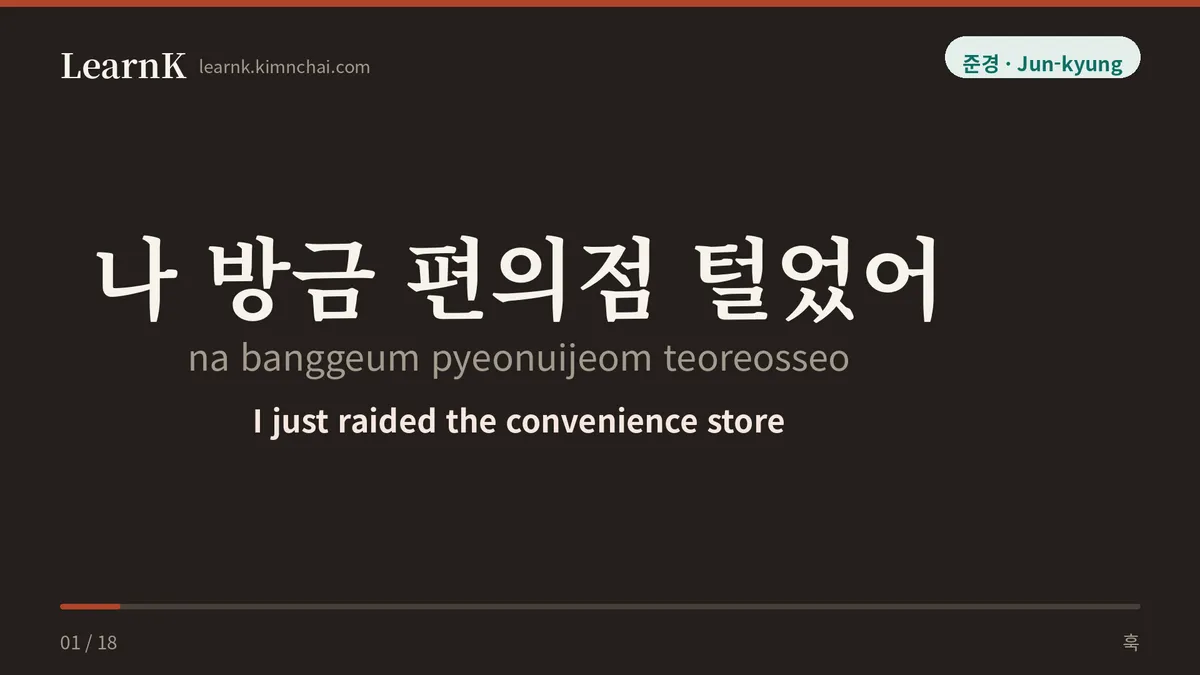
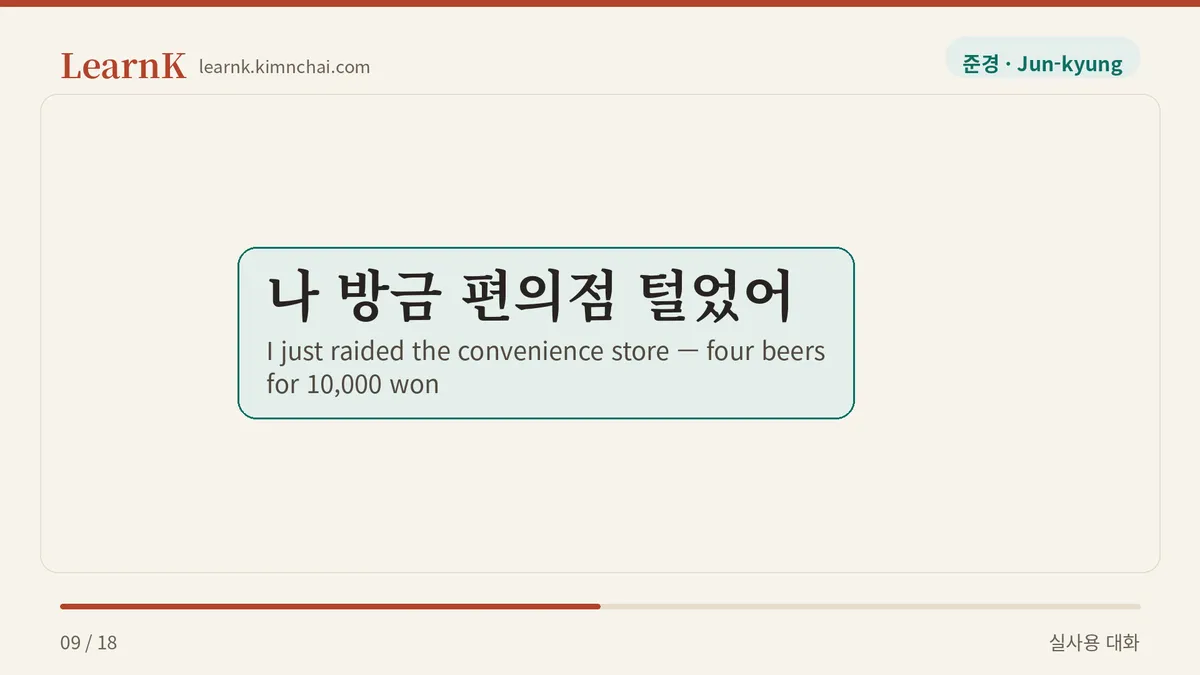
준경: 야, 여기! 나 방금 편의점 털었어. 맥주 네 캔에 만 원. Hey, over here! I just raided the convenience store — four beers for 10,000 won.
에밀리: 오, 굿. 나 지금 딱 시원한 거 필요했는데. Oh, nice. Something cold is exactly what I needed.
준경: 근데 너 자전거 타고 왔잖아. 마셔도 돼? But you came on your bike. Are you okay to drink?
에밀리: 딱 한 캔만. 운동하고 마시는 맥주가 제일 맛있잖아. Just one can. Beer after a workout tastes the best, you know?
준경: 인정. 자, 거품 죽기 전에 빨리 따. True. Here, open it before the foam dies.
에밀리: 야, 근데 우리 맥주만 시키고 치킨은 안 시킨 거 아니지? Hey, wait — we did order chicken too, right? Not just beer?
This sounds off
Since 맥주 is the name of an object, it isn’t a word that changes depending on who you’re talking to. Instead, let’s look at two misunderstandings learners trip over all the time.
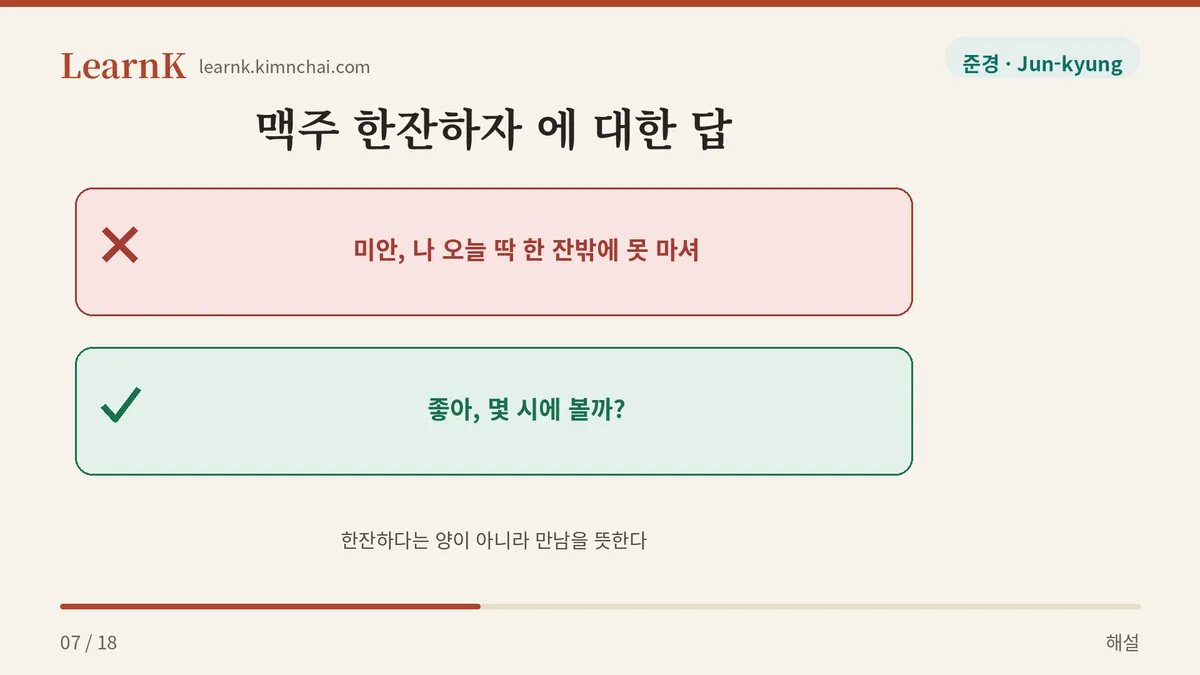
✗ (When a friend says “금요일에 맥주 한잔하자”) 미안, 나 오늘 딱 한 잔밖에 못 마셔. — Sorry, I can only have exactly one glass today. ✓ (Same situation) 좋아, 몇 시에 볼까? — Sounds good, what time should we meet? → 한잔하다 (hanjanhada) isn’t about counting glasses; it’s an invitation meaning “let’s get together for a drink.” It has nothing to do with how much you actually drink. If you answer by tallying up glasses, the other person will feel like their invitation was turned down.
✗ (At a beer pub) 맥주 두 개 주세요. ✓ (At a beer pub) 생맥주 두 잔 주세요. / (At a convenience store) 이 맥주 두 개 주세요. → It isn’t that the grammar is wrong — it’s that the counting unit changes with the setting. At a place that sells it by the glass, use ‘잔 (jan, glass)’; at a place that sells bottles, ‘병 (byeong, bottle)’; at a convenience store where you grab it off the shelf yourself, ‘개 (gae, item)’ or ‘캔 (kaen, can)’ is natural. Matching the counter makes you sound like someone who’s been here before.
Example sentences by situation
1. Moving day — the last box is in, and you sit down on the floor of the empty room
다 끝났다. 맥주 한 캔씩 하고 가자. (da kkeutnatda. maekju han kaenssik hago gaja.) It’s all done. Let’s each have a can of beer before we go.
In Korea, after physical work like moving, a housewarming, or a big clean-out, beer shows up almost as a ritual. ‘한 캔씩 (han kaenssik)’ means “one can each,” and it’s the tone of someone proposing a low-pressure way to wrap things up.
2. At a work dinner, flagging in advance that you can’t drink much
저는 소주는 못 하고 맥주만 조금 마셔요. (jeoneun sojuneun mot hago maekjuman jogeum masyeoyo.) I can’t handle soju — I only drink a little beer.
This is an extremely handy sentence for settings where saying no is hard. Because 맥주 is understood as the “light” drink, simply choosing it sends the signal “I’m pacing myself tonight.” It’s a way to draw a line without being rude.
3. Near the end of the workday, gently inviting a colleague
끝나고 맥주 한잔하실래요? (kkeutnago maekju hanjanhasillaeyo?) Would you like to grab a beer after work?
‘-실래요? (-sillaeyo?)’ is a soft, polite way of asking what the other person would like to do. Say the same thing to a friend and it becomes “끝나고 맥주 한잔할래? (hanjanhallae?)”
Polite and casual forms, and related expressions
The same invitation changes clothes depending on who’s hearing it.
- To a senior or a business contact: 맥주 한잔하시겠어요? (maekju hanjanhasigesseoyo?)
- To a 선배 (seonbae, senior) or a coworker: 맥주 한잔하실래요? (maekju hanjanhasillaeyo?)
- To a friend or someone younger: 맥주 한잔할래? (maekju hanjanhallae?)
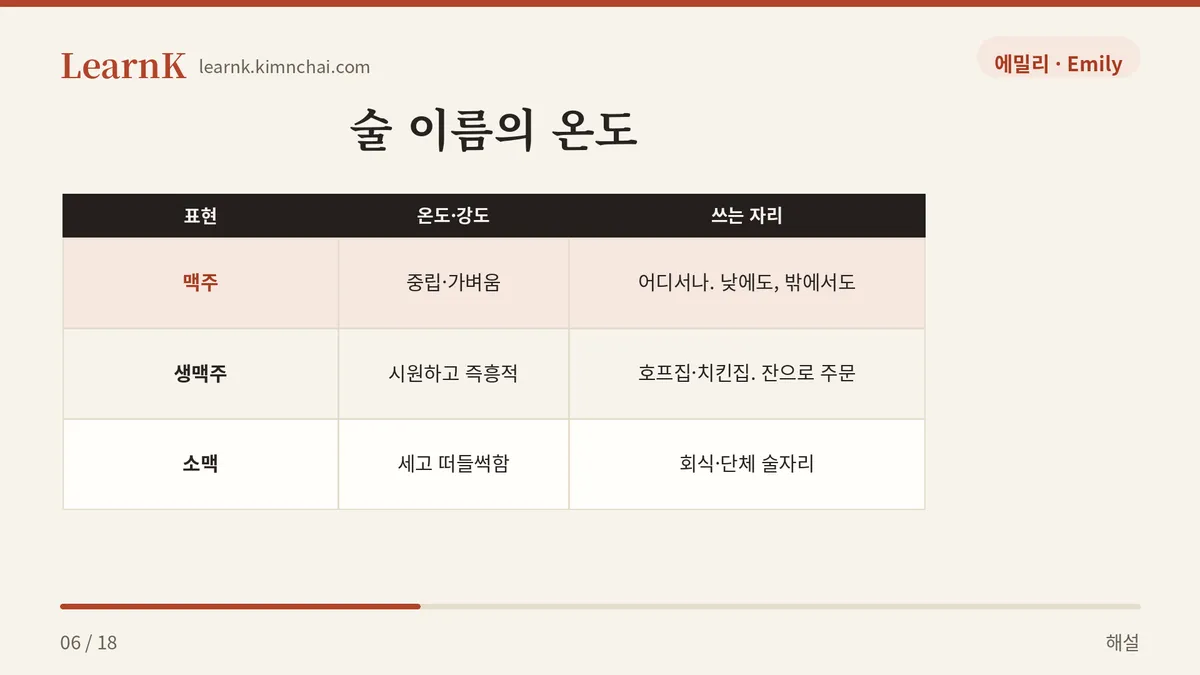
Words that look similar can run at quite different temperatures.
| Expression | Temperature / intensity | Where it’s used |
|---|---|---|
| 맥주 (maekju) | Neutral | Anywhere. It’s the name of a thing, so it doesn’t care about the setting |
| 생맥주 (saengmaekju) | Cold and spur-of-the-moment | Beer pubs, chicken places. Ordered by the ‘잔 (jan, glass)’ |
| 치맥 (chimaek) | Light and upbeat | Among peers, on social media. Not used in formal settings |
| 소맥 (somaek) | Strong and rowdy | Work dinners, group drinking. It’s fine to decline if you can’t handle it |
| 술 (sul) | Broad, sometimes heavy | When the type hasn’t been decided yet |
“술 한잔하자 (sul hanjanhaja)” and “맥주 한잔하자 (maekju hanjanhaja)” are subtly different. The first can mean “there’s something I want to talk about,” while the second usually just means let’s have something cold.
Cultural background — a drink brewed from barley, and its seat beside the chicken
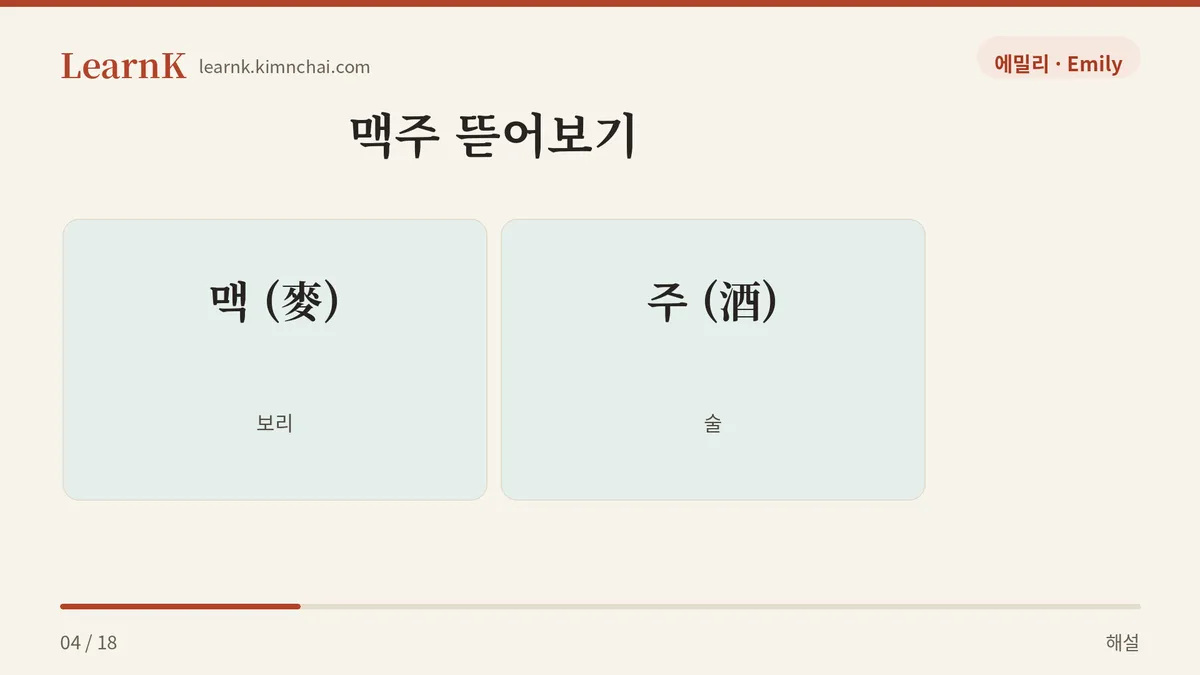
‘맥주’ is a Sino-Korean word. 맥(麥) is barley and 주(酒) is alcohol — literally “barley liquor.” The dictionary example we saw earlier, “겉보리는 주로 동물의 사료나 맥주를 만드는 데 사용된다,” states that ingredient outright. Cases where a word’s shape and its ingredients line up this honestly are rarer than you’d think.
In Korea, 맥주 is a drink that comes with a partner. 치맥 (chimaek) is 치킨 (chicken) and 맥주 stuck together, and 소맥 (somaek) is 소주 mixed with 맥주. Both are abbreviations built from the first syllable of each word — and the very fact that such shortcuts exist tells you how common those pairings are.
The scenery beer belongs to is fairly fixed, too. A picnic mat at Hangang Park on a summer evening, the stands at a baseball game, the parasol outside a convenience store, and the chicken joint. If 소주 mostly belongs to indoor nights, 맥주 is also permitted outdoors and in daylight. Even in dramas, when a character pulls out 소주, a heavy conversation is about to start; when someone cracks open a can of beer, what usually follows is a light vent or a reconciliation. The type of drink tells you the temperature of the scene in advance.
One more thing. At a Korean drinking table, you don’t fill your own glass. When the person next to you empties theirs, you pour for them, and when someone pours for you, you receive the glass with both hands. Pouring for someone senior is a two-handed job as well. Even when it’s just a can of beer being shared, that gesture is still alive.
Today’s quiz
A friend texts you: “금요일에 맥주 한잔하자!” Which is closest to what this means?
- Let’s drink exactly one glass of beer
- Let’s meet up on Friday and have some drinks together
- Buy me a glass of beer
The answer is 2. 한잔하다 (hanjanhada) refers not to a number of glasses but to “getting together over drinks.” A reply of “좋아, 몇 시에 볼까? (joa, myeot si-e bolkka?)” is plenty. And if you don’t drink, saying “나 술은 잘 못 마시는데, 그래도 나갈게 (I’m not much of a drinker, but I’ll still come out)” isn’t the least bit awkward — because the point of that gathering was never the beer. It was the people.
Definitions and example sentences are from the National Institute of Korean Language’s Basic Korean Dictionary (krdict.korean.go.kr); that portion of this post, including our translations, is licensed under CC BY-SA 2.0 KR.