막내 (mangnae): From the Youngest Sibling to the Idol Group's Baby, a Name Full of Love
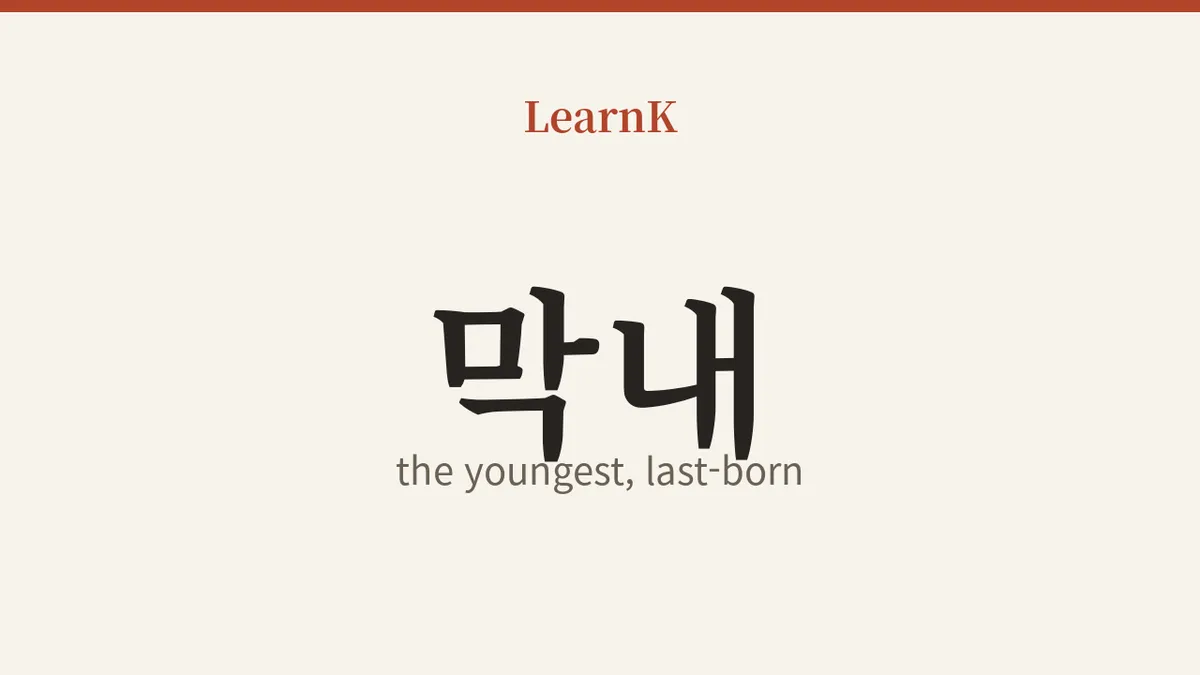
막내
When you watch Korean dramas, you’ll often see a scene like this. The whole family is gathered around the dinner table, and when the youngest child fusses about the side dishes, the mother smiles and takes the child’s side. The name they call that child is 막내 (mangnae). You’ll hear it often in K-pop group introduction videos too. When someone says, “This one is our team’s 막내예요 (mangnae-yeyo),” they’re pointing to the youngest member of the group.
Today, let’s take a deep look at 막내 (mangnae) — a word that’s a key to understanding Korean relationships, whether within a family or within a group like a company or a club.
Meaning and Nuance
막내 (mangnae) is used mainly in two situations. First, the youngest person born last among siblings. Second, the youngest person in an organization or group, such as a company, a club, or an idol group.
What matters is that it carries emotion beyond simply the fact of being “the youngest.” 막내 (mangnae) is infused with a nuance of affection and care — “they’re adorable,” “we need to look after them,” “we cut them a little slack.” On the flip side, expectations come with being the mangnae too: “they follow their older siblings and seniors well and mind their manners.”
Checking the National Institute of Korean Language Dictionary
막내 (noun)
- The youngest person, born last among siblings. [en] the youngest; last-born [es] menor [zh] 老小 — National Institute of Korean Language, Basic Korean Dictionary (krdict.korean.go.kr)
막내 (noun) 2. The youngest person in an organization or group. [en] the youngest [es] menor [zh] 老幺 — National Institute of Korean Language, Basic Korean Dictionary (krdict.korean.go.kr)
Let’s also look at some real usage examples from the dictionary.
막내딸이 큰딸에게 구박을 받으면 아버지는 항상 막내를 감싸 주었다. — National Institute of Korean Language, Basic Korean Dictionary (krdict.korean.go.kr)
This paints a picture of parents specially protecting the youngest child among siblings. It’s a sentence that clearly shows the nuance of affection contained in 막내 (mangnae).
막내가 집에 있을 텐데 왜 전화를 안 받지? — National Institute of Korean Language, Basic Korean Dictionary (krdict.korean.go.kr)
This is an everyday conversation, worrying about and trying to reach the young sibling who should be at home. Here, mangnae is used as a term of address for “the youngest child in our house” instead of a name.
밥벌이도 못할 줄 알았던 막내가 지금은 큰 회사 사장이라네. — National Institute of Korean Language, Basic Korean Dictionary (krdict.korean.go.kr)
This is a remark full of pride, saying that the mangnae — who they thought wouldn’t even be able to make a living — has grown up wonderfully.
유학을 간 막내가 연락을 자주 안 해서 걱정되시죠? — National Institute of Korean Language, Basic Korean Dictionary (krdict.korean.go.kr)
This is an expression comforting a parent’s heart toward the mangnae who has gone far away to study abroad. All four example sentences share the same emotion: “a being who is young, worried about, and cherished.”
Example Sentences by Situation
Situation 1 — Introducing Your Family
저는 삼 남매 중 막내예요. (jeoneun sam-nammae jung mangnae-yeyo.) “I’m the youngest of three siblings.” This is the perfect sentence for explaining your family relationships to someone you’ve just met.
Situation 2 — A Company Gathering
막내가 수저 좀 놓을게요. (mangnae-ga sujeo jom noeulge-yo.) “Since I’m the youngest here, I’ll set out the spoons and chopsticks.” This shows the culture at Korean company dinners where the youngest person naturally steps up to take care of things.
Situation 3 — A Chat Among Idol Fans
우리 그룹 막내가 제일 춤을 잘 춰요. (uri geurup mangnae-ga jeil chumeul jal chwo-yo.) “The youngest member of our group dances the best.” This is an expression K-pop fans commonly use when bragging about their favorite member.
Comparing Formal/Informal Speech and Similar Expressions
Because 막내 (mangnae) is both a term of address and a noun, its ending changes depending on whether you speak formally or informally.
- Formal: 쟤가 우리 막내예요. (jyaega uri mangnae-yeyo.)
- Informal: 쟤가 우리 막내야. (jyaega uri mangnae-ya.)
The opposite is 맏이 (maji) — the first-born among siblings. It has a different feel from 동생 (dongsaeng), which similarly refers to a younger person. 동생 (dongsaeng) is a relative concept meaning “someone younger than me,” but 막내 (mangnae) refers only to “the single, absolutely youngest person in that group.”
Cultural Background
In Korea, age and hierarchy are the backbone of relationships. That’s why the position of 막내 (mangnae) holds a unique place. Along with the privilege of being seen as cute even when acting playful and endearing (애교), it also comes with the duty of taking care of the unpleasant chores first and treating the elders attentively. This is also why, in drama stories about big families, the character who monopolizes the whole family’s love even after causing trouble is usually the mangnae. On variety shows, scenes where the cast members check each other’s ages and then designate the youngest as the “mangnae” to run errands likewise show that this word is a living cultural code.
Today’s Quiz
In a company team of five people working together, what do you call the youngest new employee in a single word?
See the answer
The answer is 막내 (mangnae). It corresponds exactly to definition 2, “the youngest person in an organization or group.” Even if they aren’t siblings, anyone who is the youngest in any group can be called the mangnae.
Definitions and example sentences are from the National Institute of Korean Language’s Basic Korean Dictionary (krdict.korean.go.kr); that portion of this post, including our translations, is licensed under CC BY-SA 2.0 KR.