레전드 (lejeondeu): That Moment You'll Be Talking About for Years
레전드
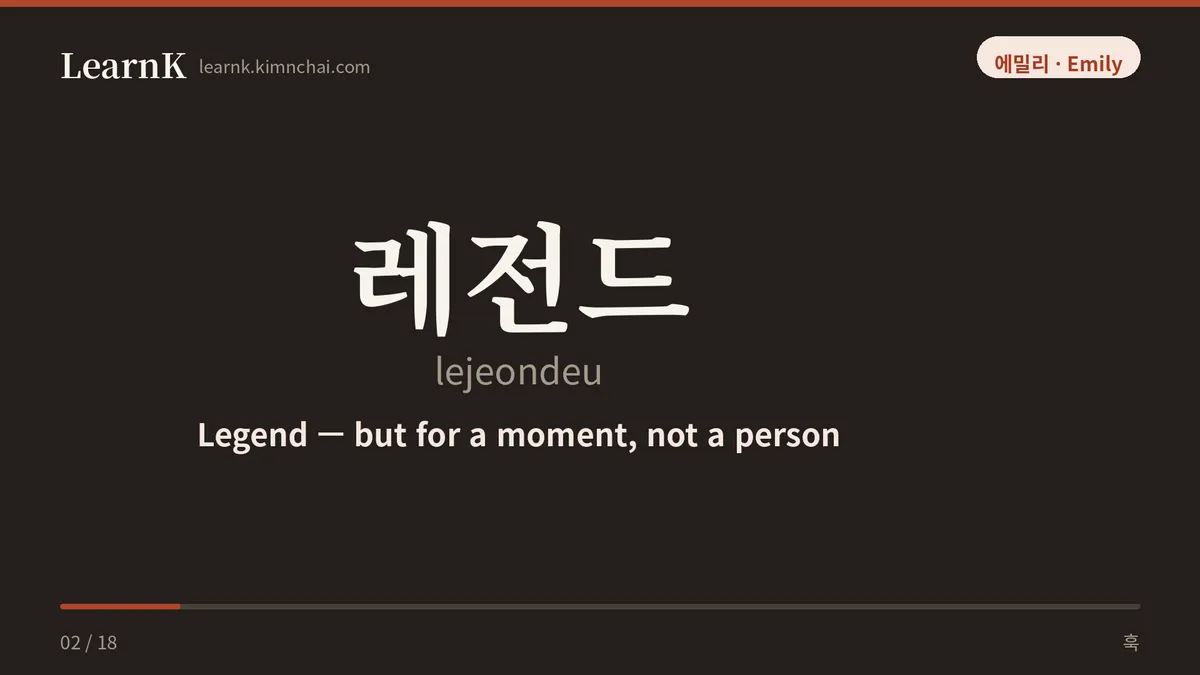
레전드 (lejeondeu) means “a moment, a scene, or a person so amazing — or, in the opposite direction, so absurd — that it refuses to be forgotten and keeps getting brought up for years.” It was borrowed straight from the English word legend, but in Korean it gets attached far more often to something that just unfolded right in front of you than to a figure who belongs in a biography.
A go-ahead home run with two outs in the bottom of the ninth. The last 30 seconds of a performance video you’ve replayed for three days straight. That thing your friend pulled on a school trip ten years ago. These three have exactly one thing in common — long after the moment has passed, people are still bringing it up. Korean speakers call that 레전드 (lejeondeu).
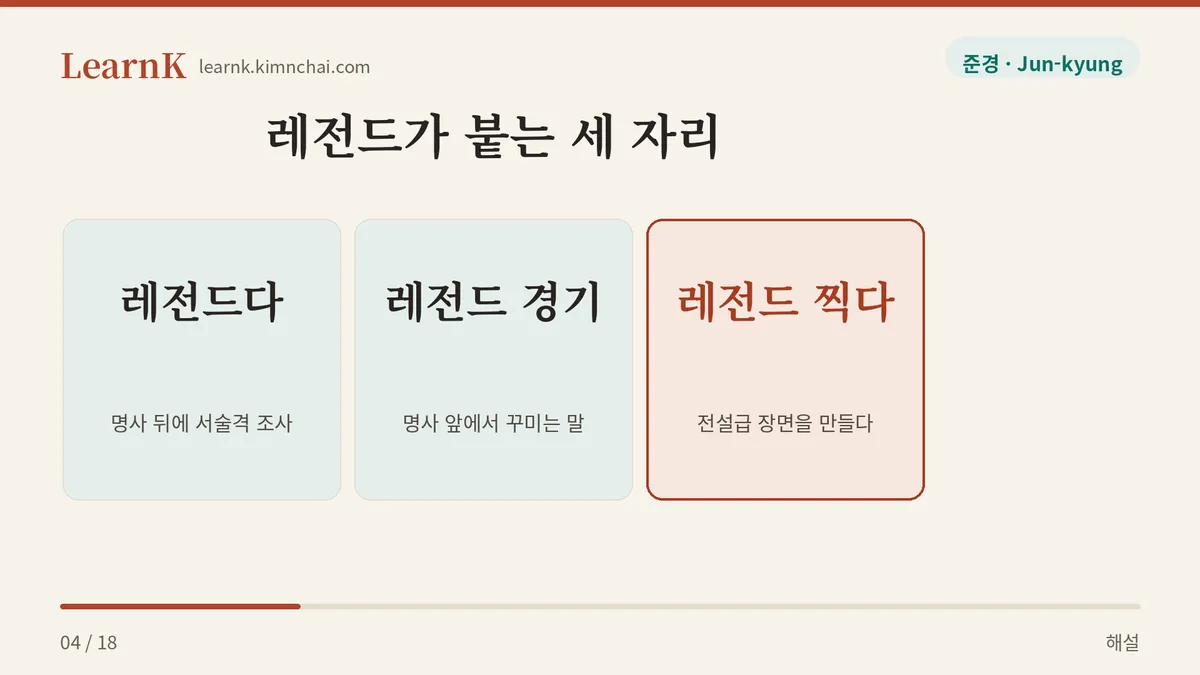
By part of speech, it’s a noun. So it takes a copula ending on the back — 레전드다 (lejeondeu-da), 레전드였어 (lejeondeu-yeosseo) — and it can also sit in front of another noun as a modifier: 레전드 경기 (lejeondeu gyeonggi, a legendary game), 레전드 무대 (lejeondeu mudae, a legendary stage performance), 레전드 짤 (lejeondeu jjal, a legendary meme image). Paired with a verb, 레전드 찍다 (lejeondeu jjikda) means “to produce a scene that will live on as a legend,” and it’s one of the forms Korean speakers reach for most happily.
The temperature is hot; the weight is light. That both of these hold at the same time is the heart of this word. In terms of content it’s a superlative, so you can’t stick it on just anything — but in tone it’s close to an internet-and-spoken-language exclamation, so it doesn’t suit formal occasions. That’s why, about the very same person, friends will say 진짜 레전드야 (jinjja lejeondeu-ya), “he’s an absolute legend,” while an official congratulatory speech says 전설적인 분입니다 (jeonseoljeogin bunimnida), “he is a legendary figure.”
One more thing that’s easy to miss — 레전드 is not for praise only. The test isn’t “was it done well?” but “does it stick in your memory?” So it lands just as easily on an all-time great piece of acting as on all-time terrible acting. The surrounding context and the speaker’s face decide which direction it points. Conversely, you don’t use it for something that was merely, ordinarily nice. Call yesterday’s lunch a 레전드 and your Korean friend will laugh and ask back, 그 정도야? (geu jeongdo-ya?) — “was it really that good?”
See It in a Real Conversation
Setting: a neighborhood fried-chicken place. A baseball game is on TV — bottom of the ninth, two outs, bases loaded.
Jun-kyung: 야, 치킨 식든 말든 이건 봐야 돼. 9회 말 만루야. Hey, forget the chicken getting cold — you have to watch this. Bases loaded, bottom of the ninth.
Emily: 어? 대타 나왔는데? 저 선수 작년에 2군 갔던 사람 아니야? Huh? They put in a pinch hitter. Isn’t that the guy who got sent down to the minors last year?
Jun-kyung: 맞아. 근데 5월에 끝내기 친 거 기억 안 나? 그거 완전 레전드였잖아. Yeah. But don’t you remember his walk-off in May? That was a total legend moment.
Emily: 아 맞다, 나 그 영상 짤로만 열 번은 봤어. Oh right, I’ve watched that clip like ten times.
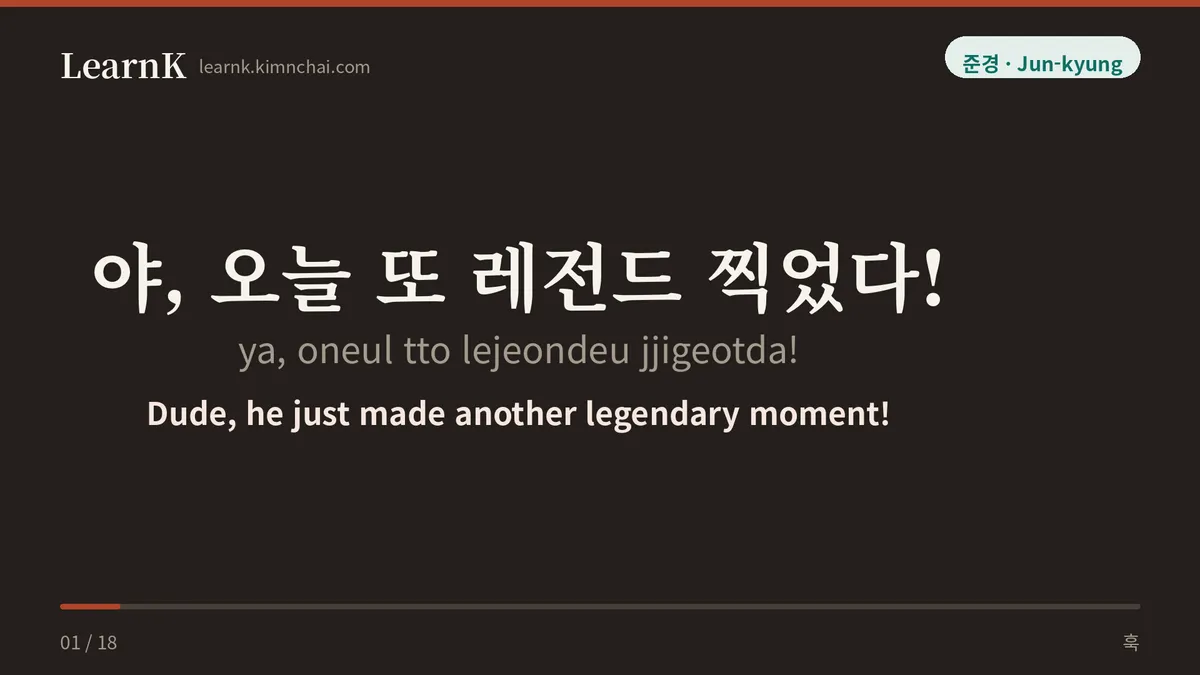
Jun-kyung: …쳤다! 넘어갔어! 야, 오늘 또 레전드 찍었다! …He hit it! It’s gone! Dude, he just made another legendary moment!
Emily: 대박, 나 손 떨려. 이건 내년까지 얘기할 듯. Oh my god, my hands are shaking. People are gonna talk about this until next year.
This Is Where It Sounds Off
✗ (Taking the mic at a company anniversary ceremony) 부장님, 30년 근속 진짜 레전드세요. (bujangnim, samsimnyeon geunsok jinjja lejeondeu-seyo.) ✓ (At a company anniversary ceremony) 부장님, 30년 근속 정말 전설적이십니다. (bujangnim, samsimnyeon geunsok jeongmal jeonseoljeogisimnida.) — “Sir, thirty years of service is truly legendary.” → Switching only the ending to polite form leaves the temperature of the word itself untouched. It grew up on the internet and in the broadcast booth, so using it toward someone senior on an official occasion sounds less like praise and more like a joke. For the same meaning in a formal setting, use 전설적이다 (jeonseoljeogida).
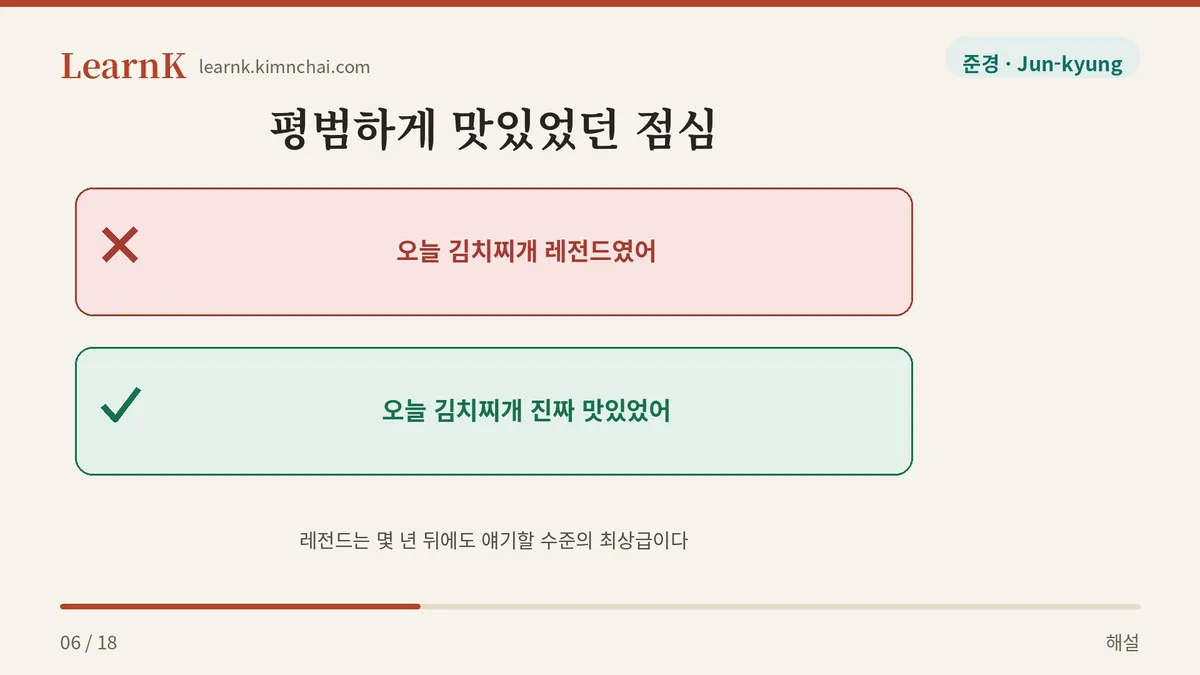
✗ (About a lunch that was ordinarily tasty) 오늘 김치찌개 레전드였어. (oneul gimchijjigae lejeondeu-yeosseo.) ✓ (About a lunch that was ordinarily tasty) 오늘 김치찌개 진짜 맛있었어. (oneul gimchijjigae jinjja masisseosseo.) — “Today’s kimchi stew was really good.” → 레전드 is a superlative at the level of “I’ll still be telling this story years from now.” Attach it to anything and everything and the word wears thin, so when a real legend finally comes along, you’ll have nothing left to say.
Example Sentences by Situation
1. Replying to a concert fancam video a friend sent you
어제 그 무대 봤어? 마지막 30초 진짜 레전드야.
어제 그 무대 봤어? 마지막 30초 진짜 레전드야. (eoje geu mudae bwasseo? majimak samsipcho jinjja lejeondeu-ya.) Did you see that stage yesterday? The last 30 seconds were an absolute legend.
Pinning down a specific stretch — “the last 30 seconds” rather than the whole performance — sounds far more natural. 레전드 is at its best pointing to the exact spot you keep rewinding to, rather than serving as an overall verdict that the whole thing was excellent.
2. Talking with coworkers the day after a company dinner about last night’s karaoke
부장님 어제 탬버린 레전드 찍으셨어. (bujangnim eoje taembeorin lejeondeu jjigeusyeosseo.) The manager pulled off a legendary tambourine performance last night.
What matters here is that this is said among coworkers, not to the manager’s face. In this sentence 레전드 sits somewhere between “that was incredible” and “that was hilarious” — a temperature that could embarrass the person if he overheard it. It leans more toward fond reminiscing than talking behind someone’s back, but it’s clearly a phrase you have to pick your setting for.
3. Introducing a favorite long-time restaurant to a friend
이 집 3년째 가격 그대로래. 가성비 레전드. (i jip samnyeonjjae gagyeok geudaerorae. gaseongbi lejeondeu.) Apparently this place hasn’t changed its prices in three years. Legendary value for money.
This is the form that stops on a noun at the end of the sentence, with no predicate at all. Putting a noun in front to set the standard — 가성비 레전드 (legendary value), 실력 레전드 (legendary skill) — makes it clear exactly what is legend-tier. It’s a short form you’ll see especially often in speech and on social media.
Polite and Casual Forms, and Similar Expressions
Since 레전드 is a noun, you can make it as polite as you like: 레전드예요 (lejeondeu-yeyo), 레전드입니다 (lejeondeu-imnida). But raising the ending doesn’t solve the problem of the setting. Polite forms show up all the time in TV subtitles, YouTube titles, and reviews — yet they’re still out of place in a report to your boss or in an official document.
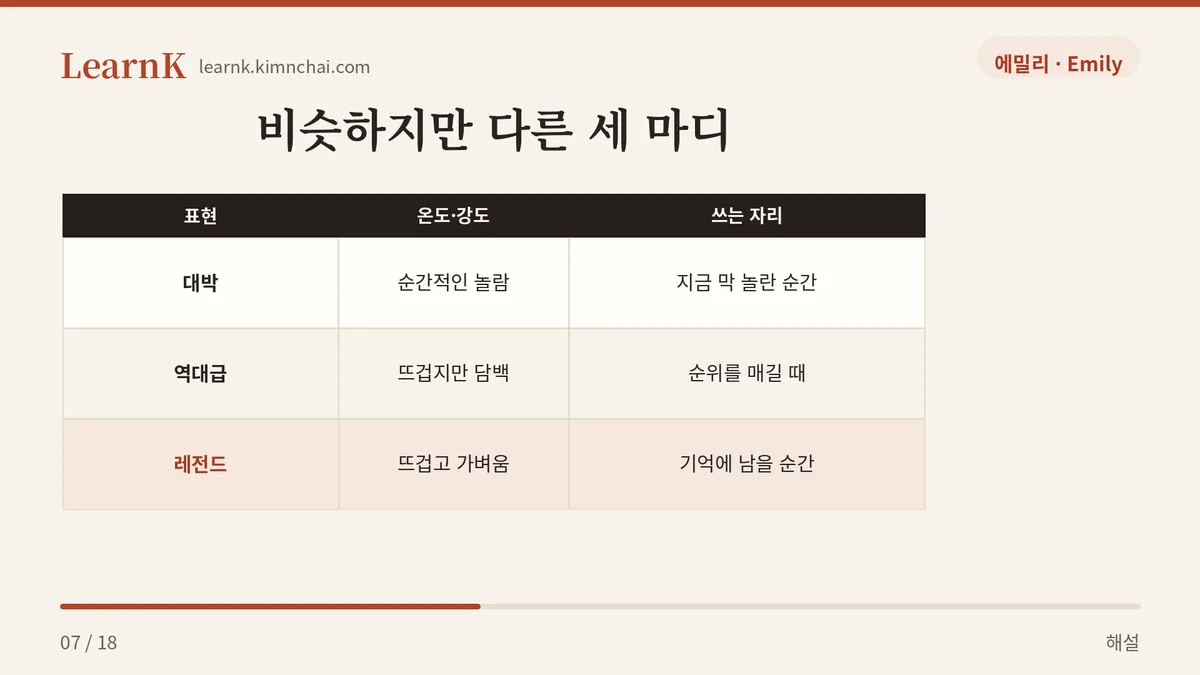
| Expression | Temperature / Intensity | Where it’s used |
|---|---|---|
| 레전드 (lejeondeu) | Very hot and very light. Superlative | Among peers, on social media, while watching a game. Not for formal occasions |
| 역대급 (yeokdaegeup) | Hot, but a little more understated | Among peers, and often in article headlines too |
| 전설적이다 (jeonseoljeogida) | Heavy and formal | Speeches, articles, anywhere polite language is required |
| 대박 (daebak) | Momentary astonishment | Among peers. The reaction the instant you’re surprised |
The difference in one line: 대박 is what bursts out of you at the moment of surprise, while 레전드 is what you attach when that moment looks like it will stay with you as a memory. 역대급 carries a strong comparative nuance of “the best so far,” so it’s the one to use when you need the feel of ranking things.
Cultural Background — People Who Save Their Highlights
The English word legend originally refers to a legend, and to a master of a given field. On its way into Korean, the word widened its range from people to moments. Used of a person, it means almost exactly what it does in English (축구 레전드 (chukgu lejeondeu, a soccer legend), 그룹의 레전드 멤버 (geurup-ui lejeondeu membeo, a group’s legendary member)) — but by far the more common use is on scenes and moments.
Behind how naturally that expansion happened is a culture of rewatching. Game highlights, fancams of stage performances, broadcast clips, and the capture images known as 짤방 (jjalbang). Korean speakers don’t let a great scene drift past in the moment — they cut it out, save it, replay it, and share it. A clip that survives that way for years naturally needs a label, and that label is 레전드. It’s why YouTube overflows with titles like ‘레전드 모음 (lejeondeu moeum, legend compilation)’ and ‘레전드 경기 다시보기 (lejeondeu gyeonggi dasibogi, legendary game replay)’.
So when a Korean friend sends you a link saying “이거 레전드야 (igeo lejeondeu-ya)” — “this one’s a legend” — it isn’t a simple recommendation. It’s closer to saying they want to show you something they’ve replayed over and over themselves. When you answer, “아 이거 왜 이제 봤지 (a igeo wae ije bwatji)” — “why am I only seeing this now?” — makes for a much more fun conversation than a flat “재밌네 (jaeminne)”, “that’s funny.”
Today’s Quiz
In which of the following settings would ‘레전드’ be the most awkward choice?
① When a walk-off home run lands while you’re watching a baseball broadcast with a friend ② When you’re giving an official congratulatory speech at a company anniversary for a senior colleague with thirty years of service ③ When you’re posting a video from yesterday’s concert in a group chat
The answer is ②. In terms of content, thirty years of service is exactly the sort of thing that’s legend-tier — but 레전드 is a light word that grew up on the internet and in casual speech, so using it toward someone senior in an official speech can come across as rude. In that setting, 전설적이십니다 (jeonseoljeogisimnida) is the right choice. ① and ③ are the classic settings for the word: among peers, about a moment that’s likely to stick in memory.