Today's Expression: "한강 가자 (Hangang gaja)" — Seoul's Invitation to Chill
When you watch Korean dramas or variety shows, you’ll often see characters spreading out a picnic mat, ordering fried chicken, and laughing in the breeze off the river. Nine times out of ten, that backdrop is the 한강 (Hangang), the big river that runs through the middle of Seoul. And right before scenes like that, someone usually tosses out a casual little line — which is exactly today’s expression.
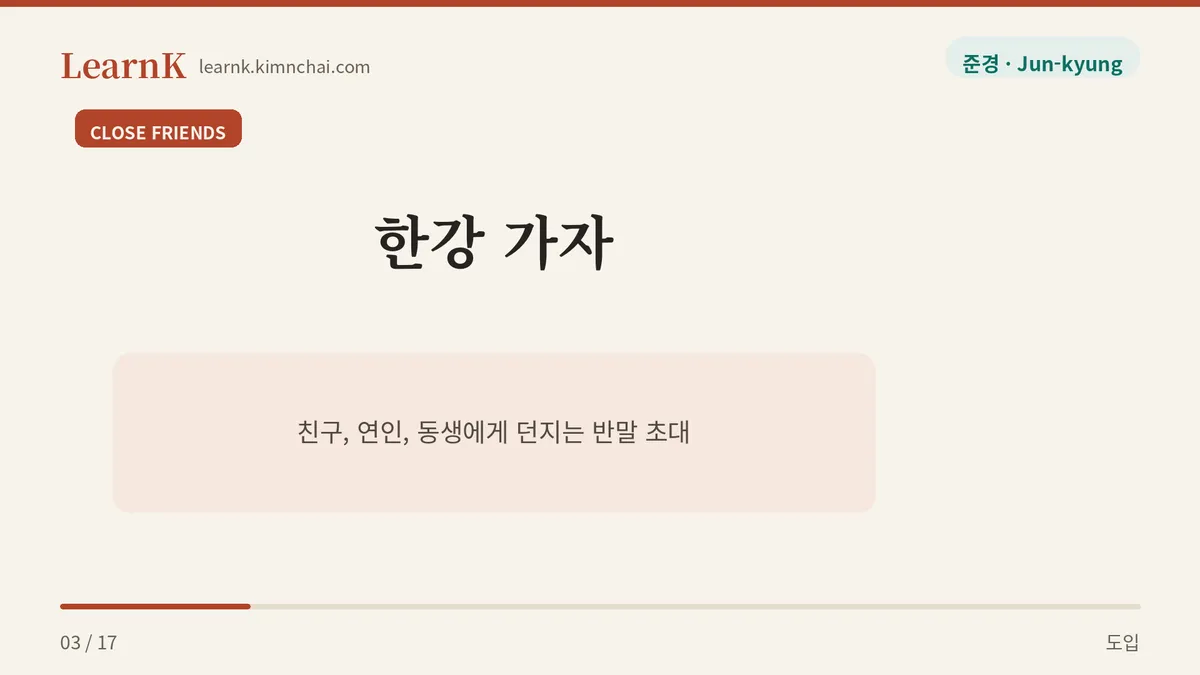
한강 가자
한강 가자 (Hangang gaja) literally means “Let’s go to the Han River.” But this phrase isn’t just about picking a destination. For Korea’s younger generation, this single line is closer to an invitation — something like “Let’s blow off some stress today,” “Let’s go get some fresh air,” or “Let’s hang out.”
Let’s break the sentence down:
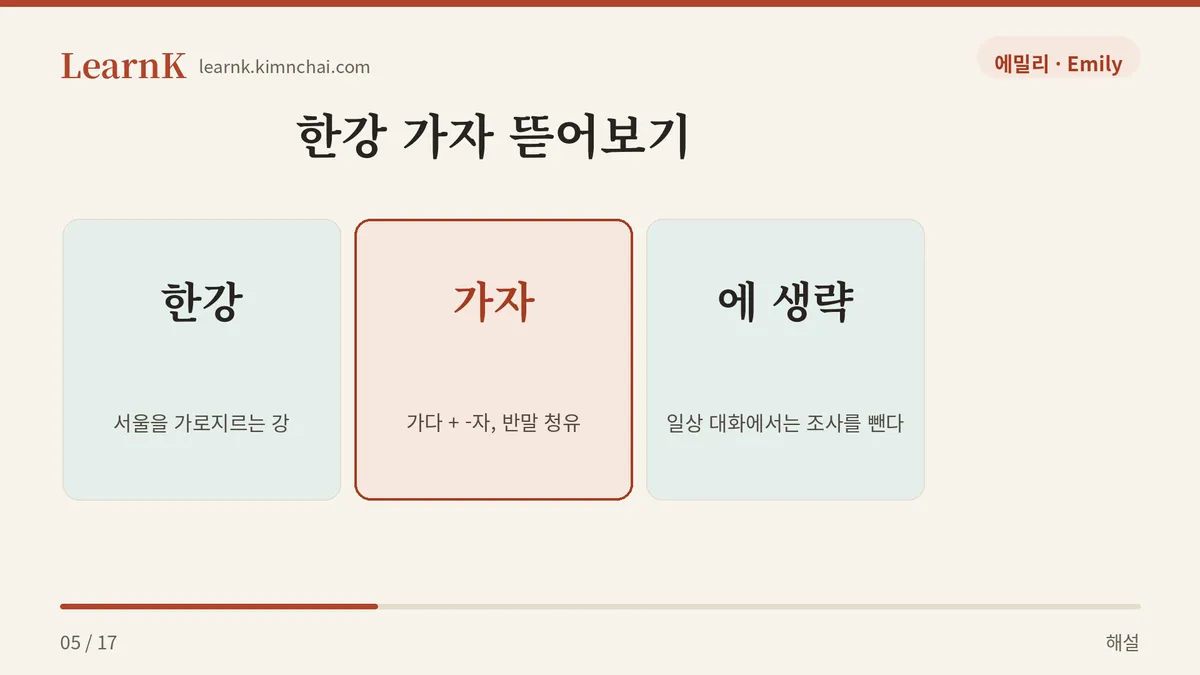
- 한강 (Hangang) — the name of the river flowing through the heart of Seoul. Wide parks (한강공원, Hangang Parks) stretch along its banks, making it one of the city’s go-to spots to relax.
- 가자 (gaja) — the verb 가다 (gada, 가다 = to go) with the propositive ending -자 (-ja) attached. It’s a casual way of suggesting “let’s ~.”
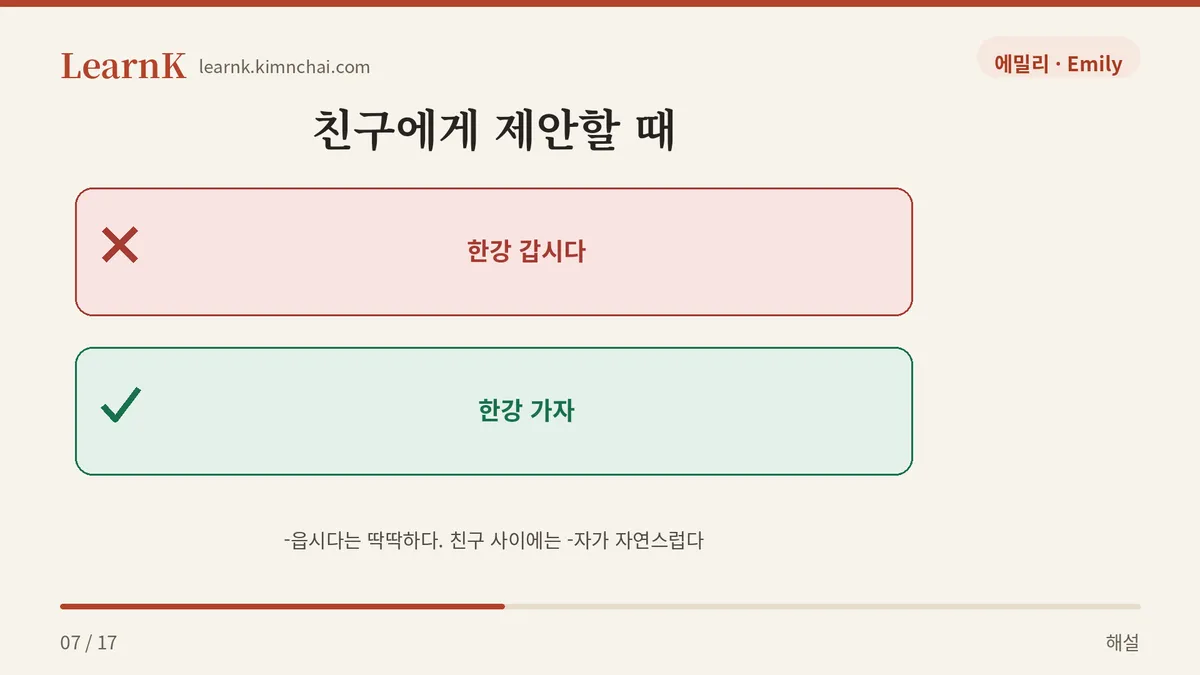
So 한강 가자 is an invitation in 반말 (banmal, casual/informal speech) — the kind you only use with people you’re close to. Technically, the fully grammatical version adds the particle 에 (e) to make “한강에 가자,” but in everyday conversation it sounds much more natural to drop the particle and say 한강 가자 for short.
What kind of feeling does it carry?
This expression has a certain lightness and excitement to it. It’s not some grand travel plan — it’s a simple little outing to a place just a few subway stops away, somewhere you can slip off to on a whim. That’s why “한강 가자” can also become a comforting thing to say to each other when you’re worn out and stuck in a rut.
Example Sentences by Situation
Situation 1 — To a friend who just finished an exam
시험 끝났지? 오늘 저녁에 한강 가자 (Hangang gaja). 치킨은 내가 살게. (Your exam’s done, right? Let’s go to the Han River this evening. Chicken’s on me.)
Here you’re suggesting a mix of celebration and rest to a friend who’s been working hard. The Han River and chicken + beer (치맥, chimaek) are practically a package deal.
Situation 2 — At the end of a frustrating day
요즘 너무 힘들다… 우리 한강 가서 (Hangang gaseo) 바람 좀 쐴까? (Things have been so rough lately… should we go to the Han River and get some fresh air?)
Here, instead of the propositive 가자, we use “가서 (가 + 아서)” to smoothly connect the ideas as “let’s go and ~.” It’s an expression you reach for when you want to comfort someone.
Situation 3 — When making a date plan
이번 주말에 날씨 좋대. 한강 가자 (Hangang gaja), 자전거도 타고. (They say the weather’s nice this weekend. Let’s go to the Han River — we can ride bikes too.)
The Han River parks are popular date spots too, with plenty to do: bike rentals, walks, cooking instant ramen, and more.
Formal vs. Casual Speech
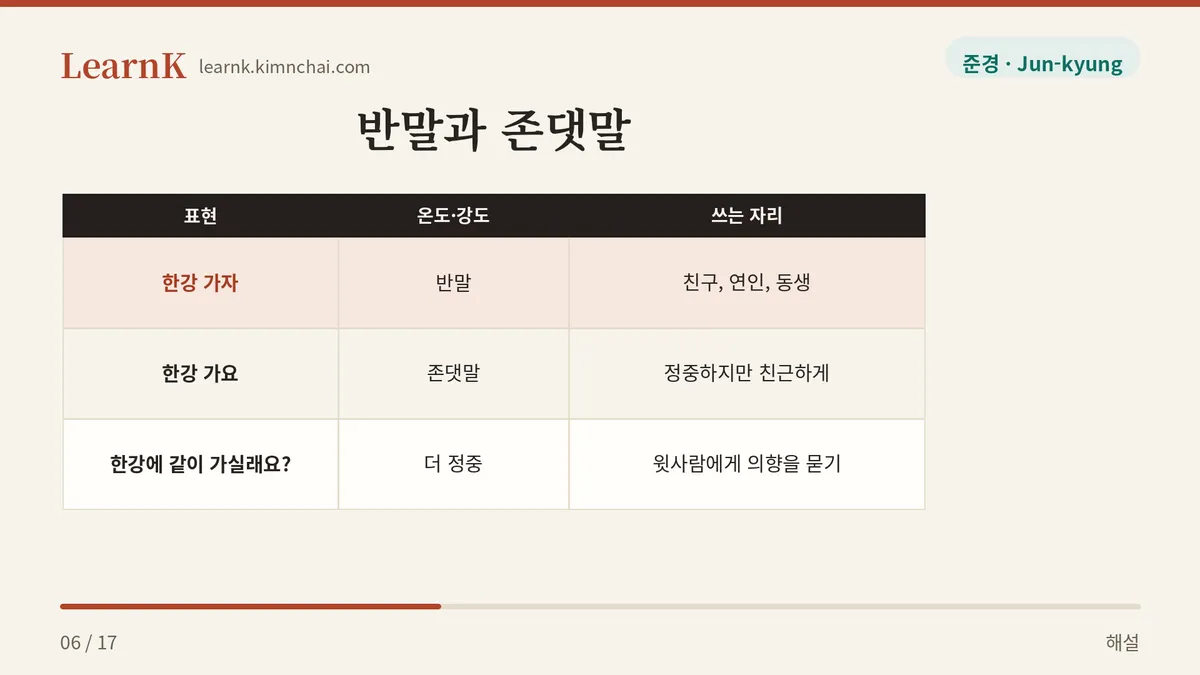
Since 한강 가자 is casual (반말), you don’t use it with elders or your boss at work. Adjust it to fit the person you’re talking to:
- Casual: 한강 가자 (Hangang gaja) — for friends, partners, or younger siblings.
- Polite (propositive): 한강 가요 (Hangang gayo) — polite but still friendly.
- Even more polite: 한강에 같이 가실래요? (Hangang-e gachi gasillaeyo?) — a courteous way to ask about someone’s willingness to go.
Similar invitation phrases you’ll hear a lot include 바람 쐬러 가자 (baram sswaereo gaja, 바람 쐬다 = to go out for some fresh air) and 놀러 가자 (nolleo gaja, 놀러 = in order to have fun/hang out). Just swap out the destination and you can adapt it endlessly, like 바다 가자 (bada gaja, let’s go to the beach) or 공원 가자 (gongwon gaja, let’s go to the park).
Cultural Background
The Han River isn’t just a river — it’s the emotional backdrop of Seoulites’ lives. In dramas, whether the main character is happy or crying over a breakup, the camera turns to the Han River. When night falls, the lights of the bridges shimmer across the water, and with nothing more than instant ramen and a beer from the convenience store, an ordinary night becomes something special.
In Korean coming-of-age dramas, you’ll often see a scene where a character sitting by the river with a heavy heart finally opens up when a friend says, “한강이나 가자 (Let’s just go to the Han River or something).” In this way, the expression carries an unspoken tenderness — a quiet “I’ll be here by your side.”
Wrap-Up Quiz
Suppose you want to politely suggest to a 선배 (senior colleague) at work — not a close friend — “Should we go to the Han River this weekend?” How would you rephrase 한강 가자 (Hangang gaja) so it sounds most natural?
Answer: 한강 가요 (Hangang gayo) or 한강에 같이 가실래요? (Hangang-e gachi gasillaeyo?) — the key is changing the casual ending -자 into polite speech.
So go ahead and use today’s expression, 한강 가자 — the next time you make a Korean friend, be the first to say it. They’ll almost certainly break into a bright smile and answer, “콜! (kol, You’re on!)”