맵찔이 (maepjjiri) — The Name Tag People Who Can't Handle Spice Put On Themselves
맵찔이
맵찔이 (maepjjiri) means someone who isn’t good at eating spicy food. It isn’t standard Korean and you won’t find it in the dictionary — it’s slang that took root on the internet and in everyday conversation from the late 2010s on.
The moment this word comes out most often is the moment you order. When the malatang shop asks you to pick a spice level. When your finger stalls between “mild” and “spicy” on the tteokbokki menu. When a friend grabs a pack of Buldak ramen at the convenience store and asks, “You too?” In Korea, spiciness is treated less like a preference and more like a rank, so the moment where you have to declare which rung you’re standing on keeps coming around. Instead of the long version — “Sorry, my stomach doesn’t really handle spicy food” — there’s a three-syllable word that ends it: 맵찔이. One 나 맵찔이야 (na maepjjiri-ya) and the other person moves the order toward the mild end on their own.
The shape of the word is clearly teasing. Because of how the ‘-찔이 (-jjiri)’ on the end lands, learners hearing it for the first time sometimes flinch, wondering whether it’s a harsh thing to say. But in actual use, it’s mostly self-reporting. Less a weapon for putting other people down, more a name tag you raise your own hand to wear: “this is as far as I go.” So the default delivery is a smile with no trace of hurt feelings, and the listener answers not by teasing but with “okay, let’s get the mild one.”
Sorted by temperature, there are three settings. Used about yourself, the cost is zero. Used with a close friend your own age, it becomes light teasing and leaves a laugh behind. The problem is the third setting — aim it at someone you don’t know well, or someone older than you, and all that’s left is mockery without affection, which turns rude. The difference between those three settings is the heart of this expression, and we’ll go through them one at a time below.
Seeing It in a Real Conversation
Scene: a malatang shop on a Friday evening. They’ve filled their baskets with ingredients, put them on the scale, and are picking a spice level at the register.
Jun-kyung: 에밀리, 몇 단계 할래? 난 오늘 3단계 도전. Emily, what spice level? I’m going for level 3 today.
Emily: 난 1단계. 알잖아, 나 맵찔이야. Level 1 for me. You know I can’t handle spicy food.
Jun-kyung: 한국 15년 차 맵찔이라니, 좀 억울하지 않아? Fifteen years in Korea and still can’t take the heat — doesn’t that bug you?
Emily: 산 세월이랑 혀는 상관없어. 그리고 여기 1단계도 은근 매워. Years lived and tongue are two different things. Besides, level 1 here is no joke.
Jun-kyung: 알았어, 1단계 두 개요! …나도 어제 3단계 먹고 새벽에 속 쓰렸어. Fine — two level ones, please! …Honestly, level 3 yesterday had my stomach burning at dawn.
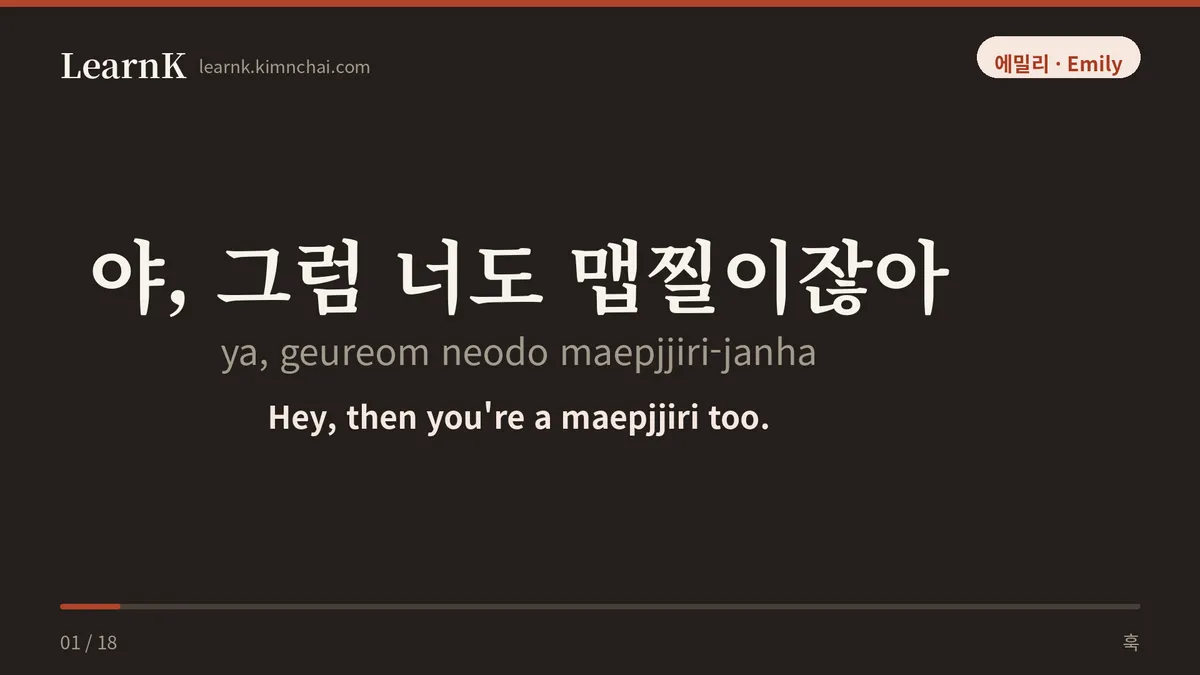
Emily: 야, 그럼 너도 맵찔이잖아. 왜 3단계인 척했어? Hey, then you’re a maepjjiri too. Why were you pretending?
It’s a short exchange, but almost every use of the word is in it. Emily brought it up about herself first (cost: zero), Jun-kyung fired back as a joke because they’re close (light teasing), and at the end she pinned it, laughing, on someone who’d been caught out. All three work only because they’re peers.
Uses That Land Wrong
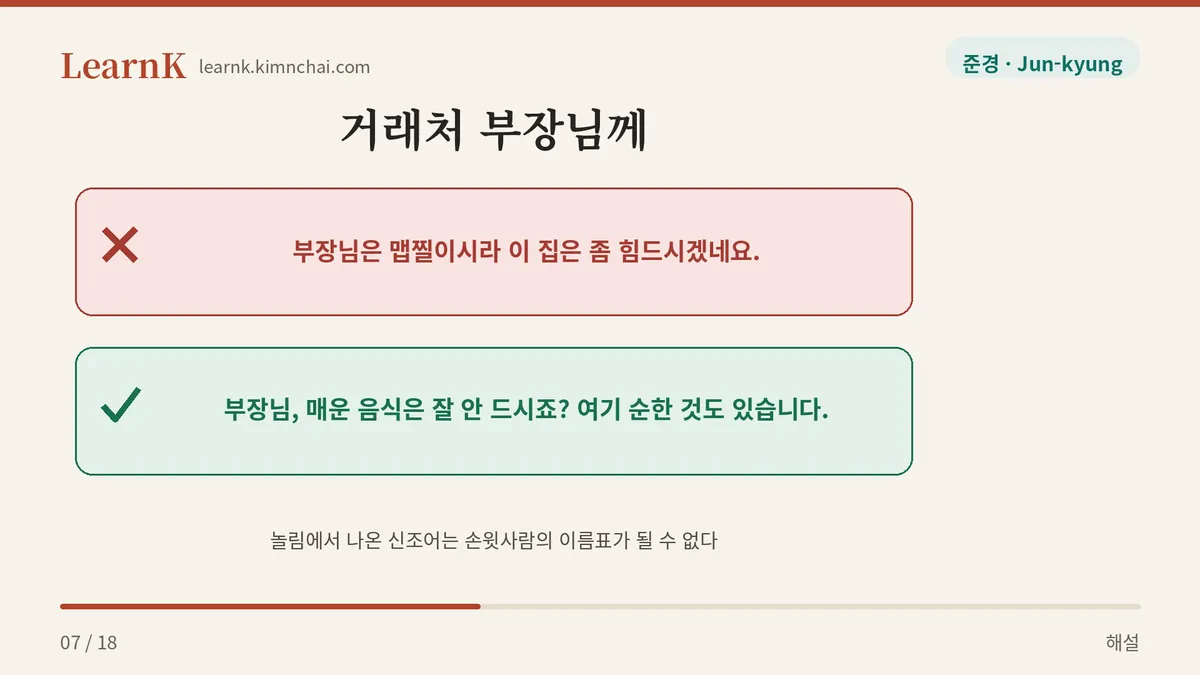
✗ (To a manager at a client company) 부장님은 맵찔이시라 이 집은 좀 힘드시겠네요. “You’re a maepjjiri, sir, so this place might be rough for you.” ✓ (To a manager at a client company) 부장님, 매운 음식은 잘 안 드시죠? 여기 순한 것도 있습니다. “You don’t really eat spicy food, do you, sir? They have mild dishes here too.” → Raising the verb ending doesn’t remove the lightness baked into the word itself. Pin a piece of teasing slang on someone senior to you as a name tag and what begins as consideration ends as rudeness.
✗ (To a friend with bad gastritis) 너 또 못 먹어? 완전 맵찔이네. “You can’t eat it again? Total maepjjiri.” ✓ (To a friend with bad gastritis) 너 속 안 좋다고 했지? 순한 거 시키자. “You said your stomach’s been bad, right? Let’s order something mild.” → Used on someone who can’t eat spicy food because they’re unwell, it stops being teasing and becomes dismissal. This word is only funny in the light situation of “just can’t take the heat.”
Example Sentences by Situation
1) In the group chat where the team dinner is being planned The department is choosing a menu and one candidate is a Buldak specialty place. Keeping the verb endings polite while aiming the word only at yourself is the safe combination.
저 맵찔이라서, 순한 메뉴도 있는 데로 가면 안 될까요? (jeo maepjjiri-raseo, sunhan menyu-do inneun de-ro gamyeon andoelkkayo?) — I’m not good with spicy food, so could we go somewhere that has mild options too?
2) When a friend suggests splitting a pack of Buldak ramen If the two of you already have a failed attempt on record, leaning on that record is the natural way to phrase it.
나 지난번에 맵찔이 인증했잖아, 반만 줘. (na jinbeone maepjjiri injeunghaetjanha, banman jwo.) — I already proved last time that I can’t do spicy, so just give me half.
3) When posting a spicy-food review on social media Because it’s a word you use to poke fun at yourself, it works especially well as a post title. Here it isn’t a sentence — it’s dropped in like a name tag.
맵찔이 생존 후기 — 우유 두 컵 마셨습니다. (maepjjiri saengjon hugi — uyu du keop masyeotseumnida.) — Survival report from someone who can’t handle spice — I drank two glasses of milk.
Polite and Casual Forms, and Similar Expressions
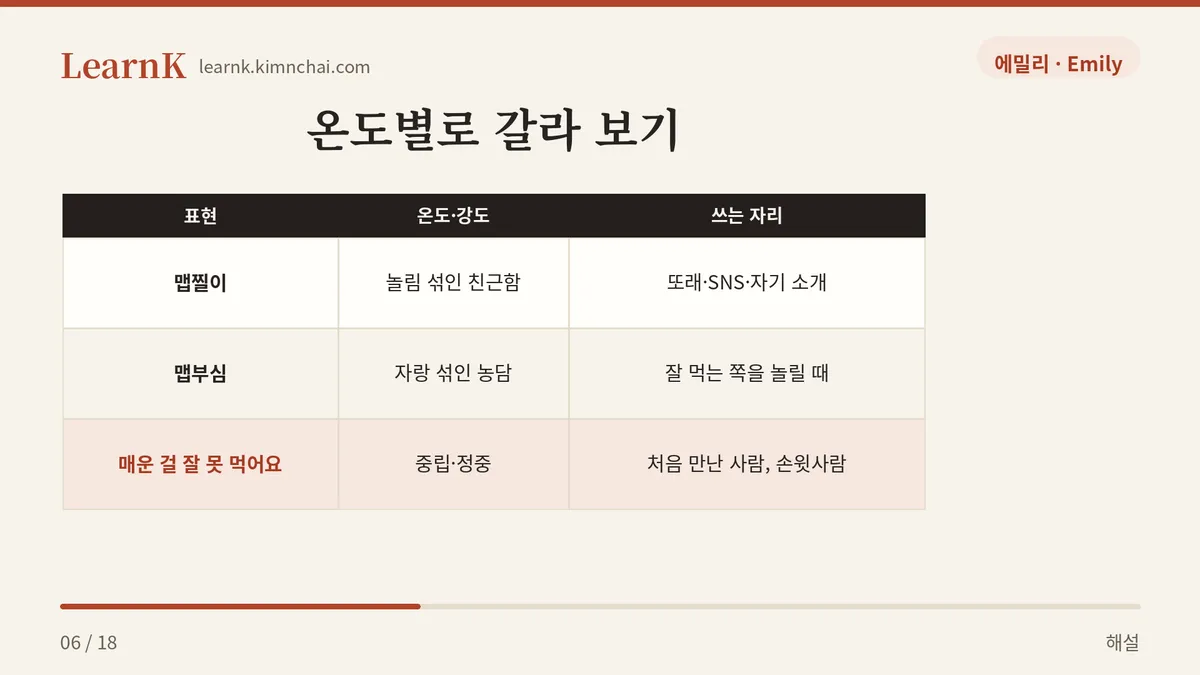
맵찔이 is a noun, so changing only the ending gives you both casual and polite versions: 맵찔이야 / 맵찔이예요 (maepjjiri-ya / maepjjiri-yeyo). But raising the ending makes the sentence polite — it doesn’t strip the lightness out of the word. So even in polite speech, the target is almost always “me.” You can safely assume that using this word while elevating the person you’re speaking to simply doesn’t work as a combination.
| Expression | Temperature / intensity | Where it’s used |
|---|---|---|
| 맵찔이 (maepjjiri) | teasing but friendly, light | peers, social media, introducing yourself. Not used to point at others, especially not at seniors |
| 맵부심 (maepbusim) | boastful, joking | for teasing the people who can eat spicy food. Among peers |
| 매운 걸 잘 못 먹어요 (maeun geol jal mot meogeoyo) | neutral, polite | anywhere. People you’ve just met, seniors, ordering at a restaurant |
| 매운 거에 약해요 (maeun geo-e yakaeyo) | soft and plain | polite but not stiff settings. Fine with older people too |
The most practical row in the table is the third. If you’ve just arrived in Korea, the safe approach is to understand 맵찔이 when you hear it but reach for 매운 걸 잘 못 먹어요 when you speak. If the other person throws out the 맵찔이 joke first, that’s your signal that you can now answer with the same word.
Cultural Background — Between 맵찔이 and 맵부심
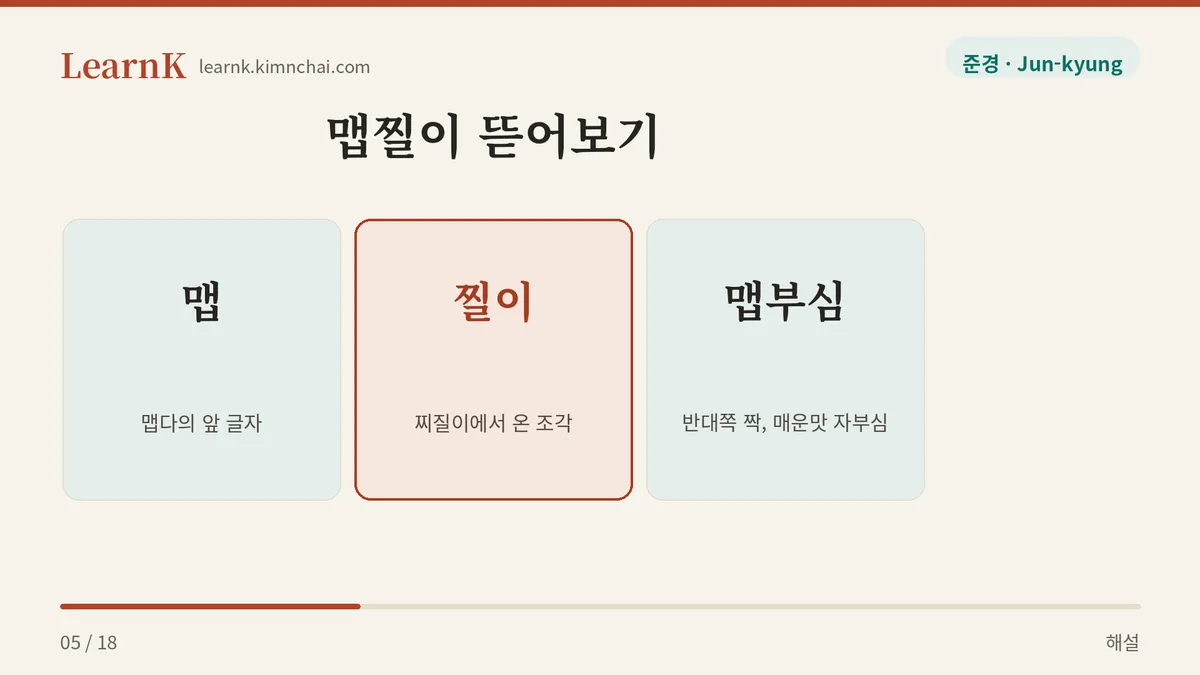
The word-building is fairly transparent. It’s read as 맵, the first syllable of 맵다 (maepda, “to be spicy”), plus 찔이 (jjiri) taken from 찌질이 (jjijiri, roughly “loser”). Its matching pair is 맵부심 (maepbusim), made by attaching 자부심 (jabusim, “pride”) to the same 맵. Korean slang often produces pairs like this, splitting a domain into the side that’s bad at it (-찔이) and the side that brags about it (-부심). The coinage used for people who can’t hold their liquor comes from the same frame.
Why this word grew out of spiciness in particular is easy to guess if you look at the table. Spicy food in Korea isn’t a single intensity — it’s a staircase. Malatang shops make you pick a level by number, tteokbokki franchises line theirs up with names running from “mild” to “the spiciest,” and the ramen aisle sets everything side by side, from gentle to challenge-grade. Where there’s a staircase, people have to say which step they’re standing on. 맵찔이 is the name for the lower end of that staircase.
Television did its part, too. On variety shows and mukbang, spicy food has long been used as a device for revealing a cast member’s personality. The person who cries and finishes the plate anyway, the person who surrenders after one bite, the person who has milk ready in advance — all sitting in the same frame. Because the scene reads from the picture alone, without needing the dialogue translated, the word spread fast through subtitles and comment sections.
One more shift is worth adding. Not being able to eat spicy food used to be treated as a quiet weakness; now the mild option has been promoted to a legitimate choice. Names like level 0, “mild,” and “gentle” are printed right on the menu, and the people who pick that box are the first to bring out the self-mocking name, smiling as they do. That’s why 맵찔이 runs warm for a teasing word. A name tag you put on yourself rarely becomes a scar.
Today’s Quiz
Dinner at a company workshop. The team lead sitting next to you takes one bite of the spicy stir-fried octopus and starts downing water. What’s the most natural thing to say here?
- 팀장님, 맵찔이세요? “Are you a maepjjiri, sir?”
- 팀장님, 매운 거에 약하신가 봐요. 계란찜도 시킬까요? “You’re not so strong with spicy food, are you? Should we order some steamed egg as well?”
- 팀장님도 맵찔이 인증하셨네요! “Looks like you’ve certified yourself a maepjjiri too, sir!”
The answer is 2. Options 1 and 3 are grammatically fine, but they’re wrong for the setting. 맵찔이 is a word for peers, or for yourself, so the instant you pin it on someone senior to you as a name tag it turns into light mockery. Flip the direction, though, and if you’re the one who can’t take the heat, you can absolutely say something like 저 맵찔이라서 계란찜 좀 시켜도 될까요? (jeo maepjjiri-raseo gyeranjjim jom sikyeodo doelkkayo?) in that very same seat. Same word, only the direction changed — and having really learned this expression means being able to tell those two directions apart.
The definitions, example sentences, and dialogue in this post are all our own original work. ‘맵찔이 (maepjjiri)’ is slang that is not listed in the National Institute of Korean Language’s Basic Korean Dictionary (krdict.korean.go.kr), so this post contains no material subject to dictionary citation or the accompanying CC BY-SA 2.0 KR notice.