Manbanjalbu — The Four Syllables You Drop Into a New Group Chat

만반잘부
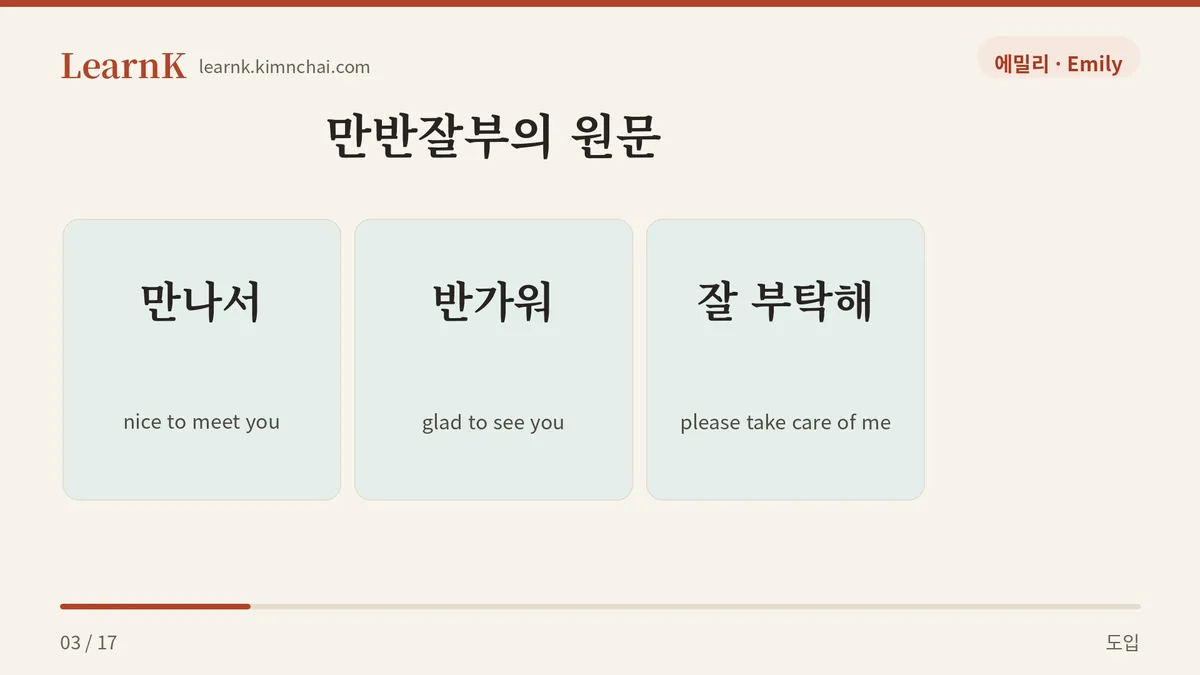
만반잘부 (manbanjalbu) is a first greeting built from the first syllable of each word in 만나서 반가워, 잘 부탁해 (mannaseo bangawo, jal butakhae) — “Nice to meet you, please take care of me.” It shows up when people are meeting for the first time, and especially when they meet as text before they ever see a face. A group chat you’ve just been added to, a game party, an open chat for a club, the department group chat at the start of a semester — type your name plus these four syllables and the introductions are done.
Korean first greetings are long by nature. 처음 뵙겠습니다 (cheoeum boepgetseumnida), 만나서 반갑습니다 (mannaseo bangapseumnida), 앞으로 잘 부탁드립니다 (apeuro jal butakdeurimnida). They’re properly polite, but they’re heavy for a group chat. If ten people greet each other like that in a row, the whole room stiffens up like a job interview. 만반잘부 compresses those two sentences into four syllables — it keeps the courtesy and strips out the weight.
The tone is bright and light. It’s less a bow than a wave. Just remember that the “반가워” and “부탁해” inside it are both 반말 (banmal), casual speech. It isn’t talking down to anyone, but the form is unmistakably casual, so it only works with peers, with people younger than you, or in anonymous spaces where nobody knows anyone’s age.
It also has an expiration date. 만반잘부 is for the very first line only. From the second conversation onward, you don’t use it. Since “만나서 반가워” is baked right into it, using it with someone you already know is like winding the clock back to zero — a strange greeting.
A real conversation
Setting: the first meetup day for a neighborhood badminton club. Emily is standing outside the gym door, staring at the group chat she was just invited to.
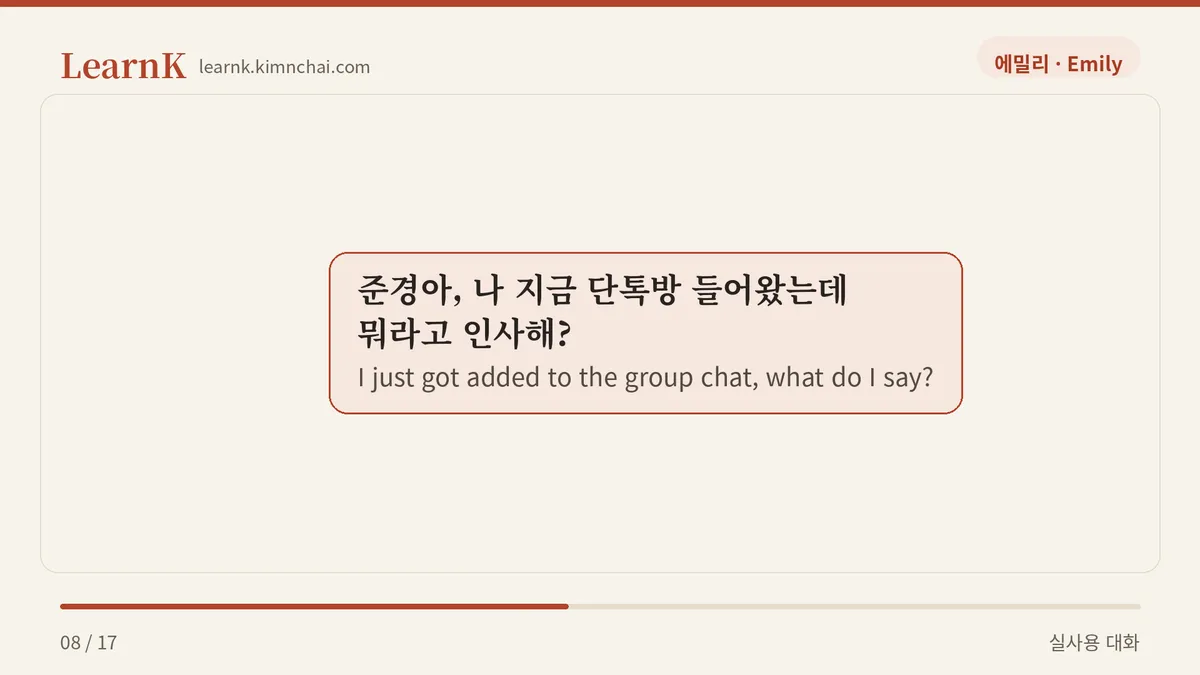
Emily: 준경아, 나 지금 단톡방 들어왔는데 뭐라고 인사해? Jun-kyung, I just got added to the group chat — what do I even say?
Jun-kyung: 이름 쓰고 만반잘부 하면 돼. 다들 그렇게 해. Just write your name and say manbanjalbu. Everyone does it that way.
Emily: 만반… 잘부? 그게 무슨 말이야? Manban… jalbu? What is that supposed to mean?
Jun-kyung: 만나서 반가워 잘 부탁해. 앞 글자만 딴 거야. ‘Nice to meet you, please take care of me.’ Just the first letters.
Emily: 아, 귀엽다. 근데 나 서른둘인데 반말로 써도 돼? Oh, that’s cute. But I’m thirty-two — is casual speech okay?
Jun-kyung: 여긴 나이 안 따져. 그냥 만반잘부, 끝. 형님들도 다 그렇게 써. Nobody’s counting ages here. Just manbanjalbu, done. Even the older guys write it.
This would sound off
✗ (to the panel at a job interview) 안녕하세요, 최다인입니다. 만반잘부! (annyeonghaseyo, Choe Da-in-imnida. manbanjalbu!) ✓ (to the panel at a job interview) 안녕하세요, 최다인입니다. 잘 부탁드립니다. (annyeonghaseyo, Choe Da-in-imnida. jal butakdeurimnida.) → It’s a clipped bit of new slang, and casual speech underneath, so in a formal setting it lands as a joke rather than a greeting. In front of people who are evaluating you, the unabbreviated “잘 부탁드립니다” is the safe choice.
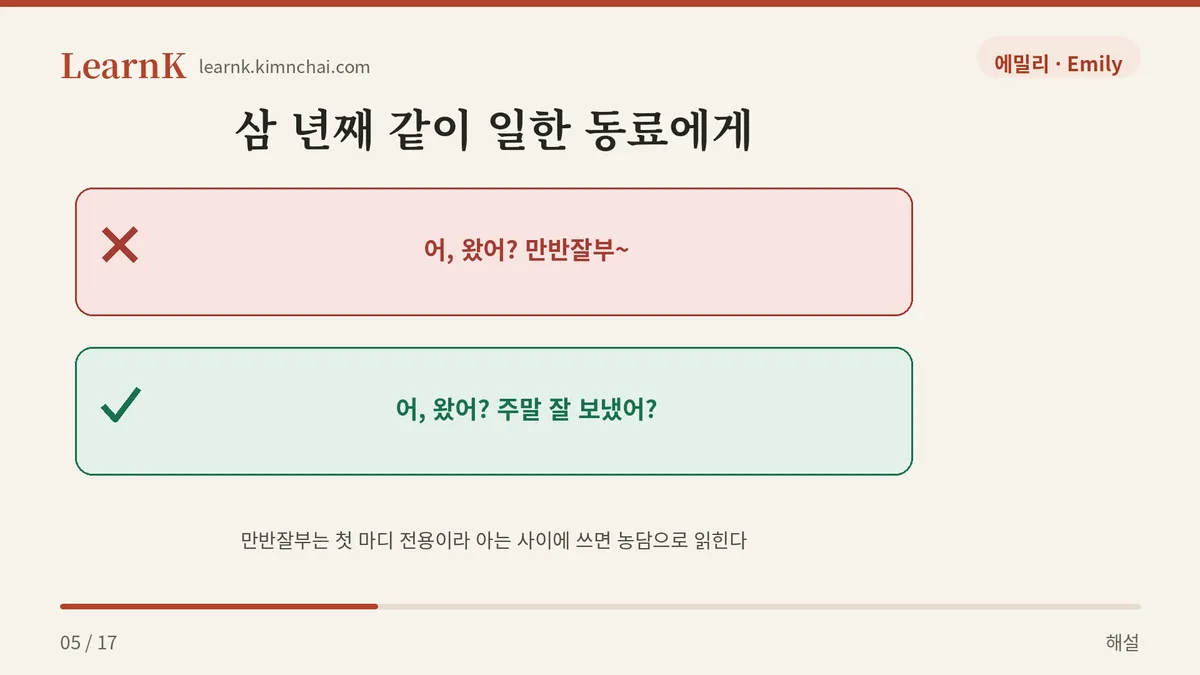
✗ (to a coworker of three years, Monday morning) 어, 왔어? 만반잘부~ (eo, wasseo? manbanjalbu~) ✓ (to a coworker of three years) 어, 왔어? 주말 잘 보냈어? (eo, wasseo? jumal jal bonaesseo?) → 만반잘부 belongs to the first line only. Use it with someone you already know and it’ll be taken as a joke — or you’ll get a “wait, have we not met?” back.
Example sentences by situation
1. In the chat window right before a match starts, with teammates you’ve just been paired with in an online game. You don’t know their faces, their voices, or their ages.
만반잘부! 저 힐러 볼게요. (manbanjalbu! jeo hilleo bolgeyo.)
The first half is casual slang, the second half is polite speech. It looks mismatched, but it’s an extremely common combination in anonymous spaces. That’s because 만반잘부 has hardened into a single chunk of a word, and the sense of it being casual speech has faded.
2. First week of March, introducing yourself in a university freshman department group chat.
안녕하세요, 신입생 최다인입니다! 만반잘부요~ (annyeonghaseyo, sinipsaeng Choe Da-in-imnida! manbanjalbuyo~)
The first sentence handles the politeness; the last four syllables loosen up the stiffness. Adding 요 on the end — 만반잘부요 (manbanjalbuyo) — is a touch softer, and it’s the common pick when there are probably people older than you mixed into the room.
3. First day at a new company, in a group chat with only the people who started the same day.
다들 반가워요, 저는 개발팀 배정받았어요. 만반잘부! (dadeul bangawoyo, jeoneun gaebalpim baejeongbadasseoyo. manbanjalbu!)
Even at the same company, you wouldn’t use it in the department group chat — the one your boss is in. A chat for same-year hires, where there’s no one above or below, is exactly where this expression sits most comfortably.
Similar expressions, formal and casual
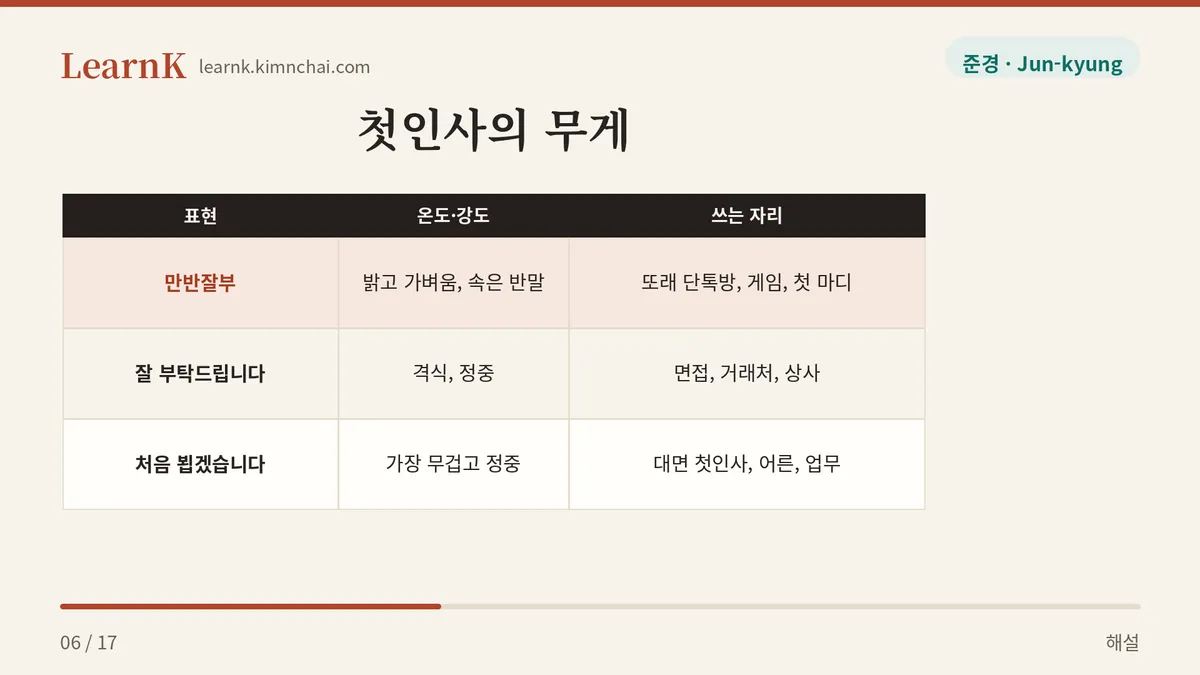
| Expression | Tone & intensity | Where it’s used |
|---|---|---|
| 만반잘부 (manbanjalbu) | Bright and light; casual speech underneath | Peers, anonymous group chats, gaming. First line only |
| 만반잘부요 (manbanjalbuyo) | Still light, but one notch lower | Open chats where you don’t know ages. A bit safer |
| 반가워 (bangawo) | Neutral, casual speech | With peers, anytime. Doesn’t have to be a first meeting |
| 잘 부탁드립니다 (jal butakdeurimnida) | Formal, polite | Interviews, clients, bosses, official documents |
| 처음 뵙겠습니다 (cheoeum boepgetseumnida) | The heaviest and most polite | First greeting in person, with elders or in business settings |
Read the table top to bottom and the rule appears. The further down you go, the more syllables there are — and the more syllables there are, the greater the distance between you and the other person. In Korean, length is the unit of politeness. The very fact that 만반잘부 is only four syllables is itself a signal: “we’re not the kind of people who need to stand on ceremony.”
Cultural background — the habit of clipping to four syllables
만반잘부 was made by peeling off the first syllable of each word and sticking them together. Words built with the same formula are everywhere. 생일 축하해 (“happy birthday”) becomes 생축 (saengchuk); 갑자기 분위기 싸해짐 (“the mood suddenly went cold”) becomes 갑분싸 (gapbunssa). Because one syllable is one written character in Korean, this kind of trimming works unusually well. Even when four words are cut down to four syllables, most people can still reconstruct the original.
But what’s more interesting than the trimming method is the original phrase being trimmed. Where an English first greeting ends at saying it’s nice to meet you, a Korean one almost always tacks on “잘 부탁해.” It’s a greeting that acknowledges up front that you’re going to be indebted to this person in some way. Underneath it lies the assumption that the relationship won’t end with a single meeting but will keep going. 만반잘부 carries that assumption intact — it just changed into lighter outerwear.
There’s a reason this expression took hold online in particular. To start a conversation in Korean, you need to know the other person’s age to choose between polite and casual speech — and in an anonymous chat room there’s no way to know. 만반잘부 acts as a cushion for getting through that awkward first moment. The form is casual, but it’s fused into a single greeting-chunk, so you can toss it out without checking anyone’s age and it won’t read as rude.
In dramas and variety shows, these four syllables also work as a device for telling you a character’s age. A newly joined younger character leaves a short greeting in the group chat, and an older character reading it squints at it for a long while, not knowing what it means — it’s a frequent way of showing a generation gap without a single line of explanatory dialogue.
Today’s quiz
Which of the following is the most appropriate place to use 만반잘부 (manbanjalbu)?
① In front of three interviewers at a job interview ② As a Monday morning greeting to a senior colleague you’ve been on the same team with for five years ③ As your first message in the open chat room of a club you’ve just joined ④ At a first meeting with a department head from a client company
Answer: ③
① and ④ are settings that call for formality, so you’d use “잘 부탁드립니다” or “처음 뵙겠습니다.” In ②, you already know each other, so there’s no room for an expression reserved for first greetings. A place like ③ — where everyone is meeting for the first time, nobody knows anyone’s age, and the mood is light — is 만반잘부’s home turf.