만찢남 (manjjinnam) — The Word You Reach For When a Face Looks Like It Tore Its Way Out of a Comic
만찢남 (manjjinnam)
만찢남 (manjjinnam) means a man so unrealistically good-looking that he seems to have torn his way out of a comic book. Korean has plenty of ways to compliment a man’s appearance, but 만찢남 sits on just about the top shelf. You reach for it when “handsome” isn’t enough — when you also want to add the feeling that this person’s face is bending the laws of physics just a little.
The situations that produce this word are surprisingly specific. In front of an idol’s birthday ad hanging in a subway transfer corridor. In the group chat on the day the casting for a webtoon-based drama gets announced. The moment you first spot the groom standing there in his tuxedo at a friend’s wedding. They all have something in common: the person in front of you looks like he was inside a drawing until one second ago.
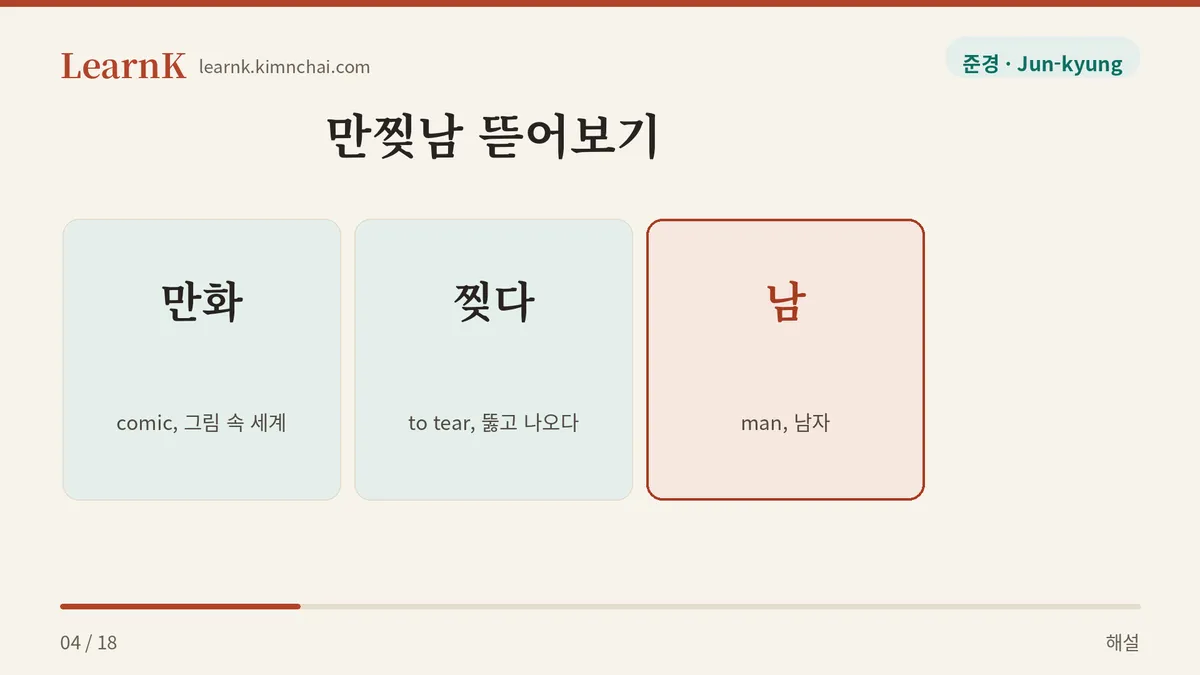
Take the word apart and the meaning is right there. 만화 (manhwa, “comic”) + 찢다 (jjitda, “to tear”) + 남 (nam, “man”). The picture is of a character who punched through a sheet of paper and walked out into three dimensions. That’s why the word carries more than simple attraction — there’s a flicker of surprise in it. If 예쁘다 (yeppeuda) and 멋있다 (meositda) are impressions, 만찢남 is closer to an exclamation. The counterpart used for women is 만찢녀 (manjjinnyeo).
There are three things about the nuance you absolutely have to catch.
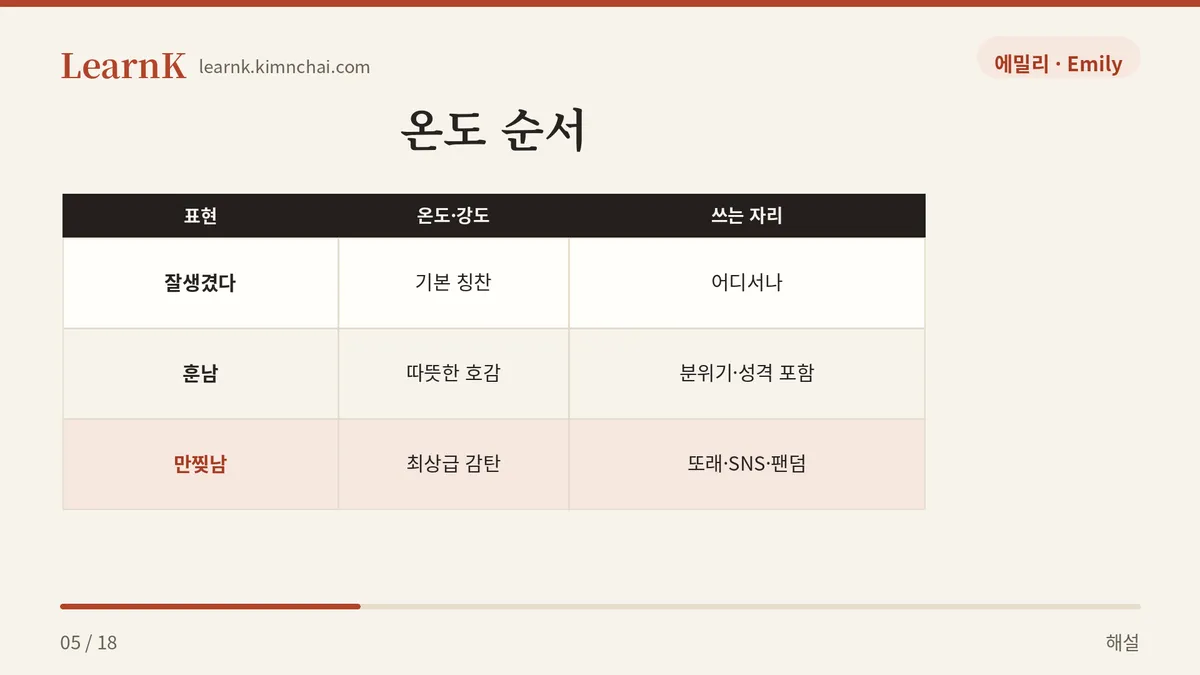
First, the intensity is superlative. Picture the temperature climbing in this order: 잘생겼다 (jalsaenggyeotda, “handsome”) → 훈남 (hunnam) → 만찢남 (manjjinnam). Because it’s the top of the scale, throwing it around cheapens it. Use it on a coworker who merely looks neat and put-together, and the listener will take it as a joke.
Second, it’s about looks only — and specifically about visual unreality. It carries no sense at all of a good personality or impressive ability. A lot of learners miss this part.
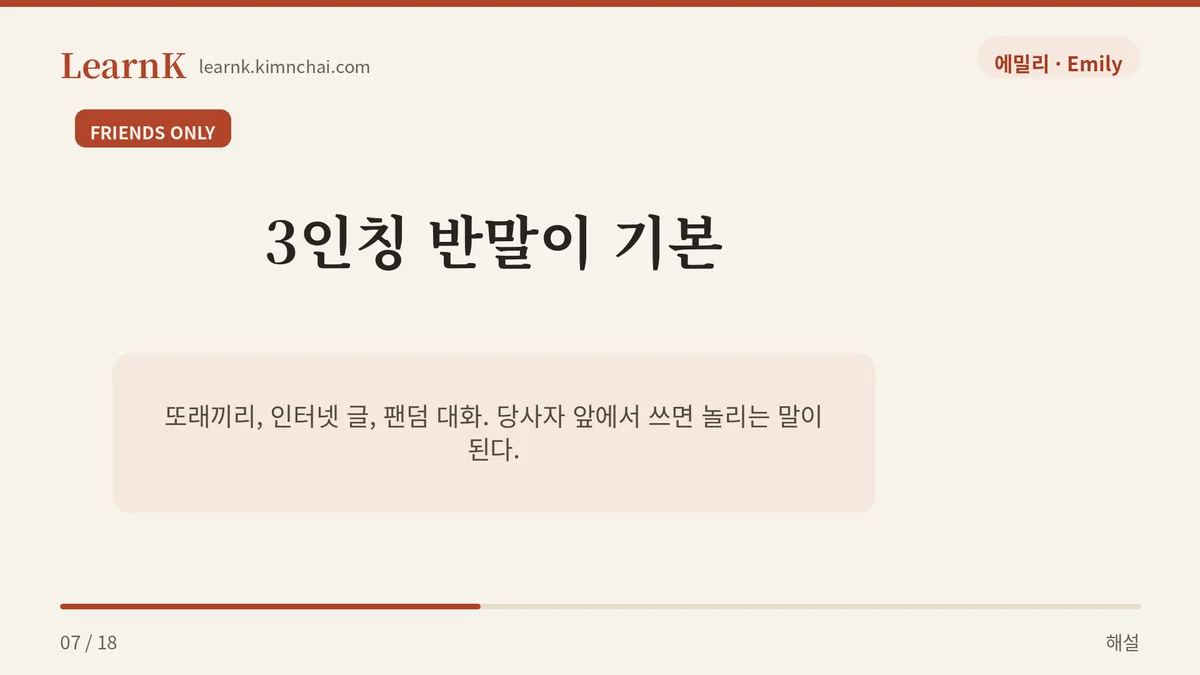
Third, it’s casual internet slang. Its home turf is 반말 (banmal, casual speech), online writing, and conversation between peers. And it’s almost always used in the third person. 저 사람 만찢남이야 (jeo saram manjjinnam-iya, “That guy is a 만찢남”) sounds perfectly natural, but say it straight to the person’s face and it comes off less as a compliment than as teasing.
A real conversation
Scene: A subway transfer corridor on the way home from work. A huge idol birthday ad covers the wall, and Emily suddenly stops walking.
Emily: 야, 잠깐만. 이거 실제 사람 맞아? 완전 만찢남인데. Hey, hold on. Is this an actual person? He’s a total “manjjinnam.”
Jun-kyung: 어, 나도 저번 주에 보고 좀 놀랐어. 얼굴에 그림자가 없잖아. Yeah, I was kind of shocked when I saw it last week too. There’s not a single shadow on his face.
Emily: 근데 이거 보정 다 한 거 아니야? But isn’t this all retouched?
Jun-kyung: 실물이 더 낫대. 우리 팀 후배가 팬사인회 갔다 왔는데, 진짜 만찢남이었다고 사흘 내내 그 얘기만 하더라. They say he looks even better in person. A junior on my team went to a fan signing and talked about nothing else for three days — said he really was a “manjjinnam.”
Emily: 아 부럽다. 근데 너는? 너도 대학교 때 만찢남 소리 들어 봤어? Aw, I’m jealous. What about you? Did anyone ever call you a “manjjinnam” back in college?
Jun-kyung: …야, 환승 놓치겠다. 빨리 가. …Hey, we’re gonna miss our transfer. Move.
Using it this way sounds off
✗ (to a manager at a client company) 부장님, 오늘 정장 입으시니까 완전 만찢남이세요. Sir, in that suit today you’re a total 만찢남. ✓ (to a friend) 야, 너 오늘 정장 입으니까 완전 만찢남인데? Hey, in that suit today you’re a total 만찢남! → It’s internet slang, and on top of that it passes judgment on someone’s appearance, so using it with a person senior to you sounds flippant and rude. With a superior, 오늘 정말 멋지십니다 (oneul jeongmal meotjisimnida, “You look really sharp today”) is the safe choice.
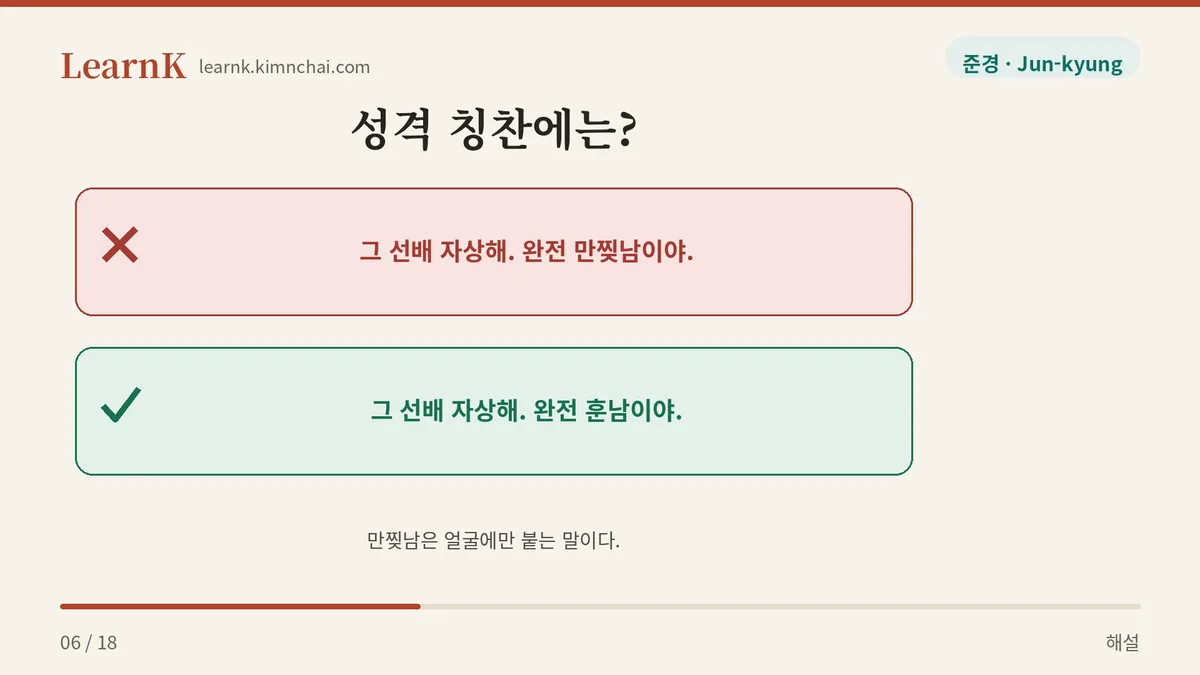
✗ 그 선배 진짜 자상하고 배려심 많아. 완전 만찢남이야. That 선배 is so kind and considerate. He’s a total 만찢남. ✓ 그 선배 진짜 자상하고 배려심 많아. 완전 훈남이야. That 선배 is so kind and considerate. He’s a total 훈남. → 만찢남 attaches to a face and nothing else. For warmth that includes personality and character, use 훈남 (hunnam). Use 만찢남 to praise someone’s personality and the listener will pause for a second, unsure what you meant.
Example sentences by situation
1) In the group chat, on the day the casting for a webtoon-based drama is announced
이번 캐스팅 진짜 잘했다. 원작 그림이 그대로 걸어 나왔어. 완전 만찢남이야. (ibeon kaeseuting jinjja jal haetda. wonjak geurimi geudaero georeo nawasseo. wanjeon manjjinnam-iya.) They nailed the casting this time. The original artwork just walked right off the page. He’s a total 만찢남. → This is where 만찢남 is most at home. You’re literally holding the comic character and the actor side by side, so “he tore his way out of a comic” stops being a metaphor and becomes almost a description.
2) At a friend’s wedding, outside the bride’s waiting room
신랑 오늘 왜 저래? 평소엔 안 그러더니 오늘은 진짜 만찢남 됐네. (sillang oneul wae jeorae? pyeongsoen an geureoteoni oneureun jinjja manjjinnam dwaenne.) What’s up with the groom today? He never looks like that normally, but today he’s turned into a real 만찢남. → There’s laughter mixed into this one. These are people who know exactly what he looks like on a normal day, so it’s a teasing sort of compliment about how unusually good he looks for this one day. The ending 됐네 (dwaenne) is what creates that temperature.
3) The day after a concert, a junior speaking to a senior colleague
저 어제 실물 처음 봤는데요, 사진이 오히려 손해예요. 진짜 만찢남이었어요. (jeo eoje silmul cheoeum bwanneundeyo, sajini ohiryeo sonhaeyeyo. jinjja manjjinnam-ieosseoyo.) I saw him in person for the first time yesterday, and honestly the photos don’t do him justice. He really was a 만찢남. → The endings are polite, but the listener is a senior the speaker is comfortable with. This is just about the only place 만찢남 works in 존댓말 (jondaenmal, polite speech). In settings that call for real formality, it still doesn’t belong.
Polite vs. casual speech, and similar expressions
만찢남 is a noun, so grammatically you can attach honorific endings to it — 만찢남이세요 (manjjinnam-iseyo), 만찢남이시더라고요 (manjjinnam-isideoragoyo). But raising the ending doesn’t make the word itself formal. It’s closer to wearing a necktie with jeans. With someone senior to you, it’s better to switch to a sentence like 오늘 정말 멋지십니다 (oneul jeongmal meotjisimnida, “You look really sharp today”) or 화면발 정말 잘 받으시네요 (hwamyeonbal jeongmal jal badeusineyo, “You photograph really well”).
Line it up against its neighbors and its place gets clearer.
| Expression | Temperature / intensity | Where it fits |
|---|---|---|
| 만찢남 (manjjinnam) | Superlative. Closer to an exclamation than a compliment | Peers, social media, fandom. Third person by default. Not used with seniors |
| 훈남 (hunnam) | Warm, comfortable attraction | Covers atmosphere and personality along with looks. Fine in any everyday conversation |
| 조각미남 (jogangminam) | Strong, but a little stiff | For sharply defined features. Also shows up in articles and profile blurbs |
| 얼굴 천재 (eolgul cheonjae) | Superlative. Fandom register | Inside idol fan communities. Less common in everyday conversation |
The same face can call for a different word. For someone who’s handsome in an easygoing way, 훈남; for someone whose features are cut like sculpture, 조각미남; and when the gap between the photos and the real thing is visually overwhelming to the point of disbelief, out comes 만찢남.
Cultural background — the man who tore his way out of a comic
The word-building is transparent: 만화 (comic) + 찢다 (to tear) + 남 (man). But why comics, of all things? Handsome characters in Korean comics and webtoons come with a long-standing set of drawing conventions: proportions taller than eight heads, a jawline that drops away sharply, skin with almost no texture and almost no shadow. The things a real human face always has are exactly what the drawing lacks. So when that absence shows up in real life, people have no choice but to say that person came out of the paper.
Part of what spread this word is the wave of webtoon-based dramas since the 2010s. When you adapt a work whose artwork already exists, viewers automatically overlay the two faces. Every casting announcement sets off talk of 원작 싱크로율 (wonjak singkeuroyul, “synchronization rate with the original”), and at the far end of that comparison sits 만찢남, the highest score available. It’s the same reason webtoon-based dramas put such unusual care into filming the lead’s first appearance. That single shot, the crossing from drawing to human being, decides the audience’s first impression of the whole show.
Subway ad culture is another place this expression lives. In Korea, fans pool their money to put up huge ads in subway stations celebrating an idol’s birthday. Photos taller than a person fill the corridor walls, and tens of thousands of people walk past them every day. That’s exactly where the two people in the conversation above were standing. 만찢남 is spoken most often right there — in front of a wall in the city, in the moment a person’s footsteps briefly stop.
One thing to add: compliments about appearance are common in Korean, but common doesn’t mean you can use them anywhere. With 만찢남, the bigger the wonder, the closer the relationship needs to be. The size of the exclamation and the distance of the relationship move in opposite directions — and that’s the single most important instinct for handling this expression.
Today’s quiz
Which of the following uses 만찢남 (manjjinnam) most naturally?
① 우리 팀장님, 보고서 정리를 진짜 만찢남처럼 하셨어. Our team lead put that report together like a real 만찢남. ② 저 배우 어제 실물로 봤는데 진짜 만찢남이더라. I saw that actor in person yesterday and he really was a 만찢남. ③ 그 사람은 성격이 정말 만찢남이야. His personality is a real 만찢남. ④ (to a professor you’re meeting for the first time) 교수님, 오늘 만찢남이세요. Professor, you’re a 만찢남 today.
Answer: ②
① applies it to job performance and ③ to personality, so both are wrong. 만찢남 attaches only to visible appearance. ④ has the meaning right but the setting wrong — using slang to assess the looks of a senior person you’re meeting for the first time sounds rude. ② is a moment of genuine surprise at seeing someone in the flesh, in third-person casual speech, and it’s an exclamation about something visual. That’s the seat where this expression sits most comfortably.