멘탈 잡다 (mental japda) — Taking Hold of a Mind That's Come Undone
멘탈 잡다
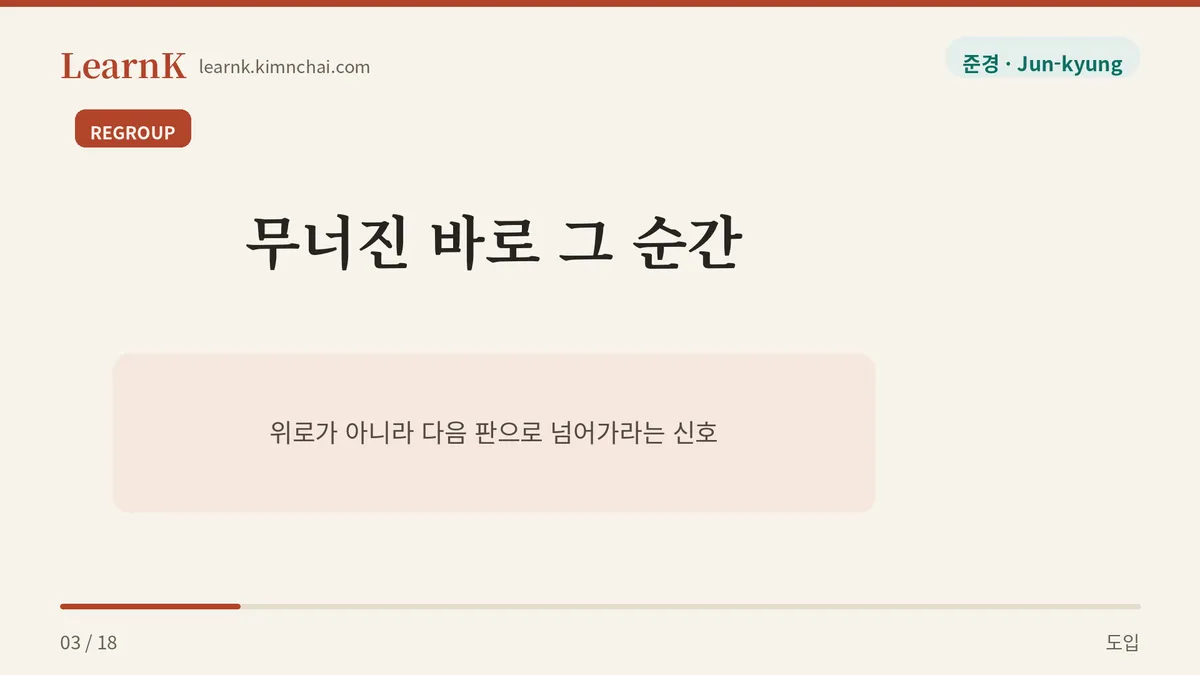
멘탈 잡다 (mental japda) means to take hold of a mind badly shaken by a shock or a mistake and pull it back into place. The moment you bomb the first period of an exam and slump down in the hallway, the moment your words tangle mid-presentation and your head goes blank, the moment you lose three games in a row — that is exactly when Koreans say this to themselves, or to the person next to them. It is less a comfort than a signal to regroup.
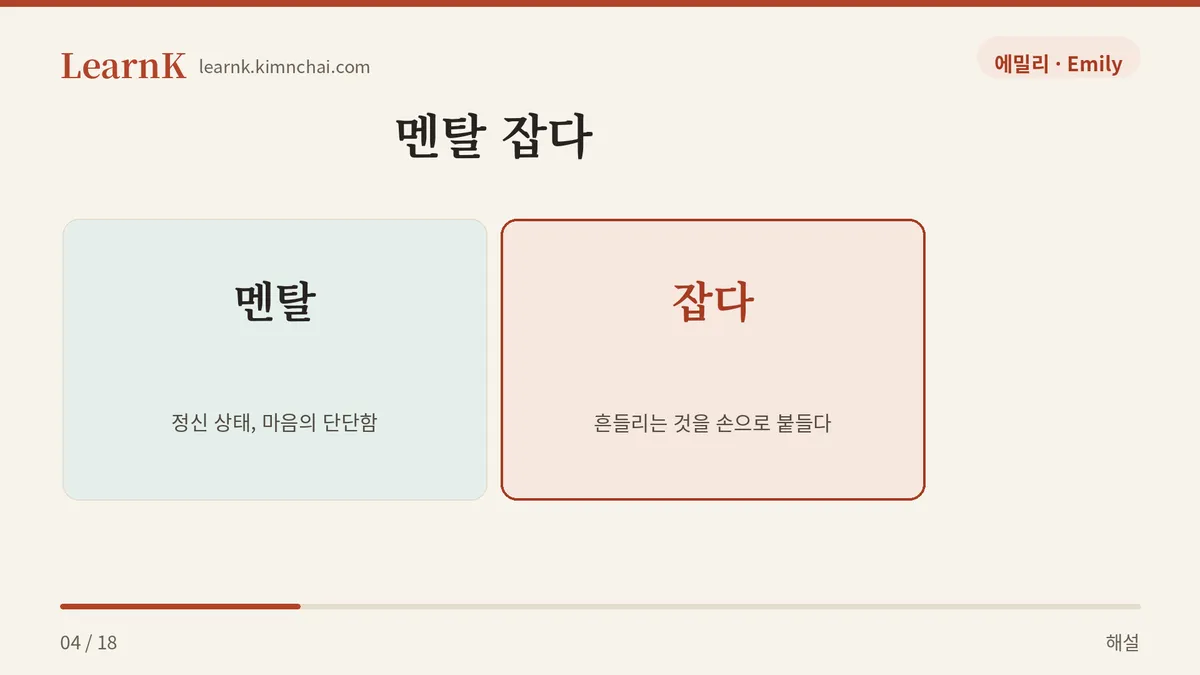
There’s a reason you rarely meet this expression in Korean textbooks. The two words have fused into something like a single idiom, and looking each one up separately doesn’t add up to the meaning. 멘탈 (mental) came in from English, but inside Korean it settled in as a noun rather than an adjective, pointing to “one’s mental state, the sturdiness of one’s mind.” 잡다 (japda) starts from “to hold in your hand” and stretches all the way to “to steady something that’s shaking.” It’s the same 잡다 as in 중심 잡다 (jungsim japda), “to find your center,” and 자리 잡다 (jari japda), “to settle into place.” Put the two together and you get a picture of gripping a scattering mind tight in your hand. Korean idioms often handle abstract things this way — as objects you can hold.
There are three things about the nuance worth remembering.
First, it comes with an assumption. This phrase rests on the judgment that the other person has already fallen apart, or is falling apart right now. Say 멘탈 잡아 (mental jaba) to someone who is calm and doing fine, and it turns into a remark that they’re wobbling.
Second, the warmth is high but the formality is low. It really is a word of encouragement, but it’s spoken language used strictly among peers. It doesn’t suit writing or formal occasions.
Third, a very large share of its use is on yourself. The forms you hear most often in real Korean conversation are the ones you say under your breath: 멘탈 잡자 (mental japja) and 멘탈 잡아야지 (mental jabayaji). It’s closer to a spell you cast on yourself in front of a mirror, in a bathroom, in a waiting room.
See It in a Real Conversation
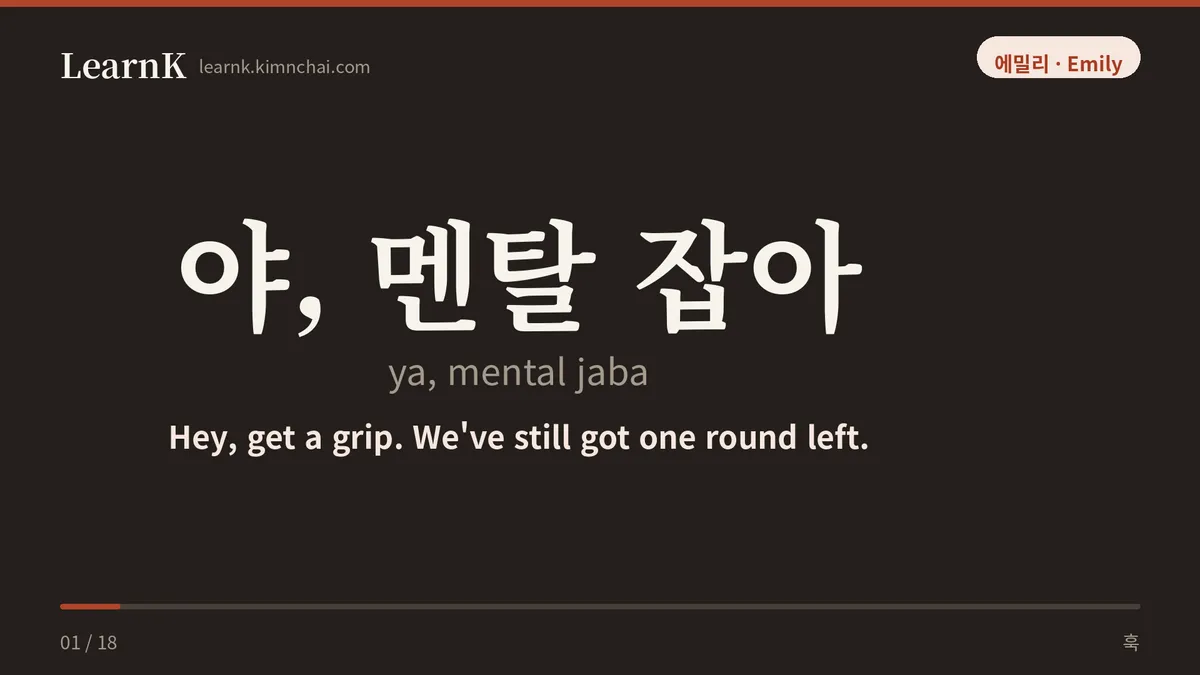
Situation: A PC bang on a Friday night. The two of them are teamed up in a versus game and have lost three rounds in a row. Jun-kyung lets go of the mouse and sinks into his chair.
Jun-kyung: 아 진짜… 마지막 판은 다 이겨 놓고 놓친 거잖아. Ugh, seriously… we had that last round won and threw it away.
Emily: 야, 멘탈 잡아. 아직 한 판 남았어. Hey, get a grip. We’ve still got one round left.
Jun-kyung: 멘탈은 무슨. 이미 나갔어, 손까지 떨려. Grip, my foot. It’s already gone — my hands are shaking.
Emily: 물 한 모금 마시고 삼십 초만 쉬자. 이거 너한테 배운 거야. Drink some water and rest thirty seconds. I learned this from you, you know.
Jun-kyung: 내가 뭘 가르쳤는데? What did I teach you?
Emily: 지고 있을 때일수록 멘탈 잡는 사람이 이긴다며. 자, 한 판만 더. You said the further behind you are, the more it’s the one who keeps it together who wins. Come on, one more round.
When It Sounds Off
✗ (To the chief mourner at a funeral) 너무 상심하지 마시고 멘탈 잡으세요 (mental jabeuseyo). “Don’t grieve too much — get a grip.” ✓ (To the chief mourner at a funeral) 얼마나 상심이 크십니까. 부디 기운 내십시오 (giun naesipsio). “How great your grief must be. Please, take heart.” → 멘탈 잡다 tells someone to pull themselves together quickly and move on to the next round. Used in a place where grief has to be lived through fully, it sounds like you’re treating that grief lightly.
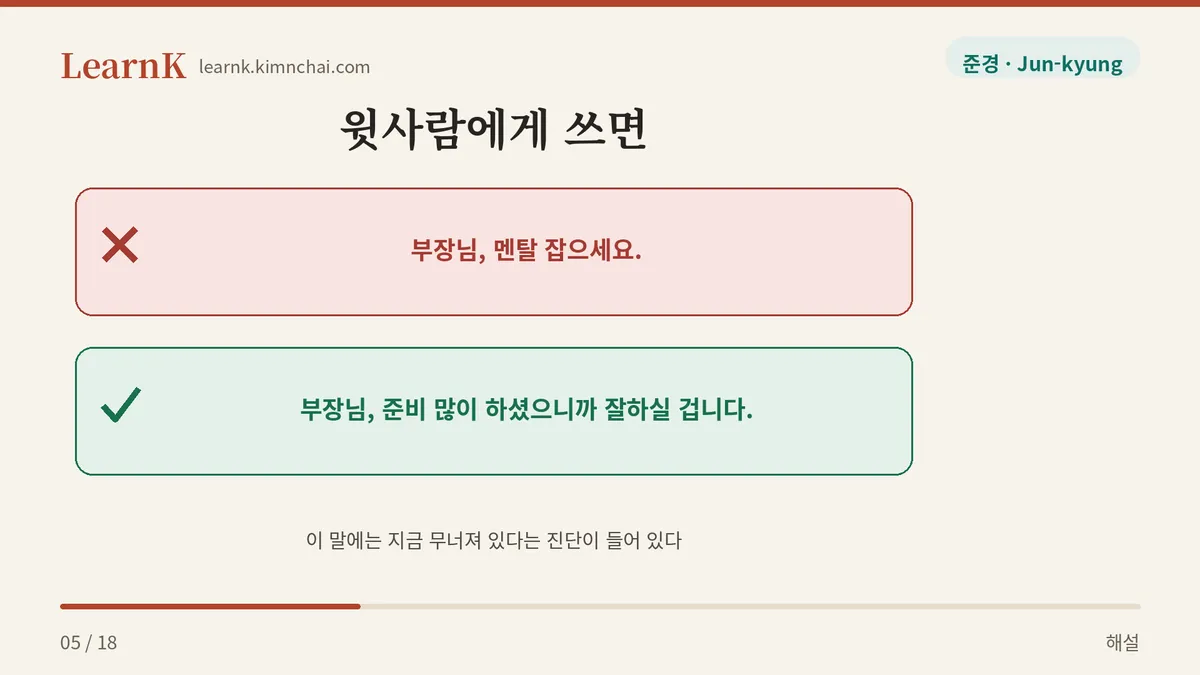
✗ (To your department head, nervous before a presentation) 부장님, 멘탈 잡으세요 (mental jabeuseyo). “Sir, get a grip.” ✓ (To your department head, nervous before a presentation) 부장님, 준비 많이 하셨으니까 잘하실 겁니다. “Sir, you’ve prepared so much — you’ll do great.” → The grammar is fine, but the setting is wrong. This phrase carries a diagnosis — “you are falling apart right now” — so using it with someone senior turns into judging their condition from below. With a senior, the safe move is not to comment on their state but to be optimistic about the outcome.
Example Sentences by Situation
1. In the bathroom off an interview waiting room, muttering to yourself in the mirror
You watched the applicant ahead of you come out, and the look on their face was grim. Suddenly your heart is pounding. This is the sentence Koreans most commonly mutter at the mirror in a moment like this.
괜찮아, 멘탈 잡자. 십 분이면 끝나. (gwaenchana, mental japja. sip-bun-imyeon kkeutna.) It’s okay, let’s get a grip. Ten minutes and it’s over.
2. When the slides won’t advance mid-presentation, from the colleague beside you, quietly
The slide has frozen and the presenter is standing stiff with the mic in hand. Here’s the one line a colleague tosses out in a low voice while flipping through the handouts.
멘탈 잡고 그냥 말로 해. 내용은 네 머릿속에 다 있잖아. (mental japgo geunyang mallo hae. naeyongeun ne meoritsoge da itjana.) Get a grip and just say it out loud. The content is all in your head anyway.
3. After dropping the first set of a match, a coach to the players
The score gap has opened up and the players’ shoulders are down. This is the scene where the coach brings up the mind before the technique.
지금부터는 실력 싸움이 아니야. 멘탈 잡는 쪽이 이겨. (jigeumbuteoneun sillyeok ssaumi aniya. mental jamneun jjogi igyeo.) From here on it’s not a contest of skill. Whichever side holds it together wins.
Polite and Casual Forms, and Similar Expressions
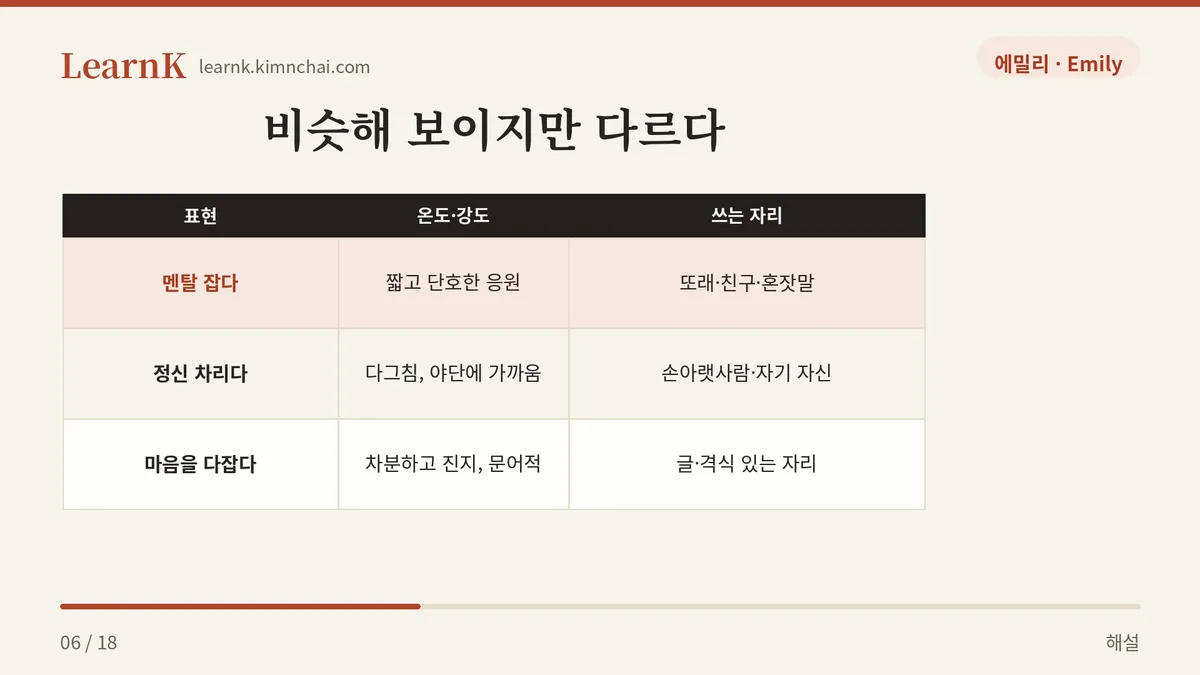
In casual speech you use 멘탈 잡아 (mental jaba), and when you’re steadying yourselves together, 멘탈 잡자 (mental japja). The polite form 멘탈 잡으세요 (mental jabeuseyo) can be built grammatically, but the places it actually gets used are narrow — with an acquaintance close to your own age with whom you happen to use polite speech, or when your role is clearly to look after the other person’s condition, like a coach with a player. With someone older or senior, you’re better off switching to the expressions further down the table below.
| Expression | Warmth & intensity | Where it’s used |
|---|---|---|
| 멘탈 잡다 (mental japda) | Short, firm encouragement. Low formality | Peers, friends, juniors. Talking to yourself. Avoided with seniors |
| 정신 차리다 (jeongsin charida) | A hard push; can edge into scolding | Juniors or yourself. Absolutely off-limits with seniors |
| 마음을 다잡다 (maeumeul dajapda) | Calm and earnest. Literary | Writing, formal settings. Safe anywhere |
| 침착하다 (chimchakhada) | Neutral, no emotion | Anywhere. Safe with seniors too |
| 멘탈 나가다 (mental nagada) | The fallen-apart state itself | Peers, social media. The flip side of 멘탈 잡다 |
One thing to add: 멘탈 잡다 and 정신 차리다 look the most alike on the surface, but they point in different directions. 멘탈 잡다 stands on your side — “I know it’s hard; let’s hold on anyway.” 정신 차리다 easily picks up a reproach — “you’re doing this wrong right now.” If a friend has made a mistake and is beating themselves up, telling them 정신 차려 will sting; telling them 멘탈 잡아 feels like a hand clapped on the shoulder from someone in your corner.
Cultural Background — 유리 멘탈 (yuri mental) and 강철 멘탈 (gangcheol mental)
멘탈 is English mental brought in and newly set as a noun inside Korean. That’s why it sounds odd to English-speaking learners at first: in English it’s an adjective, but in Korean it’s treated like something you can possess, as in 나는 멘탈이 약해 (naneun mental-i yakhae), “my mental is weak.” Once it became a noun, words started attaching on both sides. Someone who breaks easily is 유리 멘탈 (yuri mental), a “glass mental”; someone who barely wavers is 강철 멘탈 (gangcheol mental), a “steel mental.” The collapsed state is 멘탈 붕괴 (mental bunggoe), “mental collapse,” shortened to 멘붕 (menbung). These spread widely in the 2010s through the internet and game broadcasts, and now they show up routinely in news captions and variety-show subtitles.
There seems to be a reason this family of words took hold so quickly. Korea has a lot of occasions where the result is decided in one shot: the 수능 (suneung) college entrance exam, open-recruitment interviews, licensing practicals, auditions, pro matches. In those settings there’s a strong sense that your state of mind that day splits the result as much as your ability does. It’s also why athletes and idols keep giving the same answer in interviews — 멘탈 관리가 제일 어려웠다 (mental gwalliga jeil eoryeowotda), “managing my mental was the hardest part.” Skill you stack up through practice, but 멘탈 is treated as something you have to hold on to — something you have to grip fresh in your hand every single time.
The phrase turns up often in Korean dramas, too. Especially in school stories and sports stories, there’s a recurring scene where the lead makes a decisive mistake and falls apart, and a teammate or coach comes over, pats their shoulder, and sets them back on their feet. The lines exchanged here aren’t long. Usually it’s tossed out once, briefly; the other person catches their breath; and they go back to their place. Scenes like this show clearly how 멘탈 잡다 is a signal to regroup rather than a comfort. Long comfort loosens the heart; this phrase tightens it back up.
So timing matters with this expression. If the other person is still pouring their feelings out, you have to listen first. Once they’ve let enough out and the moment comes to move on to what’s next — that’s when tossing it out once, briefly, is where this phrase works best.
Today’s Quiz
Your friend bombed the first period of an important exam and is slumped in the hallway. There are 10 minutes until the second period starts. What’s the most natural thing to say?
- 멘탈 나갔네. (Your mental’s gone.)
- 멘탈 잡아, 아직 2교시 남았어. (Get a grip — you’ve still got the second period.)
- 멘탈 잡으세요. (Please get a grip. — polite form)
- 마음을 다잡으시기 바랍니다. (You are kindly requested to steady your mind.)
Answer: 2
Number 1 only confirms the state as it is; it doesn’t set anyone back on their feet. Number 3 drops sudden polite speech between friends and creates distance. Number 4 has the right meaning, but it’s literary — it sounds like a public announcement, far too stiff to say beside a friend slumped in a hallway. Tossing out something short and casual like number 2, then immediately attaching the chance that’s still left, is the most typical use of this expression.