미쳤다 (michyeotda) — How a Word That Used to Be an Insult Became the Highest Compliment

미쳤다
미쳤다 (michyeotda) means that the degree of something has crossed the line of common sense. Literally it says a person’s mind isn’t sound, but the 미쳤다 that Koreans blurt out several times a day is usually amazement. In front of a price tag at the market, walking out of a concert hall, the instant you open the front door at noon in midsummer — three syllables come flying out. “미쳤다.”
The heart of this word isn’t direction, it’s size. 미쳤다 by itself holds neither “good” nor “bad” — only “this is outside the normal range.” That’s why the same three syllables can be the highest compliment or the harshest complaint. Say 미쳤다 about a performance and it means “unbelievably good”; say it about the price of a watermelon and it means “unbelievably expensive.” The situation decides the direction; the speaker only supplies the size. So for learners, the hard part of this expression isn’t the meaning — it’s knowing where it belongs.
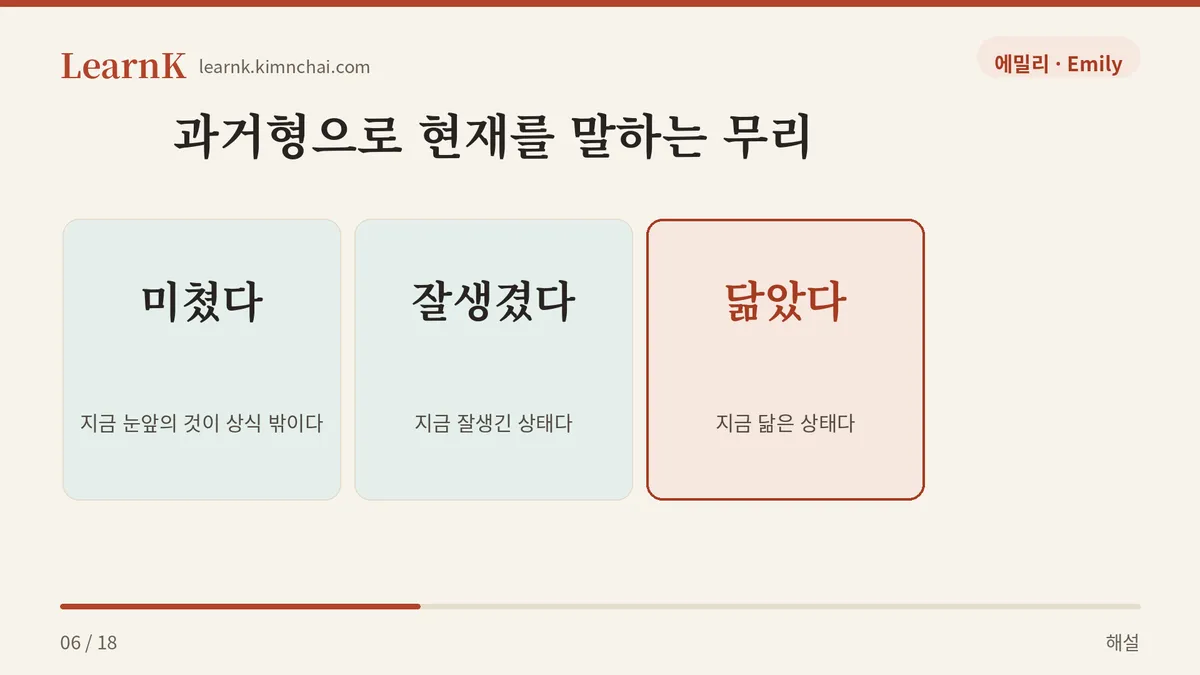
There’s one grammatical snag. 미쳤다 is past tense in form but present in meaning. It isn’t saying something went crazy yesterday; it’s saying the thing in front of you right now is crazy. Korean has a few more words like this — 잘생겼다 (jalsaenggyeotda), 늙었다 (neulgeotda), 닮았다 (dalmatda). All of them wear past-tense clothing while pointing at a present state. 미쳤다 belongs to that same group. That’s why “이 노래 미쳐요” sounds completely off, while “이 노래 미쳤어요” at least makes sense.
It’s worth learning the inflected forms together too. For talking to yourself or speaking casually, use 미쳤다 / 미쳤어 / 미쳤네 (michyeotda / michyeosseo / michyeonne); placed before a noun it becomes 미친 (michin) — 미친 가격 (michin gagyeok, a ridiculous price), 미친 맛 (michin mat, an incredible taste). When you want to say it even harder, people attach 개- (gae-) in front and say 개미쳤다 (gaemichyeotda), but that one counts as pretty rough even between friends the same age.
A Real Conversation
Scene: An afternoon in August, the fruit section of a neighborhood market. They’ve just looked at the price tag on the watermelon.
Jun-kyung: 야, 이거 봐. 수박 한 통에 사만 원이래. Hey, look at this. Forty thousand won for one watermelon.
Emily: 헐, 미쳤다 진짜. 작년엔 반값이었잖아. Whoa, that’s insane. It was half that last year.
Jun-kyung: 그니까. 그냥 복숭아나 사자. Right? Let’s just get peaches instead.
Emily: 아 맞다, 저기 시식하는 거 먹어 봤어? 그 복숭아 진짜 미쳤어. 향이 확 올라와. Oh right, did you try the sample over there? That peach is insane. The smell just hits you.
Jun-kyung: 그렇게 맛있어? 그럼 두 박스 사 가자. That good? Then let’s grab two boxes.
Emily: 두 박스는 미쳤고, 한 박스만. Two boxes is crazy — just one.
Take a close look at that last line. Emily used the same word all three times, but the temperature is different every time. The first is a complaint that something is expensive, the second is a compliment about how good it tastes, and the third is a light tap on the brakes — “okay, that’s a bit much.” Korean speakers don’t learn these three separately. The situation decides the direction for them.
Where It Sounds Off
✗ (Reporting to an executive) 이사님, 이번 분기 매출 미쳤습니다. ✓ (To a coworker) 야, 이번 분기 매출 미쳤다. → 미쳤다 isn’t a word you can bring into a formal setting. Attaching “-습니다” doesn’t make it polite; if anything, it gives the impression of clothes that don’t fit. In public or professional settings, state it as fact instead: “기대 이상입니다” (it’s beyond expectations), “역대 최고치입니다” (it’s an all-time high).
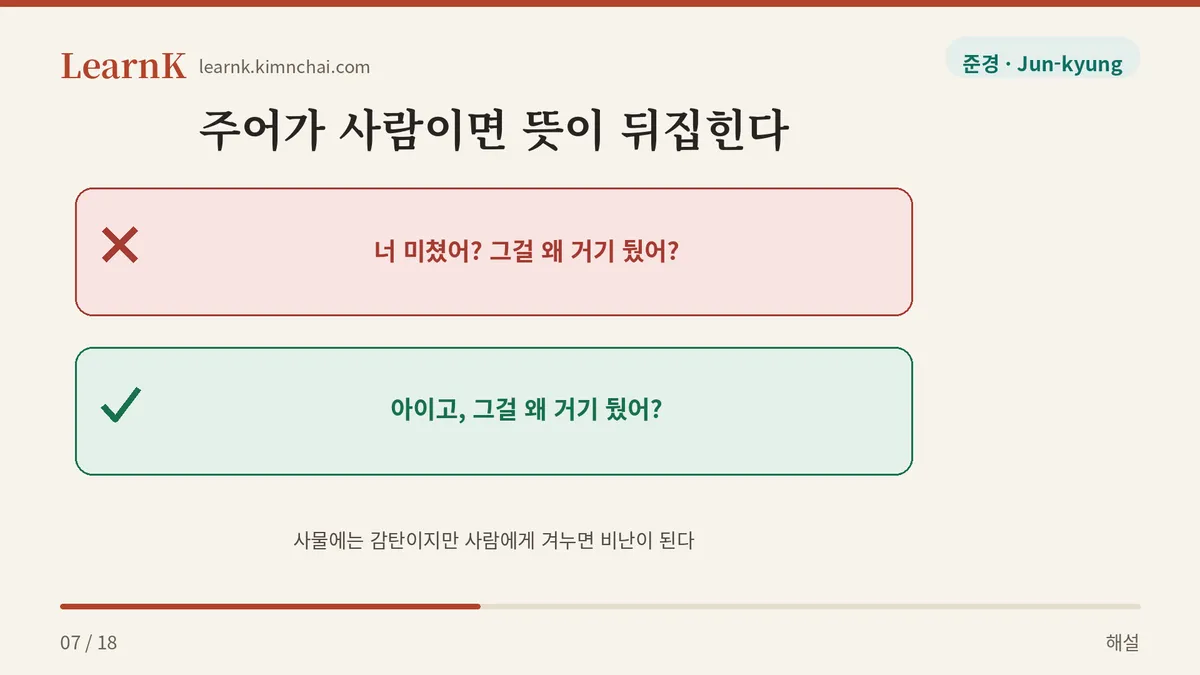
✗ (To a friend who just dropped something) 너 미쳤어? 그걸 왜 거기 뒀어? ✓ (To a friend who just dropped something) 아이고, 그걸 왜 거기 뒀어? → When the subject is a thing, it’s admiration; when the subject is a person, it’s an accusation. “너 미쳤어?” will turn into a real fight unless you’re close enough that the joke is guaranteed to land. If you want it to read as awe, it’s safer to keep the subject as something other than a person.
Example Sentences by Situation
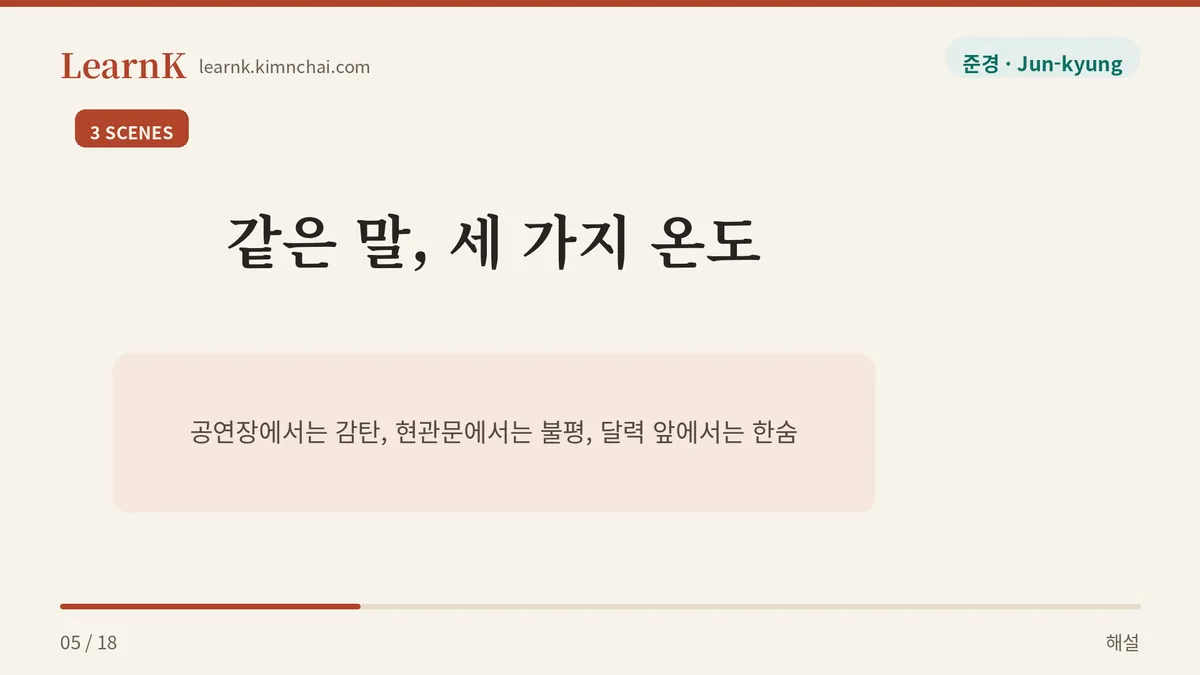
1. Walking out of a venue — as the highest compliment When it was far better than you expected. This is a moment where a long sentence actually dilutes the sincerity, so keeping it short feels most natural. 오늘 마지막 곡 진짜 미쳤다. 나 소름 돋았어. (oneul majimak gok jinjja michyeotda. na soreum dodwasseo.) The last song tonight was insane. I got goosebumps.
2. The moment you open the front door — as a complaint A midsummer afternoon, muttered to yourself as you come back in from outside. Nobody needs to be listening. 밖에 나가지 마. 오늘 더위 미쳤어. (bakke nagaji ma. oneul deowi michyeosseo.) Don’t go outside. The heat today is insane.
3. Looking at the calendar — when it’s more than you can handle When your schedule has gone past what you can manage. This 미쳤다 isn’t a compliment; it’s closer to a sigh. 이번 주 스케줄 미쳤다. 하루에 회의가 다섯 개야. (ibeon ju seukejul michyeotda. haru-e hoeuiga daseot gaeya.) My schedule this week is insane. Five meetings in one day.
Politeness Levels and Similar Expressions
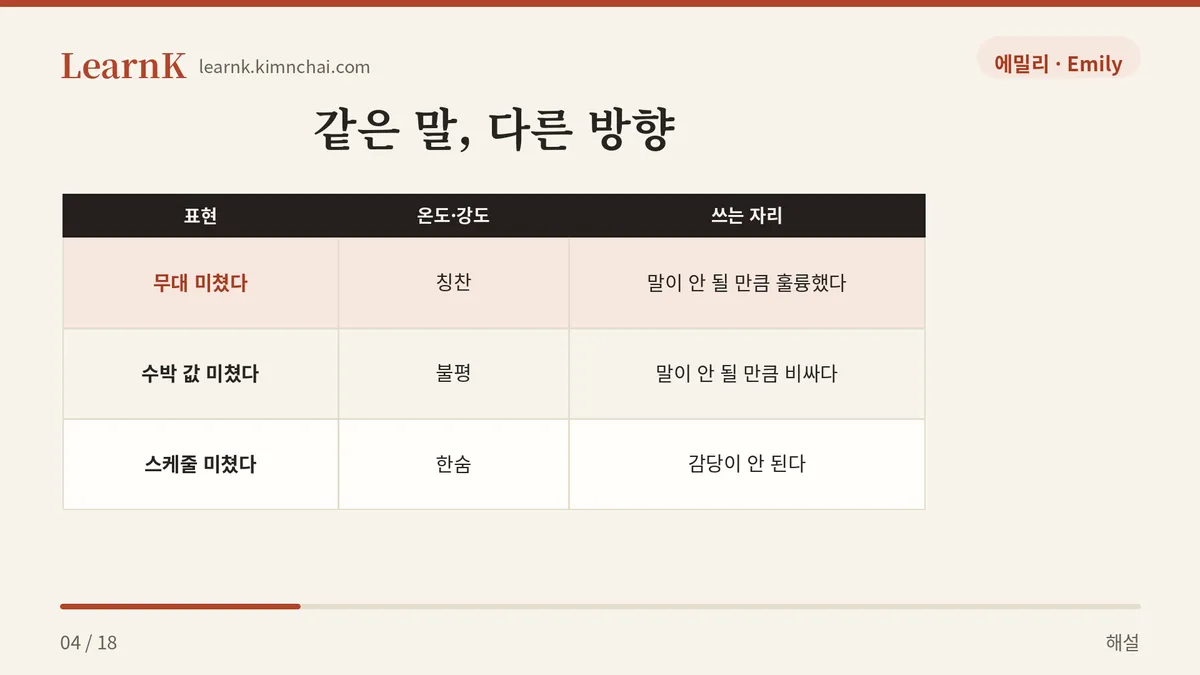
미쳤다 has essentially no usable polite form. “미쳤어요” isn’t grammatically impossible, but used in front of someone older or senior it feels like the words are spinning in place. When you need to deliver strong admiration politely, the standard move is to switch to another cell in the table below.
| Expression | Temperature & intensity | Where it fits |
|---|---|---|
| 미쳤다 (michyeotda) | Top of the scale. Blunt and rough | Peers, talking to yourself, social media. Not for formal settings |
| 대박 (daebak) | Strong, but bright and harmless | Peers, light exclamations. Be careful with seniors |
| 장난 아니다 (jangnan anida) | Strong and neutral | Works in polite speech too — “장난 아니에요” |
| 굉장하다 (goengjanghada) | Neutral and calm | Anywhere. Fine with seniors and in official settings |
To sum up: 미쳤다 with friends, 장난 아니에요 with people you’re not yet close to, 굉장합니다 in the meeting room. The meanings are similar, but the seats they’re allowed to sit in are different.
Cultural Background — From Insult to Exclamation

The root of 미쳤다 is the verb 미치다 (michida): to lose one’s sanity, and also to be completely absorbed in something — as in “그 사람 축구에 미쳤어” (he’s crazy about soccer), pointing at total immersion. Today’s 미쳤다, used as an exclamation, sits close to where those two branches meet. It’s outside the normal range, and at the same time it pulls you in.
The word tilted heavily toward the complimentary side along with the internet. In the comments under music-show stage videos and idol fancams, 미쳤다 hardened into just about the top grade of praise, and now it shows up the same way under food photos, game highlights, and sale price tags. As people kept raising the intensity of their exclamations, they ended up reaching for a word that was originally negative — and this direction of change is hardly unique to Korean.
You’ll hear it often in dramas, too. But it tends not to be a line that drifts by like background music; it bursts out when a character is hit head-on by someone else’s decision. In front of a friend announcing they’re quitting a perfectly good job, or the moment they’re handed a contract with absurd terms — one short line. That’s why English subtitles render it as both “Are you out of your mind?” and “That’s insane!” Same three syllables, opposite directions — which makes it a word translators always double-check against the surrounding context.
One last thing. 미치다 was also a word used for actual mental illness. The 미쳤다 used as an exclamation and the “미친 사람” aimed at a person carry completely different weight, and the latter is considered discriminatory in Korea today as well. Use it freely for things and situations, but never point it at a person — keep that one rule and you’ll almost never go wrong.
Today’s Quiz
Which of the following is the most inappropriate place to use 미쳤다?
① Praising the stage you just saw as you walk out of a concert with a friend ② Reporting to an executive in a meeting that this quarter’s revenue was good ③ Muttering to yourself as you come back inside after being out in a heat wave
Answer: ②
① and ③ are where 미쳤다 fits best — with peers, and talking to yourself. But ② is a public setting that calls for formality. There you’d say “이번 분기 매출이 기대 이상입니다” (this quarter’s revenue is beyond expectations) or “역대 최고치를 기록했습니다” (we recorded an all-time high). Remember: 미쳤다 isn’t a word whose meaning is rude — it’s a word that picks its seat.