밀키트 (milkiteu) — A Whole Dinner Packed Into One Box

밀키트
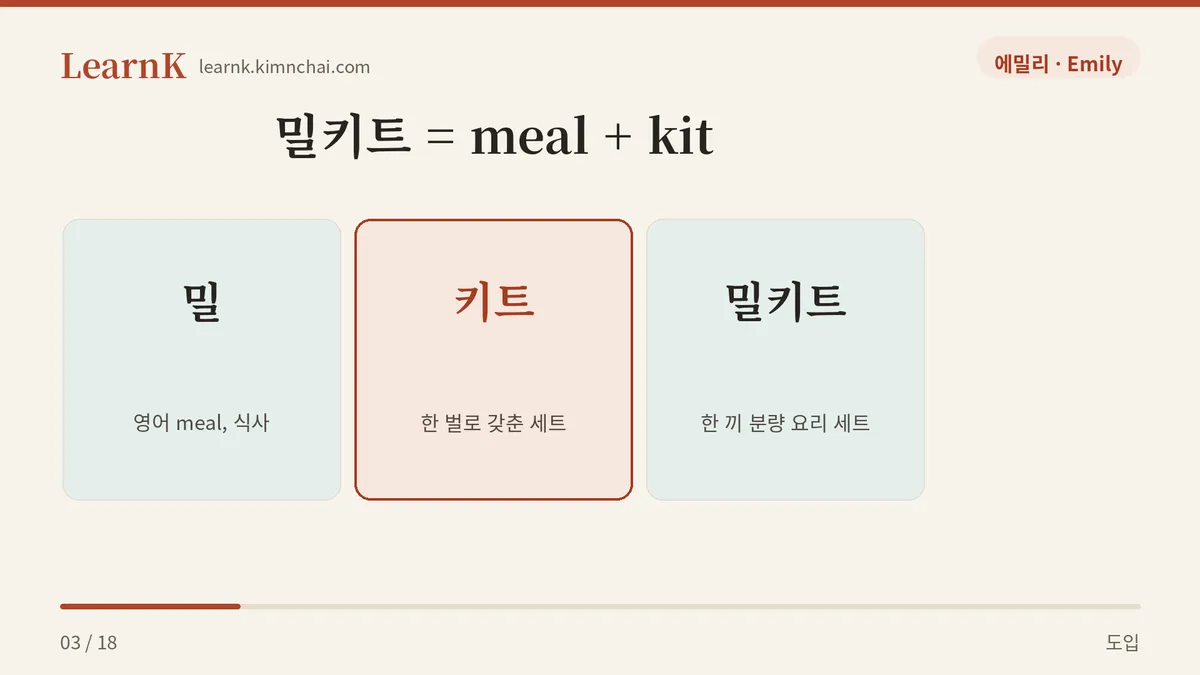
밀키트 (milkiteu) — from the English “meal kit” — means a ready-to-cook meal set in which pre-prepped ingredients and pre-measured seasonings all come in a single box, so that at home you just put it on the stove and dinner is done. Picture it this way: six-thirty in the evening, basket in hand, hovering for a good ten minutes in front of the refrigerated section of the supermarket on your way home from work, until finally your hand reaches for that box. Buying every ingredient separately means half of it goes to waste, ordering delivery means paying a delivery fee you’d rather not, and you don’t want to settle for instant noodles either — on nights like that, the meal kit is what Koreans reach for most.
밀키트 is a relatively new word, so it hasn’t picked up much of the formality temperature that words like 존댓말 (jondaenmal, polite speech) and 반말 (banmal, casual speech) carry. Because it’s simply the name of a thing, the word itself stays the same whether you’re talking to an elder or to a friend; politeness gets built at the end of the sentence. So: 밀키트예요 (milkiteuyeyo) / 밀키트야 (milkiteuya).
That said, it definitely has a nuance. The word 밀키트 carries a sense of compromise — “I’d like to eat a proper meal, but I don’t have it in me to make it all from scratch.” So if you say 오늘은 밀키트로 때웠어 (oneureun milkiteuro ttaewosseo), “I just got by on a meal kit today,” a slightly sheepish feeling comes through; but if you say 요즘 밀키트 진짜 잘 나와 (yojeum milkiteu jinjja jal nawa), “meal kits are seriously good these days,” it becomes admiration. Same word — the particles and the verb around it change the temperature.
And one more thing: a 밀키트 is something you have to cook yourself. That single line is what separates 밀키트 from other convenience foods, and it’s also the point learners get confused about most often.
See It in a Real Conversation
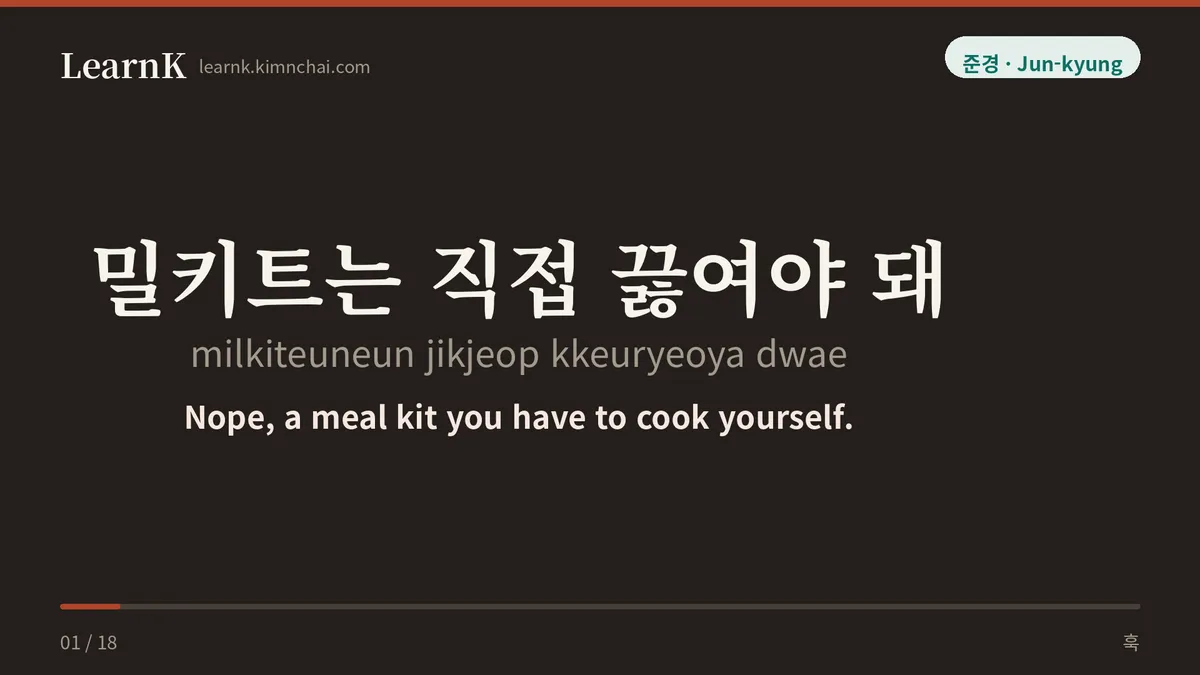
Scene: Friday evening, a big supermarket they stopped at on the way home from work. The two of them are standing side by side in front of the refrigerated meal-kit display.
Jun-kyung: 야, 이거 밀푀유나베 밀키트. 너 지난번에 먹고 싶다며. Hey, this millefeuille-nabe meal kit. You said you wanted to try it, right?
Emily: 어, 근데 나 집에 냄비 없는데. 이거 그냥 데우기만 하면 돼? Oh, but I don’t have a pot at home. Do I just heat this up?
Jun-kyung: 아니지, 밀키트는 직접 끓여야 돼. 데우기만 하면 되는 건 즉석식품이고. Nope, a meal kit you have to cook yourself. The heat-and-eat stuff is instant food.
Emily: 아 진짜? 그럼 나 냄비부터 사야 되네. Oh really? Then I need to buy a pot first.
Jun-kyung: 하나 사 둬. 요즘 밀키트 잘 나와서 혼자 살 때 이만한 게 없어. Just get one. Meal kits are so good these days — nothing beats them when you live alone.
Emily: 오케이. 그럼 이건 네가 들어, 냄비는 내가 고를게. Okay. Then you carry this, I’ll pick out the pot.
These Uses Sound Off
Since 밀키트 is just the name of a thing, it isn’t a word you have to adjust depending on who you’re talking to. Instead, here are the two misunderstandings learners actually run into most.
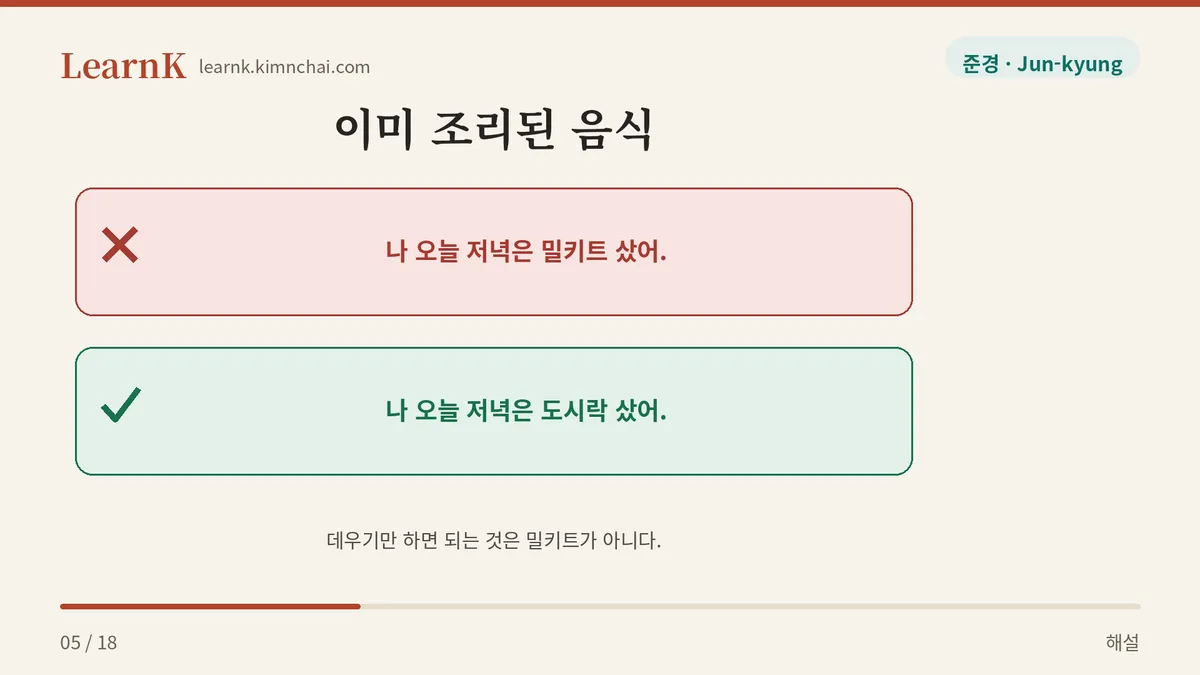
✗ (picking up a lunch box at a convenience store) 나 오늘 저녁은 밀키트 샀어. (na oneul jeonyeogeun milkiteu sasseo.) — “I bought a meal kit for dinner tonight.” ✓ (picking up a lunch box at a convenience store) 나 오늘 저녁은 도시락 샀어. (na oneul jeonyeogeun dosirak sasseo.) — “I bought a lunch box for dinner tonight.” → Something that’s already been cooked and only needs reheating is not a 밀키트. A meal kit contains prepped raw ingredients, so it isn’t finished until you stir-fry or simmer it yourself. Call a 도시락 (dosirak, lunch box), an instant soup, or a frozen meal a 밀키트 and Koreans will tilt their heads for a second.
✗ 저는 밀가루를 못 먹어서 밀키트는 아예 안 먹어요. (jeoneun milgarureul mot meogeoseo milkiteuneun aye an meogeoyo.) — “I can’t eat wheat flour, so I don’t eat meal kits at all.” ✓ 저는 밀가루를 못 먹어서 밀키트 살 때 성분표를 꼭 봐요. (jeoneun milgarureul mot meogeoseo milkiteu sal ttae seongbunpyoreul kkok bwayo.) — “I can’t eat wheat flour, so I always check the ingredient list when I buy a meal kit.” → The 밀 here is not the grain 밀 (mil, wheat) — it’s the English word meal. There are far more meal kits that have nothing to do with wheat flour: 부대찌개 (budaejjigae, army stew), 감바스 (gambaseu, gambas), 갈비찜 (galbijjim, braised short ribs). This is the classic mix-up created by the overlapping pronunciation.
Example Sentences by Situation
1. The evening a guest suddenly announces they’re coming
The situation — a friend texts that they’ll be over in an hour. There’s no time to go shopping, but just ordering delivery would look like you didn’t make an effort.
밀키트 하나 데워서 상 차리면 얼추 모양은 나와. (milkiteu hana dewoseo sang charimyeon eolchu moyangeun nawa.) → “밀키트 하나 끓여서 상 차리면 그럭저럭 그럴듯해 보여.” — “If you cook one meal kit and set the table, it comes out looking decent enough.” This is the most typical moment for pulling out a meal kit in a hurry.
2. To a friend who’s just started living alone
The situation — a friend who has never cooked has moved into a studio apartment. They’re asking what they should keep stocked.
국물 있는 밀키트로 두어 개 사 놔. 밥만 있으면 되니까. (gungmul inneun milkiteuro dueo gae sa nwa. bamman isseumyeon doenikka.) → “국물 요리 밀키트를 두세 개 사 둬. 밥만 있으면 되거든.” — “Buy two or three soup-style meal kits and keep them around. All you need on top of that is rice.” This is the casual (반말, banmal) phrasing you’d use when giving advice.
3. Chatting about lunch with a coworker (polite speech)
요즘 밀키트가 워낙 잘 나와서 웬만한 식당 못지않더라고요. (yojeum milkiteuga wonak jal nawaseo wenmanhan sikdang motjianteoragoyo.) → “요즘 밀키트 품질이 좋아서 어지간한 식당에 뒤지지 않아요.” — “Meal kits are so well made these days that they’re every bit as good as a decent restaurant.” This is the classic sentence for the admiring nuance.
Formality Levels and Similar Expressions
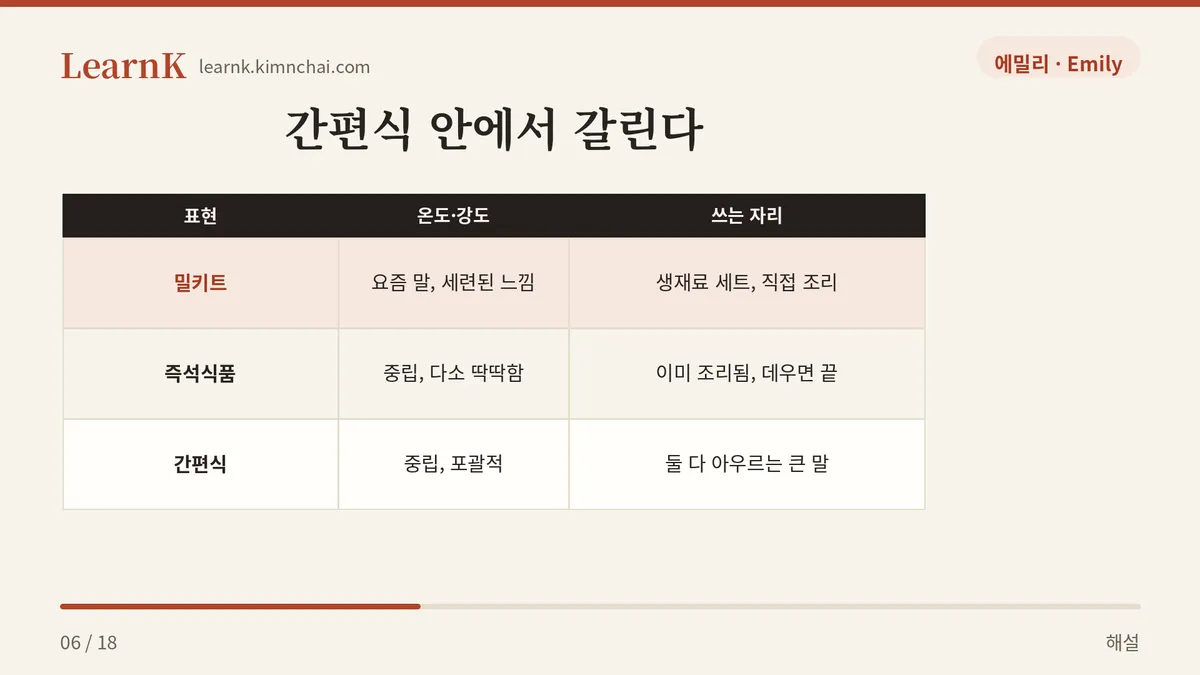
밀키트 is a noun, so there’s no honorific level built into the word itself. Just change the sentence ending and use 밀키트예요 (milkiteuyeyo) / 밀키트야 (milkiteuya). What actually trips people up isn’t politeness levels — it’s the neighboring words that look similar.
| Expression | Temperature / intensity | Where it’s used |
|---|---|---|
| 밀키트 (milkiteu) | Current slang-ish, slightly stylish feel | Prepped ingredients + seasoning set. You have to cook it yourself |
| 즉석식품 (jeukseoksikpum) | Neutral, somewhat stiff | Already cooked. Just heat it and you’re done |
| 간편식 (ganpyeonsik) | Neutral, broad | The big umbrella term covering meal kits, instant foods, and frozen foods alike |
| 반조리 식품 (banjori sikpum) | Explanatory, written style | Used in news reports or product descriptions. Rare in everyday conversation |
In one line: 간편식 (ganpyeonsik) is the widest umbrella, and within it, if you have to turn on the stove it’s a 밀키트, and if you only have to run the microwave it’s 즉석식품.
Cultural Background — Dinner Tables in One-Person Households
밀키트 is a loanword that brings the English meal and kit (a set of tools gathered together) straight into Korean. It wasn’t newly coined inside Korean; it keeps almost the exact shape of the original, which makes it an unusually easy word for English speakers to grasp. As mentioned above, though, its first syllable overlaps in pronunciation with the grain 밀 (mil, wheat), and that invites some odd misunderstandings.
The word settled into everyday Korean starting in the late 2010s. As one-person households and dual-income households increased, so did the demand summed up by “I want to eat a proper meal, but I don’t have time to shop and prep.” Then came a stretch when people were spending far more time at home, and by the end of it an entire section of the supermarket’s refrigerated aisle had turned into a meal-kit display. Today, shops that sell nothing but meal kits are common too.
What’s interesting is that meal kits have even changed the holidays. In the past, daughters-in-law would start pan-frying 전 (jeon, savory pancakes) and marinating short ribs two days ahead; these days plenty of households set the holiday table with a 갈비찜 (galbijjim) meal kit and a 잡채 (japchae) meal kit. Every year, the accusation that “there’s no care put into it” collides with the reply that “somebody’s labor just got lighter.” A single word, 밀키트, has the changes in Korean family life compressed inside it.
In TV dramas, too, a meal-kit box often shows up when a scene wants to show the kitchen of a character who lives alone. No dialogue is needed to explain it: one meal-kit box on the counter delivers the whole message at once — “this person lives alone, is busy, and still doesn’t want to eat carelessly.”
Today’s Quiz
Emily bought an instant 육개장 (yukgaejang, spicy beef soup) that just needs two minutes in the microwave at a convenience store. Which is the most natural thing for her to say?
- 나 저녁으로 밀키트 샀어. (na jeonyeogeuro milkiteu sasseo.)
- 나 저녁으로 즉석식품 샀어. (na jeonyeogeuro jeukseoksikpum sasseo.)
- 나 밀키트 끓이는 중이야. (na milkiteu kkeurineun jungiya.)
Answer: 2. Food that has already been cooked and only needs reheating isn’t a 밀키트 — it’s 즉석식품 (jeukseoksikpum, instant food). Remember that a meal kit contains prepped raw ingredients, so it’s a set that isn’t complete until you cook it yourself.
The definitions, example sentences, and dialogue in this post are all our own original writing. ‘밀키트’ does not appear as a headword in the National Institute of Korean Language’s Basic Korean Dictionary, so this entry was written without quoting any dictionary material.