부재중 전화 (bujaejung jeonhwa) — The Weight of Five Calls Stacked on Your Screen
부재중 전화 (bujaejung jeonhwa)
부재중 전화 (bujaejung jeonhwa) means a call that came in but you couldn’t pick up, so the only thing left behind is a record on your screen — in other words, a “missed call.” You flip your phone to silent on the way into a meeting room, pull it out two hours later, and there on the lock screen sit three lines of a familiar name, stacked up. That exact scene — Koreans have one phrase for it.
Live in Korea for a while and you’ll meet this word with your eyes long before you ever study it, because it’s sitting right at the top of your call log in red letters: ‘부재중 전화 3’. So the meaning clicks fast, but the moment you have to say it out loud, it gets slippery. Can you use it for a call you made that the other person didn’t answer? And what’s the polite thing to say when you miss a call from your boss? Today we’ll draw those lines clearly.
Take the word apart and the structure shows through. ‘부재중 (bujaejung, 不在中)’ is a Sino-Korean word meaning “during the time of not being there.” Originally it describes people: call an office and hear “지금 부재중이십니다 (jigeum bujaejung-isimnida)” and it means that person has stepped away from their desk. Add ‘전화 (jeonhwa)’ to it and you get “a call that came in while I wasn’t somewhere I could answer.”
The key is which way the word is facing. A 부재중 전화 is a record left on the screen of the person who couldn’t answer. It does not describe the caller’s action. That’s why the subject of this phrase is always the call itself, and the predicates that go with it are things like ‘와 있다 (wa itda, has come in)’, ‘떠 있다 (tteo itda, is showing)’, ‘찍혀 있다 (jjikhyeo itda, is logged)’, ‘쌓이다 (ssahida, to pile up)’, and ‘확인하다 (hwaginhada, to check)’. “부재중 전화가 와 있었어요 (bujaejung jeonhwaga wa isseosseoyo)” sounds natural; “제가 부재중 전화를 했어요 (jega bujaejung jeonhwareul haesseoyo)” is simply off.
The temperature is neutral. The phrase itself contains no anger and no apology — it just points at a fact. The emotion comes from the number and the person attached to it. ‘부재중 전화 한 통 (bujaejung jeonhwa han tong)’, one missed call, is nothing at all. ‘엄마 부재중 전화 열두 통 (eomma bujaejung jeonhwa yeoldu tong)’, twelve missed calls from Mom, is already an event in itself.
Seeing it in a real conversation
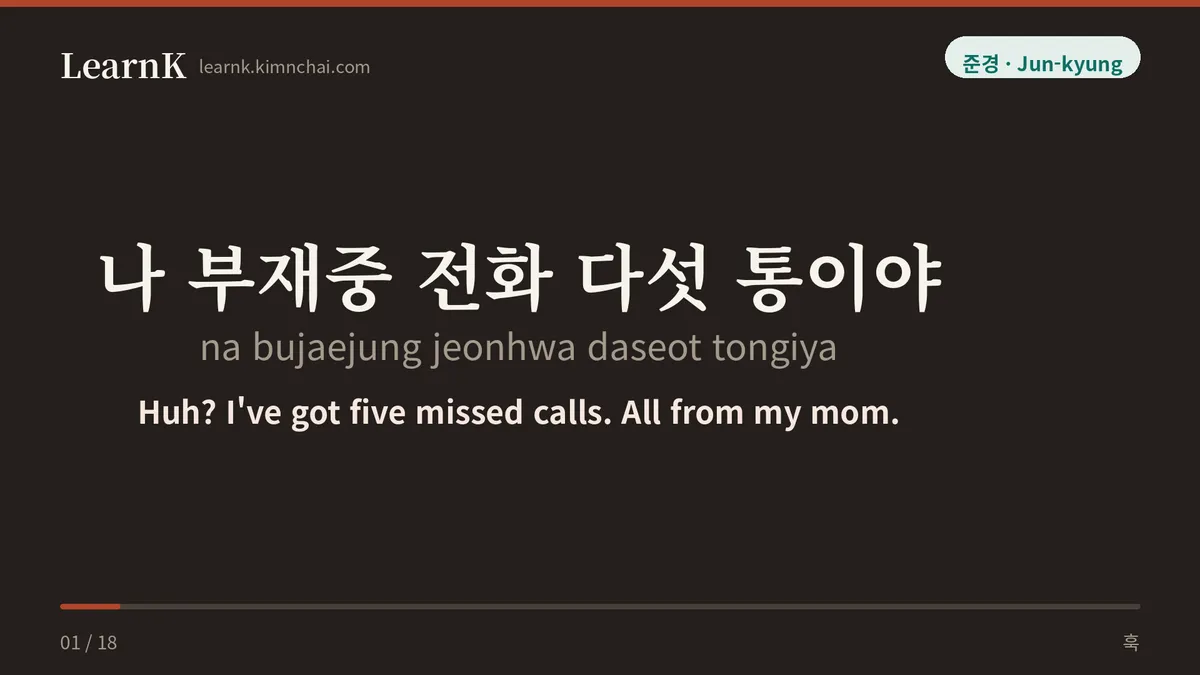
Scene: On the way out of the theater after a movie. The phone comes back on after two hours.
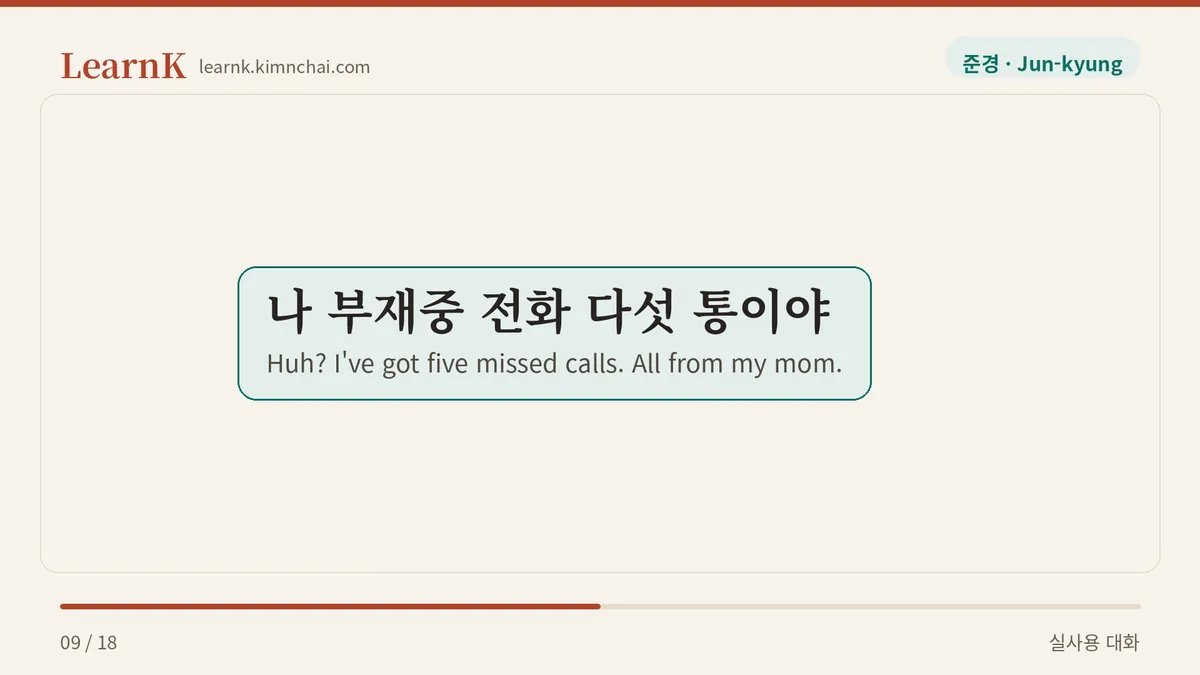
Jun-kyung: 어? 나 부재중 전화 다섯 통이야. 전부 엄마. Huh? I’ve got five missed calls. All from my mom.
Emily: 헐, 무슨 일 난 거 아니야? 빨리 걸어 봐. Whoa, did something happen? Call her back, quick.
Jun-kyung: 아, 문자도 와 있네. 잠깐만… 아, 김장하러 언제 오냐고. Oh, there’s a text too. Hold on… ah, she’s asking when I’m coming for kimjang.
Emily: 야, 놀랐잖아. 나도 아까 부재중 전화 하나 떴는데 모르는 번호더라. Hey, you scared me. I had a missed call too, but from an unknown number.
Jun-kyung: 그런 건 그냥 둬. 진짜 급하면 또 걸어. Just leave that one. If it’s actually urgent, they’ll call again.
Emily: 하긴. 근데 어머니한테는 지금 바로 걸어, 응? True. But call your mom right now, okay?
Said this way, it sounds wrong
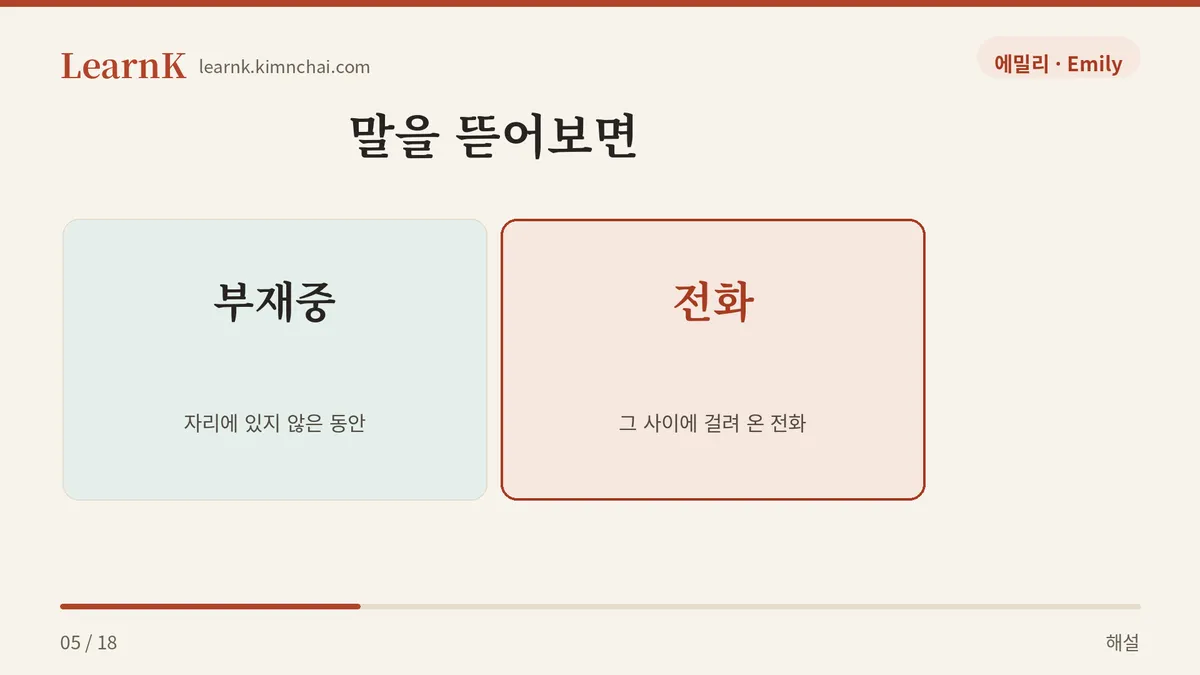
✗ (as the caller) 아까 제가 과장님께 부재중 전화를 세 번 했는데요. ✓ (as the caller) 아까 제가 과장님께 세 번 전화 드렸는데 안 받으셔서요. “I called you three times earlier, sir, but you didn’t pick up.” → A 부재중 전화 is a record that stays behind on the screen of the person who missed it — it isn’t something the caller does. Describe your own outgoing calls this way and a Korean listener will pause for half a beat.
✗ (to a senior) 부장님, 아까 부재중 전화 떠 있던데요. ✓ (to a senior) 부장님, 아까 전화 주셨는데 회의 중이라 못 받았습니다. 죄송합니다. “Sir, you called me earlier — I was in a meeting and couldn’t answer. I’m sorry.” → The grammar is perfectly fine, but the social position is wrong. Reporting a superior’s call as “it was showing on my screen” means you’re tossing out a bare fact with no explanation for why you missed it and no apology. The basic move is to elevate a superior’s call with ‘전화 주셨다 (jeonhwa jusyeotda, you kindly called)’ and attach one line explaining why you couldn’t pick up.
Example sentences by situation
1) When a meeting ran long and you missed the call (to a colleague)
회의 끝나고 폰 보니까 부재중 전화가 네 통이나 와 있더라. (hoeui kkeutnago pon bonikka bujaejung jeonhwaga ne tongina wa itdeora.) “I looked at my phone after the meeting and there were four missed calls.”
Adding ‘-더라 (-deora)’ layers in the feeling of “I just discovered this and it surprised me.” The ‘-이나 (-ina)’ attached to the number does the same job: not just four calls, but a whopping four.
2) When you miss a call from a delivery driver (muttering to yourself)
아, 택배 기사님 부재중 전화네. 다시 걸어 봐야겠다. (a, taekbae gisanim bujaejung jeonhwane. dasi georeo bwayagetda.) “Ah, a missed call from the delivery driver. I’d better call back.”
This is one of the most common places you’ll hear the expression in Korea. The driver is calling to ask whether to leave the package at the door or with the security office, so if you miss it you call right back. And that speech pattern — ending with just ‘-네 (-ne)’ after a noun, as in ‘부재중 전화네’ — is extremely common when you’re staring at your screen and talking to yourself.
3) When you check late and need to apologize (formal settings)
죄송합니다, 부재중 전화 확인이 늦었습니다. 지금 통화 괜찮으실까요? (joesonghamnida, bujaejung jeonhwa hwagini neujeotseumnida. jigeum tonghwa gwaenchaneusilkkayo?) “I’m sorry, I was late seeing your missed call. Is now a good time to talk?”
This is the textbook sentence for calling someone back. In Korean work culture, seeing a missed call and not returning it is considered rude. Missing the call isn’t the problem — failing to call back is.
Honorific vs. casual speech, and related expressions
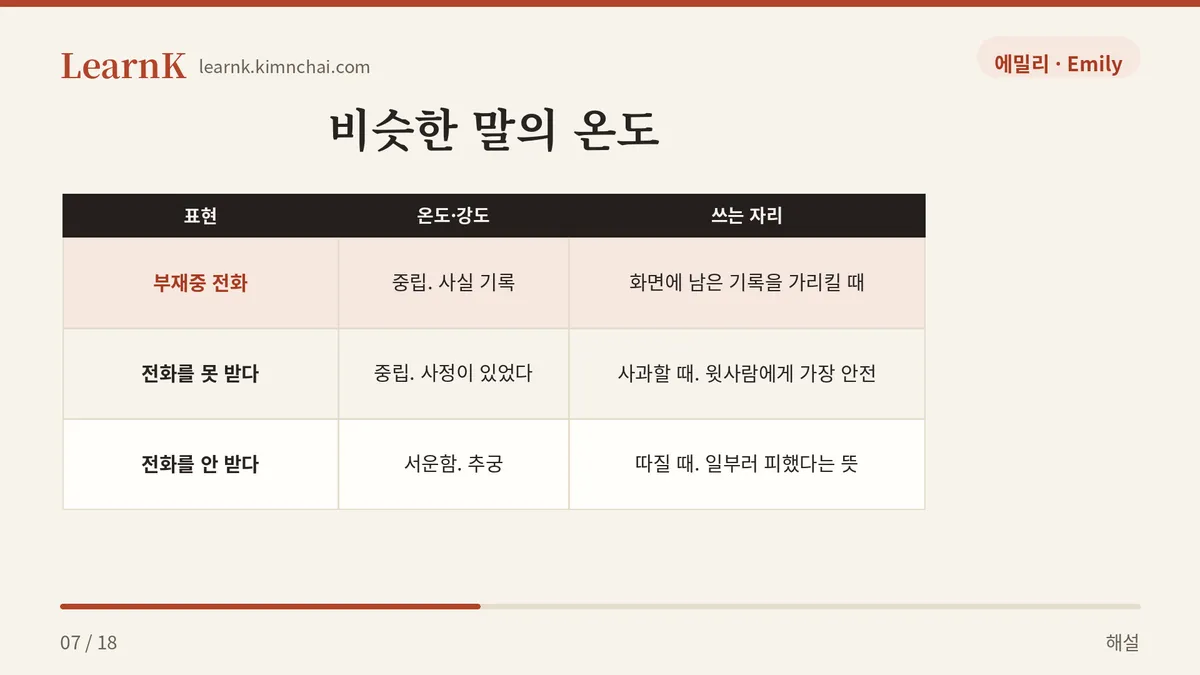
‘부재중 전화’ is a noun, so it carries no politeness level on its own. Honorific and casual speech split at the predicate that follows. To a friend it becomes “부재중 전화 왔더라 (bujaejung jeonhwa watdeora)”; to a superior, “부재중 전화가 와 있었습니다 (bujaejung jeonhwaga wa itseotseumnida).” That said, when you’re talking about a call placed by someone above you, it’s far more natural to change the expression entirely and use ‘주시다 (jusida)’, as in “전화 주셨더라고요 (jeonhwa jusyeotdeoragoyo).”
| Expression | Temperature / intensity | Where it’s used |
|---|---|---|
| 부재중 전화 (bujaejung jeonhwa) | Neutral. A factual record | Anywhere. When pointing to the record left on your screen |
| 전화를 못 받다 (jeonhwareul mot batda) | Neutral. Implies circumstances got in the way | When apologizing or explaining. The safest choice with superiors |
| 전화를 안 받다 (jeonhwareul an batda) | Hurt feelings; accusatory | When calling someone out. Sounds like they dodged you on purpose |
| 전화 씹다 (jeonhwa ssipda) | Rough and flippant | Only as a joke among peers. Never with a superior |
‘못 받다 (mot batda)’ and ‘안 받다 (an batda)’ differ by a single syllable, and that syllable changes the relationship. “왜 전화 못 받았어? (wae jeonhwa mot badasseo?)” is concern; “왜 전화 안 받았어? (wae jeonhwa an badasseo?)” is an interrogation. If you’re in a position to apologize, you must go with ‘못 (mot)’.
Cultural background — the weight of five calls
In Korea, the number of missed calls is the message. One call is information; five calls are emotion. Parents’ back-to-back missed calls in particular usually aren’t about something urgent — they’re worry piling up. Which is why the text that follows is almost predetermined. ‘전화 좀 받아라 (jeonhwa jom badara)’, ‘어디냐 (eodinya)’ — two lines is plenty.
It’s the same reason Korean dramas so often cut to a close-up of a phone screen full of missed calls. Without a single line of dialogue, it tells the audience that something happened in the meantime. One name stacked all the way down the screen can be a warning of an accident to come, or it can be the feelings an ex could never bring themselves to send.
At work, a slightly different set of rules kicks in. If you’ve seen a missed call, calling back is basic courtesy, and if you can’t talk right away you leave a text: ‘회의 중이라 못 받았습니다. 30분 뒤에 연락드리겠습니다 (hoeui jungira mot badatseumnida. samsipbun dwie yeollakdeurigetseumnida)’ — “I was in a meeting and couldn’t answer. I’ll get back to you in 30 minutes.” In a culture where response speed reads as diligence, letting it go past the day means an apology is now required.
On the flip side, not calling back a missed call from an unknown number is closer to common sense. Spam calls that ring once and hang up are so common that Koreans generally just leave a single call from a strange number alone. What Jun-kyung says in the conversation above — “진짜 급하면 또 걸어 (jinjja geupamyeon tto georeo)”, if it’s really urgent they’ll call again — is exactly that instinct. Judging by the name and the count whether a missed call is worth returning: that’s the feel of someone who really knows how to use this word.
Today’s quiz
Which of the following uses 부재중 전화 (bujaejung jeonhwa) naturally?
- 아까 제가 팀장님께 부재중 전화를 세 번 했습니다.
- 샤워하고 나오니까 부재중 전화가 세 통 와 있었어요.
- 어제는 하루 종일 전화를 부재중 전화했어요.
Answer: 2. A 부재중 전화 is a record left on the screen of the person who couldn’t answer, so it pairs with ‘와 있다 (wa itda)’ and ‘떠 있다 (tteo itda)’ — “I came out of the shower and there were three missed calls.” Number 1 describes the caller’s own action, so it has to be fixed to “세 번 전화 드렸습니다 (se beon jeonhwa deuryeotseumnida),” and number 3 uses the phrase as if it were a verb, which doesn’t work at all. The correct version is “하루 종일 전화를 못 받았어요 (haru jongil jeonhwareul mot badasseoyo).”