뮤비 (mubi) — Six O'Clock in the Evening on Comeback Day, the First Thing Korean Fans Say

뮤비
뮤비 (mubi) is the shortened form of 뮤직비디오 (myujikbidio), “music video” — a film shot and directed separately for one single song. There’s one setting where this word flies back and forth most intensely in Korea, and it’s almost always the same one: six o’clock in the evening on the day of an idol group’s comeback, the exact moment the new song drops on music streaming sites and YouTube at the same time. The instant the notification goes off, the same words come out on the subway, in a cram-school hallway, at a bus stop on the way home from work: “뮤비 떴어? (mubi tteosseo?)”
It rarely shows up in Korean textbooks, but among Korean fans, people who carefully enunciate all five syllables of ‘뮤직비디오’ are rarer than you’d expect. In real conversation, it’s 뮤비 nine times out of ten. That also makes it the very first word fans of Korean culture bump into when they start reading Korean fandom tweets and community posts.
The nuance is light and fast. As with all abbreviations, it’s the register of close friends, peers, and online spaces. On the flip side, official press releases, awards-show subtitles, and broadcast news reports still use ‘뮤직비디오’. In other words, 뮤비 and 뮤직비디오 mean exactly the same thing — only the setting is different. Since the meaning is identical it looks impossible to get wrong, but that “setting” is precisely where Korean learners tend to stumble.
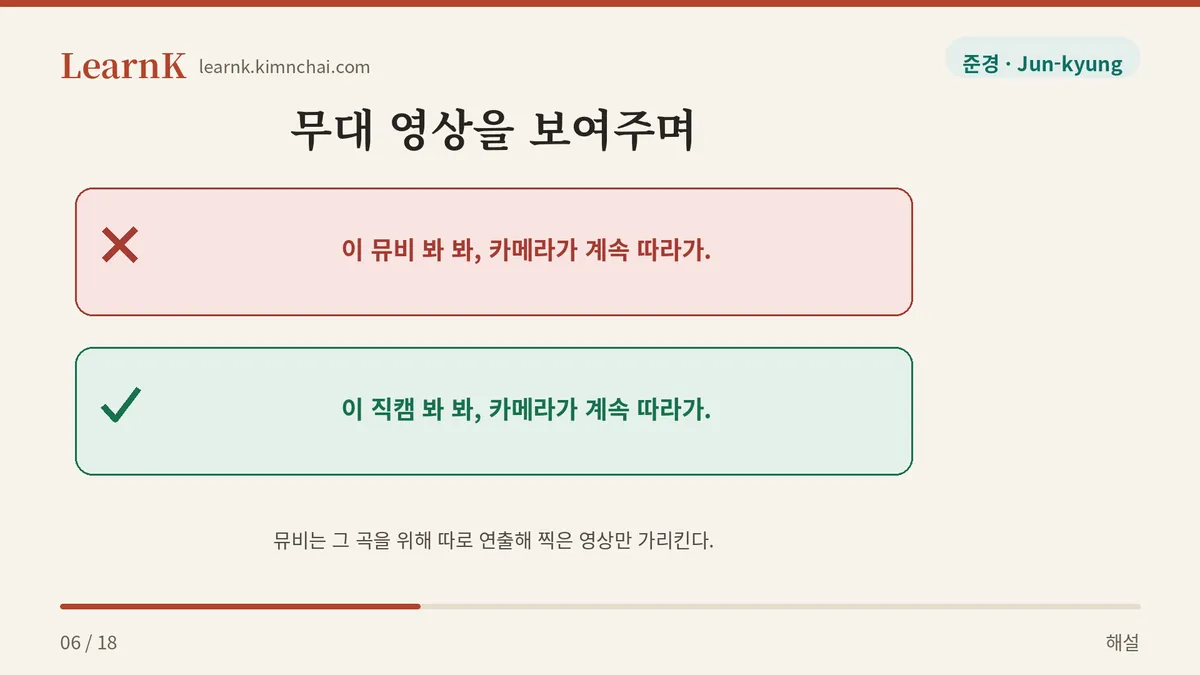
One more thing. 뮤비 is not a word for every video that has music in it. Only a video planned, directed, and produced separately for that particular song counts as a 뮤비. A stage video a fan filmed themselves at a concert, or a clip of a performance on a music show, is not called a 뮤비. We’ll come back to this distinction later.
Seeing It in Real Conversation
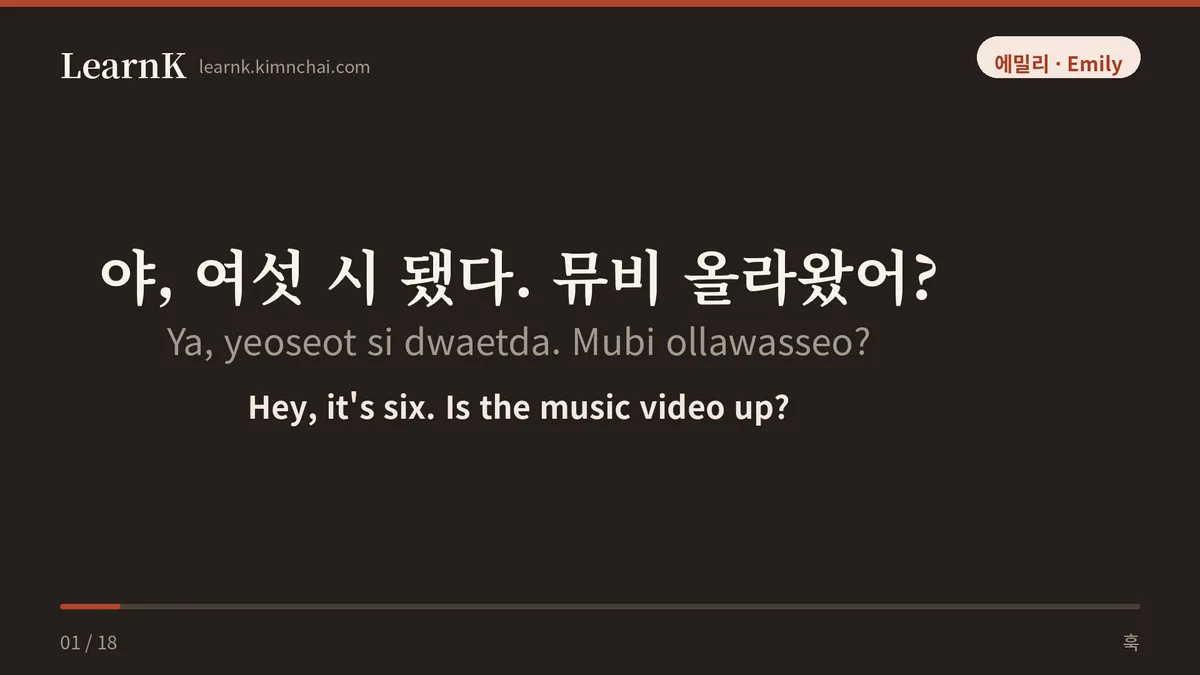
Scene: Six o’clock on a Friday evening, Subway Line 2 during the commute home. They’re standing in the train car right at their favorite group’s comeback time. Emily hands Jun-kyung one of her earbuds.
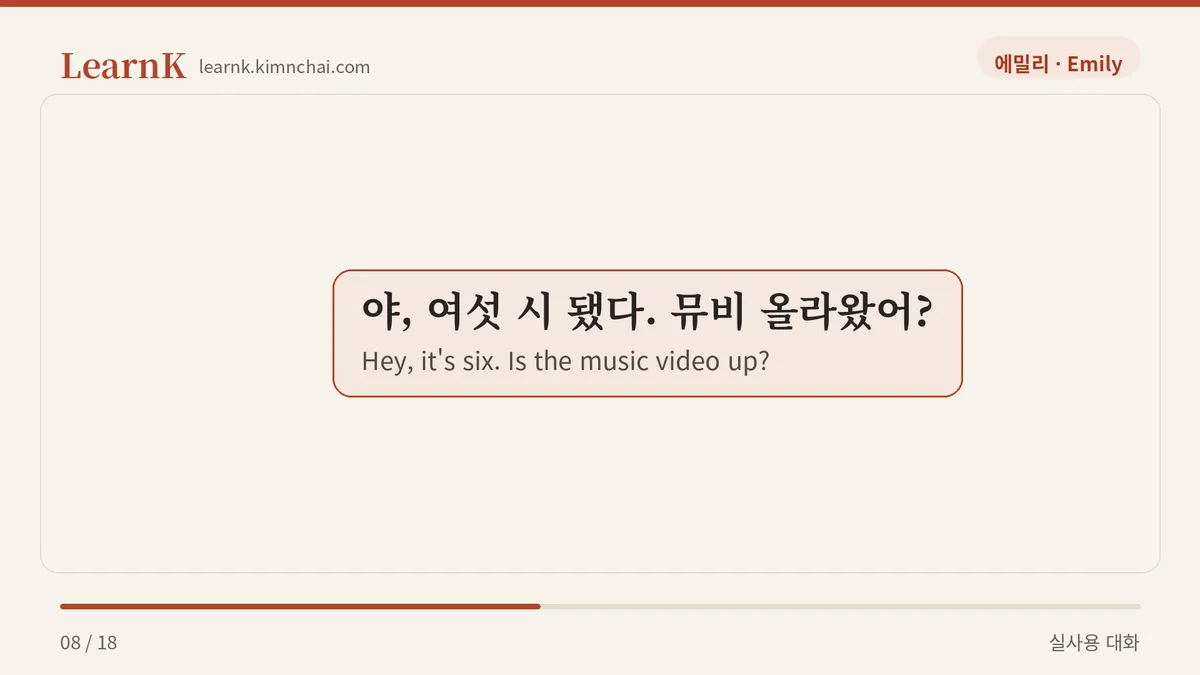
에밀리: 야, 여섯 시 됐다. 뮤비 올라왔어? Hey, it’s six. Is the music video up?
준경: 잠깐만… 어, 떴다 떴다. 이어폰 줘 봐. Hold on… oh, it’s up, it’s up. Give me the earbud.
에밀리: 근데 소리 들려? 지하철에서 봐도 되나. Can you even hear it? Is it okay to watch on the subway?
준경: 상관없어. 어차피 오늘 밤에 집에서 열 번은 더 볼 거잖아. Doesn’t matter. You’re gonna watch it ten more times at home tonight anyway.
에밀리: 인정. 근데 이번 뮤비 색감 미쳤다, 진짜. True. But the color grading on this one is insane, seriously.
준경: 그치? 저 문 열리는 장면, 저거 저번 앨범 뮤비랑 이어지는 거야. Right? That door opening — it connects to the last album’s music video.
에밀리: 헐. 나 그거 몰랐어. 집 가서 정주행해야겠다. Whoa. I didn’t know that. I’m gonna binge them all when I get home.
These Uses Sound Off
✗ (To reporters at a press conference) 저희 신곡 뮤비는 다음 주 화요일에 공개됩니다. ✓ (To reporters at a press conference) 저희 신곡 뮤직비디오는 다음 주 화요일에 공개됩니다. Our new single’s music video will be released next Tuesday. → The meaning isn’t wrong, but because it’s an abbreviation it sounds too casual in a formal setting. In front of the cameras, in press releases, and on a company’s official account, use ‘뮤직비디오’; in comments traded with fans or on a live stream, use ‘뮤비’.
✗ (Showing a fancam from a concert they went to yesterday) 이 뮤비 봐 봐, 카메라가 계속 따라가. ✓ (Showing a fancam from a concert they went to yesterday) 이 직캠 봐 봐, 카메라가 계속 따라가. Check out this fancam — the camera follows him the whole time. → This is a common misunderstanding. 뮤비 refers only to a video that was directed and filmed separately for that song. Footage of a live performance has its own names: 직캠 (jikkaem) for a fan-shot close-up, and 무대 영상 (mudae yeongsang) for a music-show stage.
Example Sentences by Situation
Situation 1 — Comeback day, texting a friend
뮤비 떴다! 지금 봐! (Mubi tteotda! Jigeum bwa!)
‘뜨다 (tteuda)’ originally means “to rise” or “to float up,” but online it means “a new post has gone up.” This two-word sentence is the one fans send each other most at comeback time. Made polite, it becomes “뮤비 올라왔어요!”
Situation 2 — Lunch break at the office, chatting with a coworker
어제 그 뮤비 조회수 벌써 천만 넘었대요. (Eoje geu mubi johoesu beolsseo cheonman neomeotdaeyo.)
‘조회수 (johoesu)’ is a video’s view count. In Korean fandom a 뮤비 is something you enjoy and, at the same time, a record — so the view count in the first 24 hours after release becomes a number fans look after together. Adding ‘-대요’ as in this sentence gives it the nuance of “passing along something I heard,” which makes it comfortable to say even at work.
Situation 3 — Making travel plans
이번 뮤비 촬영지가 강릉이래. 우리 거기 가 보자. (Ibeon mubi chwaryeongjiga Gangneungirae. Uri geogi ga boja.)
‘촬영지 (chwaryeongji)’ means filming location. Visiting the beach or café that appeared in a music video — what fans call a ‘성지순례’, a “pilgrimage” — is one pillar of Korean fan culture, and local governments actually promote these spots as tourist routes.
Formality Levels and Related Expressions
뮤비 is a noun, so the word itself has no polite/casual distinction. That said, the very fact that it’s a shortened word already marks it as relaxed speech, so there are places where ending the sentence in ‘-습니다’ just doesn’t fit. “뮤직비디오를 봤습니다” sounds more natural than “뮤비를 시청하였습니다.”
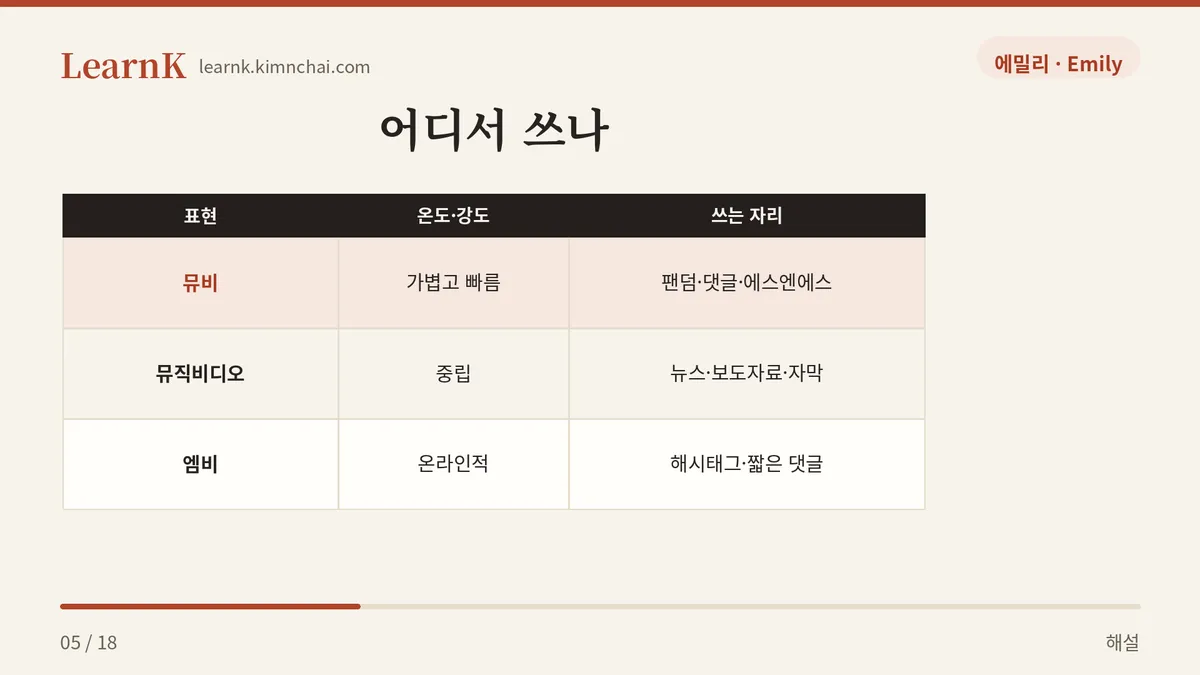
| Expression | Tone & Intensity | Where It’s Used |
|---|---|---|
| 뮤비 (mubi) | Light and fast | Peers, fandom, social media, comments. Not in official statements |
| 뮤직비디오 (myujikbidio) | Neutral | Anywhere. News, press releases, subtitles |
| 엠비 / MV | Light, internet-flavored | Hashtags, short comments. Rarely said out loud |
| 직캠 (jikkaem) | Fandom insider term | Live-stage footage only. A completely different thing from a 뮤비 |
| 티저 (tijeo) | Tinged with anticipation | The preview clip that drops a few days before the music video |
Cultural Background — The Six O’Clock Ritual
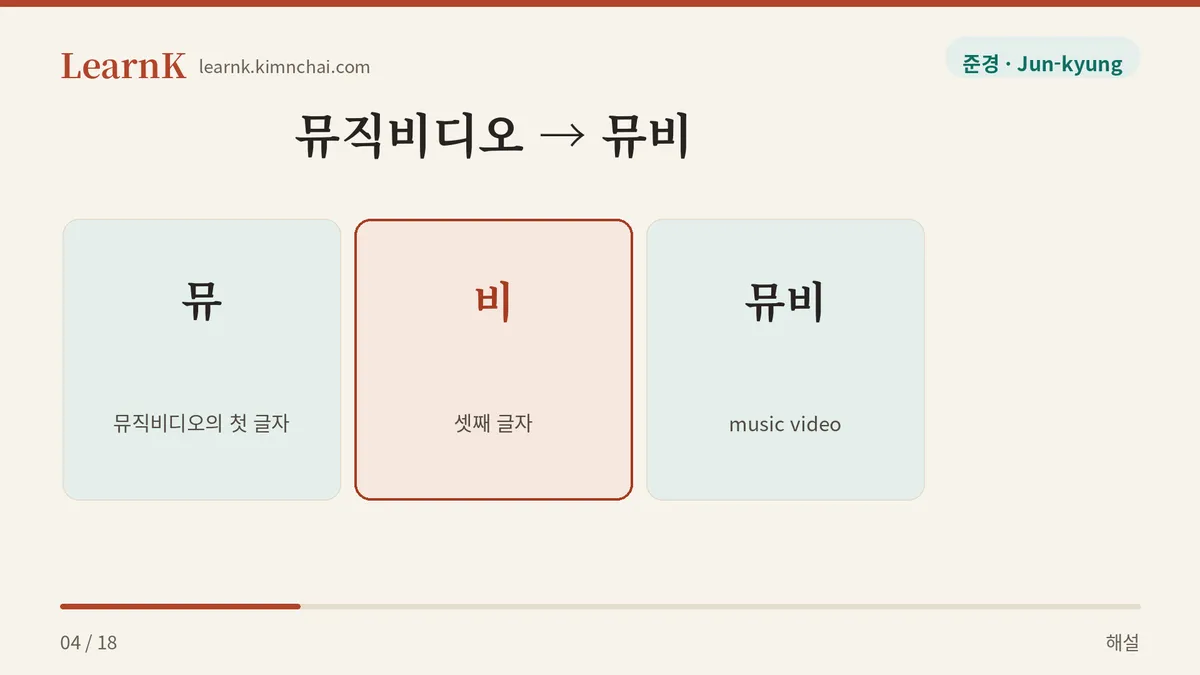
The word formation is simple: take the first and third syllables of 뮤직비디오 and stick them together. Korean often shortens long loanwords this way. 인강 (ingang) is 인터넷 강의 (online lecture), 아아 (a-a) is 아이스 아메리카노 (iced americano), and 셀카 (selka) is 셀프 카메라 (selfie). As a rule of thumb, the longer the loanword, the better the odds its abbreviation survives.
There’s a reason 뮤비 became such a big word in Korea specifically. A K-pop comeback follows a set sequence. Concept photos come out first, then the tracklist is revealed, then a short teaser drops, and finally the music video goes up. And by convention, that moment is six o’clock in the evening. Hundreds of thousands of people hitting play on the same video at the same time — right at the hour when work and school both let out — is something close to a ritual for fans.
One more thing. In Korean fandom, a 뮤비 is something you watch and something you read. A single prop in the video, a painting on the wall, a color that keeps recurring — all of it gets interpreted as a clue to the album’s fictional universe, and fans call these clues 떡밥 (tteokbap) and debate them for hours. When Jun-kyung said “저 문 열리는 장면, 저번 앨범 뮤비랑 이어지는 거야” in the conversation above, that’s exactly this culture at work. Which is why, to a Korean fan, “뮤비 봤어?” is often also an invitation: “if you’ve seen it, let’s talk about it.”
Today’s Quiz
Which of the following cannot be called a 뮤비?
① A four-minute video shot for a new single, with a set built for it and actors cast ② A performance-version video of the same song’s choreography, filmed in one space from start to finish ③ A stage video a fan shot at a concert yesterday, following just one member the whole time
Show the answer
The answer is ③. A video a fan filmed of a live stage is called a 직캠. 뮤비 refers only to a video that was planned, directed, and filmed separately for that song. A performance version like ② contains only the choreography, but since the agency produced and released it for the song, it counts as a type of 뮤비.