무대매너 (mudae maeneo) — The Three Minutes of Attitude That Outlast the Song
무대매너 (mudae maeneo)
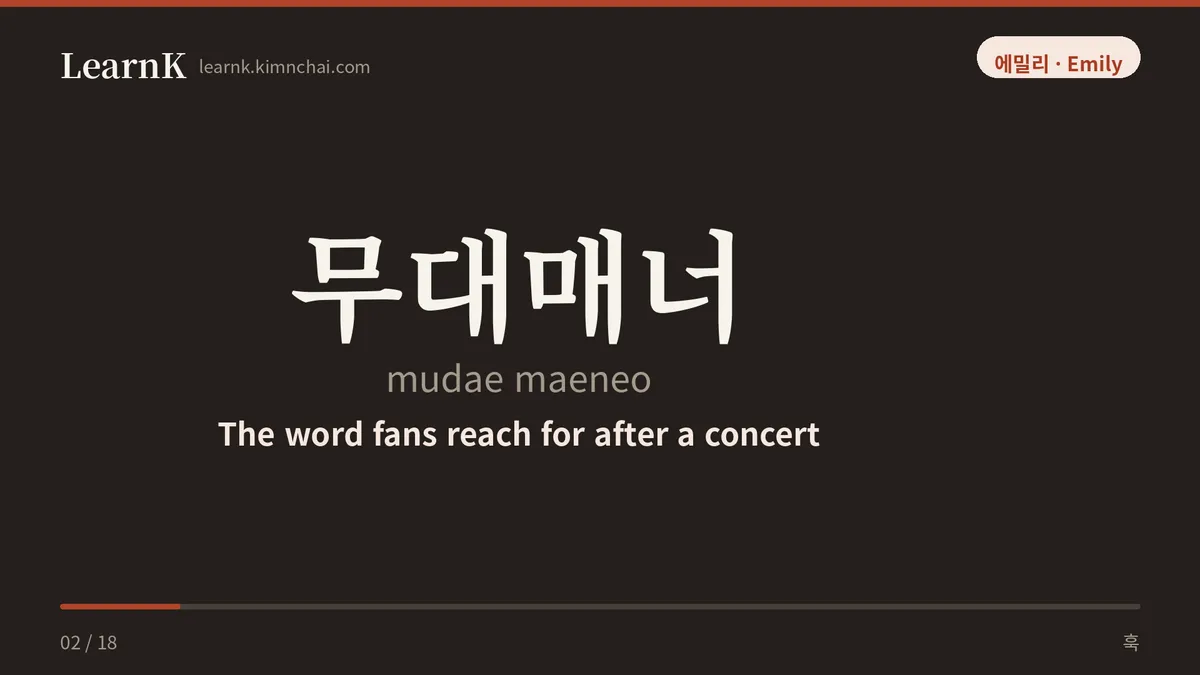
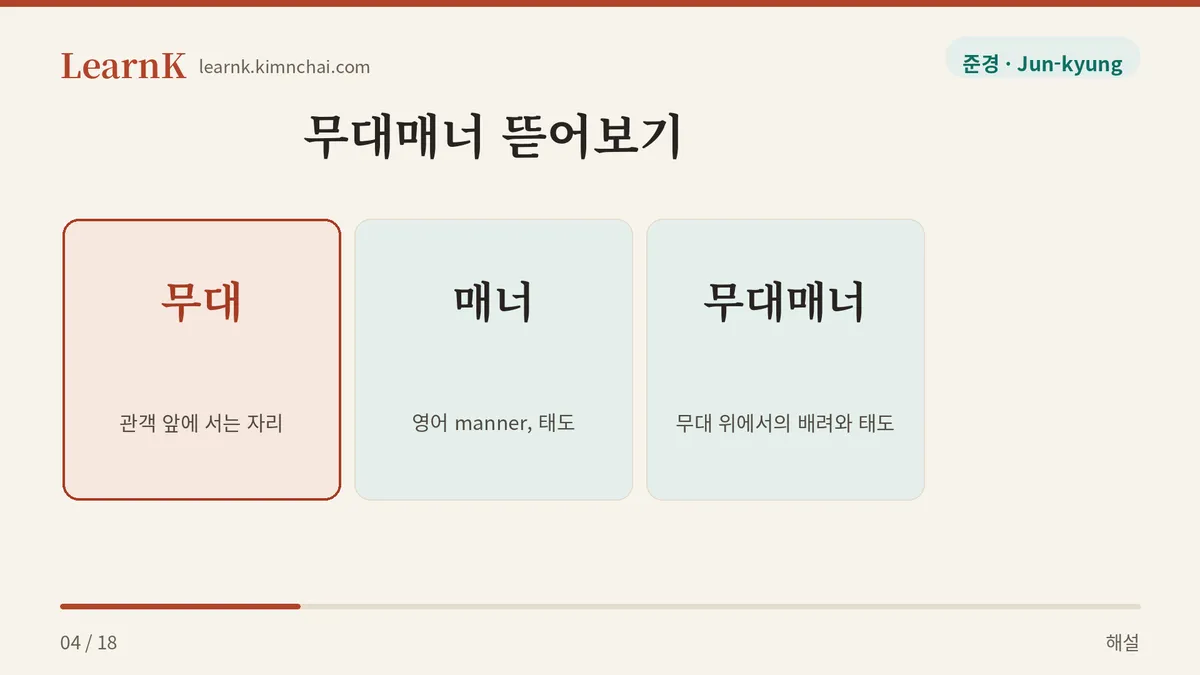
무대매너 (mudae maeneo) means the attitude and bearing a performer — a singer, an actor — shows on stage, and above all the consideration they extend to the audience and to the people beside them. What fans end up talking about longest after a show is, surprisingly, not the high notes. It’s the moment in the encore when the leader crouched down to meet the eyes of the front row. The three seconds when the backing track cut out and their expression never slipped. The hand that reached over to pick up a fallen member’s mic. The one word that bundles all of this together is 무대매너.
In the everyday conversation of Korean K-pop fandom, this word comes up almost daily. 무대매너가 좋다 (mudae maeneoga jota) — “their stage manners are good” — is one of the highest compliments a fan can hand out, while 무대매너 논란 (mudae maeneo nollan) — “a stage-manner controversy” — is heavy enough to shake an entire promotion cycle. If you’re a Hallyu fan learning Korean, whether or not you know this word makes a real difference in how hard fan-community posts feel to read.
The heart of the nuance is that this is a judgment separate from skill. Singing well is 가창력 (gachangnyeok, vocal ability). The power to command a stage is 무대 장악력 (mudae jangangnyeok, stage command). How you treat the audience and your colleagues is 무대매너 — and Korean fan discourse keeps these three quite strictly apart. That’s why both “실력은 아직인데 무대매너는 최고 (sillyeogeun ajiginde mudae maeneoneun choego)” — “the skill isn’t there yet, but the stage manners are the best” — and its opposite, “실력은 완벽한데 무대매너가 아쉽다 (sillyeogeun wanbyeokhande mudae maeneoga aswipda)” — “the skill is flawless, but the stage manners are a letdown” — are both perfectly coherent things to say. Once you see that those two sentences aren’t a contradiction, you’ve learned half of this word.
Its range of use is narrow, too. 무대매너 mostly attaches to 좋다 / 훌륭하다 / 최고다 (jota / hullyunghada / choegoda — good / excellent / the best), and it doesn’t pair with words that measure size or quantity. “무대매너가 크다 (mudae maeneoga keuda)” — “their stage manners are big” — just isn’t Korean. When people go negative, they usually soften it: “무대매너가 별로다 (mudae maeneoga byeollo-da)” or “무대매너가 아쉽다 (mudae maeneoga aswipda)”. Go all the way to 무대매너가 없다 (mudae maeneoga eopda) and it lands as a pretty harsh attack. Not a phrase to throw around lightly.
Seeing It in Real Conversation
Scene: The concert has just ended. Light stick still stuck in a bag, two friends wait on the platform for the last train.
Jun-kyung: 야, 아까 앙코르 때 봤어? 리더가 무릎 꿇고 앞줄이랑 눈 맞춰 주더라. Hey, did you see the encore? The leader knelt down and made eye contact with the front row.
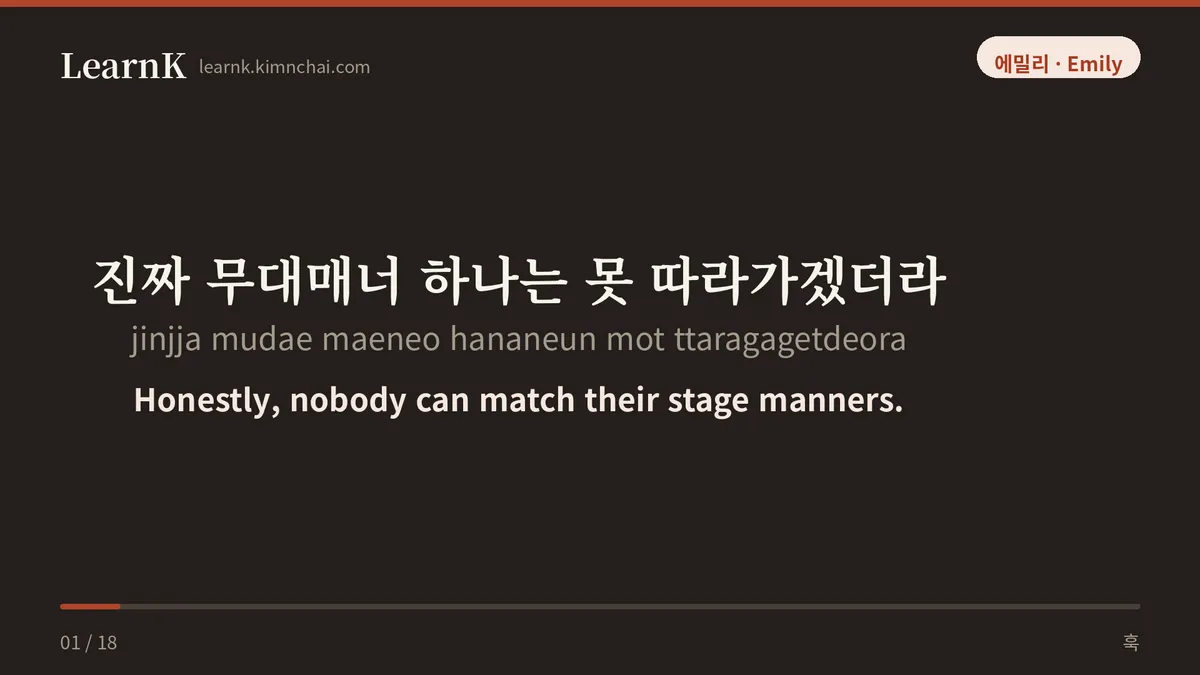
Emily: 봤지. 진짜 무대매너 하나는 못 따라가겠더라. I saw it. Honestly, nobody can match their stage manners.
Jun-kyung: 근데 오늘 목 상태 안 좋았잖아. 삑사리 났는데도 끝까지 웃던데. But their voice wasn’t in good shape today. Even after the crack, they kept smiling to the end.
Emily: 그러니까. 노래야 다음에 또 부르면 되는데, 무대매너가 좋은 건 하루아침에 되는 게 아니잖아. Right. You can always sing the song again next time, but good stage manners aren’t built overnight.
Jun-kyung: 인정. 실력만 보면 더 잘하는 팀도 있지, 근데 저 팀은 팬 대하는 게 달라. Agreed. There are teams with more skill, but that team treats fans differently.
Emily: 아 맞다 나 내일 출근인데. 막차 왔다, 뛰어! Oh no, I have work tomorrow. The last train’s here — run!
These Uses Sound Off
✗ (to a coworker after a meeting) 오늘 발표 무대매너 진짜 좋으시던데요. (oneul balpyo mudae maeneo jinjja joeusideondeyo.) — “Your stage manners in today’s presentation were really good.” ✓ (to a coworker after a meeting) 오늘 발표 태도가 진짜 안정적이시던데요. (oneul balpyo taedoga jinjja anjeongjeogisideondeyo.) — “You came across as really composed in today’s presentation.” → 무대매너 is for performing in front of an audience — singing, dancing, acting. Stick it on a conference-room presentation and it sounds like a joke, or like you’re mildly teasing the person.
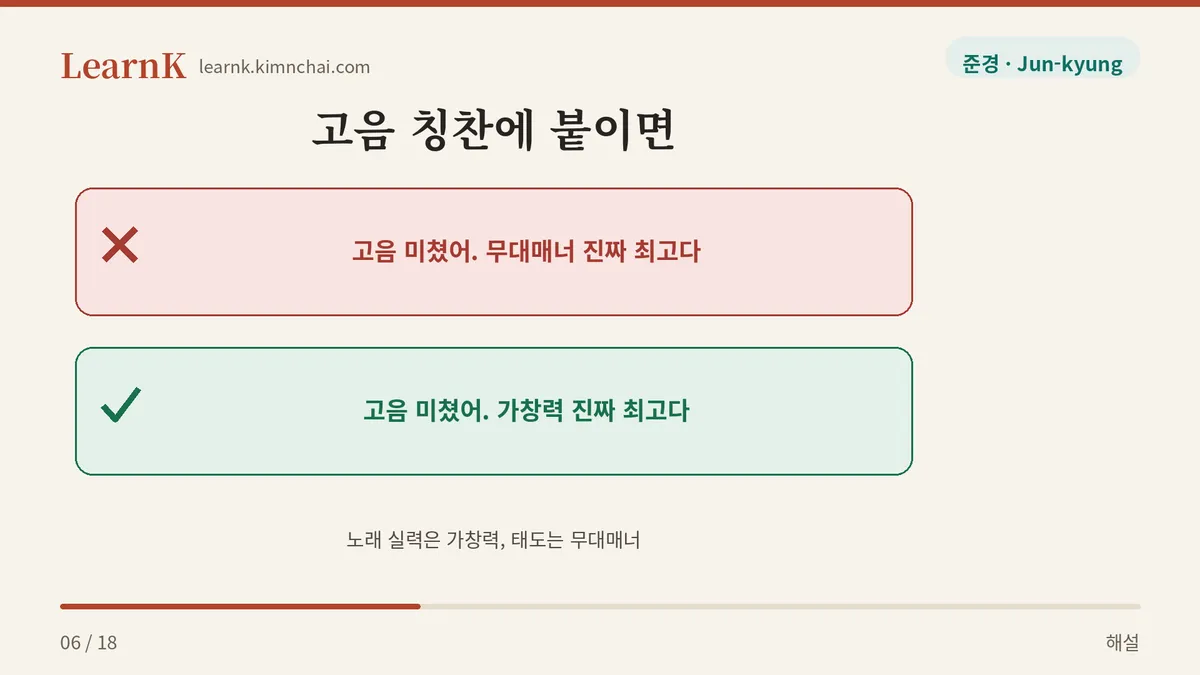
✗ 저 가수 고음 미쳤어. 무대매너 진짜 최고다. (jeo gasu goeum michyeosseo. mudae maeneo jinjja choegoda.) — “That singer’s high notes are insane. Their stage manners are the best.” ✓ 저 가수 고음 미쳤어. 가창력 진짜 최고다. (jeo gasu goeum michyeosseo. gachangnyeok jinjja choegoda.) — “That singer’s high notes are insane. Their vocal ability is the best.” → Praising someone’s singing and then following it with 무대매너 throws the focus off. The listener may hear it as, “So… you’re saying the singing is mediocre but the attitude is nice?” Praise the skill with 가창력 or 춤 실력 (chum sillyeok, dance ability); praise the attitude with 무대매너.
Example Sentences by Situation
1) Posting a concert review on social media on your way home
오늘 무대매너 진짜 최고였다. 앙코르 끝나고도 마지막 한 명까지 손 흔들어 주더라. (oneul mudae maeneo jinjja choegoyeotda. aengkora kkeutnago-do majimak han myeongkkaji son heundeureo judeora.)
Today’s stage manners were seriously the best. Even after the encore was over, they waved until the very last person had gone.
This is the classic shape of a fan review post. Writing in 반말 (banmal, casual speech), almost as if talking to yourself, feels natural — and the standard move is to follow 무대매너 with one concrete scene. Saying the stage manners were good with no evidence behind it actually reads as unconvincing in fan communities.
2) Introducing a group you’ve just fallen for to a friend
얘네는 실력도 실력인데, 무대매너가 남달라. 신인인데 선배들 챙기는 게 보여. (yaeneneun sillyeokdo sillyeokinde, mudae maeneoga namdalla. sininde seonbaedeul chaenggineun ge boyeo.)
Their skill is one thing, but their stage manners are on another level. They’re rookies, and you can see them looking after the senior artists.
“A도 A인데 B가 … (A-do A-inde B-ga …)” is a very common spoken frame meaning “A goes without saying, but B is even more impressive.” Drop 무대매너 into that slot and you’re saying, “the attitude is even more striking than the skill.”
3) Speaking politely to venue staff or an older industry person
아까 리허설 때 보니까 무대매너가 정말 좋으시더라고요. (akka riheoseol ttae bonikka mudae maeneoga jeongmal joeusideoragoyo.)
Watching the rehearsal earlier, I could really see how excellent your stage manners are.
무대매너 itself is a noun, so no honorific marking attaches to it. The honorific is handled by the predicate instead — 좋다 (jota) becomes 좋으시다 (joeusida). And -더라고요 (-deoragoyo) is the ending for “I saw it with my own eyes,” which adds a note of sincerity to the compliment.
Formal and Casual Speech, and Similar Expressions
The split between 존댓말 (jondaenmal, formal speech) and 반말 (banmal, casual speech) doesn’t happen in the word 무대매너 itself — it happens in the predicate that follows it. Casual: 무대매너 좋더라 (mudae maeneo jotdeora). Formal: 무대매너가 좋으시더라고요 (mudae maeneoga joeusideoragoyo). Note, though, that the -시- (-si-) here honors the person on stage, so slipping it in while chatting with a friend about an idol creates an awkward sense of distance. Among fans, 반말 is the default.
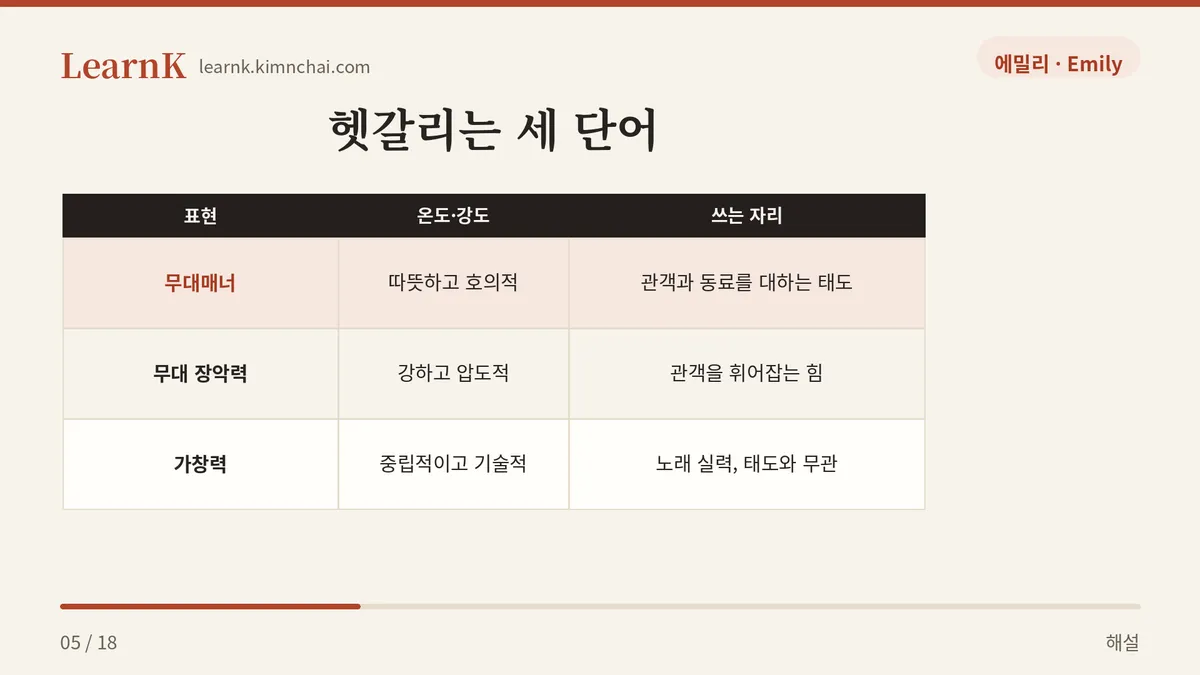
These expressions look similar but aim at different targets.
| Expression | Tone & Intensity | Where It’s Used |
|---|---|---|
| 무대매너 (mudae maeneo) | Warm and favorable | Concert reviews, fan talk. Praising attitude and consideration |
| 무대 장악력 (mudae jangangnyeok) | Strong, overwhelming | Skill evaluation. The power to grip an audience |
| 팬서비스 (paenseobiseu) | Light and friendly | Fan talk. Specific gestures — high-fives, eye contact, finger hearts |
| 가창력 (gachangnyeok) | Neutral, technical | Skill evaluation. Nothing to do with attitude |
무대매너 and 팬서비스 get mixed up especially often. 팬서비스 counts individual actions, so “팬서비스가 많다/적다 (paenseobiseuga manta / jeokda)” — “a lot of / not much fan service” — works. 무대매너, on the other hand, is a person’s overall attitude, so it’s measured only in terms of 좋다 (jota, good) or 아쉽다 (aswipda, disappointing).
Cultural Background — The Three Minutes When the Camera Never Cuts Away
This word was coined in Korea by attaching the English word manner to 무대 (mudae, 舞臺 — the stage, the place where one performs). Because of that, translating it into English as “stage manner” doesn’t really land. The English phrase that fills a similar slot, stage presence, points at charisma and command of the room — a different focus from 무대매너, which is about consideration and attitude.
So why did this particular evaluative term grow up in Korea? Korean music shows run on a weekly cycle. A single song puts a group on the stages of several broadcasters over the course of weeks, and every one of those stages survives on video. The decisive factor is 직캠 (jikkaem, fancam) culture: one camera follows one member and only that member for all three minutes. What they were doing in the back when it wasn’t their part, what their face looked like when the formation got tangled, how they covered for a colleague who slipped — all of it is recorded and replayed. An environment where even the stretches when you aren’t singing are up for evaluation is what grew this word.
So the verdict “good stage manners” tends to come out of scenes like these: yielding a spot to a senior group during a joint awards-show stage; waving all the way out to the darkened corners of the arena; keeping your face intact through an accident and carrying the song to the end. In Korean dramas about idols, there’s a scene that keeps recurring — a manager nagging a trainee on the verge of debut to “learn the attitude before the singing.” Same context.
One more thing: this word is not idol-only. It’s used for trot singers, musical actors, bands, even someone who steps onto the stage at a local festival. There’s just one condition — it has to be a place where you stand in front of an audience.
Today’s Quiz
Which of the following uses 무대매너 most naturally?
- 저 가수 3옥타브 고음이 되네. 무대매너 진짜 좋다. (jeo gasu 3-oktabeu goeumi doene. mudae maeneo jinjja jota.)
- 넘어진 멤버 일으켜 주고 끝까지 웃더라. 무대매너 진짜 좋다. (neomeojin membeo ireukyeo jugo kkeutkkaji utdeora. mudae maeneo jinjja jota.)
- 오늘 발표 자료 정리가 깔끔하네요. 무대매너 좋으시네요. (oneul balpyo jaryo jeongniga kkalkkeumhaneyo. mudae maeneo joeusineyo.)
See the answer
The answer is 2. 무대매너 points to the attitude and consideration shown on stage, so helping up a fallen member and holding a smile to the end is exactly the right kind of evidence. Number 1 is about high notes — that’s a skill matter, so 가창력 fits. Number 3 is a conference-room presentation, which isn’t a stage in the first place.
Definitions and example sentences are from the National Institute of Korean Language’s Basic Korean Dictionary (krdict.korean.go.kr); that portion of this post, including our translations, is licensed under CC BY-SA 2.0 KR.