무지성 (mujiseong) — Switching Off Your Brain and Just Going for It
무지성 (mujiseong)
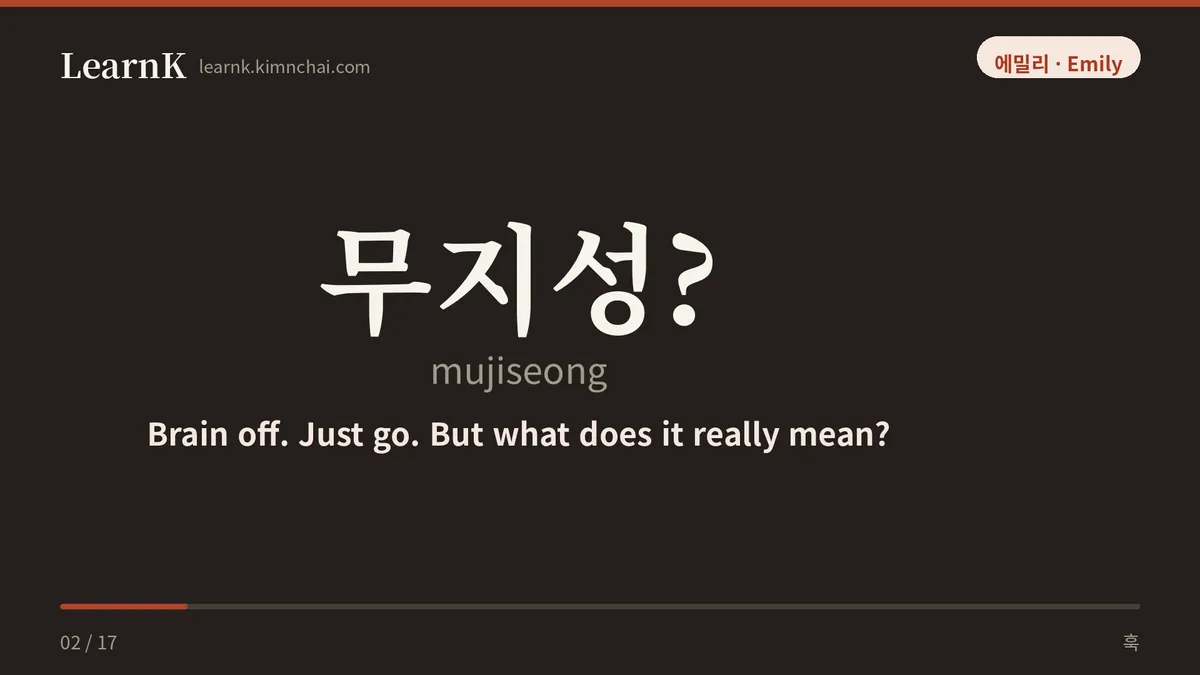
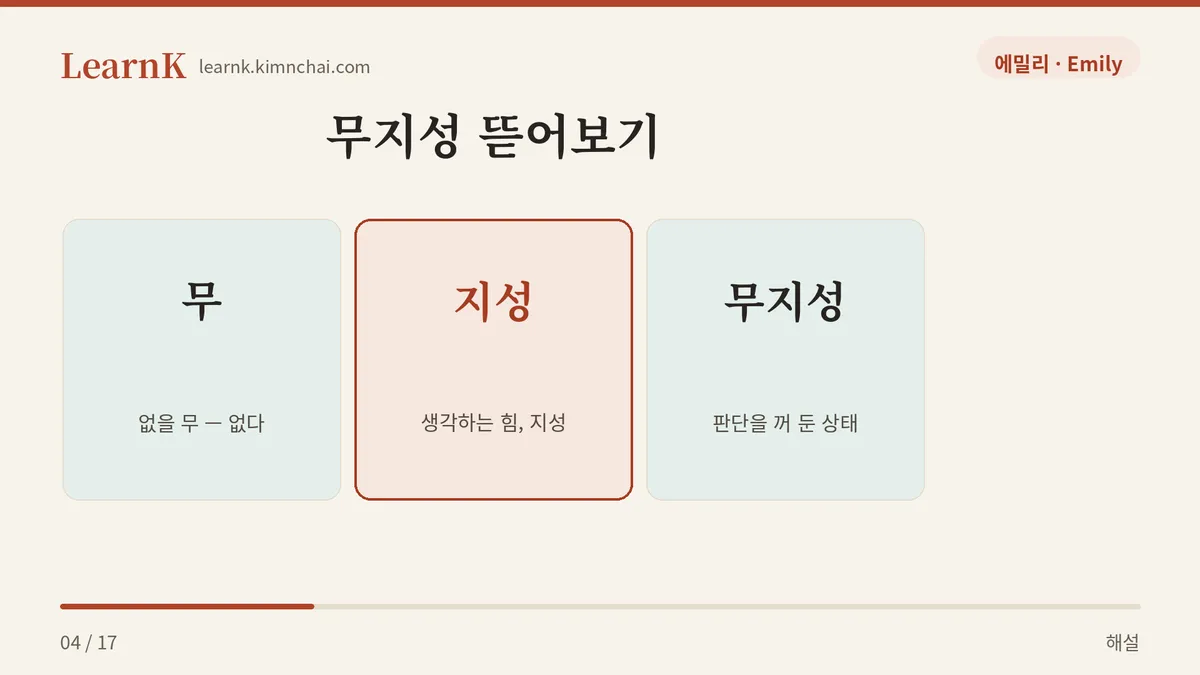
무지성 (mujiseong) describes the attitude of doing something without weighing it at all — brain off, just go. It’s an internet coinage built from the Sino-Korean 무 (無, “without”) plus 지성 (知性, “intellect”), so taken literally it means “lacking intellect.” In real conversation, though, the word doesn’t land nearly that hard. It’s two in the morning, you can’t sleep, so you check out your entire shopping cart — and the next morning you look at the tower of boxes piled up in your entryway and laugh, 어제 내가 무지성으로 질렀구나 (eoje naega mujiseongeuro jilleotguna), “wow, I really bought all that with my brain switched off yesterday.” That’s the house this word lives in most of the time.
So the baseline temperature of 무지성 is not criticism — it’s self-mockery. You’re admitting that you turned your judgment off for a moment and let your body move first, and you deliberately pick an over-the-top word so the admission doesn’t get too serious. 생각 없이 샀어 (saenggak eopsi sasseo), “I bought it without thinking,” sounds like a written apology. 무지성으로 샀어 (mujiseongeuro sasseo) turns the same fact into a joke. It’s a device for stating exactly what happened while taking the weight off it.
Grammatically it attaches in two shapes. One is adverbial: 무지성으로 (mujiseongeuro) — 무지성으로 결제했다 (mujiseongeuro gyeoljehaetda), “checked out with my brain off”; 무지성으로 눌렀다 (mujiseongeuro nulleotda), “clicked it without thinking.” The other is attributive, sitting directly in front of a noun — 무지성 결제 (mujiseong gyeolje), “a no-thought purchase”; 무지성 돌격 (mujiseong dolgyeok), “a brainless charge”; 무지성 시청 (mujiseong sicheong), “mindless watching.” It’s not fussy about which noun follows, and that flexibility is exactly why it spread so fast over just a few years.
One thing to know up front: 무지성 is not yet a headword in Korean dictionaries. The definitions and example sentences in this post were not taken from a dictionary — we wrote them ourselves, based on how Korean speakers actually use the word right now. That’s how alive and moving this word is, which means knowing precisely where it gets used matters far more than memorizing a definition.
A Real Conversation
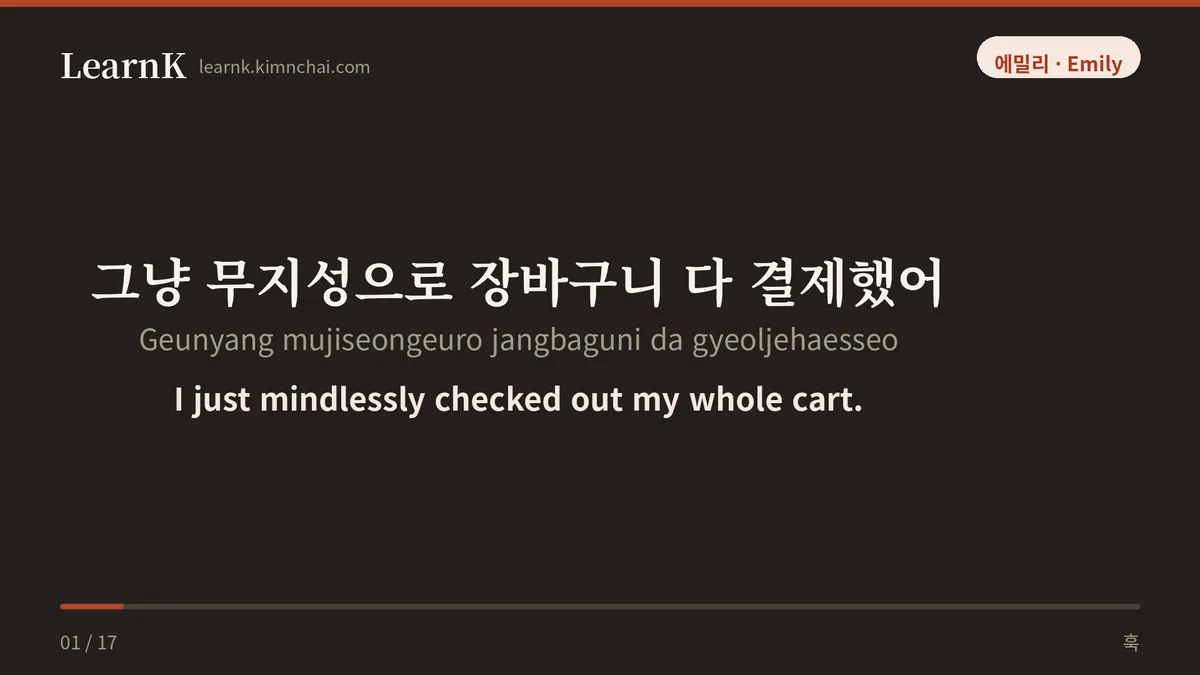
The scene: Saturday morning. Delivery boxes are piled up like a mountain in Emily’s entryway, and Jun-kyung, who has come over to hang out, stops dead in front of them.
준경: 야, 이게 다 뭐야? 현관이 택배 창고야. Hey, what is all this? Your entryway looks like a delivery warehouse.
에밀리: 어제 새벽에 잠이 안 와서… 그냥 무지성으로 장바구니 다 결제했어. I couldn’t sleep last night, so I just mindlessly checked out my whole cart.
준경: 무슨 정신으로. 이 캠핑 의자는 또 뭔데? 너 캠핑 안 가잖아. What were you thinking? And what’s this camping chair? You don’t even go camping.
에밀리: 그러니까. 세일이라길래 무지성 결제. 반품하려니까 또 귀찮고. I know. It was on sale so I bought it without a second thought. And returning it is such a hassle.
준경: 다음엔 사기 전에 나한테 물어봐. 내가 말려 줄게. Next time ask me before you buy. I’ll stop you.
에밀리: 너도 지난달에 키보드 세 개 샀잖아. 우리 사이좋게 무지성이야. You bought three keyboards last month. We’re both equally brainless about this.
Where It Sounds Off
✗ (to your manager in a meeting) 부장님, 그 건은 그냥 무지성으로 진행하시죠. (Bujangnim, geu geoneun geunyang mujiseongeuro jinhaenghasijyo.) — “Sir, let’s just push that one through without thinking.” ✓ (to a coworker) 야, 이건 그냥 무지성으로 밀어붙이자. (Ya, igeon geunyang mujiseongeuro mireobuchija.) — “Hey, let’s just steamroll this one, brain off.” → The word frames the other person’s judgment as “thoughtless,” so you can’t use it in front of a superior or a client. In formal settings, 별도 검토 없이 바로 진행하시죠 (byeoldo geomto eopsi baro jinhaenghasijyo), “let’s proceed directly without a separate review,” is the safe choice.
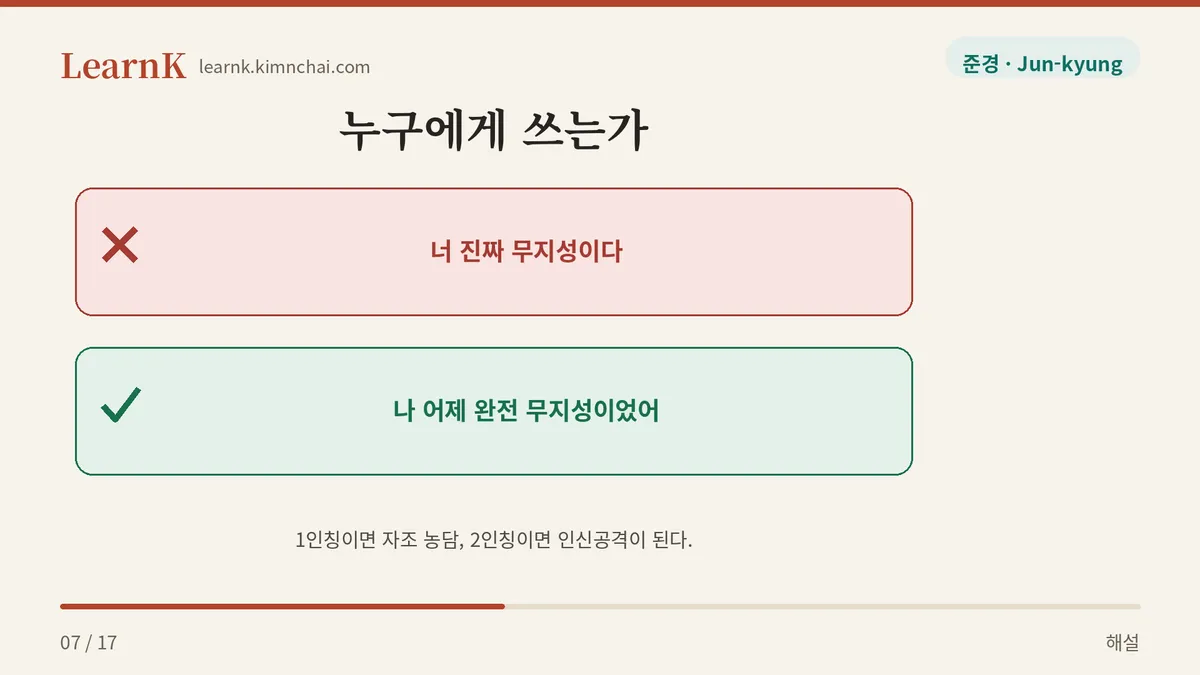
✗ (about a friend’s decision) 너 진짜 무지성이다. (Neo jinjja mujiseongida.) — “You are seriously brainless.” ✓ (talking about yourself) 나 어제 완전 무지성이었어. (Na eoje wanjeon mujiseongieosseo.) — “I was totally brain-off yesterday.” → In the first person it’s funny self-mockery, but the moment you throw it at a second person, the original Sino-Korean meaning (“lacking intellect”) comes back to life and it sounds like a personal attack. The safe zone for this word is basically “me.”
Example Sentences by Situation
Situation 1. Confessing an impulse buy — this is where 무지성 shows up most often. Use it when you regret something but don’t want to grovel about it.
- 월급 들어오자마자 무지성으로 다 써 버렸어. (Wolgeup deureoojaja mujiseongeuro da sseo beoryeosseo.) — “The second my paycheck landed I blew it all without thinking.” For when the money vanishes on payday.
- 리뷰도 안 보고 무지성 결제했다가 사이즈 틀렸잖아. (Ribyudo an bogo mujiseong gyeoljehaetdaga saijeu teullyeotjanha.) — “I checked out without even reading the reviews and of course I got the wrong size.” For when you order clothes badly.
Situation 2. Charging ahead with no strategy — this comes up a lot in gaming and workout talk. It means going on pure force without using your head.
- 작전 짜지 말고 그냥 무지성 돌격하자. (Jakjeon jjaji malgo geunyang mujiseong dolgyeokhaja.) — “Forget the strategy, let’s just charge in brainless.” Said with a laugh when the strategy meeting with your friends is dragging on.
- 무지성으로 힘만 쓰니까 금방 지치지. (Mujiseongeuro himman sseunikka geumbang jichiji.) — “Of course you gas out fast, you’re just muscling through it.” Said to someone overdoing it without paying attention to their form.
Situation 3. Taking whatever you’re given — when you keep watching whatever the algorithm serves you, or just follow whatever someone else recommends.
- 어제 유튜브 무지성 시청하다가 세 시간 날렸어. (Eoje YouTube mujiseong sicheonghadaga se sigan nallyeosseo.) — “I mindlessly watched YouTube yesterday and lost three hours.” The morning after an endless late-night scroll.
- 남들 산다니까 무지성으로 따라 샀지 뭐. (Namdeul sandanikka mujiseongeuro ttara satji mwo.) — “Everyone else was buying it so I just bought it too, no thought involved.” After picking up a trendy item for no particular reason.
Politeness Levels and Similar Expressions
무지성 has no separate honorific form of its own. Among people you’re close to, going up to the 해요체 (haeyoche) polite style — 무지성으로 샀어요 (mujiseongeuro sasseoyo) — sounds natural enough, but in a report or an official announcement you have to swap it out for 충분한 검토 없이 (chungbunhan geomto eopsi), “without sufficient review.” The key point is that raising the politeness of your speech style doesn’t make the lightness of the word itself go away.
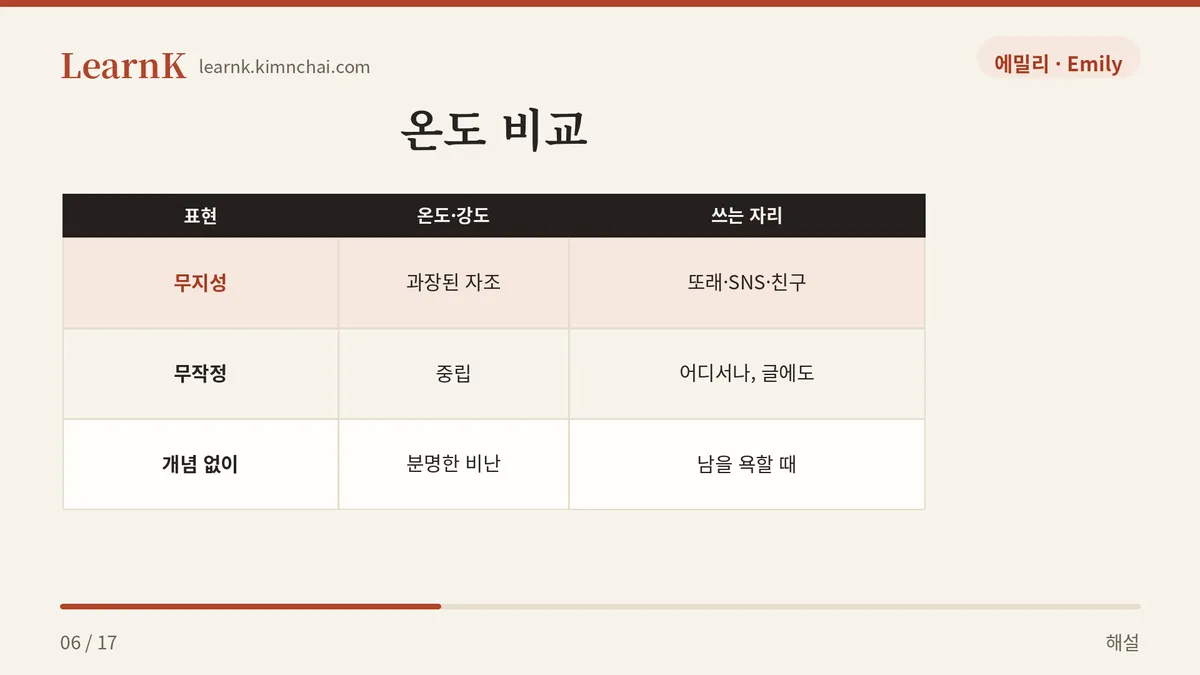
| Expression | Temperature / intensity | Where it’s used |
|---|---|---|
| 무지성 (mujiseong) | Light, exaggerated self-mockery. Strong but funny | Peers, social media, friends. Not with superiors or in official documents |
| 무작정 (mujakjeong) | Neutral. Simply states that there was no plan | Anywhere. Fine in writing too |
| 생각 없이 (saenggak eopsi) | Neutral to mildly reproachful | General everyday conversation. Stings a little when aimed at someone else |
| 개념 없이 (gaenyeom eopsi) | Clear criticism. Attacks the person’s character | For badmouthing someone. Hard to pass off as a joke |
A lot of learners mix up 무지성 and 개념 없이, but the distance between them is considerable. 무지성 means “didn’t use my head”; 개념 없이 means “has no manners or common sense.” The first becomes a joke when you aim it at yourself; the second starts a fight no matter who you aim it at.
Cultural Background — Words That Start With 무 (無)
Korean has long had a pattern of putting the Sino-Korean 무 (無) in front of a word to create “the absence of that thing.” 무의미 (muuimi, “meaningless”), 무관심 (mugwansim, “indifference”), 무조건 (mujogeon, “unconditionally”), and 무제한 (mujehan, “unlimited”) all follow the same frame. 무지성 slots the rather grandiose word 지성 (“intellect”) into that familiar frame. And that’s exactly where the laugh comes from. Hauling out a big word like “lacking intellect” over nothing more than a late-night food order or a sale purchase — the exaggeration itself is the joke.
The word grew noticeably more common around 2020, spreading through online communities and gaming streams. At first it leaned toward tearing down other people’s judgment, but as more people used it, the arrow turned back on the speaker. These days, using it to laugh at yourself is far more common than using it to jab at someone else.
Why did it catch on so well? Because we live in an era where searching, comparing, reading reviews, and checking for the lowest price before buying anything has become the default. When all of that gets exhausting, people occasionally just switch their judgment off. 무지성 is the name you give that moment — and at the same time, it’s a declaration that you’re not going to hate yourself too much for it. If you’ve ever seen a Korean drama or variety show slap a caption with this kind of slang on a character right after they do something impulsive, that’s exactly the structure of the joke.
Today’s Quiz
In which of the following situations would 무지성 (mujiseong) be the most natural choice?
① Proposing an approach for a new project to your department manager ② Confessing last night’s impulse buy to a friend ③ Describing your work style in the personal statement on your résumé ④ Explaining company strategy to a client contact you’re meeting for the first time
Answer: ②
무지성 is a light piece of slang used between peers — and mostly about yourself. Using it in front of a superior or a business contact, as in ① and ④, amounts to calling their judgment “thoughtless,” so it comes off as rude, and using it in an official document like ③ is a mismatch in register. Telling a friend with a laugh, 어제 무지성으로 다 질렀어 (eoje mujiseongeuro da jilleosseo), “I blew it all yesterday with my brain off” — situation ② is where this word sits most comfortably.
무지성 is a newly coined word that is not yet listed as a headword in the National Institute of Korean Language’s Basic Korean Dictionary (krdict.korean.go.kr). The definitions, example sentences, and dialogue in this post were all written by our editorial team and contain no material quoted from the dictionary.