낚이다 (nakkida) — The Word for Laughing at Yourself for Taking the Bait
낚이다
낚이다 (nakkida) means to be taken in by someone’s words or a trick. Literally it describes a fish getting caught on a hook or in a net, but these days, when a Korean says this word, the setting is almost never a riverbank — it’s a phone screen. The thumbnail looked amazing so you tapped it, and there was nothing inside. The rating was high so you booked tickets, and every good scene turned out to be in the trailer. A banner said ‘90% off everything,’ you followed it in, and exactly one item was 90% off. At moments like these, Koreans say one short thing: 낚였다 (nakkyeotda).
The most important thing about this word is its temperature. Someone who says 낚였다 (nakkyeotda) is usually not angry. They’re smiling. They’re admitting that the mouth that grabbed the bait was, in the end, their own — so rather than condemning whoever set the trap, they tease themselves for biting. That’s why 낚이다 (nakkida) works less like a complaint about being wronged and more like a self-mocking exclamation. If real money was lost or an actual crime took place, Koreans don’t say 낚였다 (nakkyeotda); they say 사기당했다 (sagi-danghaetda). Miss that line and the word turns someone else’s real loss into a joke.
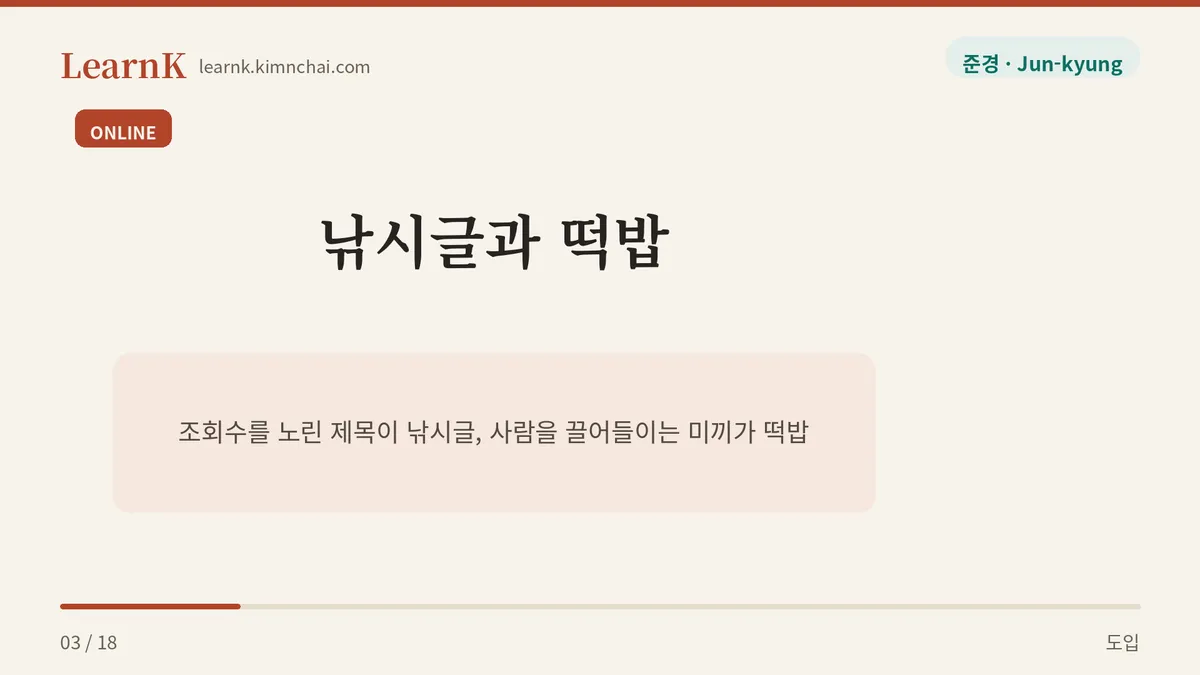
Structurally, 낚이다 (nakkida) is the passive form of 낚다 (nakda), ‘to fish, to hook,’ built with the passive suffix ‘-이- (-i-)’. The subject isn’t the one doing the hooking but the one getting hooked — the one who bit. It’s pronounced [나끼다] (nakkida), and in real conversation the conjugated forms show up far more than the dictionary form: 낚였다 (nakkyeotda), 낚였어 (nakkyeosseo), 낚인 거야 (nakgin geoya), 낚이지 마 (nakkiji ma). A whole family of words has grown out of it, too. A post or headline exaggerated to farm views is a 낚시글 (naksi-geul), that kind of headline is called a 낚시성 제목 (naksi-seong jemok), and the bait tossed out to reel people in is 떡밥 (tteokbap). One fishing metaphor has spread across the entire Korean internet.
Checking the National Institute of Korean Language dictionary
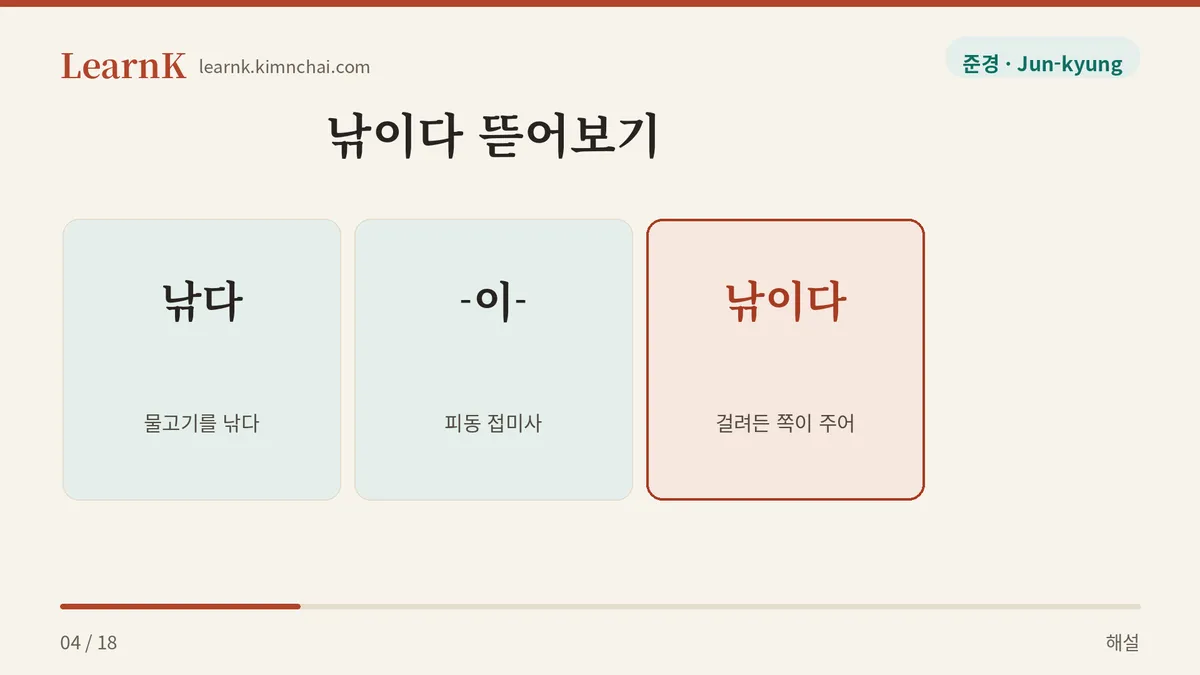
The National Institute of Korean Language’s 《한국어기초사전》 (Basic Korean Dictionary) lists 낚이다 (nakkida) as a verb and splits it into three senses.
1. 낚시나 그물에 물고기가 잡히다. [en] be caught; be hooked — For fish to be captured into a fishing rod or net. [ja] つられる【釣られる】。つれる【釣れる】 — 釣竿や網に魚がかかる。 [es] pescarse, capturarse, atraparse, agarrar, cogerse — Agarrar peces con caña o red para pescar. [zh] 被钓 — 鱼被鱼钩或渔网捕获。 — National Institute of Korean Language, Basic Korean Dictionary (krdict.korean.go.kr)
2. 다른 사람의 말이나 꾐에 넘어가다. [en] be fooled; be tricked — To be fooled by someone’s words or tricks. [ja] つられる【釣られる】 — 他人の言葉や誘いに引っ掛かる。 [es] pescarse, tentarse, cautivarse, arrebatarse, caerse — Caer en la trampa o picar en el anzuelo de otra persona. [zh] 被引诱,被忽悠 — 轻信别人的话或上别人的当。 — National Institute of Korean Language, Basic Korean Dictionary (krdict.korean.go.kr)
3. (속된 말로) 이성에게 유혹되다. [en] be hooked; be enticed — (slang) To be seduced by the opposite sex. [ja] つられる【釣られる】。ひっかかる【引っ掛かる】 — 理性に誘惑されることを俗にいう語。 [es] pescarse, enamorarse, cautivarse, caerse — (VULGAR) Quedar seducido por el sexo opuesto. [zh] 被勾引 — (粗俗)被异性引诱。 — National Institute of Korean Language, Basic Korean Dictionary (krdict.korean.go.kr)
A Portuguese gloss isn’t included in this dictionary. For reference, sense 2 would come out roughly as ser enganado, cair na conversa de alguém — but we should be clear that this one line is our own rendering, not dictionary data.
Below are five of the dictionary’s actual usage examples, quoted as they appear, with a note on the kind of situation each one fits.
미끼에 낚이다. 낚시에 낚이다. 월척이 낚이다. 친구에게 낚이다. 바람둥이에게 낚이다. — National Institute of Korean Language, Basic Korean Dictionary (krdict.korean.go.kr)
- 미끼에 낚이다 (mikkie nakkida) — ‘to be hooked by the bait.’ This is the most basic picture of sense 1, and at the same time it shows at a glance where today’s sense 2 came from. When Koreans say 미끼 (mikki, ‘bait’) now, they far more often mean an exaggerated headline than a worm on a hook.
- 낚시에 낚이다 (naksie nakkida) — Here 낚시 (naksi) means the act of fishing, or the hook itself. Online, this exact sentence has been recycled as a metaphor: getting caught by a clickbait post.
- 월척이 낚이다 (wolcheogi nakkida) — 월척 (wolcheok) means a really big fish. This is pure sense 1, what you say when you land a monster at the fishing hole; carried into metaphor, it also works as praise for landing something big.
- 친구에게 낚이다 (chinguege nakkida) — The textbook case of sense 2: your friend told a lie or pulled a prank and you swallowed it whole. It comes up most around April Fools’ Day, hidden-camera pranks, and surprise-party planning.
- 바람둥이에게 낚이다 (baramdungiege nakkida) — This belongs to sense 3, the use the dictionary itself marks as slang. Learners are better off knowing the meaning and never saying it out loud. It passes judgment on a person, so using it for real can make the other person uncomfortable.
Seeing it in real conversation
Situation: Saturday night, walking out into the theater lobby after the movie.
Jun-kyung: 야, 이게 뭐야. 재밌는 장면은 예고편에 다 나왔잖아. Hey, what was that? All the good scenes were already in the trailer.
Emily: 그러니까. 우리 완전 낚였다. Right? We totally got baited.
Jun-kyung: 별점 9점대라며. 너 그거 보고 예매하자고 했잖아. You said it had a 9-star rating. That’s why you told me to book it.
Emily: 그거 개봉 첫날 별점이었어… 방금 다시 봤는데 6점대야. That was the opening-day rating… I just checked again, it’s down to 6.
Jun-kyung: 아이고. 그럼 우리 두 번 낚인 거네. Oh man. So we got hooked twice.
Emily: 팝콘값은 네가 내라. 예매 링크 보낸 사람이 책임져야지. You’re paying for the popcorn. Whoever sent the booking link takes responsibility.
These usages sound off
✗ (To an elderly neighbor who lost three million won to a phone scam) 어르신, 그거 낚이신 거예요. (eoreusin, geugeo nakkisin geoyeyo.) — Sir, you got baited on that one. ✓ (Same situation) 어르신, 그거 보이스피싱에 속으신 거예요. (eoreusin, geugeo boiseupising-e sogeusin geoyeyo.) — Sir, you were deceived by a voice-phishing scam. → 낚이다 (nakkida) is for light deceptions you can laugh off. Applied to real financial loss, it treats someone’s damage like a joke — and aimed at an elder, it lands even more flippantly.
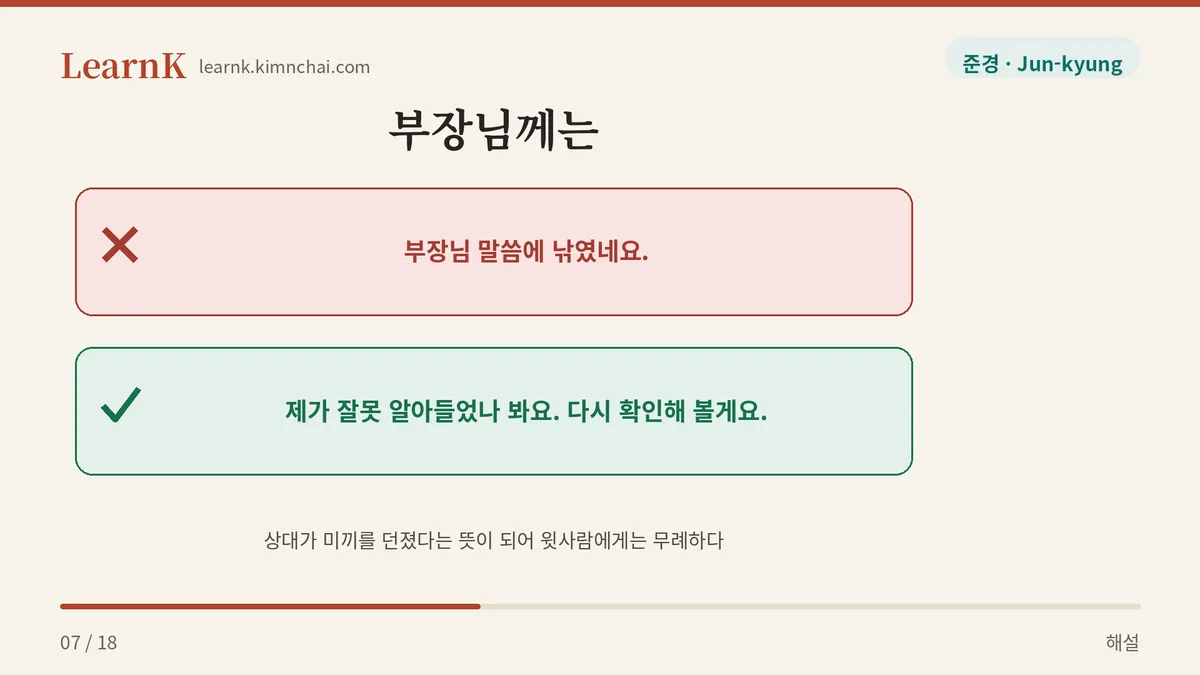
✗ (After a wasted trip caused by bad information from your boss) 부장님 말씀에 낚였네요. (bujangnim malsseume nakkyeonneyo.) — I got baited by what you told me, sir. ✓ (Same situation) 제가 잘못 알아들었나 봐요. 다시 확인해 볼게요. (jega jalmot aradeureonna bwayo. dasi hwaginhae bolgeyo.) — I must have misunderstood. Let me check again. → Built into 낚이다 (nakkida) is the assumption that the other person threw out bait. Used toward a superior, it effectively accuses them of trying to deceive you, so even as a joke it freezes the room. This word is only safe between friends.
Example sentences by situation
1. When you trusted a restaurant photo on social media, waited in line for two hours, and the food was ordinary
사진에 낚여서 두 시간이나 줄 섰는데, 맛은 그냥 그랬어. (sajine nakkyeoseo du sigani na jul seonneunde, maseun geunyang geuraesseo.) I got baited by the photo and stood in line for two whole hours, and the food was just so-so.
‘~에 낚여서 (~e nakkyeoseo)’ is the most common shape for naming what the bait was. 사진에 (sajine, by the photo), 제목에 (jemoge, by the headline), 광고에 (gwanggoe, by the ad), 후기에 (hugie, by the review) — drop the bait into the front slot and the sentence is complete.
2. When your friend pranked you again and you fell for it
아, 또 낚였네. 너 진짜 연기 잘한다. (a, tto nakkyeonne. neo jinjja yeongi jalhanda.) Ugh, you got me again. You’re a seriously good actor.
‘또 낚였네 (tto nakkyeonne)’ has hardened into something close to a set phrase. Instead of getting angry, you’re crediting the other person’s skill — and that one line wraps the whole situation up in laughter.
3. Warning a friend in advance when they send you a sketchy event link
그런 거 낚이지 마. 개인 정보만 가져가는 거야. (geureon geo nakkiji ma. gaein jeongboman gajyeoganeun geoya.) Don’t fall for that kind of thing. They’re just harvesting your personal info.
낚이다 (nakkida) isn’t only for things that already happened. In the imperative, as in ‘낚이지 마 (nakkiji ma),’ it becomes a warning not to get hooked — a kind, meddling heads-up that heads off trouble before it starts.
Politeness levels and similar expressions
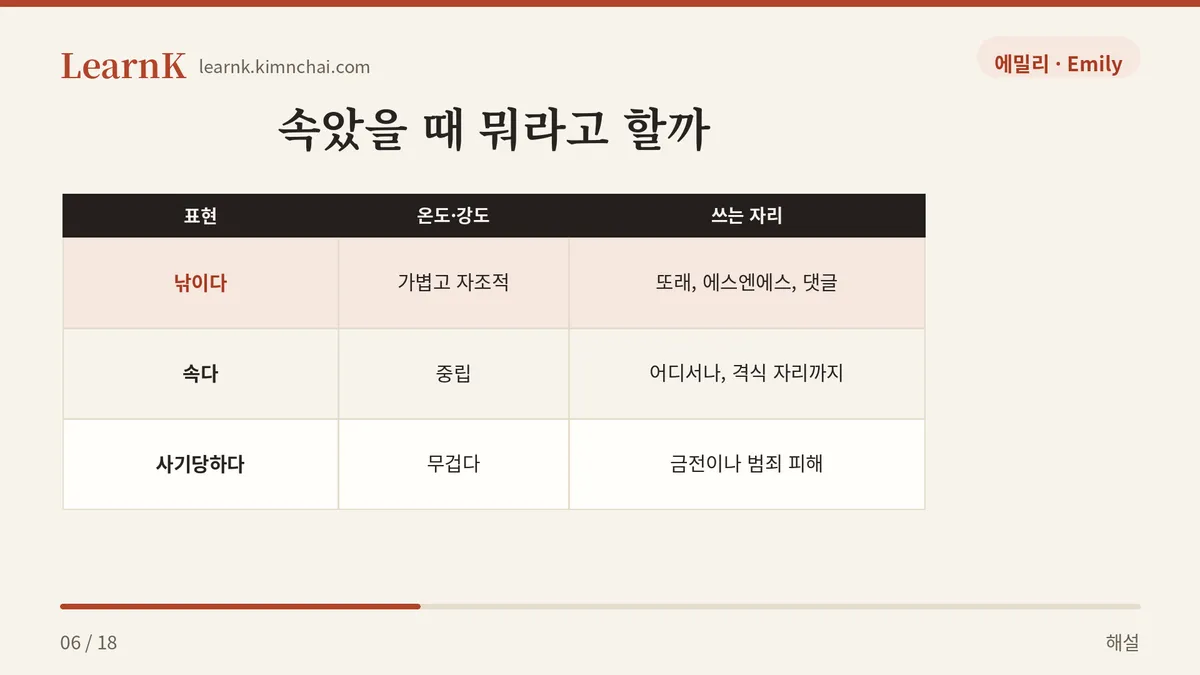
낚이다 (nakkida) is most natural in 반말 (banmal, casual speech). 낚였어 (nakkyeosseo) / 낚였네 (nakkyeonne) / 낚였다 (nakkyeotda) are the basic forms, and with a close senior or an easygoing coworker you can stretch to 낚였어요 (nakkyeosseoyo). But a formal form like 낚였습니다 (nakkyeotseumnida) is essentially never used — the lightness of slang collides with the weight of formal speech. In official settings, it’s safer to switch to 속다 (sokda) from the table below.
| Expression | Tone & intensity | Where it’s used |
|---|---|---|
| 낚이다 (nakkida) | Light and self-mocking, usually with a smile | Among peers, on social media, in comments. Not for superiors or official documents |
| 속다 (sokda) | Neutral | Anywhere — formal settings and written documents included |
| 넘어가다 (neomeogada) | Soft and indirect | For giving in to persuasion, as in 말에 넘어갔다 (mare neomeogatda). Fine even in front of superiors |
| 사기당하다 (sagi-danghada) | Heavy; presumes real harm | Financial loss or crime. Never as a joke |
The tricky part is the distance between 낚이다 (nakkida) and 속다 (sokda). They share sense 2, but 속다 (sokda) simply describes the event, while 낚이다 (nakkida) carries the speaker’s attitude along with it. ‘속았어 (sogasseo)’ is matter-of-fact; ‘낚였어 (nakkyeosseo)’ is already half laughing.
Cultural background — from fishing rod to thumbnail
The picture 낚이다 (nakkida) paints is simple. The fish bites because it thinks the bait is food. The hook is inside the bait. Sense 2 is that whole picture transplanted onto human affairs, and the fact that the dictionary lists senses 1 and 2 side by side is the evidence of that migration.
The reason the word is used so heavily today lies in Korea’s online message-board culture. As posts with nothing but a sensational headline multiplied, people started calling them 낚시글 (naksi-geul), and anyone who got caught by one described themselves as 낚였다 (nakkyeotda). By now the stage has widened to YouTube thumbnails, shopping-app banners, and news headlines. The related vocabulary lives on alongside it. A topic tossed out to draw a crowd is called 떡밥 (tteokbap), and the act of scattering it is 떡밥 던진다 (tteokbap deonjinda). Among drama fans, foreshadowing that finally pays off in a later episode gets described as 떡밥 회수했다 (tteokbap hoesuhaetda), ‘they reeled the bait back in.’
The word shows up often in Korean dramas, too. What’s worth watching, though, is less the line itself than the scene it appears in. At the moment the lead realizes they’ve fallen for someone’s lie, the character on screen usually doesn’t shout. They let out a short, dry laugh and toss off one line. Serious betrayal gets expressed with other words; 낚이다 (nakkida) is used while the relationship is still safe. The word coming out is close to a signal that these two people can still laugh together.
As for sense 3 — being seduced by someone you’re attracted to — the dictionary itself marks it as slang. In practice it isn’t much used by younger generations either, and many people avoid it because it treats a person like an object. For learners, understanding it when you read it is plenty.
Today’s quiz
On April Fools’ Day, a friend told you ‘나 회사 그만뒀어 (na hoesa geumandwosseo)’ — ‘I quit my job’ — and you seriously worried about them and even offered comfort. Then you just found out it was a prank. What’s the most natural Korean reaction here?
- 저는 사기를 당했습니다. (jeoneun sagireul danghaetseumnida.)
- 아, 나 또 낚였네. (a, na tto nakkyeonne.)
- 당신에게 낚이었습니다. (dangsinege nakkieotseumnida.)
Answer: 2. In option 1, 사기당하다 (sagi-danghada) is a heavy word reserved for real financial or criminal harm, so it’s overkill for an April Fools’ prank. Option 3 goes wrong in two ways. The conjugation should be 낚였습니다 (nakkyeotseumnida), not 낚이었습니다 (nakkieotseumnida), and more fundamentally, 낚이다 (nakkida) is slang that doesn’t sit well with formal speech at all. On top of that, you wouldn’t call a friend 당신 (dangsin). Short, casual, and delivered with a smile, like option 2 — that’s where this word belongs.
Definitions and example sentences are from the National Institute of Korean Language’s Basic Korean Dictionary (krdict.korean.go.kr); that portion of this post, including our translations, is licensed under CC BY-SA 2.0 KR.