나쁜 남자 (nappeun namja) — Why Are K-Drama Male Leads So Cold?
나쁜 남자
나쁜 남자 (nappeun namja) doesn’t describe a morally evil person. It describes a man who acts blunt and cold — and who somehow pulls you in precisely because of it. Read literally, the words are just 나쁜 (bad) + 남자 (man), so it’s easy to picture a criminal or a villain. But when Koreans actually say this phrase out loud, the setting is almost always a conversation about dating, or about a drama.
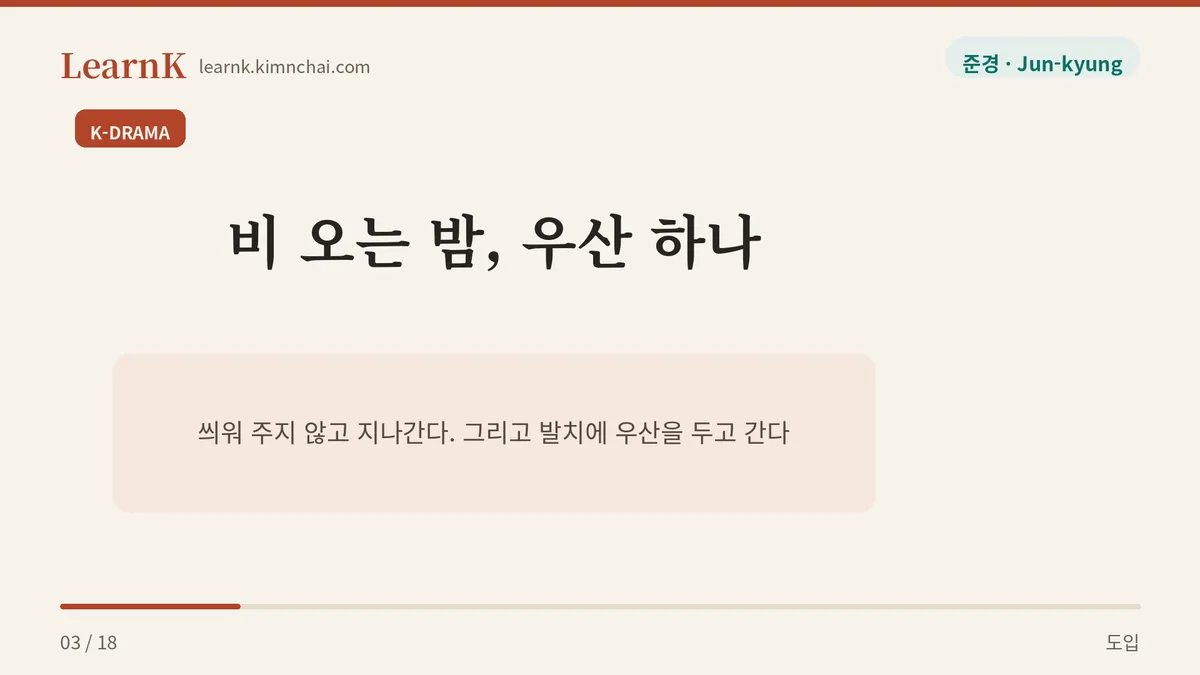
Picture a scene. A pouring-rain night; a woman is standing there with no umbrella. A man walks up. But he doesn’t hold his umbrella over her, doesn’t even meet her eyes, tosses out one short line, and walks right past. A few seconds later the camera pans back — his umbrella is sitting at her feet. Watching that, what Korean viewers say is exactly this: “아, 저거 완전 나쁜 남자네” (“Oh, that is such a bad boy move”). And they’re not saying it in anger. They’re saying it half in admiration.
That’s what makes the temperature of this expression so odd. It sounds like criticism, but it isn’t. It sounds like a compliment, but it isn’t that either. The judgment “he’s mean” and the confession “I’m into him” are stuck together in a single lump. If a Korean learner understands the phrase only by its dictionary meaning, the conversation goes sideways. If a friend grins and says “내 남자친구 좀 나쁜 남자야” (“My boyfriend is kind of a bad boy”), and you reply with a dead-serious face, “헤어져” (“Break up with him”), you’ve just become the person who couldn’t take the joke.
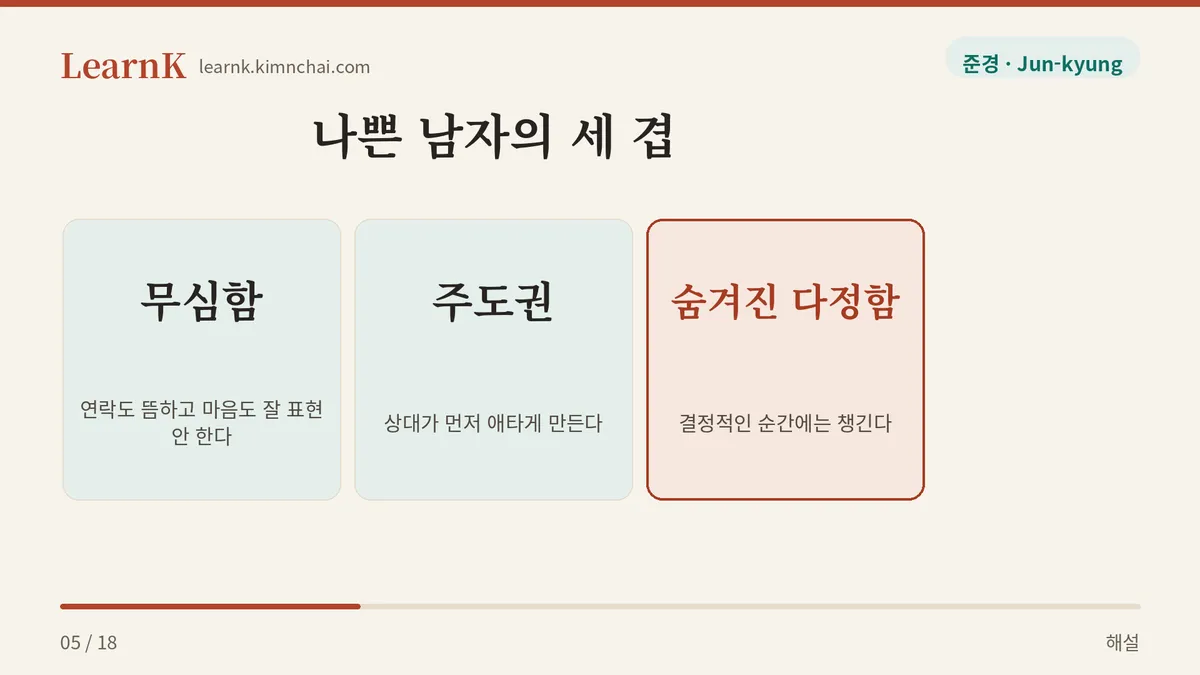
The nuance splits into three layers. First, 무심함 (musimham) — indifference. He doesn’t text often and doesn’t express his feelings well. Second, 주도권 (judogwon) — holding the upper hand. He makes the other person do the wanting, the reaching out. Third, 숨겨진 다정함 (sumgyeojin dajeongham) — hidden tenderness. He’s cold on the surface, but at the decisive moment he takes care of her. Remove that third layer and he’s simply a 못된 남자 (motdoen namja), a genuinely mean guy — and then this expression doesn’t get used at all. In other words, 나쁜 남자 is a phrase built on a twist that’s assumed in advance: he isn’t actually bad.
Seeing it in a real conversation
Situation: A hair salon, Saturday afternoon. The perm solution is on and they’re waiting; on the TV mounted on the wall, a rerun of a weekend drama is playing.
Jun-kyung: 어? 저 남자 또 저러네. 여자 우산도 안 씌워 주고 그냥 가 버리잖아. Huh? There he goes again. He doesn’t even share his umbrella with her — he just walks off.
Emily: 저게 딱 나쁜 남자 공식이야. 이따가 몰래 우산 놓고 갈걸? That’s the classic “bad boy” formula. Bet he leaves the umbrella behind on the sly in a minute.
Jun-kyung: …진짜네. 야, 너 눈치 진짜 빠르다. …You’re right. Wow, you catch on fast.
Emily: 15년 봤는데 이 정도는. 근데 난 저런 거 좀 답답해. Fifteen years of watching these — this much I know. Honestly though, that type frustrates me.
Jun-kyung: 왜? 다들 나쁜 남자한테 끌린다던데. Why? They say everyone falls for a bad boy.
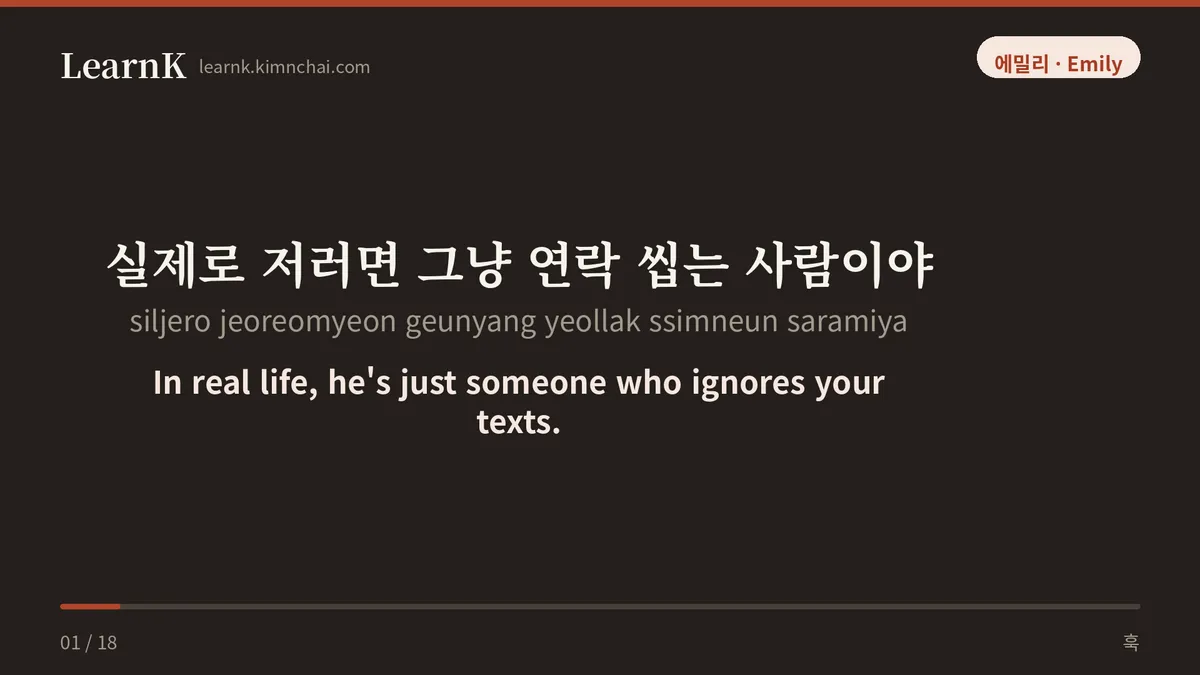
Emily: 드라마에서만. 실제로 저러면 그냥 연락 씹는 사람이야. Only in dramas. In real life that guy’s just someone who ignores your texts.
These uses sound off
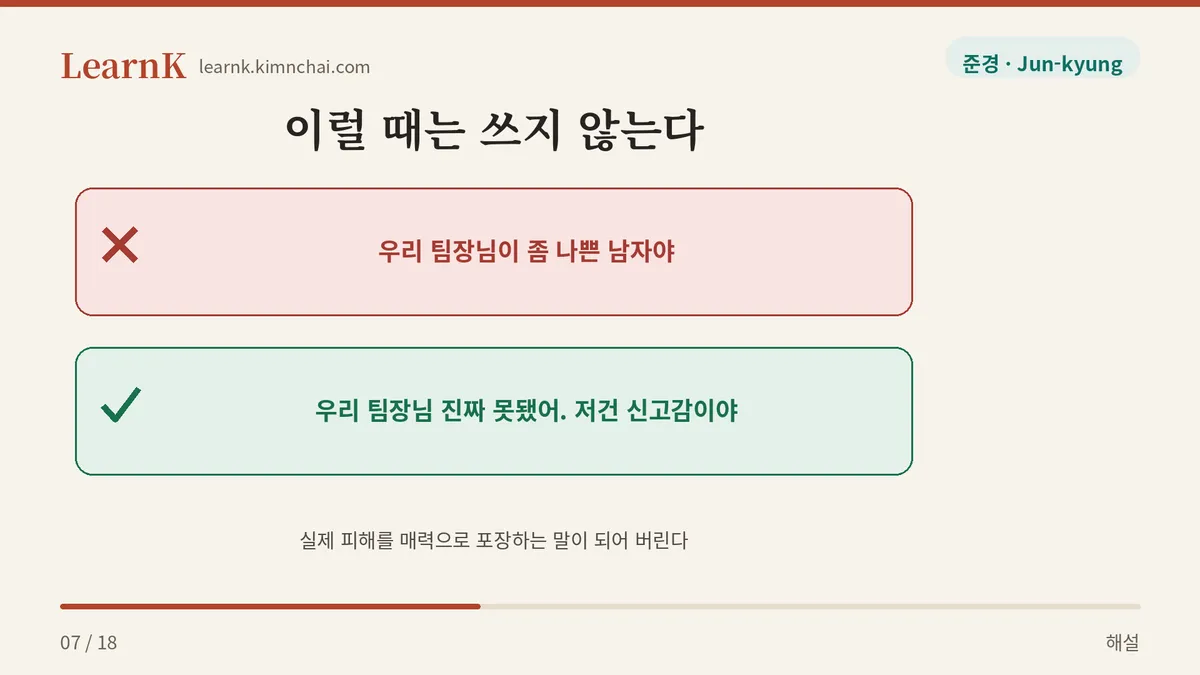
✗ (about a boss who verbally abuses people at work) 우리 팀장님이 좀 나쁜 남자야. My team lead is kind of a bad boy.
✓ (about a boss who verbally abuses people at work) 우리 팀장님 진짜 못됐어. 저건 신고감이야. My team lead is genuinely nasty. That’s something you report.
→ This expression comes with a romantic filter attached to it. Stick it onto behavior that causes real harm, and it turns into a phrase that dresses up abuse as charm. For a person who is actually bad, use 못됐다 (motdoetda) or 무례하다 (muryehada).
✗ (saying it about yourself on a blind date) 제가 좀 나쁜 남자예요. I’m kind of a bad boy.
✓ (a friend saying it about him) 쟤가 좀 나쁜 남자 스타일이야. He’s kind of the bad-boy type.
→ This is a label someone else has to give you. The moment you claim it yourself it sounds like self-flattery, and the other person is quietly laughing on the inside. Korean has quite a few compliments like this — ones that only work when they come from someone else — and this expression is a prime example.
Example sentences by situation
1) When you’re worried about a friend’s new relationship
너 또 나쁜 남자한테 빠졌구나. 지난번이랑 똑같잖아. (neo tto nappeun namja-hante ppajyeotguna. jinantberang ttokgatjana.) You’ve fallen for another bad boy. It’s exactly like last time.
This is something you say to a close friend, half teasing. The ending ‘-구나 (-guna)’ carries the feeling of having just realized something, so it lands less like an interrogation and more like a sighing confirmation.
2) When you’re talking about your drama taste
요즘은 나쁜 남자보다 다정한 남자가 더 인기예요. (yojeumeun nappeun namja-boda dajeonghan namjaga deo inkkiyeyo.) These days a kind guy is more popular than a bad boy.
This one is in polite speech. Leave the expression itself exactly as it is and just switch the sentence ending to ‘-예요’, and you can use it anywhere.
3) When you’re describing your ideal type
저는 나쁜 남자 스타일은 별로예요. 연락 잘 되는 사람이 좋아요. (jeoneun nappeun namja seutaireun byeollo-yeyo. yeollak jal doeneun sarami joayo.) Bad boys aren’t really my thing. I like someone who actually answers his phone.
Attaching ‘스타일 (seutail)’ to the end, as in ‘나쁜 남자 스타일’, shifts the reference from one specific person to the whole type, which makes it much softer. The sense that you’re picking on someone in particular disappears.
Polite vs. casual speech, and similar expressions
This expression is a noun phrase, so it carries no politeness level of its own. The level is decided at the end of the sentence.
- Casual: 쟤 완전 나쁜 남자야. (jyae wanjeon nappeun namja-ya.) — He is such a bad boy.
- Polite: 그분 좀 나쁜 남자예요. (geubun jom nappeun namja-yeyo.) — He’s kind of a bad boy.
That said, even in polite speech the topic itself is a private one, so it’s better not to bring it up with someone older than you or in a work setting.
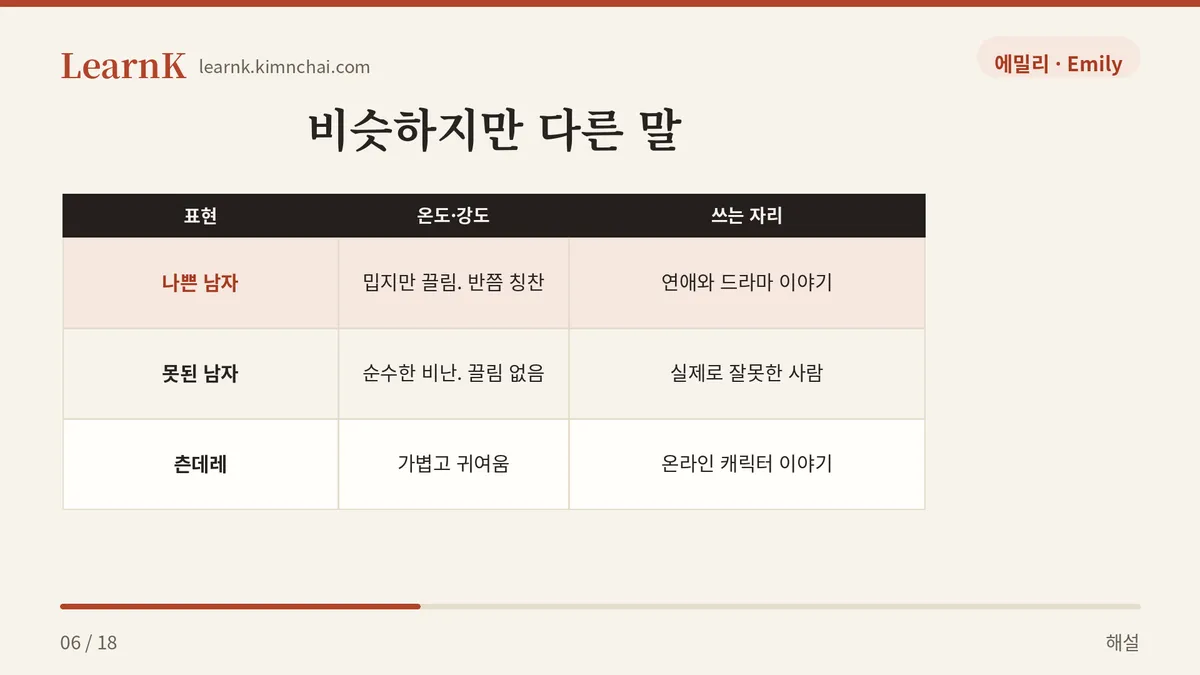
| Expression | Temperature / intensity | Where it’s used |
|---|---|---|
| 나쁜 남자 (nappeun namja) | Infuriating but magnetic; half a compliment | Talk about dating and dramas; among peers |
| 못된 남자 (motdoen namja) | Pure criticism; no attraction | About someone who actually did wrong |
| 츤데레 (cheundere) | Light and cute | Online, among peers; cold outside, warm inside |
| 상남자 (sangnamja) | Bold and decisive; a compliment | For a man with a fiery personality |
| 다정남 (dajeongnam) | Warmth; a compliment | The exact opposite pole from ‘나쁜 남자’ |
The difference from 못된 남자 (motdoen namja) matters most. Both contain a word for “bad,” but 못된 남자 has no twist. If he’s bad, he’s just bad. 나쁜 남자, on the other hand, leaks a signal that the speaker’s heart is already leaning toward him. Listen to which of the two your Korean friend picks, and you can roughly guess where that relationship is headed.
Cultural background — the era when the cold male lead sold
The word formation itself is simple. Take 나쁜, the adjectival form of ‘나쁘다 (nappeuda)’, attach ‘남자 (namja)’, and you have a grammatically unremarkable structure. What’s interesting is that this unremarkable structure hardened into the name of a distinct character type. The literal meaning and the actual usage have drifted apart, making it exactly the kind of word you could never learn from a dictionary alone.
The phrase gained its power from the grammar of male leads in Korean dramas from the late 1990s through the 2000s. Male leads of that era were generally sons of wealthy families, curt in speech, pushing the female lead away again and again and only revealing their feelings in the final few episodes. Viewers endured the “pushing away” stretch and received the eventual confession as a kind of reward. As the structure repeated, the type got a name, and in 2010 a drama aired using this exact phrase as its title. There was also a film with the same title in 2001, but that one is far from romance — a much heavier work — so it shares nothing with this expression’s romantic flavor beyond the name. Several pop songs carry the title as well, so searching it turns up dramas, films, and songs all mixed together.
Around the same period, the word 츤데레 (cheundere) came over from Japan and started being used alongside it. But 츤데레 has a much lighter, cuter feel. The degree to which the character keeps the other person hanging is lower, and it’s mainly used online to describe fictional characters. If 나쁜 남자 is a phrase that comes up in actual relationship advice sessions, 츤데레 is closer to a phrase that comes up in online communities when people talk about characters.
The current trend has clearly shifted. Since the late 2010s, as public conversation about dating violence and emotional neglect grew, the storytelling grammar that painted indifference as charm has visibly shrunk. In its place, the 다정남 (dajeongnam) type — the guy who texts back and says how he feels honestly — has taken over the lead role. So when Koreans use this phrase today, there’s often a note of reminiscing about old dramas, or a slight edge of sarcasm mixed in. A question like “아직도 나쁜 남자 좋아해?” (“You still like bad boys?”) usually has some teasing in it.
Today’s quiz
A friend is telling you about the person she’s just started seeing, and says this with a smile on her face.
걔가 좀 나쁜 남자 스타일이야. He’s kind of the bad-boy type.
What’s the most natural reaction?
- 경찰에 신고해야 하는 거 아니야? — Shouldn’t you report him to the police?
- 오, 그래서 더 좋은 거지? 연락은 잘 와? — Oh, and that’s part of the appeal, right? Does he text you back, at least?
- 그런 사람이랑은 말도 섞지 마. — Don’t even talk to a guy like that.
Answer: 2. This expression already has the speaker’s affection baked into it. Options 1 and 3 are reactions to the literal meaning only, and they bring the conversation to a dead stop. If the friend were genuinely voicing a worry, she would have reached for 못됐다 (motdoetda) or 무례하다 (muryehada) instead of 나쁜 남자. Which word someone picks tells you exactly where their heart is.