너 T야? (neo ti-ya?) — When You Wanted Comfort and Got a Solution Instead
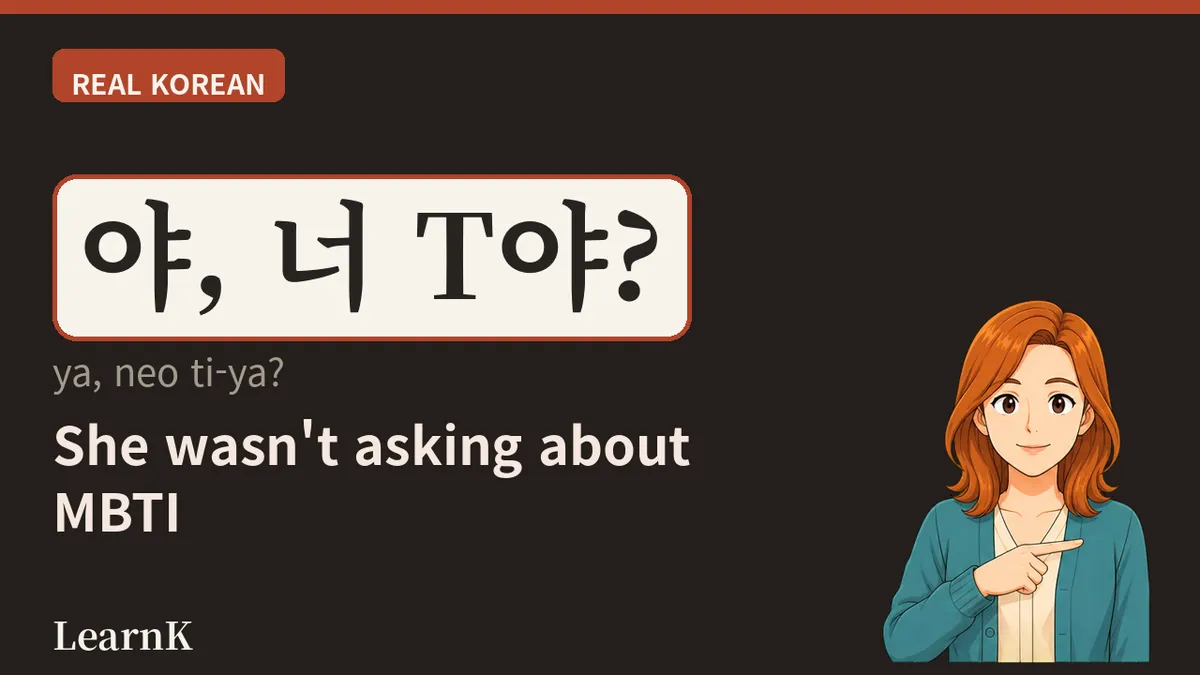
“나 무릎 다 까졌어, 너무 아파.” (na mureup da kkajyeosseo, neomu apa. — “My knee is all scraped up, it hurts so much.”)
“소독부터 해. 그리고 아까 보니까 브레이크를 잘못 잡더라.” (sodokbuteo hae. geurigo akka bonikka beureikeureul jalmot japdeora. — “Disinfect it first. And from what I saw earlier, you were working the brakes wrong.”)
If the gap between those two lines feels subtly off to you, then you already understand why today’s expression exists. In moments like this, Koreans grin and toss out just four little characters.
너 T야? (neo ti-ya?)
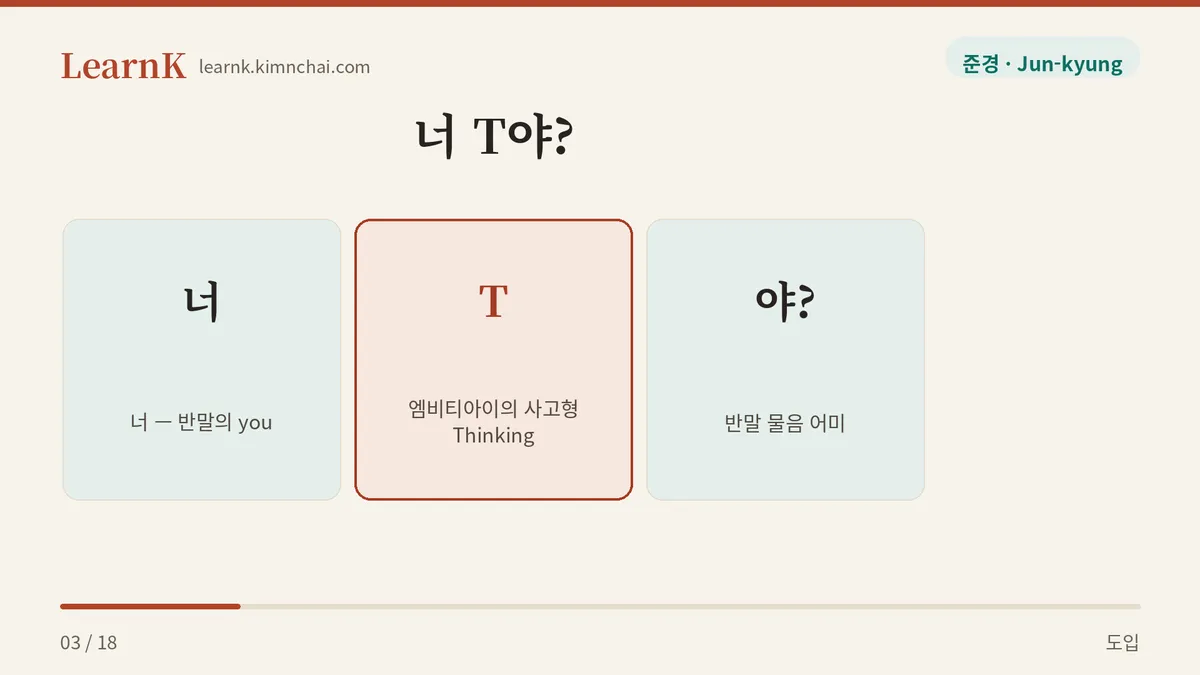
너 T야? (neo ti-ya?) literally means “Are you a T (a Thinking type)?” It’s what you throw out — lightly, teasingly — when you open up hoping for comfort and the other person responds with facts or solutions instead of feelings. The message underneath is: “Isn’t your reaction a little cold right now?” The T here refers to Thinking from the MBTI personality test, and on the opposite side sits F, Feeling.
The important thing is that this is not a real question. People almost never ask because they’re curious about your test results. Nine times out of ten, it’s a complaint wrapped in a joke: “What I wanted right now wasn’t a solution — it was one little ‘아이고, 어떡해 (aigo, eotteokae)’ — ‘oh no, that’s awful.’” Which is exactly why, when the answer comes back 응, ISTJ야 (eung, ISTJ-ya) — “Yeah, I’m an ISTJ” — the conversation only gets funnier. There’s a question mark attached, but no answer is actually wanted. That’s the first key to this expression.
The temperature is basically light. You say it with a side-eye and a half-smile. When you genuinely want to criticize someone, you don’t reach for this one — you go with 너 진짜 너무한다 (neo jinjja neomuhanda), “you’re really being too much.” That said, hearing it over and over from the same person can start to sound like a label — “you have no empathy” — so if the other person already feels bad about it, say it once and let it go.
The form flexes easily. 너 T야? (neo ti-ya?), 너 T지? (neo ti-ji?), 너 T 맞지? (neo ti matji?), and in polite speech, 혹시 T세요? (hoksi ti-seyo?). You can even use it on yourself — when the words are already out of your mouth and you realize your mistake, you patch it up with 나 방금 너무 T였나? (na bangeum neomu ti-yeonna?) — “Was I being way too much of a T just now?”
See It in a Real Conversation
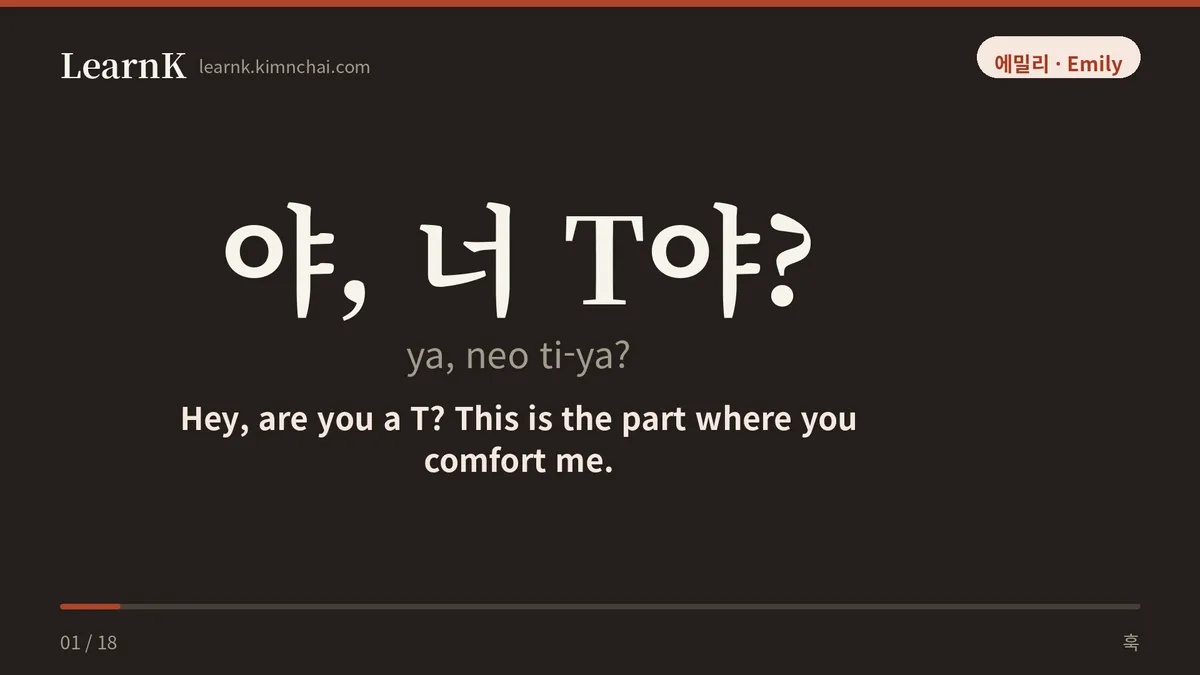
Scene: The waiting room of an orthopedic clinic, where Jun-kyung has brought Emily after she fell off her bike. They’ve just finished checking in and sat down.
Emily: 아 진짜 아파 죽겠어. 무릎 다 까졌어, 봐 봐. Ugh, it hurts so bad. My knee is all scraped up, look.
Jun-kyung: 까진 건 별거 아니고. 인대가 문제야, 엑스레이 찍어 봐야 알아. The scrape is nothing. The ligament’s the issue — you’ll need an X-ray.
Emily: …야, 너 T야? 지금 위로해 줄 타이밍이잖아. …Hey, are you a T? This is the part where you’re supposed to comfort me.
Jun-kyung: 위로한다고 무릎이 낫냐. 아 그리고 내리막에서 앞브레이크만 잡으면 안 된다니까. Comforting you won’t heal your knee. And I told you not to grab only the front brake downhill.
Emily: 됐다 됐어. 너 T 맞지? 나 오늘 확신했어. Forget it. You’re a T, right? I’m totally sure now.
Jun-kyung: …미안. 많이 아팠겠다, 손 줘 봐. …Sorry. That must’ve really hurt. Here, give me your hand.
Where It Sounds Off
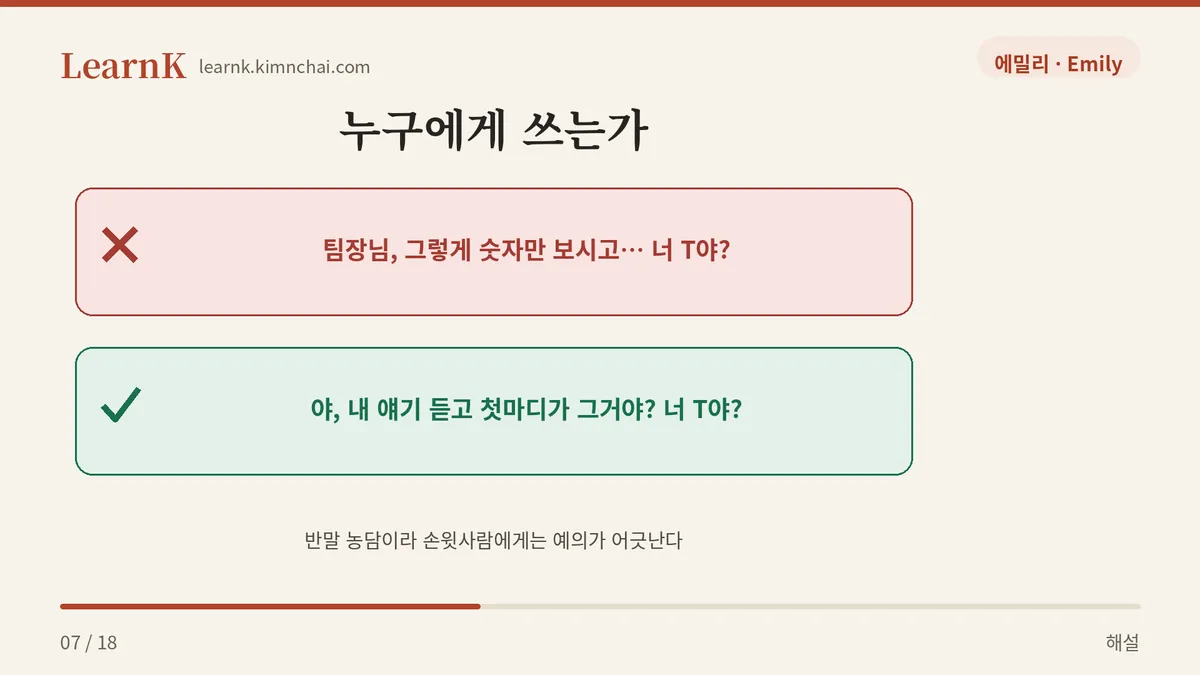
✗ (To your team lead in a meeting) 팀장님, 그렇게 숫자만 보시고… 너 T야? (timjangnim, geureoke sutjaman bosigo… neo ti-ya? — “Sir, all you look at is the numbers… are you a T?”) ✓ (To a coworker your own age sitting next to you) 야, 내 얘기 듣고 첫마디가 그거야? 너 T야? (ya, nae yaegi deutgo cheotmadiga geugeoya? neo ti-ya? — “Hey, that’s your first response after hearing my story? Are you a T?”) → It’s a joke in casual speech, so it’s simply impolite toward anyone senior to you. When a superior is being coldly analytical, something like 역시 냉정하게 보시네요 (yeoksi naengjeonghage bosineyo) — “you really do see things objectively” — is the safe move.
✗ (To a client contact you’re meeting for the first time) 대리님 되게 딱 부러지시네요. 혹시 T세요? (daerinim doege ttak bureojisineyo. hoksi ti-seyo? — “You’re so crisp and decisive. Are you by any chance a T?”) ✓ (To someone you’ve worked with for a long time) 과장님 또 시작이다, 혹시 T세요? (gwajangnim tto sijagida, hoksi ti-seyo? — “Here we go again — are you a T or what?”) → In Korea, MBTI is a personal topic. Bring it up before you’ve built any closeness and it comes across as judging someone’s character, which creates distance.
Example Sentences by Situation
Situation 1 — Eleven at night, a call from a friend who just broke up. Your friend is choking back tears, and cold analysis comes out of your mouth.
야, 지금 그런 얘기 할 때야? 너 T야? (ya, jigeum geureon yaegi hal ttaeya? neo ti-ya?) Hey, is this really the moment for that? Are you a T?
Situation 2 — A coworker who just lost a file at work. The answer that comes back is “What about the backup?”, so you deflect with the polite version.
선배, 혹시 T세요? 지금 백업이 문제가 아니라 제 멘탈이 문제인데요. (seonbae, hoksi ti-seyo? jigeum baegeobi munjega anira je mentari munjeindeyo.) Are you a T, by any chance? The problem right now isn’t the backup — it’s my sanity.
Situation 3 — When you catch your own mistake right after saying it. This is the use where you clean up your own reaction.
아 미안, 나 방금 너무 T였나? 다시. 아이고, 어떡해. (a mian, na bangeum neomu ti-yeonna? dasi. aigo, eotteokae.) Ah, sorry — was I being way too much of a T just now? Let me try again. Oh no, that’s awful.
Polite vs. Casual, and Similar Expressions
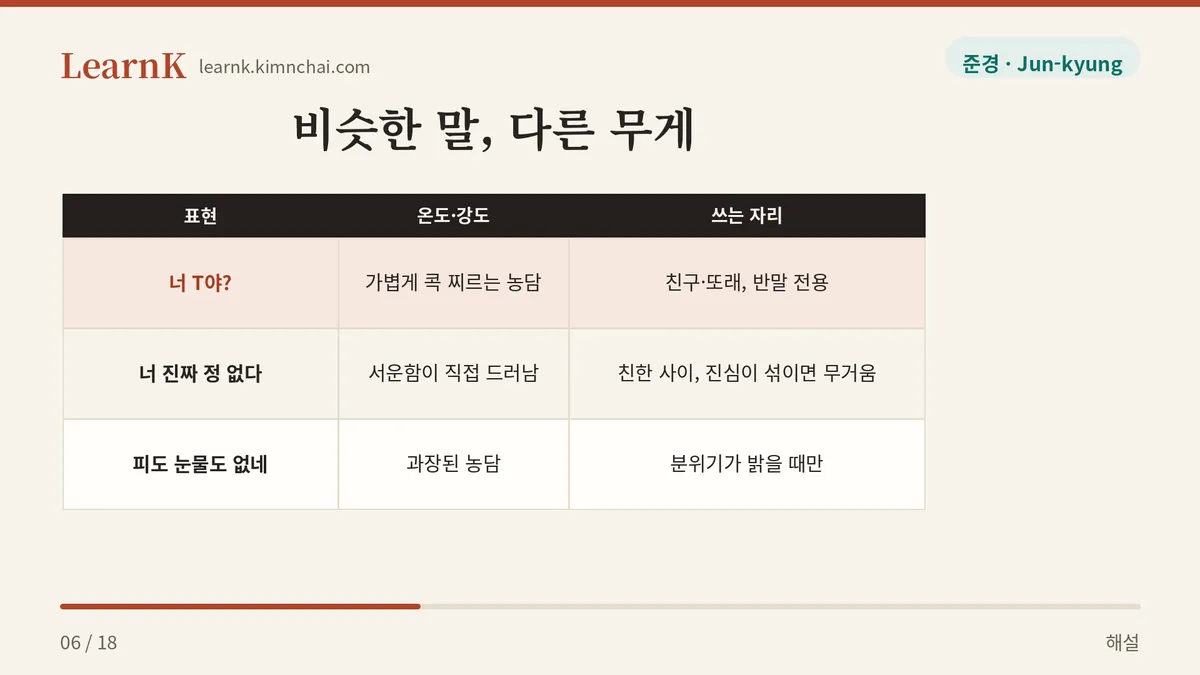
| Expression | Tone & intensity | Where it fits |
|---|---|---|
| 너 T야? (neo ti-ya?) | A light poke; purely joking | Friends and peers. Casual speech only |
| 혹시 T세요? (hoksi ti-seyo?) | Softened polite version; takes a step back | Coworkers you’ve grown close to; online |
| 너 진짜 정 없다 (neo jinjja jeong eopda) | Hurt feelings show through directly | Close relationships. Gets heavy once you mean it |
| 피도 눈물도 없네 (pido nunmuldo eomne) | Exaggerated joke; can land hard | Among peers, and only when the mood is bright |
Even in the same situation, 너 T야? blames the type rather than the person, so it leaves the least residue. 정 없다 (jeong eopda) aims at who someone is, which puts it in a different weight class.
Cultural Background — How Four Characters Came to Stand In for a Personality
MBTI is originally a personality assessment called the Myers-Briggs Type Indicator. The third of its four indicators is the judging function, split between T (Thinking), which leads with logic and principle, and F (Feeling), which leads with people and relationships. As the test exploded in popularity in Korea in the 2020s, MBTI became more than a set of results — it became a language for introducing yourself. On a blind date, “MBTI 뭐예요? (MBTI mwoyeyo?)” — “What’s your MBTI?” — is as common a question as asking about hobbies, and it shows up as an icebreaker card at company workshops and university freshman gatherings too.
너 T야? was born right in the middle of that boom. A conversation that used to require reciting all sixteen type names got compressed down to a single letter of the alphabet. “너 T야?” is much faster than “너 ISTJ야? (neo ISTJ-ya?)” — and, more importantly, much funnier.
There’s an older habit of Korean conversation underneath this, too. In Korea, venting is generally not an act of seeking solutions. That’s exactly why phrases like 밥은 먹었어? (babeun meogeosseo?) — “Have you eaten?” — and 아이고, 어떡해 (aigo, eotteokae) — “oh no, what are you going to do” — stay in constant use even though they solve nothing practical. Tending to the other person’s state first and getting to the actual point second is a sequence people have in their bones. T is, in effect, the name tag that gets pinned on whoever skips that sequence.
The setup is a staple in dramas and variety shows as well. The perfectionist character who can’t read emotions recites statistics as if that were comfort, and the other person stares at them in disbelief — and these days Korean viewers are silently reciting “너 T야?” to themselves in that scene, no subtitles needed. On the flip side, the teasing aimed at F grew up right alongside it. Get misty-eyed over something trivial and you’ll hear F 나왔다 (F nawatda) — “the F is coming out.” In the end, these expressions work less like accusations and more like a device for handling each other’s differences with a joke instead of blame.
Remember just one thing. This phrase stays a joke only when the relationship is already warm. Use it in a chilly one and it’s just criticism.
Today’s Quiz
A friend confides, “나 오늘 면접 완전히 망친 것 같아 (na oneul myeonjeop wanjeonhi mangchin geot gata)” — “I think I completely bombed my interview today.” Which of the following replies is most likely to get you a “너 T야?”
- 아이고, 많이 속상하겠다. (aigo, mani soksanghagetda. — “Oh no, you must be so upset.”)
- 거기 붙어도 연봉 얼마 안 되더라. 다음 거 준비해. (geogi buteodo yeonbong eolma an doedeora. daeum geo junbihae. — “Even if you’d gotten it, the salary isn’t much. Get ready for the next one.”)
- 오늘 저녁 내가 살게, 나와. (oneul jeonyeok naega salge, nawa. — “Dinner’s on me tonight — come out.”)
Answer: number 2. Look at the content alone and there isn’t a single wrong statement in it — it’s genuinely helpful advice. But what your friend wanted wasn’t information; it was one line of “that must have been rough.” Numbers 1 and 3 receive the emotion first, so they’ll never earn this phrase. The advice isn’t the problem — the order is. And the order is, in the end, exactly what today’s expression is here to teach.
Definitions and example sentences are from the National Institute of Korean Language’s Basic Korean Dictionary (krdict.korean.go.kr); that portion of this post, including our translations, is licensed under CC BY-SA 2.0 KR.