넘사벽 (neomsabyeok): 'An Unclimbable Wall' — Awe and Resignation in a Single Word
When you scroll through Korean variety shows or the comment sections on YouTube, you’ll often run into a moment where someone marvels at another person’s skill or looks — so much so that they end up sounding half-resigned — and says, “That’s just 넘사벽 (neomsabyeok).” It’s a curious phrase that sounds like a compliment and a sigh at the same time. Today, we’re taking a deep dive into a slang word that was born on the Korean internet and has now fully seeped into everyday conversation: 넘사벽 (neomsabyeok).
넘사벽
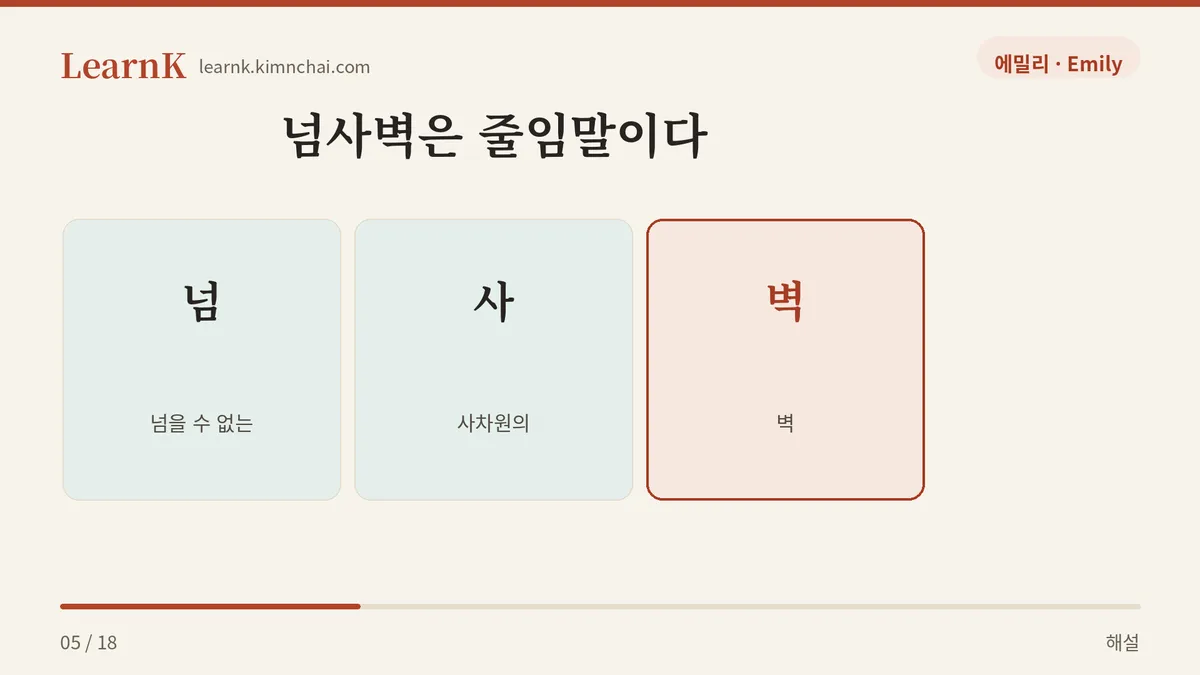
넘사벽 (neomsabyeok) is an abbreviation made from the first letters of “넘을 수 없는 사차원의 벽 (neom-eul su eomneun sachawon-ui byeok)” — literally, “a wall from another dimension that you cannot climb over.” Read word for word, it means “an unclimbable wall that exists in a different dimension.” It’s a phrase — with a slight touch of exaggeration — for a gap in skill or level so huge that no matter how hard you try, you simply can’t catch up.
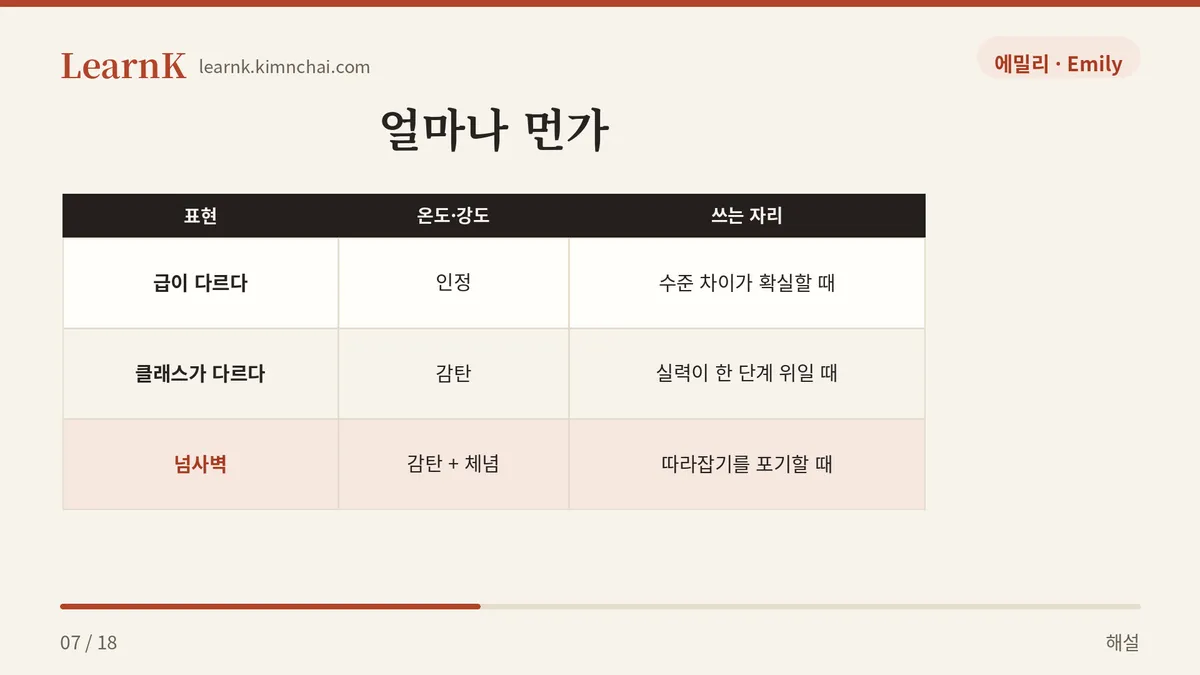
What matters here is the “temperature” of the phrase. 넘사벽 isn’t merely “that person is better than me”; it carries a mix of awe and resignation — “they’re on such a different plane that comparison itself doesn’t even hold.” So envy, admiration, and a little bit of self-mockery all come through at once. Be sure to remember that it’s by no means a put-down — in fact, it’s closer to a compliment that lifts the person all the way up. The wall is so high you can’t even imagine climbing it — that exact feeling is the heart of this word.
Seeing It in a Real Conversation
Scene: A weekend afternoon at an indoor climbing gym. On the wall right in front of them, an expert zips up the hardest route in a flash.
Jun-kyung: 야, 저 사람 좀 봐. 저 코스를 저렇게 쉽게 올라간다고? Hey, look at that guy. He’s climbing that route that easily?
Emily: 헐… 저건 진짜 넘사벽이다. 난 저 첫 홀드도 못 잡겠는데. Whoa… that’s on a whole other level. I can’t even grab that first hold.
Jun-kyung: 그치? 우리랑은 아예 레벨이 다르네. 완전 다른 세계 사람이야. Right? He’s on a totally different level from us. Like he’s from another world.
Emily: 나 여기 삼 개월이나 다녔는데도 저 근처도 못 가. 그냥 넘사벽이야. I’ve been coming here three whole months and I’m not even close. It’s just unreachable.
Jun-kyung: 에이, 그래도 처음보단 훨씬 늘었잖아. 꾸준히 하면 돼. Come on, you’ve improved a lot since the start. Keep at it and you’ll get there.
Emily: 위로는 고마운데… 저 사람은 그냥 넘사벽으로 남겨둘게. ㅋㅋ Thanks for the encouragement, but I’ll just leave him as my unreachable wall. Haha.
Example Sentences by Situation
① When an idol fan watches their favorite perform “저 무대 장악력은 진짜 넘사벽이야.” (jeo mudae jangangnyeok-eun jinjja neomsabyeok-iya.) — “That command of the stage is truly on an unclimbable-wall level.” This is when you compare the seasoned skill of a singer several years into their career with rookies and hype them up, saying there’s just no way to measure them on the same scale. The tone is 90% admiration, 10% envy.
② While checking a game ranking “1위랑 점수 차이가 넘사벽이네.” (il-wi-rang jeomsu chai-ga neomsabyeok-ine.) — “The score gap with the No. 1 player is like an unclimbable wall.” This is a half-awe, half-resignation expression you use when the gap has widened so much that you, sitting at No. 2, could run as hard as you want and still never catch the No. 1.
③ After visiting a great restaurant “여기 먹고 나니까 다른 집은 못 가겠어. 여기가 넘사벽이야.” (yeogi meokgo nanikka dareun jib-eun mot gagesseo. yeogi-ga neomsabyeok-iya.) — “After eating here, I can’t go anywhere else. This place is on a whole other level.” You also use it like this when something has climbed to an incomparable top spot, making every other option feel underwhelming.
Formal vs. Casual Speech and Similar Expressions
Since 넘사벽 was born as internet slang, it’s rarely used in formal settings or official documents. Among friends, you toss it out casually, like “완전 넘사벽이야 (wanjeon neomsabyeok-iya),” and in slightly more polite settings, you just raise the ending a bit and say “넘사벽이에요 (neomsabyeok-ieyo).” That said, no matter how much you polish the ending, the word itself is casual, so keep in mind that it doesn’t fit serious occasions with a boss or an elder you’re meeting for the first time.
Similar expressions include “클래스가 다르다 (keullaeseu-ga dareuda)” (in a different class), “급이 다르다 (geub-i dareuda)” (on a different tier), and “차원이 다르다 (chawon-i dareuda)” (on a different dimension). All three mean “the gap in level is huge,” but among them, 넘사벽 carries the strongest sense of absolute distance — so far that you’d give up trying to catch up altogether. Conversely, when two people are so evenly matched that it’s hard to declare a winner, you use the idiom “도토리 키 재기 (dotori ki jaegi)” (acorns measuring their heights).
Cultural Background
넘사벽 is a classic abbreviated coinage believed to have been created in Korean online communities in the late 2000s. It nicely shows a hallmark of Korean internet language: compressing a long sentence by taking only the first letters. At first it spread within gaming, sports, and idol fandoms as a term for “an unassailable top dog,” and now it has become a national slang word for expressing an “overwhelming gap” in nearly every domain — cooking, studying, looks, and more.
Characters in Korean variety shows and dramas also frequently have it pop up in the subtitles when they throw up their hands in awe at someone’s talent. So when you run into this word while watching Korean content, you can read it as, “Ah, that person is recognizing the other as the absolute best right now.” Once more, for emphasis: it’s not negative criticism but the highest form of respect.
Today’s Quiz

A friend listens to a famous pianist perform and marvels, “Wow, no matter how much we practice, we could never, ever catch up to that skill.” What’s the single three-syllable slang word that sums up this feeling? (Hint: 넘을 수 없는 사차원의 벽 — a wall from another dimension you can’t climb over.)
The answer is, of course, 넘사벽 (neomsabyeok). With this one phrase you learned today, you too can naturally join in on Korean fans’ expressions of awe!