뇌절 (noejeol) — How to Say 'Enough Already' in One Word
뇌절
뇌절 (noejeol) means repeating the same words or actions so often that everyone watching gets sick of it — or pushing something well past the point where it still works. It was coined on the Korean internet, and these days you’ll hear it in everyday offline conversation too.
Picture the scene. A friend imitates a catchphrase from the variety show they watched yesterday. The first time, you laughed. The second time, you laughed to be nice. But then they keep doing it all through dinner, at the café, on the subway. It’s not just that the funny thing stopped being funny — now it’s mildly irritating. That exact point is what Korean pins down in a single word: 뇌절이야. (noejeoriya.) It’s a name for the feeling that even something that killed the first time dies on repeat.
The heart of 뇌절 isn’t the content — it’s the count and the degree. It doesn’t mean the joke itself was bad. It means the joke would have been great once, and got ruined by the fourth or fifth try. So 뇌절 isn’t really used for things that were never funny to begin with. If it was dull from the start, that’s 노잼 (nojaem). 뇌절 carries a slightly rueful nuance: something good got spoiled by repetition.
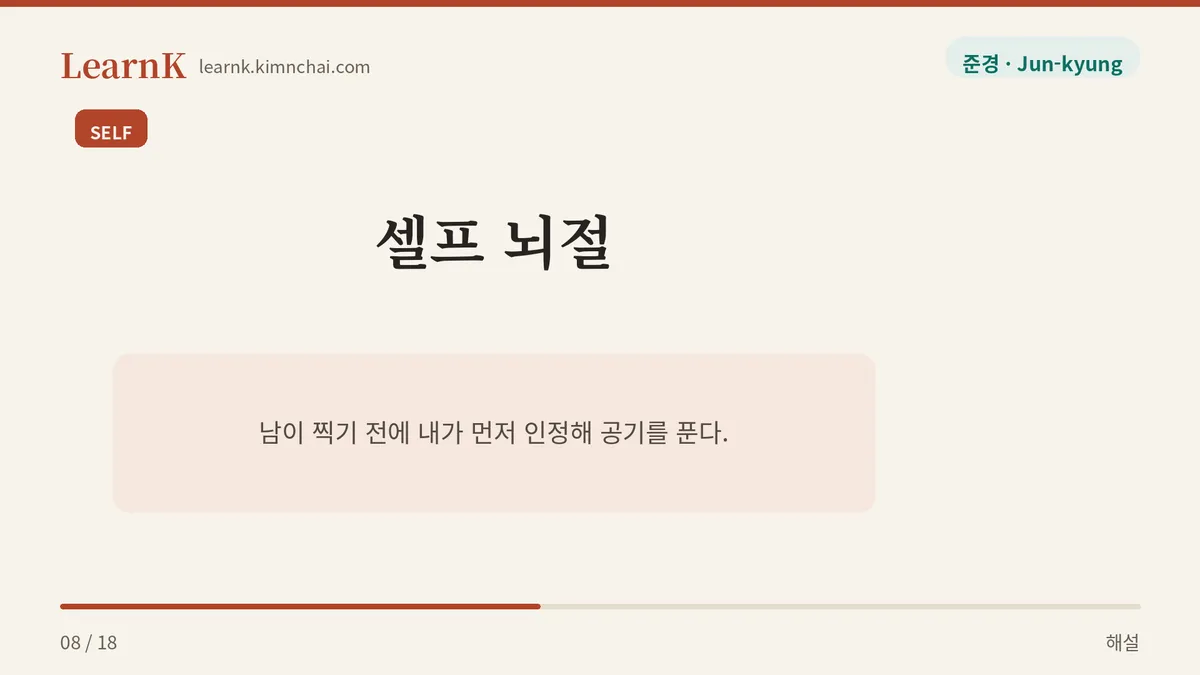
It’s flexible. As a noun you say 뇌절이다 (noejeorida), and as a verb, 뇌절하다 (noejeolhada). You can aim it at someone else, or stick it on yourself. When the mood was good until you piled on one more joke and the air went cold, you say: 아, 나 방금 뇌절했다. (a, na banggeum noejeolhaetda.) This is called ‘셀프 뇌절 (selpeu noejeol)’ — self-noejeol. Admitting your own misfire first to clear away the awkwardness is a very Korean way of patching things up.
The temperature is high. 뇌절 is neither a compliment nor a neutral description — it’s a jab with teasing mixed in. That’s why the places you can use it are clearly fixed: peers, friends, people you’re comfortable with, online. Cross that line in the wrong direction and the meaning may land, but the relationship takes damage. Let’s map out where that line is.
See It in Real Conversation
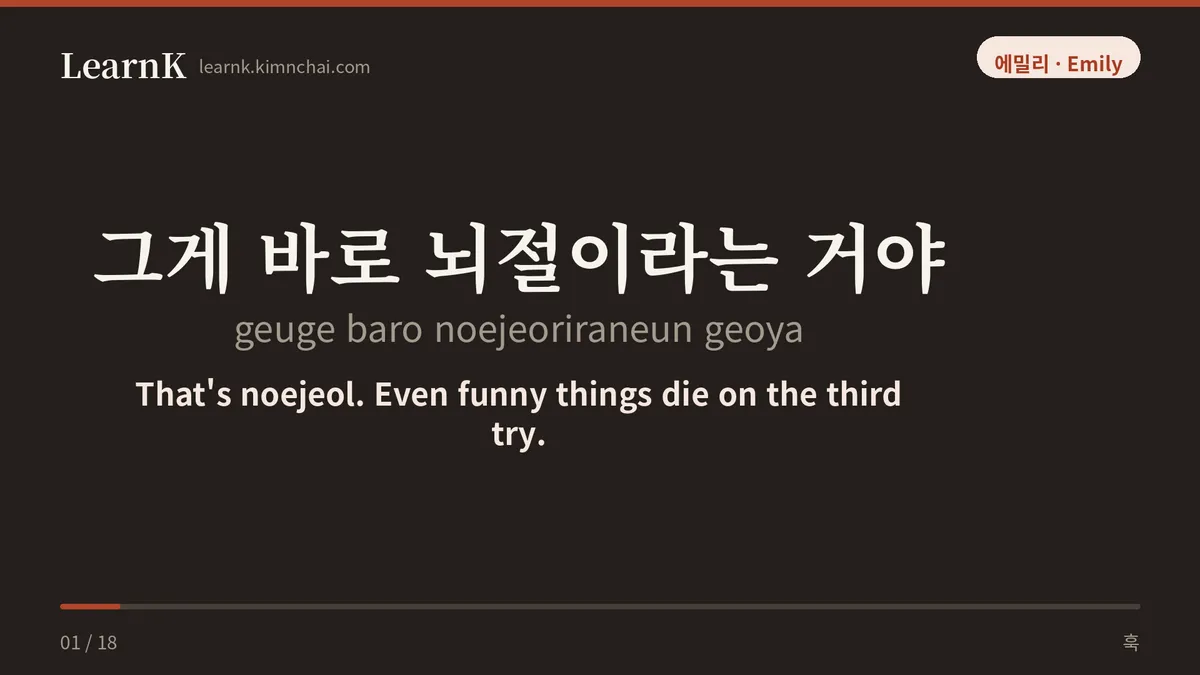
Scene: Friday night at a noraebang. They booked an hour, and Jun-kyung hasn’t let go of the mic for thirty minutes.
준경: 자, 이번이 진짜 마지막. 아까 그 노래 한 번만 더 부를게. Okay, this is really the last one. Let me sing that same song one more time.
에밀리: 야, 그거 벌써 세 번째야. 1절만 해, 1절만. Hey, that’s already the third time. Just one verse, one verse.
준경: 아니 이번엔 키를 낮춰서 부르는 거라 완전히 다르다니까? No, this time I’m singing it in a lower key, so it’s completely different.
에밀리: 그게 바로 뇌절이라는 거야. 웃기던 것도 세 번 하면 노잼 돼. That’s exactly what we mean by 뇌절. Even something funny turns unfunny by the third round.
준경: 알겠어 알겠어. 그럼 난 탬버린만 칠게. Fine, fine. Then I’ll just play the tambourine.
에밀리: 그 탬버린도 아까부터 뇌절하고 있거든? That tambourine has been 뇌절-ing for a while now, you know?
When This Sounds Off
✗ (Listening to your manager present in a team meeting) 부장님, 그 얘기 좀 뇌절이신데요. Sir, that story is getting a bit 뇌절. ✓ (To a coworker your own level, after the meeting) 야, 아까 그 얘기 세 번째야. 완전 뇌절. Hey, that’s the third time he’s told that story. Total 뇌절. → 뇌절 flatly declares that what someone is saying has become tiresome, so aimed at a senior it sounds rude. Attaching polite endings — ‘뇌절이세요 (noejeoriseyo)’ — doesn’t help. In front of a superior, something like ‘그 부분은 앞에서 이미 말씀해 주신 것 같습니다 (geu bubuneun apeseo imi malsseumhae jusin geot gatseumnida)’ — “I believe you covered that point earlier” — is the safe route.
✗ (When a friend has been talking about caring for their sick father for days) 그 얘기 이제 뇌절이야, 그만해. That story is 뇌절 by now. Stop it. ✓ 많이 힘들지. 계속 마음이 거기 가 있나 보다. That must be so hard. Sounds like your mind is still there. → 뇌절 is for repetition of light things: jokes, trends, bits. Attach it to something genuinely painful and you turn another person’s suffering into a punchline. Being understood and being allowed to say it are two different things.
Example Sentences by Situation
1. In the company group chat, when the same meme keeps getting posted
그 짤 오늘만 다섯 번째야. 슬슬 뇌절인데? (geu jjal oneulman daseot beonjjaeya. seulseul noejeorinde?)
Adding ‘슬슬 (seulseul)’ turns it into a heads-up: “I’m not mad yet, but you’re about to cross the line.” It taps the brakes gently instead of calling someone out hard, which makes it well suited to a group chat.
2. Talking about a drama or a series
시즌 1은 진짜 좋았는데, 5부터는 좀 뇌절 아니야? (sijeun ireun jinjja joatneunde, obeuteoneun jom noejeol aniya?)
This doesn’t mean the show is bad — it means they’ve squeezed the same formula for far too long. Putting ‘진짜 좋았는데 (jinjja joatneunde)’ in front makes it clear this is criticism from a place of affection. It’s the form you’ll see most often in Korean fan communities.
3. On yourself (셀프 뇌절)
아까 그 농담 한 번 더 한 거, 내가 생각해도 뇌절이었어. (akka geu nongdam han beon deo han geo, naega saenggakhaedo noejeorieosseo.)
This is a sentence that owns the mistake before anyone else can point it out. Say it and the awkward air usually clears. For learners, this usage is the safest of all — 뇌절 aimed at yourself can’t hurt anyone’s feelings.
Politeness Levels and Similar Expressions
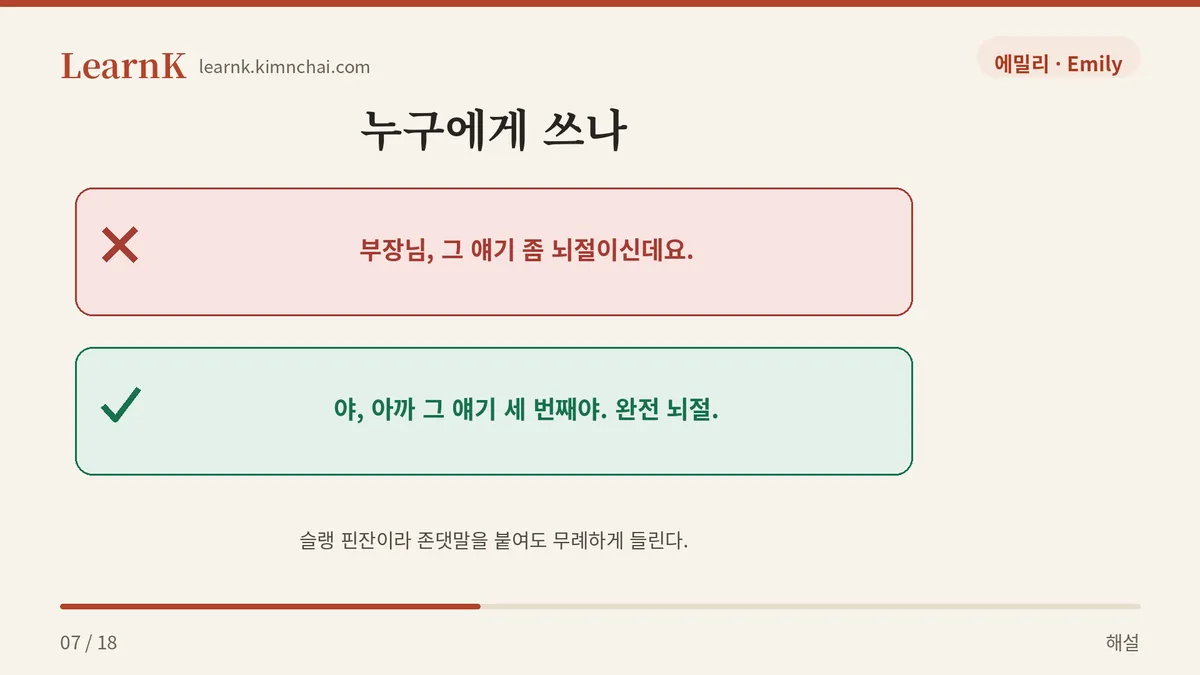
뇌절 isn’t a standard dictionary word, so tacking on polite endings doesn’t make it formal. ‘뇌절이에요 (noejeorieyo)’ is grammatically possible but still reads as peer-level speech, and it doesn’t belong in meetings, presentations, or customer-facing situations. If you need to convey the same idea to someone senior, it’s better to spell it out — something like ‘조금 반복되는 것 같습니다 (jogeum banbokdoeneun geot gatseumnida)’, “it seems to be getting a little repetitive.”
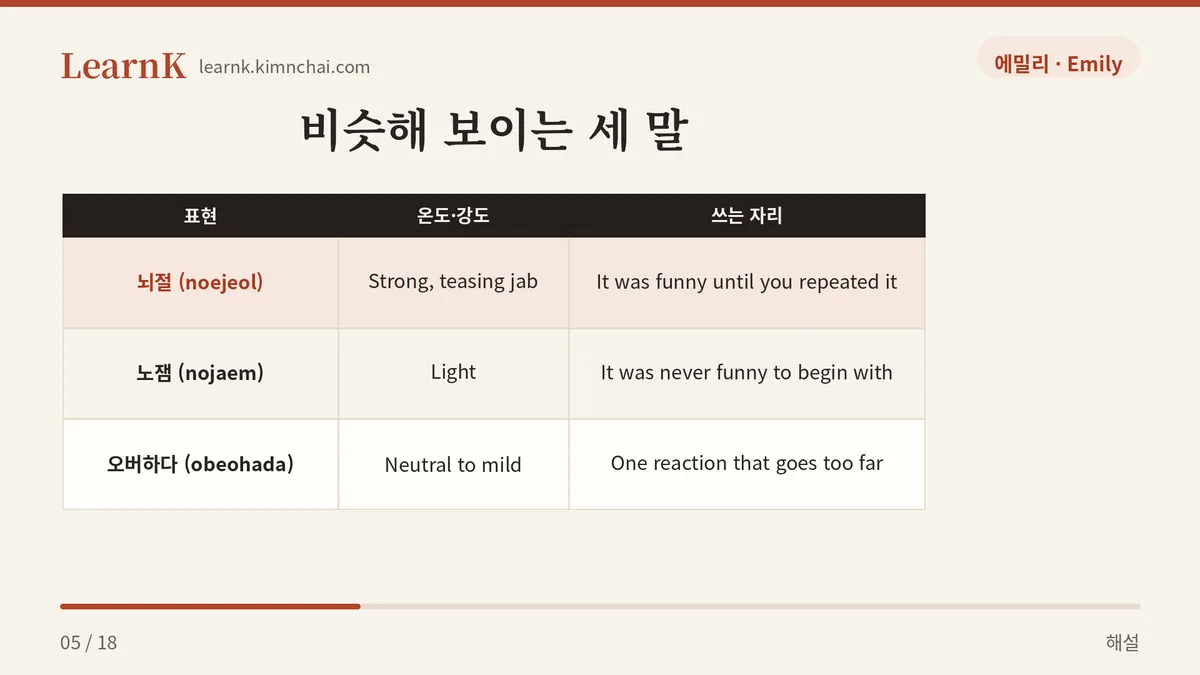
| Expression | Temperature / Strength | Where to Use It |
|---|---|---|
| 뇌절 (noejeol) | Strong. A jab with teasing in it | Peers, friends, online. Not with seniors |
| 1절만 해 (iljeolman hae) | Playful warning. Just before 뇌절 | Peers. Said with a laugh while stopping someone |
| 오버하다 (obeohada) | Neutral to mildly negative | Anywhere. Can be softened even in front of seniors |
| 질리다 (jillida) | Calm description. No emotional flare-up | Anywhere. Natural in writing too |
| 노잼 (nojaem) | Light. Nothing to do with repetition | Peers, social media |
The trickiest pair in the table is 뇌절 and 노잼. 노잼 means “it wasn’t funny in the first place”; 뇌절 means “it was funny, and repetition killed it.” So for a joke you’re hearing for the first time, you can say 노잼 but not 뇌절. 오버하다, on the other hand, is less about repetition and more about a single instance going too far. Someone whose reactions are way too big is 오버한다 — you wouldn’t usually say they’re 뇌절한다.
Cultural Background — 1절, 2절, and 뇌절
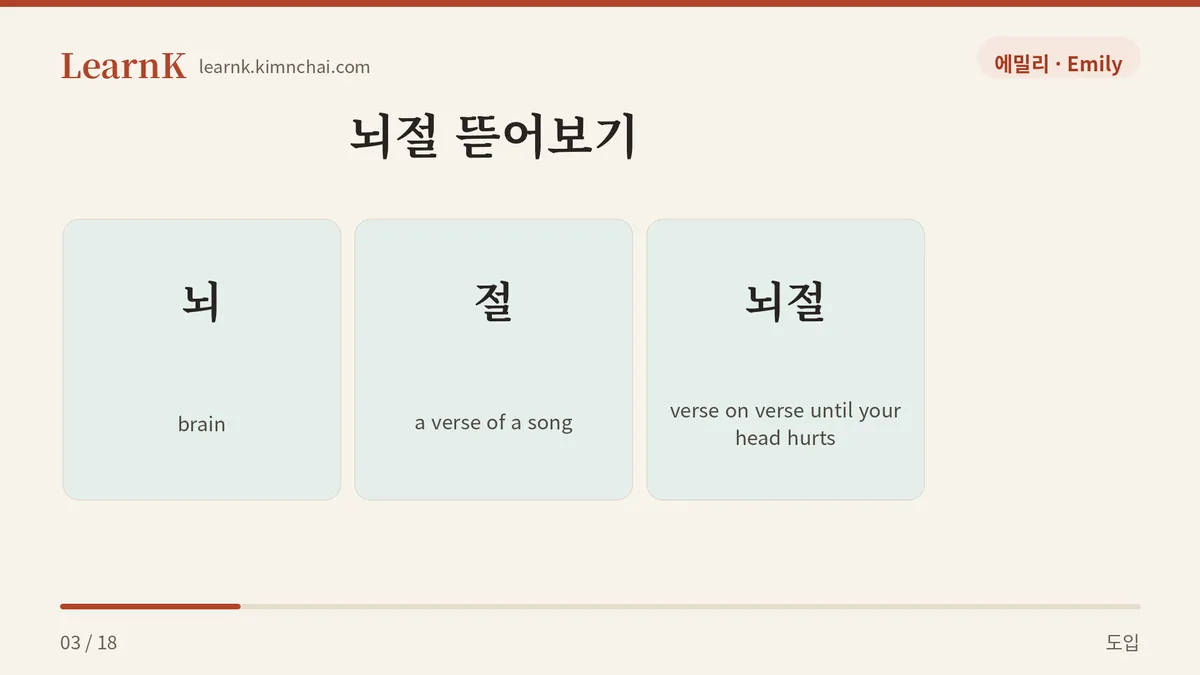
The root of this word is the ‘절 (節)’ of a song — a verse. Korean has long had an idiom for reining in someone who’s going on too long: ‘1절만 해 (iljeolman hae)’, “sing only the first verse.” Telling someone to stop at verse one came to mean “that’s enough.” But if they keep going despite the warning, it runs on to verse two, three, four. 뇌절 was coined as a comic name for where that ends — verse piled on verse until your brain hurts, a bit of wordplay built out of 뇌 (brain) plus 절 (verse). That’s why ‘1절만 해’ and ‘뇌절’ still show up side by side in the same conversation. In the noraebang exchange above, Emily warns with ‘1절만 해’ first and then delivers the verdict with ‘뇌절’ — that’s the pair in action.
Why did Korea in particular need a word like this? Korean online culture has an unusually short meme lifespan. A catchphrase spreads nationwide in a week and is already dated the week after. On variety shows, it’s common for the production team to slip a subtitle jab at a cast member who keeps recycling the same bit. In an environment with that little patience for repetition, a word that tells you when to stop becomes socially useful. 뇌절 works, in effect, as a traffic light announcing that now is the time to quit.
For learners, the word is useful twice over. First, you’ll understand it when Korean friends drop it into conversation. Second, it makes you watch out for a common learner trap — falling in love with a newly learned expression and using it ten times a day. The better the expression, the more sparingly you should spend it. This word teaches that lesson all by itself.
Today’s Quiz
Which sentence uses 뇌절 most naturally?
- (To an interviewer, in a job interview) 제 지원 동기는 뇌절입니다.
- (To a friend) 야, 그 유행어 오늘만 열 번째야. 이제 뇌절이야.
- (Visiting someone in the hospital) 어머니가 편찮으시다니 정말 뇌절이네요.
Show the answer
Answer: 2
뇌절 means “something light has been repeated so much that people are sick of it,” and it’s slang for casual relationships. In sentence 2, the target (a catchphrase), the repetition (the tenth time), and the listener (a friend) all line up.
Sentence 1 drops slang into a formal setting and doesn’t even make sense. Sentence 3 pins a teasing word onto someone else’s misfortune — the grammar is fine, but it’s a serious breach of manners. 뇌절 is a word where you check the setting before you check the meaning.
Definitions and example sentences are from the National Institute of Korean Language’s Basic Korean Dictionary (krdict.korean.go.kr); that portion of this post, including our translations, is licensed under CC BY-SA 2.0 KR.