뇌섹남 — The Word for Falling in Love with a Mind, Not a Face
뇌섹남
뇌섹남 (noesengnam) means “a man whose brain is sexy” — a guy you fall for because of the way he talks, his quick wit, and how he unpacks what he knows, rather than because of his looks. For a long time in Korea, the words people reached for when praising someone were attached to the face. Then, at some point, people started telling a different story. Ask a friend just back from a blind date “그 사람 어땠어? (geu saram eottaesseo?, How was he?)” and the answer comes back not as “잘생겼어 (jalsaenggyeosseo, He’s good-looking)” but “말을 진짜 잘하더라 (mareul jinjja jalhadeora, He’s really good with words)” — and the one word that gets attached to that answer is this one.
Let’s pin the nuance down precisely. This word is not a synonym for 똑똑하다 (ttokttokada, to be smart). It isn’t a label that attaches automatically to high test scores or a degree. 뇌섹남 attaches instead to the way that intelligence shows on the outside. Someone who explains a hard thing simply. Someone who comes at a conversation from an angle you didn’t see coming. Someone who notices first what you don’t know, and starts talking from there. This word comes out when it isn’t the amount of knowledge but the way a person handles knowledge that reads as attractive.
One more thing. Since the word literally contains 섹 — from 섹시하다 (seksihada, to be sexy) — it clearly lives in the territory of attraction and romantic appeal. That makes it warm and light. It’s half admiration, half teasing, and it is not a word for a serious written evaluation. It’s a word that pops out among friends, on social media, or while watching a variety show.
See It in a Real Conversation

Situation: The subway home on a Friday evening. Emily, who went on a blind date yesterday, happens to run into Jun-kyung in the same car.
Jun-kyung: 야, 어제 소개팅 어땠어? 연락은 왔고? Hey, how did the blind date go yesterday? Did he text you?
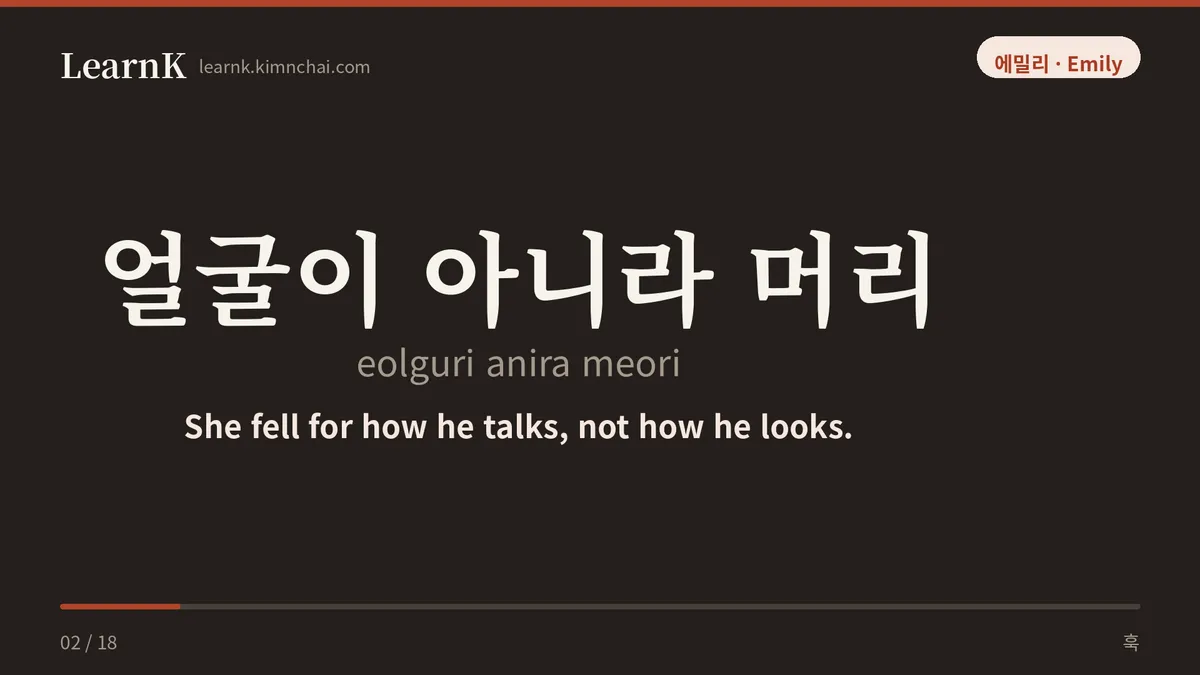
Emily: 왔어. 근데 나 아직도 어제 대화가 생각나. 완전 뇌섹남이더라. He did. But I’m still replaying our conversation. He was a total brainy hottie.
Jun-kyung: 뭐야, 얼굴 얘기는 한마디도 안 하네? What—you haven’t said a single word about his looks.
Emily: 그게 기억이 잘 안 나. 말을 어찌나 재밌게 하는지 두 시간이 십 분 같았어. I honestly can’t remember them. He talked so well that two hours felt like ten minutes.
Jun-kyung: 하여간 너 옛날부터 말 잘하는 사람한테 약했어. You’ve always had a weakness for people who are good with words.
Emily: 어쩌겠어, 나한텐 그게 제일 큰 매력인걸. 너도 뇌섹남 소리 좀 들어 봐. What can I say, that’s the biggest draw for me. You should try getting called one too.
Where It Sounds Off
✗ (Said straight to your boss after a meeting) 부장님, 오늘 발표 들었는데 진짜 뇌섹남이세요. Sir, I heard your presentation today — you’re a total brainy hottie. ✓ (Said to a coworker) 야, 부장님 오늘 설명 깔끔하시더라. 요즘 말로 뇌섹남이지. Hey, the boss explained things really cleanly today. In today’s slang, that makes him a 뇌섹남. → Because “sexy” is built into this word, no matter how kindly you mean it, saying it to someone senior turns it into a comment on their attractiveness, delivered to their face. On top of that, it’s informal slang. When you’re speaking directly to someone above you, something like 설명을 참 쉽게 해 주십니다 (seolmyeongeul cham swipge hae jusimnida, “You explain things so clearly”) is the safe choice.
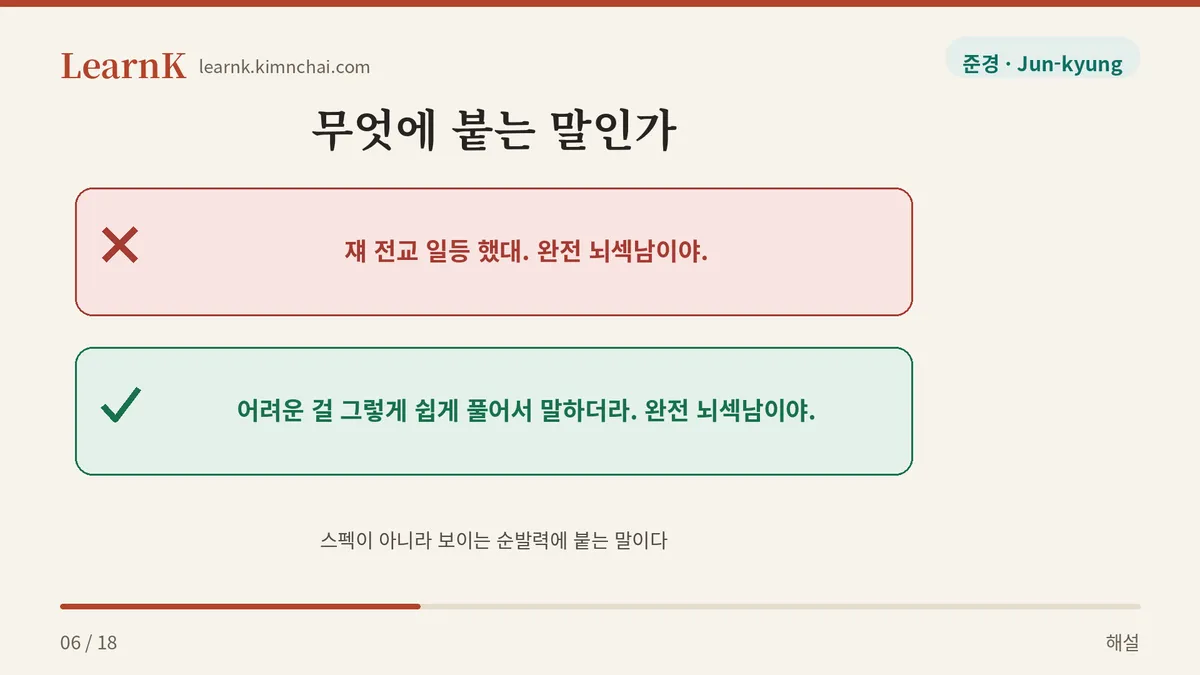
✗ 쟤 이번에 전교 1등 했대. 완전 뇌섹남이야. I hear he came first in the whole school this time. He’s a total brainy hottie. ✓ 쟤 어제 발표 봤어? 어려운 걸 그렇게 쉽게 풀어서 말하더라. 완전 뇌섹남이야. Did you see his presentation yesterday? He took something difficult and laid it out so simply. He’s a total brainy hottie. → Grades, school pedigree, and certifications don’t really work as grounds for this word. It attaches to quickness you can actually see. Use it based on credentials alone and you get one of those sentences learners produce often — the meaning gets across, but something is subtly off.
Example Sentences by Situation
1) While watching a variety or quiz show together When a contestant breezes through a hard problem, or reaches an answer from an angle nobody else saw — this is where the word comes flying out of the living room most often.
이 사람 말하는 거 봐. 진짜 뇌섹남이다. (i saram malhaneun geo bwa. jinjja noesengnamida.) Just look at the way he talks. He’s genuinely brain-sexy.
2) Listening to a friend’s blind-date or dating story When a friend goes on at length about the conversation rather than the looks, you use it to sum up for them: ah, so that’s the part you fell for.
너 그 사람 뇌섹남이라서 좋아하는 거지? (neo geu saram noesengnamiraseo joahaneun geo jiji?) You like him because he’s intellectually attractive, right?
3) About yourself — strictly as a joke This is a word other people pin on you. Calling yourself one is self-praise, so if you’re going to use it, use it only in an unmistakably joking tone.
나도 오늘부터 책 읽고 뇌섹남 될 거야. (nado oneulbuteo chaek ilkko noesengnam doel geoya.) Starting today I’m going to read books and become a brainy guy too.
Politeness Levels and Similar Expressions
Since this is a noun, attaching a polite ending — as in 뇌섹남이세요 (noesengnamiseyo) — is grammatically possible in itself. But raising the ending doesn’t raise the register of the word; it stays just as light. Remember that the problem isn’t grammar, it’s the setting.
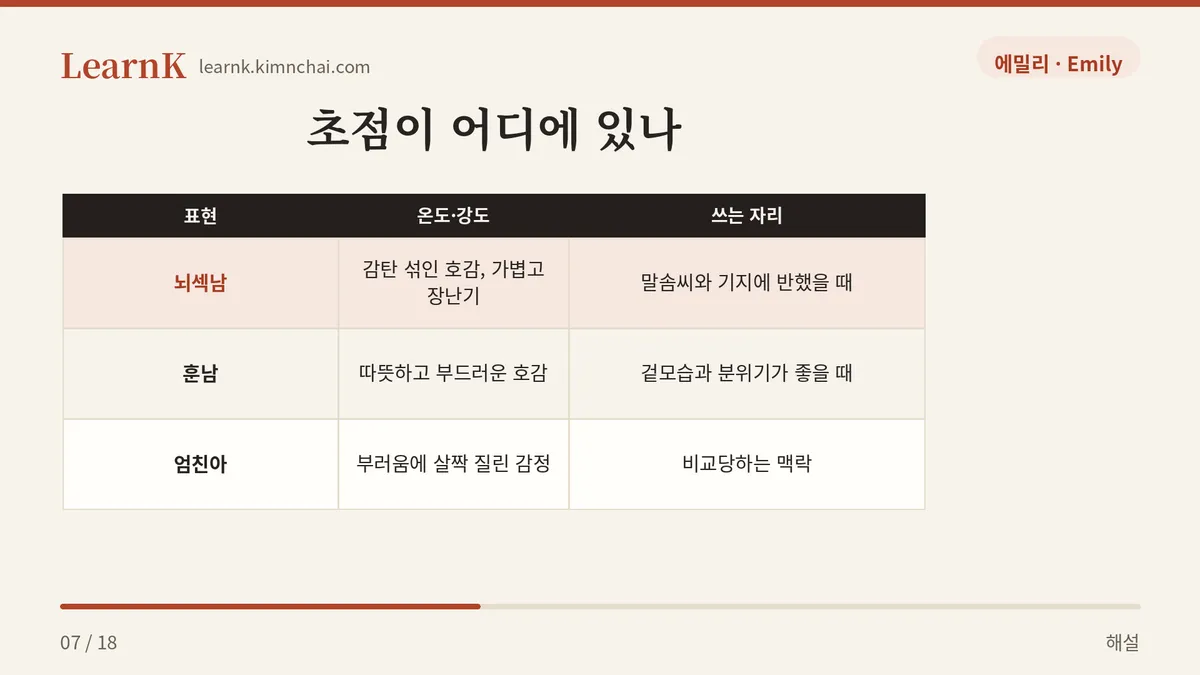
| Expression | Tone & intensity | Where it fits |
|---|---|---|
| 뇌섹남 (noesengnam) | Admiring attraction; light and playful | Peers, social media, variety-show talk. Careful in formal settings or to the person’s face |
| 뇌섹녀 (noesengnyeo) | Same temperature, for a woman | Same as above |
| 훈남 (hunnam) | Warm, gentle liking | Peer conversation. The focus is on appearance and vibe |
| 엄친아 (eomchina) | Envy with a slightly fed-up edge mixed in | Contexts of being compared. Not pure praise |
| 똑똑하다 (ttokttokada) | Neutral, closer to an assessment | Anywhere. Safe with seniors and in formal settings |
To sum up: for looks, 훈남; when envy is mixed in, 엄친아; when you want to be safe and neutral, 똑똑하다; and when it’s the admiring “I fell for the way that mind works,” it’s 뇌섹남.
Cultural Background — Where the Focus of Attraction Moved
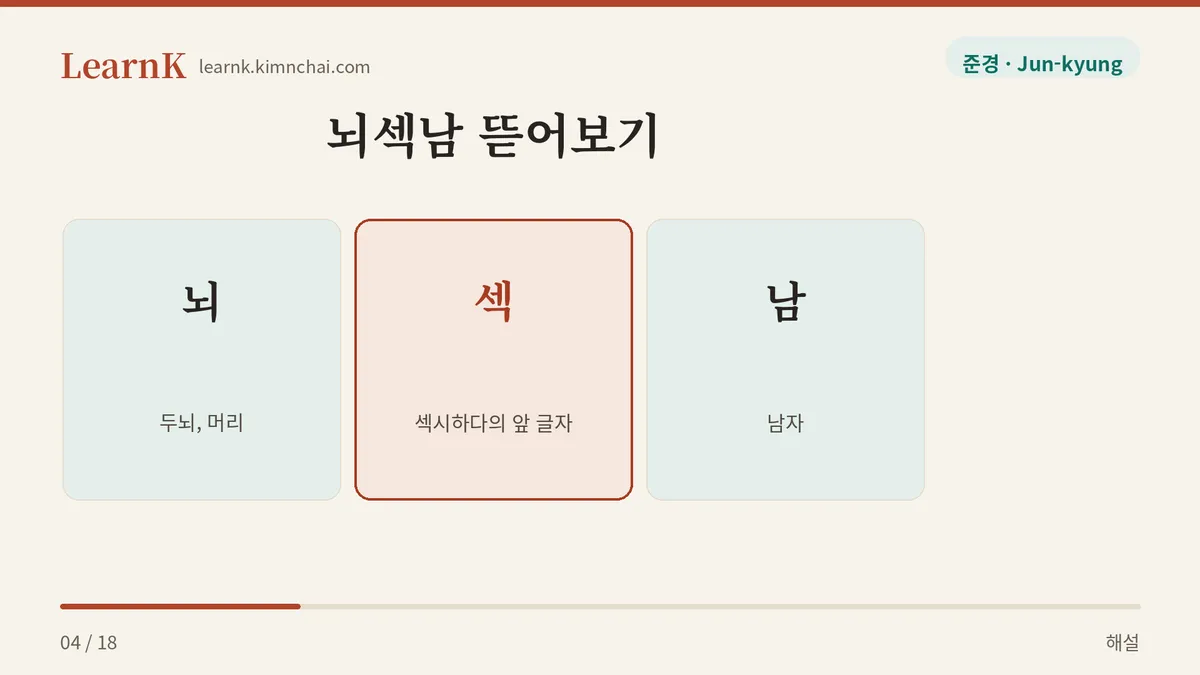
The word-building is transparent. 뇌 (noe, brain) + 섹 (sek, the first syllable of 섹시하다 seksihada, “sexy”) + 남 (nam, man). Three pieces, one syllable clipped from each — a textbook Korean-style abbreviation coinage. 뇌섹녀 came out of the same frame, and a usage where just the 뇌섹 part gets stuck in front of other words has appeared too.
The word spread widely thanks to the variety show 뇌섹시대 — 문제적 남자 (Noeseksidae — Munjejeok Namja, “The Brain-Sexy Era — Problematic Men”), which began on tvN in 2015. It’s a program that shows contestants solving hard problems together, and with 뇌섹 riding on the title, the word came down off the airwaves and into everyday speech.
What’s interesting is the difference in temperature before and after this word appeared. Before it, Korea’s coined compliments were almost all attached to the face. This word put “the mind” on that list for the first time, and so in the early days of the trend it was sometimes discussed as more than a simple buzzword — alongside the idea that “Korea’s standards of attractiveness are changing.”
One more thing worth telling learners: slang has an age. This word peaked around 2015, and while it isn’t completely dead now, it isn’t exactly fresh either. Rather than a buzzword that people in their early twenties use in real time, it’s closer to “a word of its era” that people in their thirties and forties pull out comfortably. So it will land if you use it, but it can feel slightly dated when you’re talking with a much younger crowd — know that much and you’re a truly advanced user.
Today’s Quiz
Which of the following uses 뇌섹남 most naturally?
- 부장님, 넥타이가 잘 어울리세요. 진짜 뇌섹남이십니다. Sir, that tie really suits you. You’re a true brainy hottie.
- 저 사람 어제 회의에서 복잡한 자료를 5분 만에 정리해서 설명하더라. 완전 뇌섹남이야. In yesterday’s meeting he pulled complicated material together and explained it in five minutes. He’s a total brainy hottie.
- 제 소개를 하겠습니다. 저는 뇌섹남입니다. Let me introduce myself. I am a brainy hottie.
Show the answer
Answer: 2
Number 1 is a compliment about a tie — that is, about appearance — so the focus doesn’t match this word. It’s also inappropriate because it comments on a senior person’s attractiveness to their face. In a moment like that, not even 훈남 fits; a plain “잘 어울리세요 (jal eoullyeoseyo, It suits you well)” is the right call.
Number 3 is a case of calling yourself one during a self-introduction. This word is a label other people give you, so unless the joking mood is unmistakable, it sounds like patting yourself on the back.
Number 2 admires not the amount of knowledge but the way something difficult was organized and shown. This is the word sitting exactly where it belongs.
The definition, dialogue, example sentences, and quiz in this post are all original work written by us.