노포 (nopo) — The Shop Where a Faded Sign Is the Qualification

노포
노포 (nopo) means an old shop that has kept its doors open in the same spot for decades. Walk the back alleys of Euljiro in Seoul or Choryang Market in Busan and you’ll run into a gukbap joint whose sign has half peeled away, or a naengmyeon place with a wooden door rubbed glossy by decades of hands. If you’ve ever seen phrases like 을지로 노포 투어 (Euljiro nopo tueo) — ‘Euljiro nopo tour’ — or 3대째 이어 온 노포 (samdaejjae ieo on nopo) — ‘a nopo carried on for three generations’ — on a travel blog, those are exactly the shops they mean. It’s also a word worth typing into a search bar while you’re traveling in Korea. Search 맛집 (matjip) and the ads come up first; search 노포 (nopo) and the years come up first.
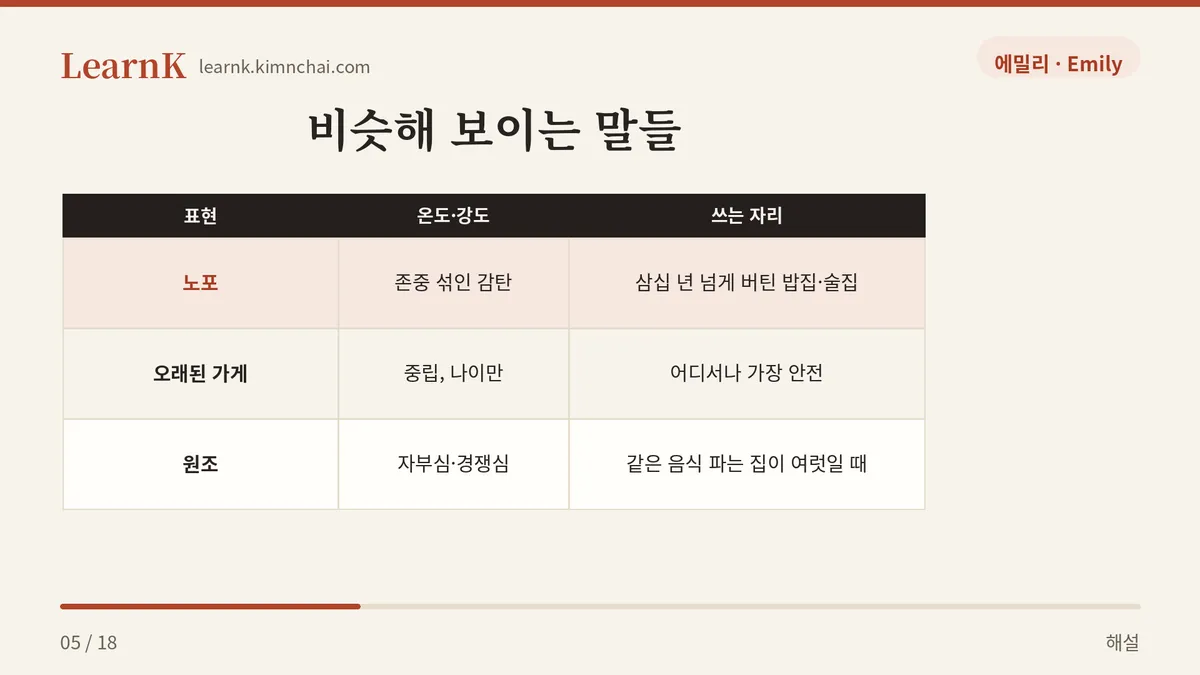
오래된 가게 (oraedoen gage), ‘an old shop,’ overlaps with 노포 in meaning, but the temperature is different. 오래된 가게 talks about age and nothing else. 노포 lays a layer of respect on top of that age. It’s an uncommon kind of word in Korean — one where being worn down isn’t a flaw but a qualification. So the moment you call a place a 노포, the speaker’s attitude comes out along with it: I recognize the time this shop has weathered.
There’s no official number of years, but when people call somewhere a 노포, three things usually line up. First, it’s been in business for around thirty years or more. Second, it has stayed in the same spot, if at all possible. Third, the owner or the recipe has been handed down through generations. That’s why a twenty-year-old branch of a big franchise never gets called a 노포, however long it’s been standing. 노포 is a word for shops where you can still see the person behind the counter.
Seeing It in Real Conversation
Scene: Saturday evening, a back alley in Euljiro, Seoul. Two people stop in front of a shop whose sign has half worn away.
Jun-kyung: 여기야. 올해로 43년 됐대. This is the place. It turned 43 this year.
Emily: 와, 이 정도면 진짜 노포다. 간판이 거의 안 보여. Wow, this is a real nopo. I can barely read the sign.
Jun-kyung: 겉 보고 놀라지 마. 안은 더 심해. Don’t let the outside shock you. Inside is worse.
Emily: 괜찮아. 이런 데가 인테리어에 돈 안 쓰고 국물에 쓰잖아. It’s fine. Places like this spend the money on the broth, not the interior.
Jun-kyung: 어, 나 여기 초등학교 때 아버지 손 잡고 왔었어. Yeah. I used to come here holding my dad’s hand, back in elementary school.
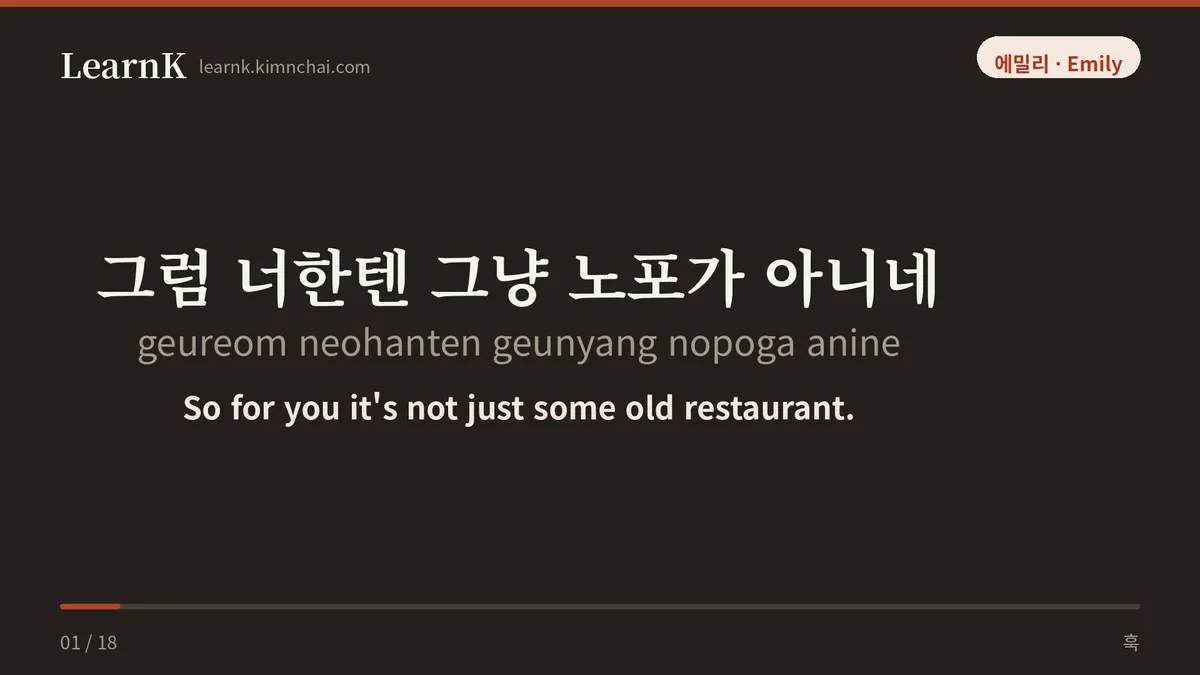
Emily: 아, 그럼 너한텐 그냥 노포가 아니네. Ah, so for you it’s not just some old restaurant.
Ways It Sounds Off
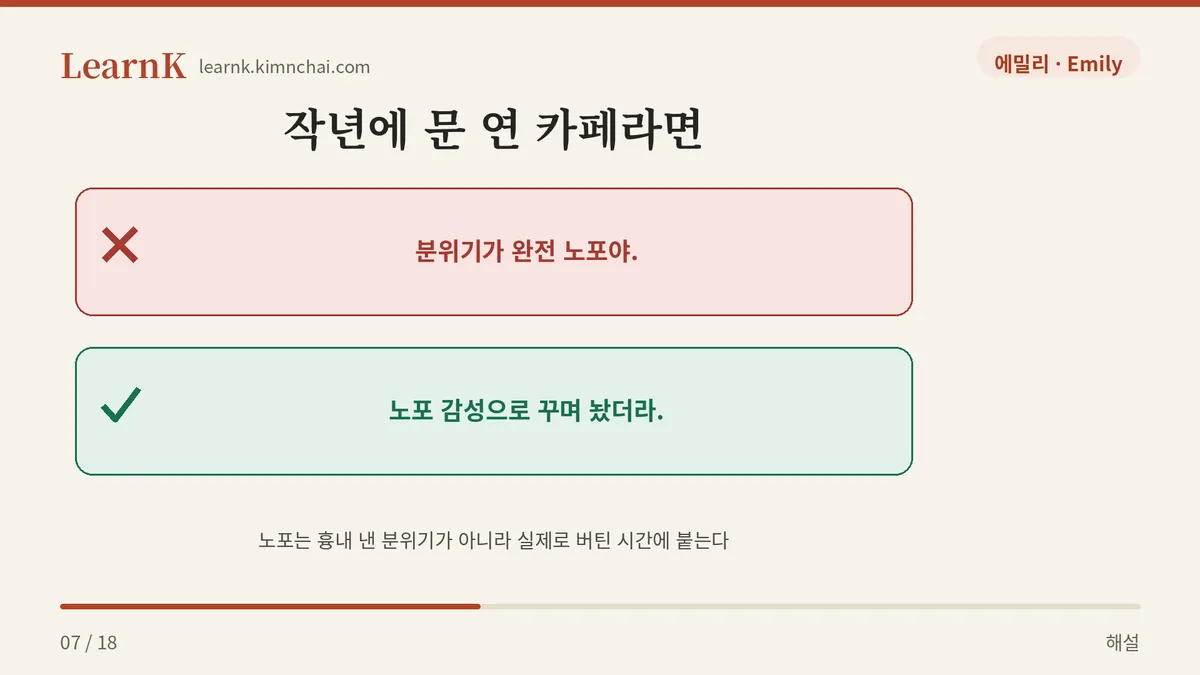
✗ 작년에 문 연 카페인데 분위기가 완전 노포야. (jangnyeone mun yeon kapeinde bunwigiga wanjeon nopoya.) It’s a café that opened last year, but the vibe is totally nopo.
✓ 작년에 문 연 카페인데 노포 감성으로 꾸며 놨더라. (jangnyeone mun yeon kapeinde nopo gamseongeuro kkumyeo nwatdeora.) It’s a café that opened last year, but they’ve done it up with that nopo feel.
→ 노포 attaches to time actually survived, not to an imitated mood. If a new shop has merely styled itself to look old, you should say 노포 감성 (nopo gamseong), ‘nopo aesthetic,’ or 레트로 (retero), ‘retro.’ Calling a brand-new place a 노포 isn’t a compliment — it’s just factually wrong.
✗ 저희 회사는 100년 된 반도체 노포입니다. (jeohui hoesaneun baengnyeon doen bandoche nopoimnida.) Our company is a 100-year-old semiconductor nopo.
✓ 시장 골목에 100년 된 떡집 노포가 하나 있어요. (sijang golmoge baengnyeon doen tteokjip nopoga hana isseoyo.) There’s a 100-year-old rice-cake shop, a real nopo, down the market alley.
→ 노포 is used for small places a customer walks into personally — especially restaurants, bars, and rice-cake shops, places where you eat or buy something to take home. Stick it on a factory or a conglomerate and the word floats free of its meaning. For those you’d say 오래된 기업 (oraedoen gieop), ‘an old company,’ or 100년 기업 (baengnyeon gieop), ‘a hundred-year company.‘
Example Sentences by Situation
Situation 1 — Planning a trip, talking to a friend (casual speech)
이번엔 관광지 말고 노포만 돌아볼래. (ibeonen gwangwangji malgo nopoman dorabollae.) This time I want to skip the tourist spots and just make the rounds of the old-timer places.
This says you’ll focus on long-standing restaurants and bars instead of the famous observation decks and palaces. It’s the kind of thing people say on their second or later trip to Korea, so this one sentence signals I’m not a first-time tourist.
Situation 2 — In a taxi, speaking to the driver (polite speech)
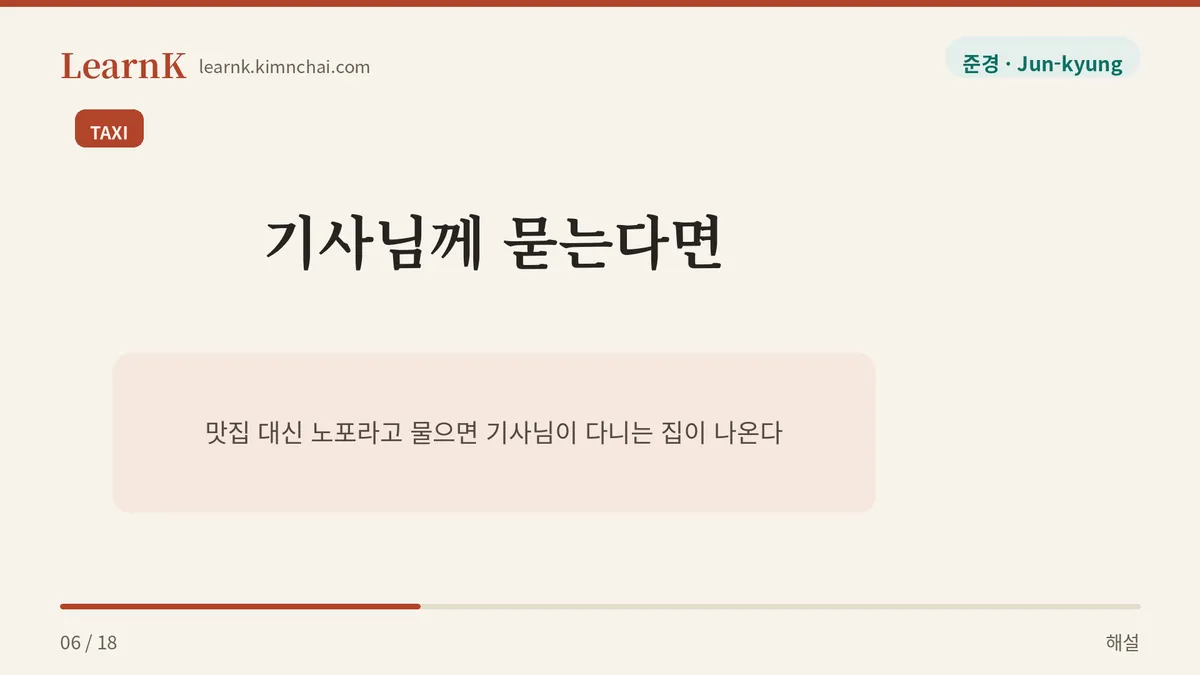
기사님, 이 근처에 오래된 노포 국밥집 있을까요? (gisanim, i geuncheoe oraedoen nopo gukbapjip isseulkkayo?) Excuse me, is there an old, long-running gukbap place around here?
Taxi drivers often know exactly which shop has been trading longest in a neighborhood. Ask for a 맛집 (matjip) and you’ll likely get pointed to a place built for tourists; ask for a 노포 (nopo) and the driver thinks of where he actually eats. One word changes the answer.
Situation 3 — Writing a review after the visit
40년 된 노포답게 국물 맛이 흔들림이 없었다. (sasimnyeon doen nopodapge gungmul masi heundeullimi eopseotda.) True to a 40-year-old establishment, the broth never wavered.
-답게 (-dapge) means ‘as befits ~.’ Writing 노포답게 turns the sentence into praise: the shop actually delivered what you expect from an old place — a flavor that doesn’t change, a menu with nothing extra on it.
Polite vs. Casual, and Neighboring Expressions
노포 is a noun, so it carries no politeness of its own. You adjust that at the end of the sentence. Casual: 여기 유명한 노포야 (yeogi yumyeonghan nopoya). Polite: 여기 유명한 노포예요 (yeogi yumyeonghan nopoyeyo). In formal writing or an introduction: 3대째 이어 온 노포입니다 (samdaejjae ieo on nopoimnida).
Set it beside the words it resembles and its place becomes clear.
| Expression | Tone & intensity | Where it fits |
|---|---|---|
| 노포 (nopo) | Admiration mixed with respect | Restaurants and bars that have lasted 30+ years. Travel writing, reviews |
| 오래된 가게 (oraedoen gage) | Neutral. States age only | Anywhere. The safest option |
| 원조 (wonjo) | Pride, rivalry | When several shops sell the same dish |
| 맛집 (matjip) | Light and excited | Nothing to do with age. Social media, among peers |
| 노포 감성 (nopo gamseong) | Imitation, atmosphere | When a new shop puts on an old feel |
원조 (wonjo) is the easiest one to confuse it with. 원조 is a claim — ‘I invented this dish’ — while 노포 is a fact: ‘this place lasted.’ That’s why one alley can hold several 원조 (you really will find 원조, 진짜원조, and 원조할머니집 lined up side by side), but 노포 is not a word people fight over.
Cultural Background — Where Being Old Becomes a Qualification
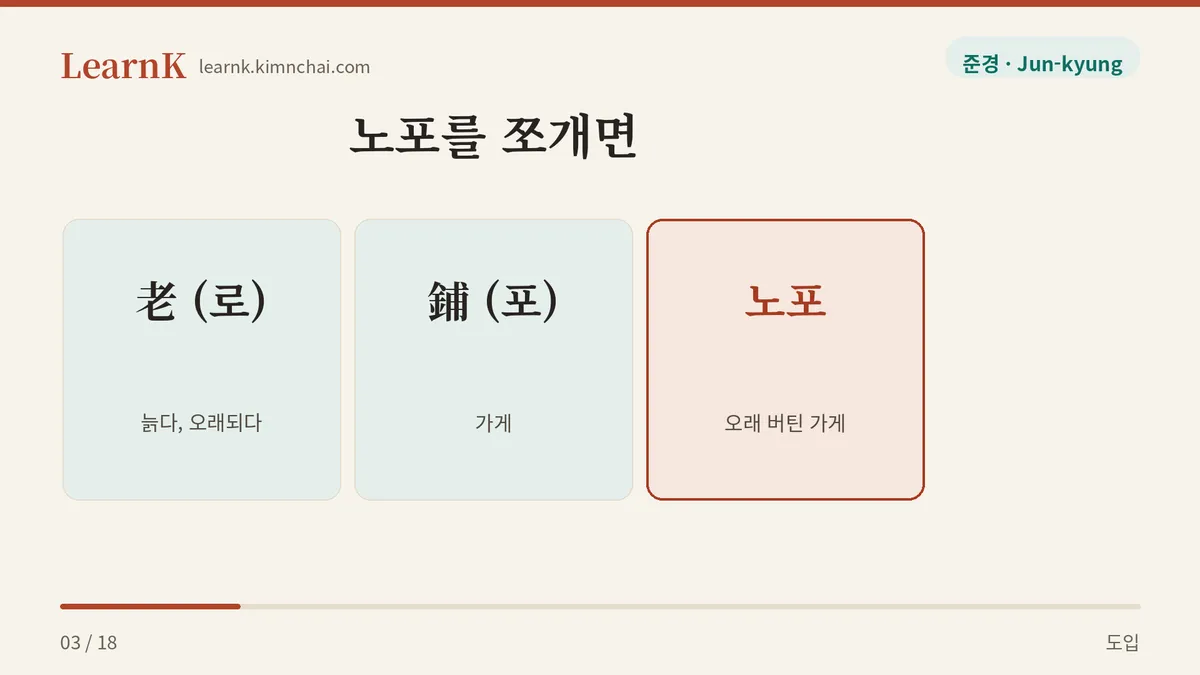
노포 is a Sino-Korean word. 老 (늙을 로, ‘old’) meets 鋪 (가게 포, ‘shop’) to make, literally, ‘old shop.’ There aren’t many words even in Korean where calling something old is this openly a compliment.
Why this particular word gained its force in Korea is easier to guess if you look at the cities. In Seoul, twenty years is enough to replace an entire neighborhood. At that speed, the bare fact of holding the same spot for forty years becomes a story in itself. That’s why a 노포 closing for redevelopment makes the news, and why a line forms outside on the final day of business. People go to eat gukbap and to see something off at the same time.
A few things are worth knowing before a traveler walks into a 노포. The menu is very short — many places sell only one or two things, and that’s the point of pride. Just say 하나요 (hanayo), ‘one, please,’ without agonizing over it. Some shops still don’t take cards, so a little cash in your pocket makes life easier. Seating is tight and you may end up sharing a table with a stranger; that isn’t rudeness, it’s how the place has always worked. And don’t be startled if the owner is brusque. The longer a shop has dealt with customers, the fewer words it uses. That isn’t unfriendliness, it’s the absence of anything extra — and that absence is part of what a 노포 tastes like.
The reason old gukbap joints and shabby little taverns keep showing up in Korean dramas is much the same. Such shops are one of the few places where a character’s childhood and present can be laid over each other in a single frame — the way, in the conversation above, the shop’s age becomes Jun-kyung’s age the moment he says he used to come here holding his father’s hand.
Today’s Quiz
Which sentence uses 노포 (nopo) most naturally?
- 우리 할아버지는 동네에서 유명한 노포야. (uri harabeojineun dongnaeeseo yumyeonghan nopoya.)
- 작년에 생긴 카페인데 인테리어가 완전 노포야. (jangnyeone saenggin kapeinde inteorieoga wanjeon nopoya.)
- 시장 안에 3대째 이어 온 칼국수 노포가 하나 있어. (sijang ane samdaejjae ieo on kalguksu nopoga hana isseo.)
- 저희 회사는 반도체를 만드는 100년 노포입니다. (jeohui hoesaneun bandochereul mandeuneun baengnyeon nopoimnida.)
Answer: 3
It gets both halves right: a long stretch of time (three generations) and a small eating place customers walk in and out of (a kalguksu shop). Number 1 is wrong because it’s applied to a person — 노포 attaches only to shops. Number 2 has the atmosphere but not the years, so it should be 노포 감성 (nopo gamseong). Number 4 is off on both scale and industry; for a large company or a factory, 오래된 기업 (oraedoen gieop) is the right phrase.
The definitions, example sentences, and dialogue in this post are entirely our own original work, because the National Institute of Korean Language’s Basic Korean Dictionary (krdict.korean.go.kr) has no headword for 노포. Where this series does quote the dictionary, those portions — including our translations — are used and distributed under the CC BY-SA 2.0 KR license.