눈물버튼 (nunmulbeoteun) — The Scene That Gets You Every Time, Even When You See It Coming
눈물버튼
There is always one scene you have rewatched more times than you can count, subtitles off. You know how it ends, you can recite the next line before it happens, and still, when that episode reaches that exact moment, your nose stings without fail. Korean drama fans have a name for that spot: 눈물버튼 (nunmulbeoteun), literally a “tear button.” Like a switch that fires the instant you press it, a 눈물버튼 is the scene, song, object, person, or memory that makes you cry the moment you see or hear it. Here is the heart of the word: it does not point at the sadness itself, it points at the switch that turns the sadness on.
It is a coinage built by attaching the English word button straight onto 눈물 (nunmul), “tears.” It is not standard Korean listed in the dictionary. It took hold in drama-viewer communities and on social media, then climbed into variety-show subtitles and article headlines. So what matters more than the definition is where you place it.
Three patterns are the most common.
- A는 B의 눈물버튼이다 (A-neun B-ui nunmulbeoteun-ida) — A is the trigger that makes B cry. Example: 그 편지 장면이 내 눈물버튼이야 (geu pyeonji jangmyeon-i nae nunmulbeoteun-iya), “That letter scene is my tear button.”
- 눈물버튼이 눌리다 (nunmulbeoteun-i nullida) — the tears burst out, as if a switch had been pressed. Example: 또 눈물버튼 눌렸어 (tto nunmulbeoteun nullyeosseo), “My tear button got pressed again.”
- 눈물버튼 주의 (nunmulbeoteun ju-ui) — a heads-up tacked onto a video title or a comment. Close to “You will cry here, brace yourself.”
The temperature is light. It is a way of admitting, with a small smile, that you are the one crying, so it sits easily with both the speaker and the listener. If anything it is closer to a friendly confession: “this is where I am weak.” Which means, turned around, you do not use it in the face of real loss. There is a bit of playfulness mixed into the word, so setting it down where someone has actually lost a person turns their grief into something to watch.
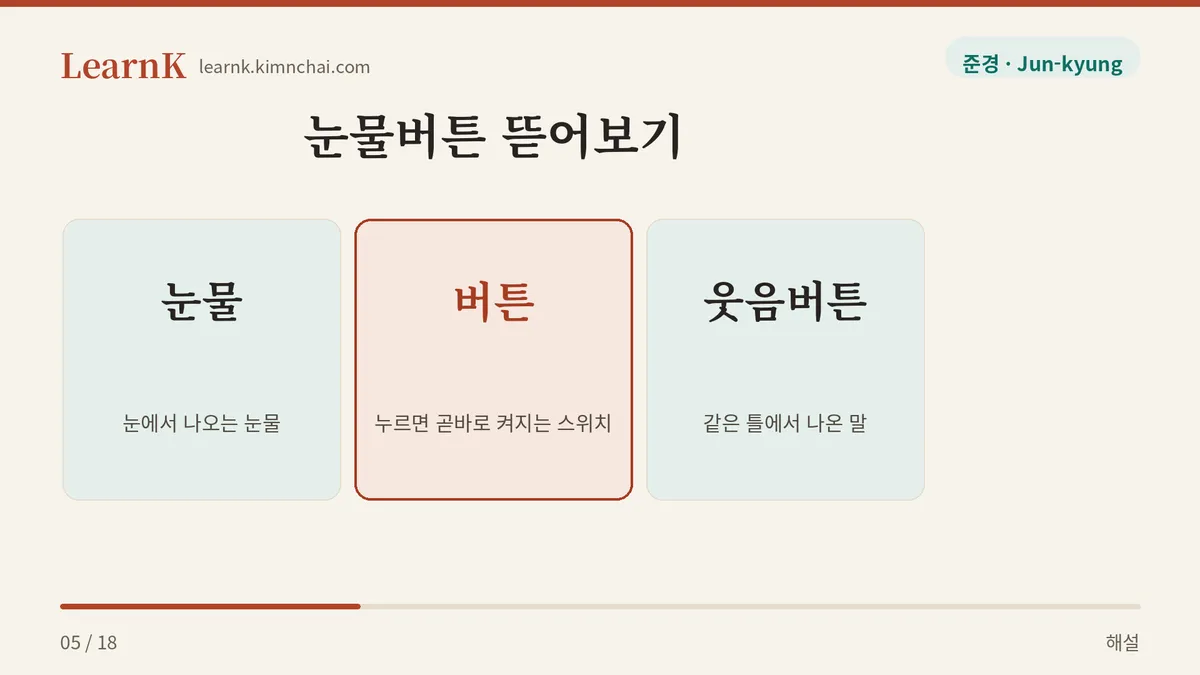
One more thing. The subject is easy to get backwards. A 눈물버튼 is not the person who cries but the thing that makes them cry. The same holds when it points at a person: 우리 할머니가 내 눈물버튼이야 (uri harmeoni-ga nae nunmulbeoteun-iya) does not mean Grandma cries easily, it means I cry the moment I think of her.
A Real Conversation
Scene: The subway on the morning commute. Emily has her earbuds in, watching the final episode of a drama on her phone, when she starts sniffling.
Jun-kyung: 야, 너 울어? 지하철에서? Hey, are you crying? On the subway?
Emily: 아, 미안. 하필 아빠가 편지 읽는 장면 나왔단 말이야. Ah, sorry. Of all things, the scene where the dad reads the letter just came on.
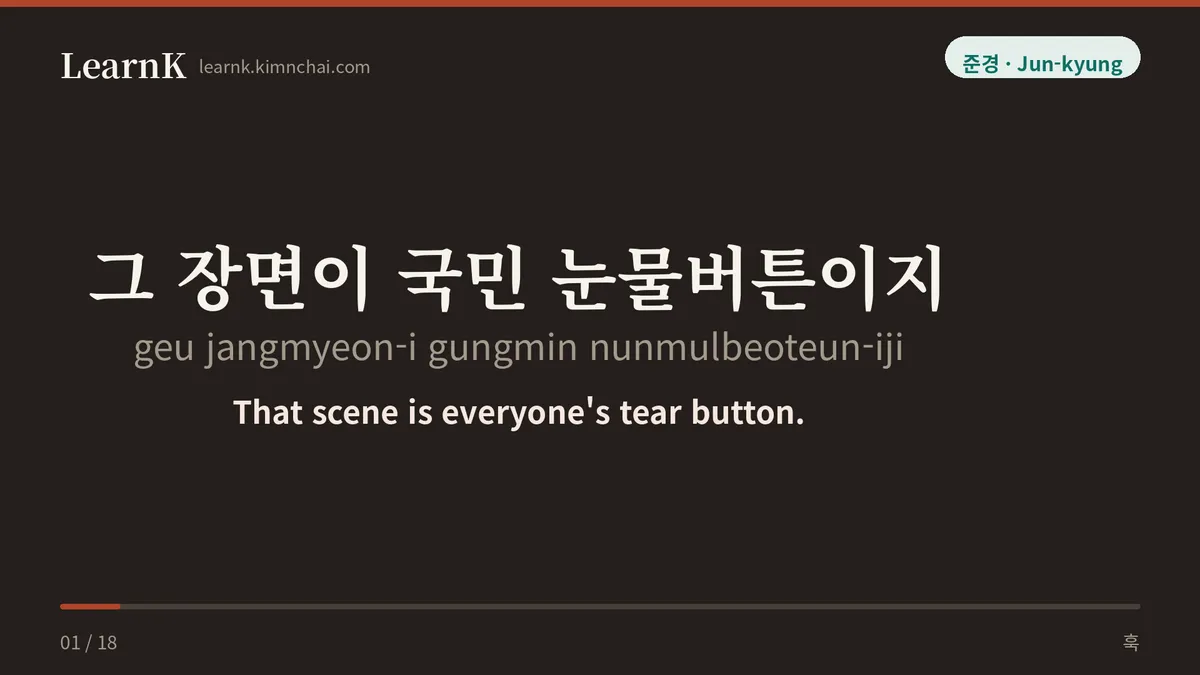
Jun-kyung: 아 거기. 나도 거기서 무너졌잖아. 그 장면이 국민 눈물버튼이지. Oh, that part. I fell apart there too. That scene is everyone’s tear button.
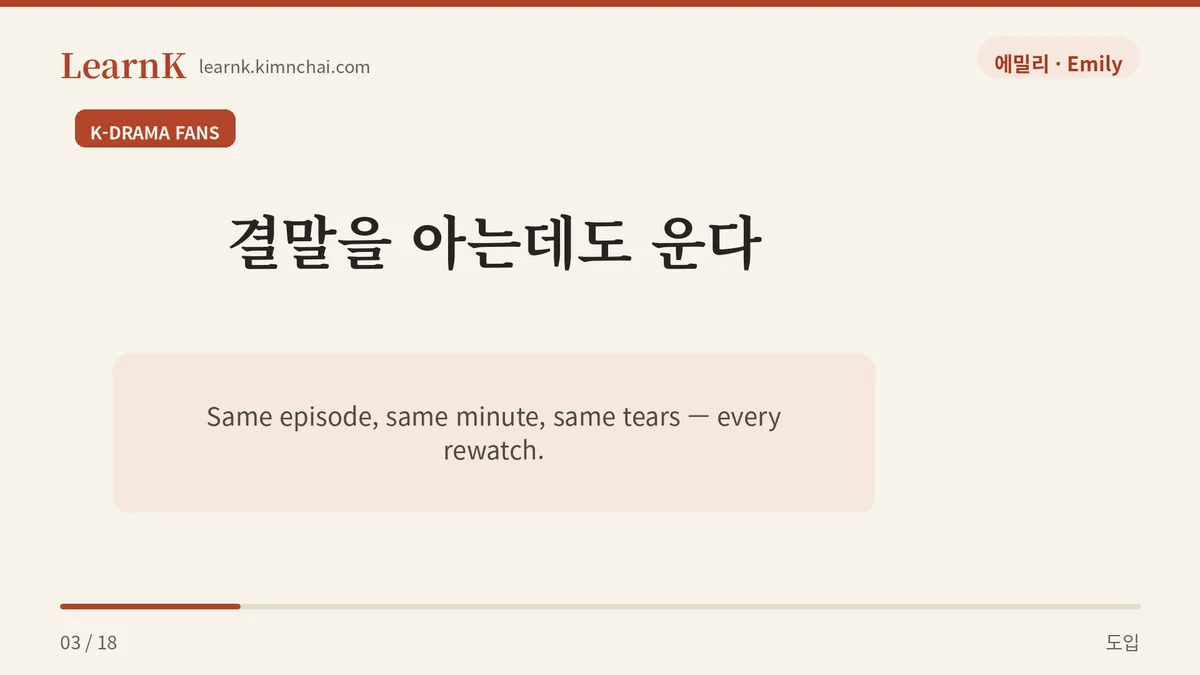
Emily: 그치? 나 이거 세 번째 보는데 매번 똑같은 데서 눈물버튼 눌려. Right? This is my third time watching, and the same spot presses my tear button every time.
Jun-kyung: 근데 어떡해, 너 눈 다 부었어. 이따 회의 들어가야 되잖아. But what are you gonna do — your eyes are all puffy. You’ve got that meeting later.
Emily: 괜찮아, 선글라스 있어. 너야말로 아까 코 훌쩍이던데? It’s fine, I’ve got sunglasses. And you — weren’t you sniffling a second ago?
Where It Sounds Off
✗ (at a funeral, to the bereaved family) 아버님 사진 보니까 진짜 눈물버튼이네요. (abeonim sajin boni-kka jinjja nunmulbeoteun-ine-yo.) “Seeing your father’s photo, that is a real tear button.” ✓ (at a funeral, to the bereaved family) 아버님 생각 많이 나시죠. 저도 사진 앞에 한참 서 있었어요. (abeonim saenggak mani nasijyo. jeodo sajin ap-e hancham seo isseosseoyo.) “You must think of him so much. I stood in front of that photo for a long while myself.” → It is slang with a playful streak, so placing it in front of a real loss turns someone else’s grief into a spectacle. In a setting like this, the safest move is to clear the slang out entirely.
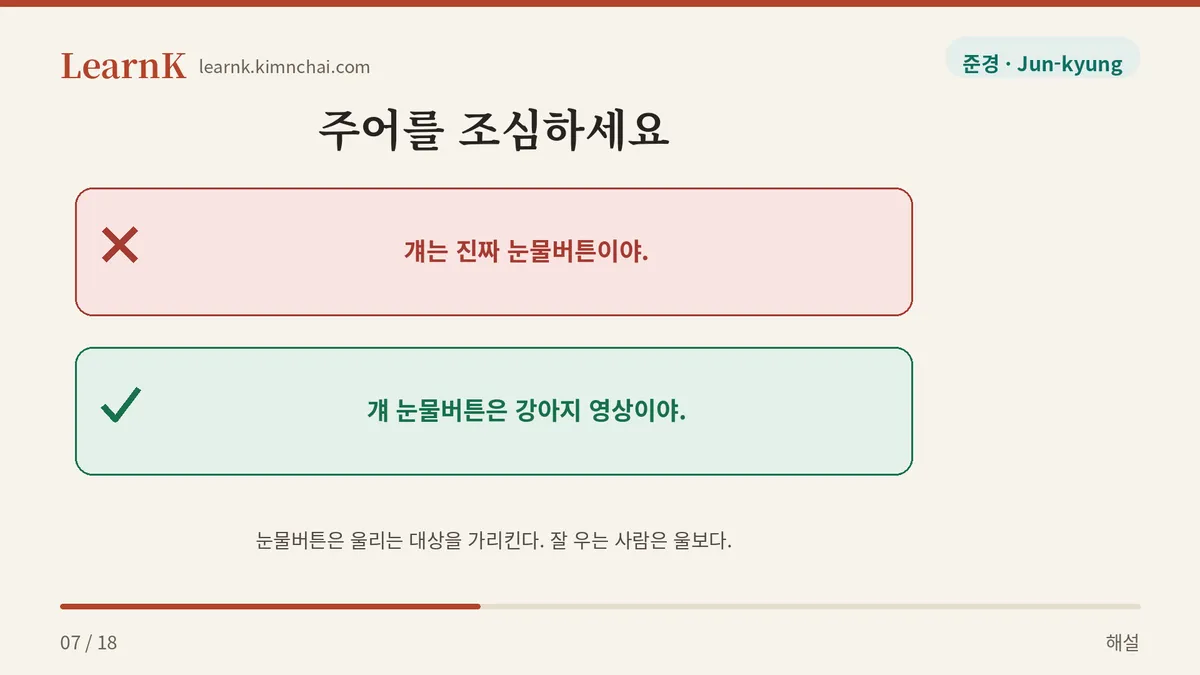
✗ 걔는 진짜 눈물버튼이야. (gyae-neun jinjja nunmulbeoteun-iya.) (intended as: she cries a lot) ✓ 걔는 진짜 울보야. (gyae-neun jinjja ulbo-ya.) / 걔 눈물버튼은 강아지 영상이야. (gyae nunmulbeoteun-eun gangaji yeongsang-iya.) → 눈물버튼 points at the thing that causes the tears, not the person shedding them. If you want a person in the sentence, seat them in the “so-and-so’s tear button is X” slot and it stands up.
Example Sentences by Situation
1. In a group chat where everyone is watching the same drama You are recommending a show to a friend and attaching a warning in advance. Pointing to the exact episode and minute is closer to basic courtesy among Korean drama fans.
12회 마지막 5분, 거기가 이 드라마 최대 눈물버튼이야. 휴지 미리 꺼내 놔. (sibi-hoe majimak o-bun, geogi-ga i deurama choedae nunmulbeoteun-iya. hyuji miri kkeonae nwa.) Episode 12, the last five minutes — that’s this drama’s biggest tear button. Get the tissues out now.
2. Talking about family Gently letting someone in on where your parents’ generation goes soft. It works in polite speech without sounding odd.
저희 엄마 눈물버튼은 손주 영상통화예요. 삼십 초면 우세요. (jeohui eomma nunmulbeoteun-eun sonju yeongsangtonghwa-yeyo. samsip-cho-myeon useyo.) My mom’s tear button is a video call with her grandkid. Thirty seconds and she’s crying.
3. In the waiting room at a wedding Before the ceremony starts, friends teasing each other back and forth.
축가만 나오면 눈물버튼 눌려서, 나 오늘 화장 다 지워질 것 같아. (chukga-man nao-myeon nunmulbeoteun nullyeoseo, na oneul hwajang da jiwojil geot gata.) The moment the wedding song starts my tear button gets pressed — my makeup’s not surviving today.
Polite and Casual Forms, and Nearby Expressions
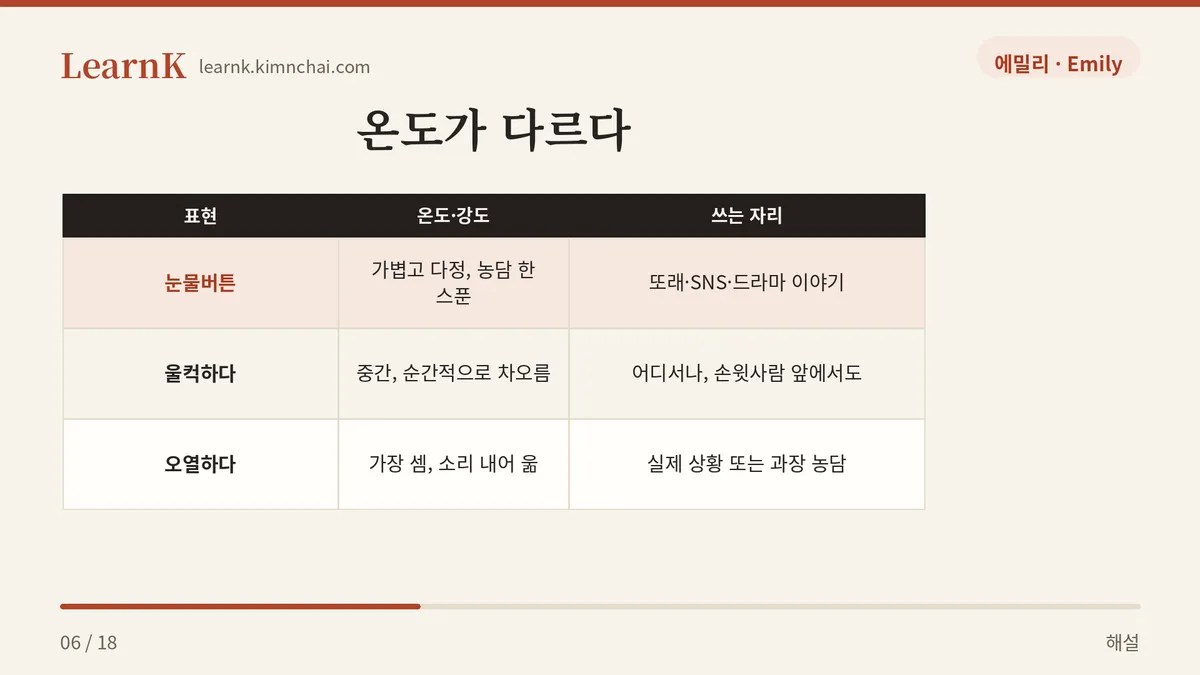
눈물버튼 is a noun, so moving between polite and casual only means changing the predicate: 눈물버튼이야 (nunmulbeoteun-iya) / 눈물버튼이에요 (nunmulbeoteun-ieyo). That said, dressing it in polite endings does not strip away the lightness that comes with slang. In formal settings or in front of someone older, 마음이 많이 쓰이는 장면이었어요 (ma-eum-i mani sseuineun jangmyeon-ieosseoyo), “it was a scene that really stayed with me,” is the safer choice.
| Expression | Tone and intensity | Where it fits |
|---|---|---|
| 눈물버튼 (nunmulbeoteun) | Light and warm, one spoonful of joking | With peers, on social media, in drama talk. Not used in the face of real loss |
| 울컥하다 (ulkeokada) | Middle. A surge that rises in an instant | Anywhere. Natural even in front of elders |
| 눈물샘을 자극하다 (nunmulsaem-eul jageukada) | Written register, the voice of a critic | Articles, reviews, write-ups about a work |
| 오열하다 (oyeolhada) | The strongest. Weeping out loud | Used for real situations, but among peers more often as exaggerated joking |
The same scene can call for a different word depending on who you are talking to. In a review you write 눈물샘을 자극하는 연출 (nunmulsaem-eul jageukaneun yeonchul), “direction that goes straight for the tear ducts”; to a friend you say 거기 눈물버튼이야 (geogi nunmulbeoteun-iya), “that part is a tear button.” If a learner swaps the two, the meaning still lands, but the speaker comes off as strange.
Cultural Background — Rewatching and Timestamps
Start with how the word is built: 눈물 (tears) + 버튼 (button). It draws feeling as a machine that switches on when pressed. Several words come out of the same mold, so 웃음버튼 (useumbeoteun), a “laugh button,” and 분노버튼 (bunnobeoteun), an “anger button,” are in circulation too. This picture of a switch installed in the human heart sells rather well in Korean slang.
There is a reason this word attaches itself so tightly to drama talk. Korea has a thick culture of 정주행 (jeongjuhaeng), watching a series straight through, and N차 관람 (N-cha gwallam), watching the same thing an Nth time. People come back to a finished show years later, and the same person watches the same work three or four times. Because they already know the ending, they go in knowing when they will cry. So minute-level coordinates like 14화 38분 (sipsa-hwa samsippal-bun), episode 14, minute 38, circulate through communities and comment sections. 눈물버튼 is the name for exactly those coordinates.
When a lot of people cry at the very same spot, it earns the label 국민 눈물버튼 (gungmin nunmulbeoteun), a “national tear button.” Take the final episode of 《응답하라 1988》 (Eungdaphara 1988), Reply 1988 (tvN, 2015), where everyone leaves the alley they lived in for so long. No single line is especially sad. People cry because nearly twenty hours spent together in that alley come rushing in all at once. This is why a tear button is not always fastened to a sad scene. The place where long-accumulated affection comes to an end, a hand patting a back without a word, the belongings of someone who is no longer here — the button is usually hidden in places like these.
For anyone learning Korean through dramas, the word is practical too. Ask a Korean friend 이 드라마 눈물버튼 어디야? (i deurama nunmulbeoteun eodiya?), “Where’s this drama’s tear button?” and the conversation opens right up. They end up telling you where they fell apart, and that story is packed with expressions no textbook carries.
Today’s Quiz
Which of the following sentences uses 눈물버튼 naturally?
- 나는 눈물이 많아서 눈물버튼이야. (na-neun nunmul-i manaseo nunmulbeoteun-iya.)
- 할머니 손을 찍은 그 사진이 내 눈물버튼이야. (harmeoni son-eul jjigeun geu sajin-i nae nunmulbeoteun-iya.)
- 어제 장례식장에서 눈물버튼 제대로 눌렸어요. (eoje jangnyesikjang-eseo nunmulbeoteun jedaero nullyeosseoyo.)
Answer: 2. 눈물버튼 points at the thing that makes you cry, not the person crying, so number 1 has to be rewritten as 나는 울보야 (na-neun ulbo-ya), “I’m a crybaby.” Number 3 is grammatically fine but lands in the wrong place — the word is far too light for an actual funeral. It sits most naturally when you seat a specific object or scene in it, the way number 2 does.
Definitions and example sentences are from the National Institute of Korean Language’s Basic Korean Dictionary (krdict.korean.go.kr); that portion of this post, including our translations, is licensed under CC BY-SA 2.0 KR.