오바하다 (obahada) — "야, 그건 좀 오바 아니야?" The Word Koreans Use at Least Once a Day
오바하다
오바하다 (obahada) means to act or react excessively — to go past the point the situation actually calls for. The friend who packs three umbrellas because rain is in the forecast. The travel buddy who rolls up with two suitcases for a one-night trip. The person who nicks a finger on a sheet of paper and takes a number at the clinic front desk. Faced with scenes like these, the first thing a Korean reaches for is “야, 그건 좀 오바 아니야? (ya, geugeon jom oba aniya?)”
Learners who have only met Korean in a classroom rarely run into this one. Textbooks list 과장하다 (gwajanghada); they don’t list 오바하다 (obahada). In real conversation, though, the frequency runs exactly the other way. The next table at the café, the group chat, variety-show subtitles, that bickering scene in a drama — leave your ears open for a single day and those two syllables, 오바, will float past you several times.
There’s one point about this expression that learners easily miss. 오바하다 (obahada) isn’t a word that says you were wrong; it’s a word that says you did too much. It touches the quantity, not the direction. So if someone says it to you, it doesn’t mean you did something off-base — it means you were right, you just need to dial it back a notch. Once you know that difference, you won’t be hurt when you hear it, and you won’t hurt anyone when you use it.
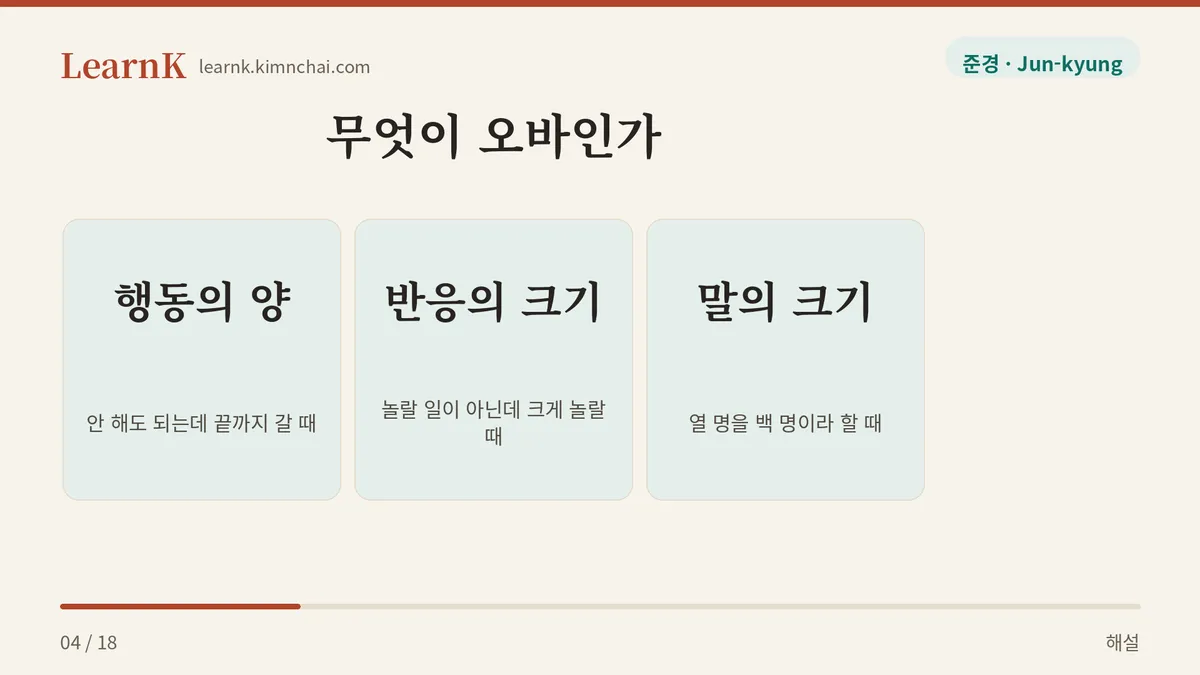
There are broadly three things 오바하다 (obahada) takes issue with.
The first is the amount of action. Too much gear, too much procedure, or going all the way when you really didn’t have to. Showing up to a walk around the neighborhood in hiking boots lands here.
The second is the size of an emotion or reaction. Being shocked when nothing shocking happened; lying awake all night worrying about something that didn’t warrant it. Korean has an unusual number of words for this category (호들갑 (hodeulgap), 유난 (yunan)), and 오바하다 (obahada) sits at the youngest, lightest end of them.
The third is the size of a statement — in other words, exaggeration. Say “사람 백 명 왔다 (saram baek myeong watda)” about a gathering of ten people and your friend will cut in with “오바하지 마 (obahaji ma).”
The temperature is usually light. It’s closer to a jab delivered with a grin, and people actually use it less when they’re not on good terms. But there’s one last thing to remember. If the other person reacted strongly because they were genuinely struggling, this word turns into a verdict: “your feelings are excessive.” More on that below.
Seeing It in Real Conversation
Scene: Saturday morning, the waiting room of a neighborhood orthopedic clinic. Jun-kyung cut his finger on a sheet of paper yesterday while sorting documents.
준경: 야, 이거 봐 봐. 어제 벤 데가 아직도 욱신거려. Hey, look at this. The spot I cut yesterday is still throbbing.
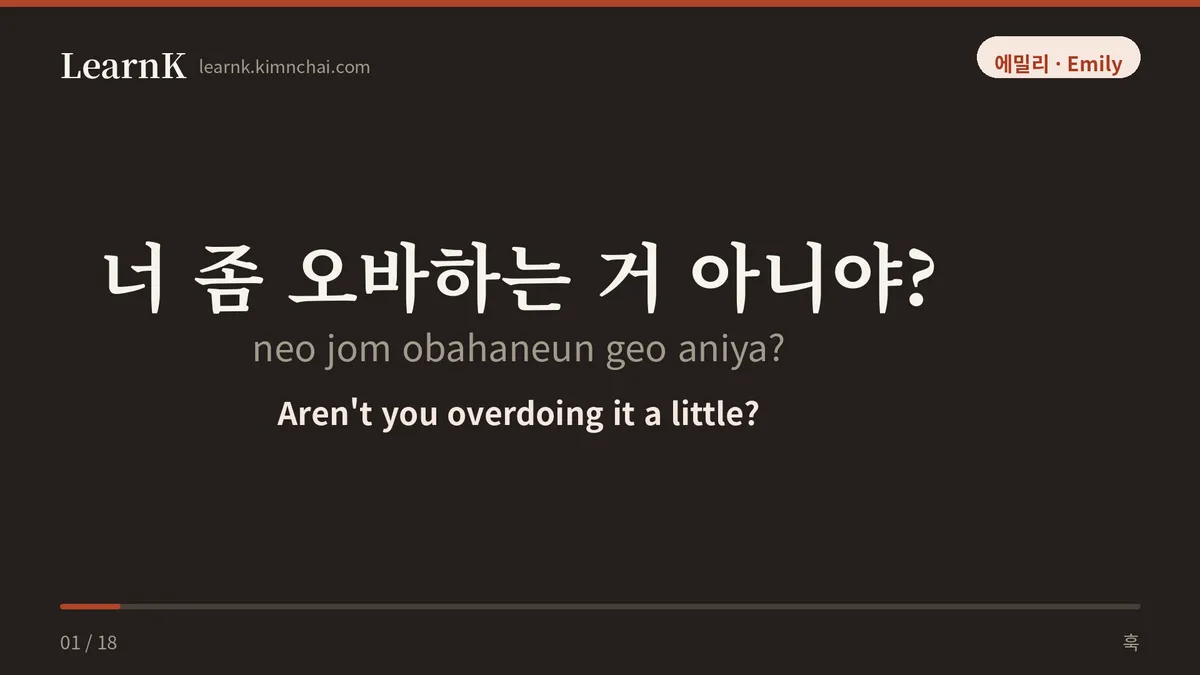
에밀리: 종이에 베인 걸로 병원을 와? 너 좀 오바하는 거 아니야? You came to a clinic over a paper cut? Aren’t you overdoing it a little?
준경: 아니 파상풍 같은 거 걸리면 어떡해. 뉴스에서 봤단 말이야. But what if I get tetanus or something? I saw it on the news.
에밀리: 밴드 하나면 끝날 걸 가지고. 너 원래 좀 오바야. One band-aid and you’d have been done. You always go a bit overboard.
준경: 그래도 접수했으니까 보고는 가자. 5분이면 돼. Well, I already checked in, so let’s at least see the doctor. It’ll take five minutes.
에밀리: 알았어, 알았어. 오바라고 한 건 취소. 아프긴 아픈 거니까. Fine, fine. I take back the “overreacting” thing. It does hurt, after all.
Pay attention to that last line. Emily throws out 오바 (oba) and then takes it back herself. That’s how someone speaks when they know this word can tip over into denying what the other person actually feels.
Where This Sounds Off
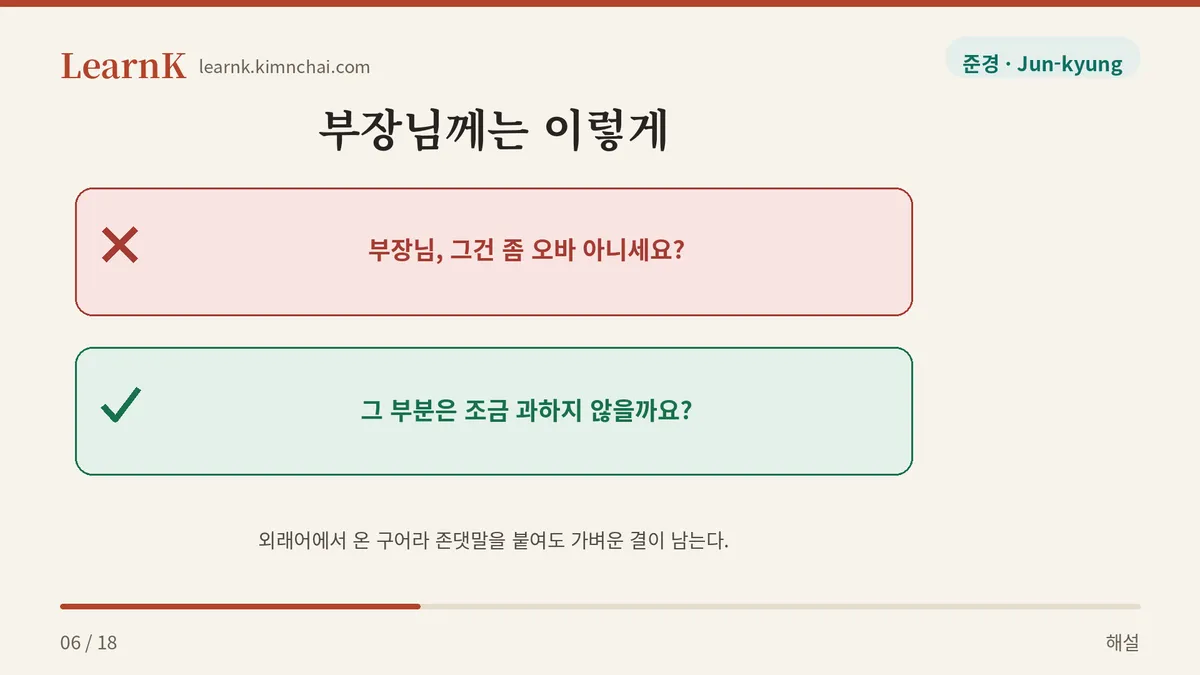
✗ (to your department head) 부장님, 그건 좀 오바 아니세요? (bujangnim, geugeon jom oba aniseyo?) ✓ (to your department head) 그 부분은 조금 과하지 않을까요? (geu bubuneun jogeum gwahaji anheulkkayo?) → 오바하다 (obahada) is colloquial, and it comes from a loanword, so no matter how many polite endings you bolt on, a casual streak remains. Aimed at a superior’s judgment, it comes out sounding like “you’re making a fuss right now.” With people above you, go around it with 과하다 (gwahada) or something like “조금 이르지 않을까요 (jogeum ireuji anheulkkayo)” — “isn’t that a bit early?” Turned on yourself, though, it’s perfectly fine: “제가 좀 오버했네요 (jega jom obeohaenneyo)” sounds natural even in a meeting room.
✗ (to a friend crying after losing their dog) 야, 너무 오바하지 마. (ya, neomu obahaji ma.) ✓ (in the same moment) 많이 속상했겠다 (mani soksanghaetgetda). 울어도 돼 (ureodo dwae). → The grammar is fine; the setting is wrong. 오바하다 (obahada) rules that someone’s reaction is bigger than the facts, so used in the face of real grief it becomes a word that審 judges whether they’ve earned the right to be sad. When the emotion is genuinely large, the safest move is not to reach for this expression at all.
Example Sentences by Situation
① Right before a one-night trip, standing outside a friend’s place
Your friend has come out dragging two suitcases. Teasing someone about how much luggage they’ve brought is the single most typical home for this word.
야, 1박인데 캐리어 두 개는 좀 오바다. (ya, ilbaginde kaerieo du gaeneun jom obada.)
Here 오바다 (obada) is being used almost like an adjective. Splitting 오바하다 (obahada) into 오바 (oba) + 이다 (ida) shifts the focus from the action to the state, which makes it lighter and more playful.
② Apologizing for your own mistake in a meeting
The moment you catch yourself ten minutes deep into apologizing for one small error and stop.
죄송합니다. …아, 제가 좀 오버했습니다. 바로 수정해서 다시 올리겠습니다. (joesonghamnida. …a, jega jom obeohaetseumnida. baro sujeonghaeseo dasi olligetseumnida.)
A word that can come off as rude pointed at someone else becomes modest self-assessment when you turn it on yourself. This is an extremely useful move in workplace Korean.
③ The day after sobbing through a drama finale
Looking back at your own reaction, tossed out almost like a thought to yourself.
나 어제 좀 오바했나? 새벽 세 시까지 울었어. (na eoje jom obahaenna? saebyeok se sikkaji ureosseo.)
Adding the questioning ending -했나? (-haenna?) turns it from self-blame into a sheepish laugh. Your friend will usually catch it with “아니야, 그 장면은 나도 울었어 (aniya, geu jangmyeoneun nado ureosseo)” — “No, I cried at that scene too.”
Polite vs. Casual Forms, and Similar Expressions
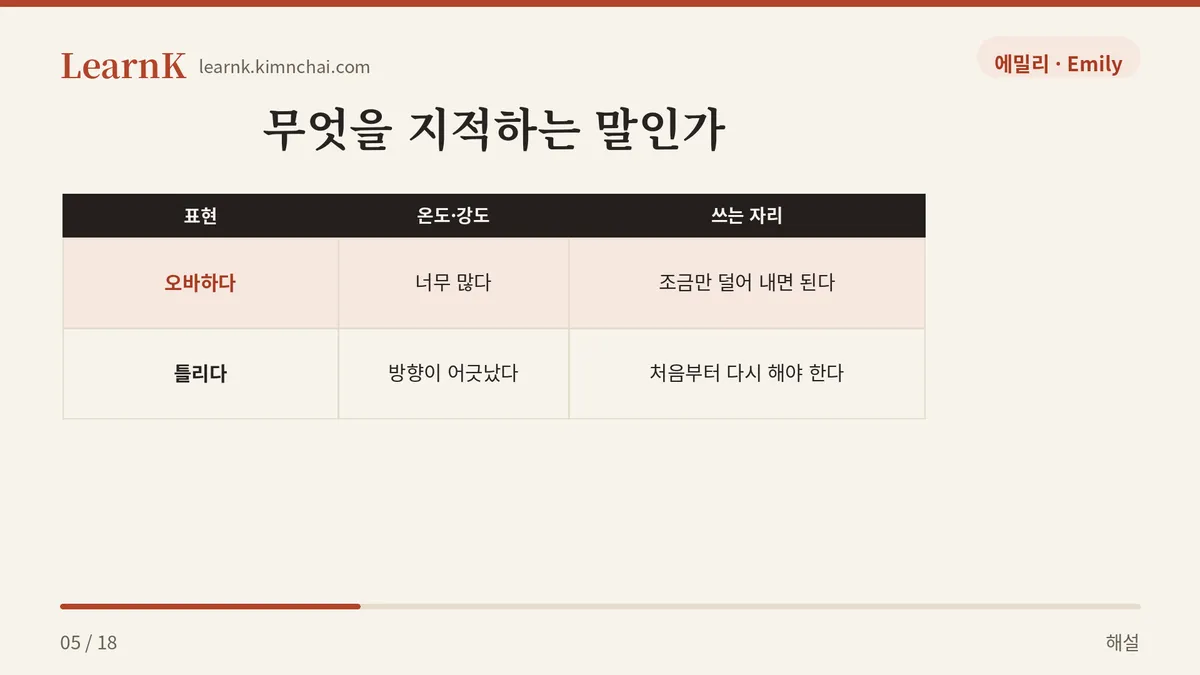
In casual speech it’s 오바해 (obahae) / 오바하지 마 (obahaji ma) / 오바야 (obaya); in polite speech, roughly 오버하시는 것 같아요 (obeohasineun geot gatayo) / 제가 오버했네요 (jega obeohaenneyo). But as we saw above, it’s safest to remember that the polite forms are only comfortable when you’re aiming them at yourself.
| Expression | Temperature / Strength | Where It’s Used |
|---|---|---|
| 오바하다 (obahada) | Light and playful | Between friends and coworkers. Also for self-reflection. Not for judging a superior |
| 과장하다 (gwajanghada) | Neutral, written-style | Anywhere. Especially when words have been inflated. Shows up in reports and news |
| 호들갑 떨다 (hodeulgap tteolda) | Somewhat negative, a noisy feel | When a reaction is loud and fluttery. The listener may take offense |
| 유난 떨다 (yunan tteolda) | The most stinging | When someone is being oddly extra all on their own. A strong rebuke |
| 적당히 해 (jeokdanghi hae) | Close to a warning | When you’ve told them several times and they’re still going |
In the same situation, 오바하다 (obahada) comes out with a smile, while 유난 떨다 (yunan tteolda) comes out with a frown. The first two in the table are as far as a learner can safely go.
Cultural Background — How English over Became a Korean Word
The etymology is simple: English over plus -하다 (-hada), the suffix that makes Korean verbs. By the official loanword transcription rules, 오버하다 (obeohada) is the standard spelling, and that’s what dictionaries and newspapers use. In spoken Korean, though, 오바 (oba) is what stuck. In subtitles, messenger apps, even on shop signs, 오바 shows up far more often. It’s a textbook case of the prescribed form and the actually-used form parting ways, so learners can simply file them side by side: 오버 (obeo) when you read, 오바 (oba) when you listen. One aside: the “오바 (oba)” tacked onto the end of a radio transmission comes from the same English word but means something completely different — “transmission finished, your turn.” No need to get confused when you hear that 오바 in a war drama.
There’s a sensibility Korean society has long prized underneath how far this word has spread: exactly as much as needed, without sticking out, within roughly the same range as everyone else. A name was needed for behavior that strays off that gauge. That’s why 오바하다 (obahada) often works not as nagging but as a signal to recalibrate the dial.
In dramas it’s mostly a comedy device. The lead who assigns a thousand meanings to a single text from their crush and spends all night decoding it; the character who catches the faintest sniffle and tours every clinic in town as if drafting a will — a friend standing nearby drops a “오바하지 마 (obahaji ma)” and the scene resolves. Here the word isn’t criticism so much as a hand cooling down an overheated feeling. In real Korean conversation, that temperature is the default.
Meanwhile, using it on yourself has grown noticeably more common lately. Admit it first with a laugh — “나 좀 오바했지? (na jom obahaetji?)” — and the other person relaxes too. Careful with others, generous with yourself: that’s the best rule of thumb for handling this expression.
Today’s Quiz
You suggested a 30-minute walk around the neighborhood, and your friend showed up in hiking boots with a sleeping bag and a portable camping stove. Which line is the most natural thing to hand them with a grin?
① 야, 너 좀 오바했다. 30분 걷는 건데. (ya, neo jom obahaetda. samsipbun geonneun geonde.) ② 부장님, 좀 오바세요. (bujangnim, jom obaseyo.) ③ 너 왜 이렇게 오바하지 마? (neo wae ireoke obahaji ma?)
Answer: ①
② is aimed at a superior, so it lands as rude. In that setting you’d need to go around it with something like “조금 과하지 않으실까요 (jogeum gwahaji anheusilkkayo).” In ③, -하지 마 (-haji ma) is an imperative, but it’s preceded by 왜 (wae), which asks for a reason — the sentence doesn’t hold together. “너 왜 이렇게 오바해? (neo wae ireoke obahae?)” would be natural. Using the past form -했다 (-haetda) as in ① gives the feeling of lightly pointing at something that has already happened, which tilts it away from scolding and toward a joke.