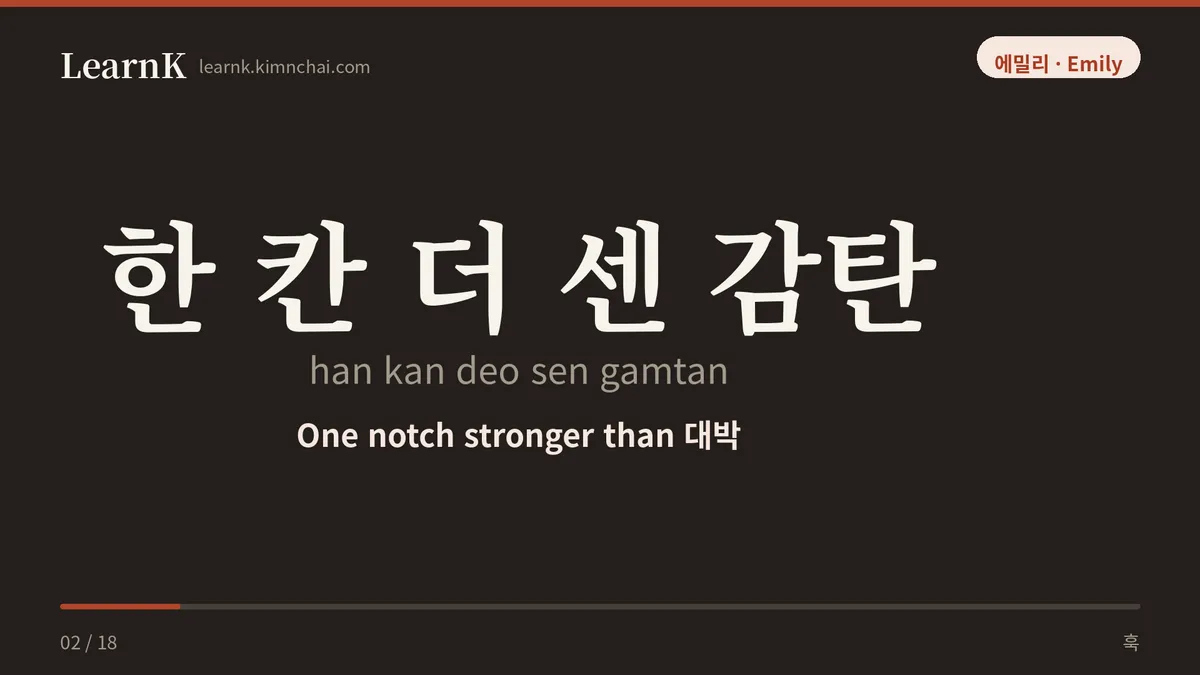
오지다 (ojida) — the exclamation one notch stronger than '대박'

오지다
오지다 (ojida) means that something is so great, so far past what you expected, that it knocks you sideways. The moment a roller coaster tips over into its first drop. The moment a band you waited three years for walks out under the stage lights. The moment one bite of spicy 떡볶이 (tteokbokki) makes your eyes water. These are the places where a Korean person blurts out 오진다 (ojinda) — the word that jumps out before the sentence has finished forming.
You’ve probably never seen it in a textbook. But it turns up several times a day in variety-show subtitles, YouTube comments, and friends’ group chats. If you want to enjoy Korean content without subtitles, this isn’t a word you can skip past.
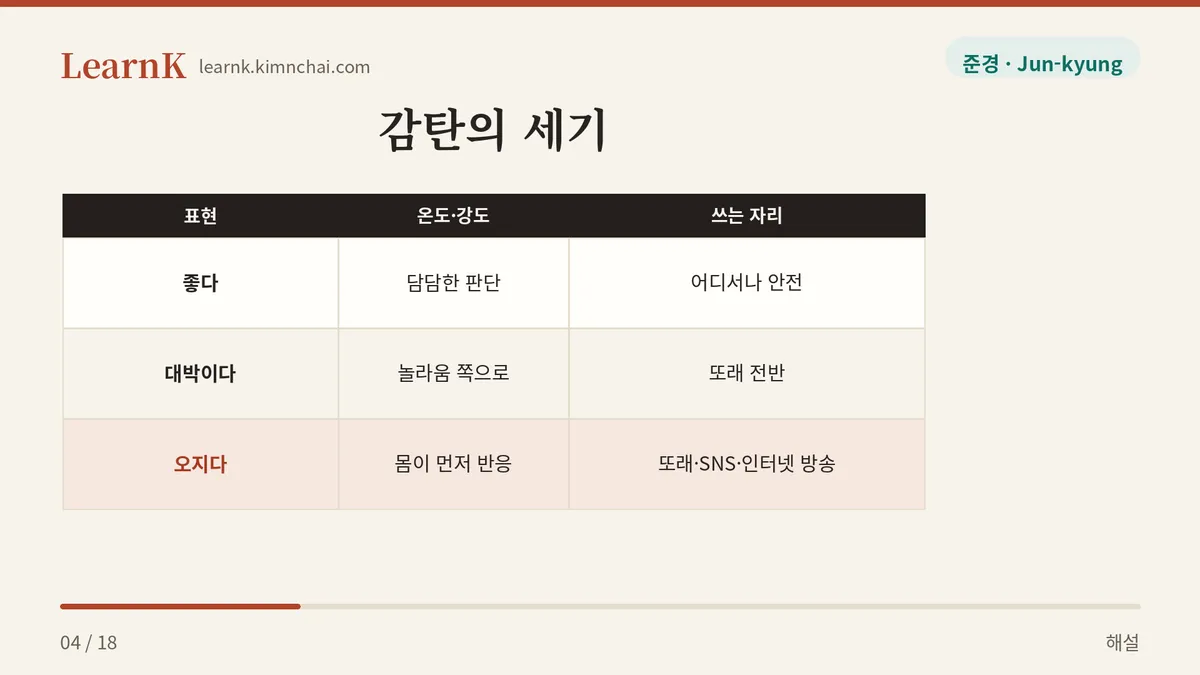
Line words up by intensity and its place becomes clear. 좋다 (jota) is calm, 대박이다 (daebagida) leans toward surprise, and 오지다 (ojida) is one notch stronger than that. If “좋다” is a judgment, “오지다” is a reaction — not the verdict your head reached, but what comes out after your body has already responded. That’s why the word doesn’t suit a quiet review. It attaches to the moments that make you shout.
A quick note on grammar. 오지다 is an adjective, but in real conversation people conjugate it like a verb, as in 오진다 (ojinda). Adjectives normally don’t work that way — you don’t say “예쁘다 → 예쁜다” — but for this one word, “오진다” has hardened into spoken Korean. Rather than trying to argue with the grammar, it’s much faster to memorize the forms whole.
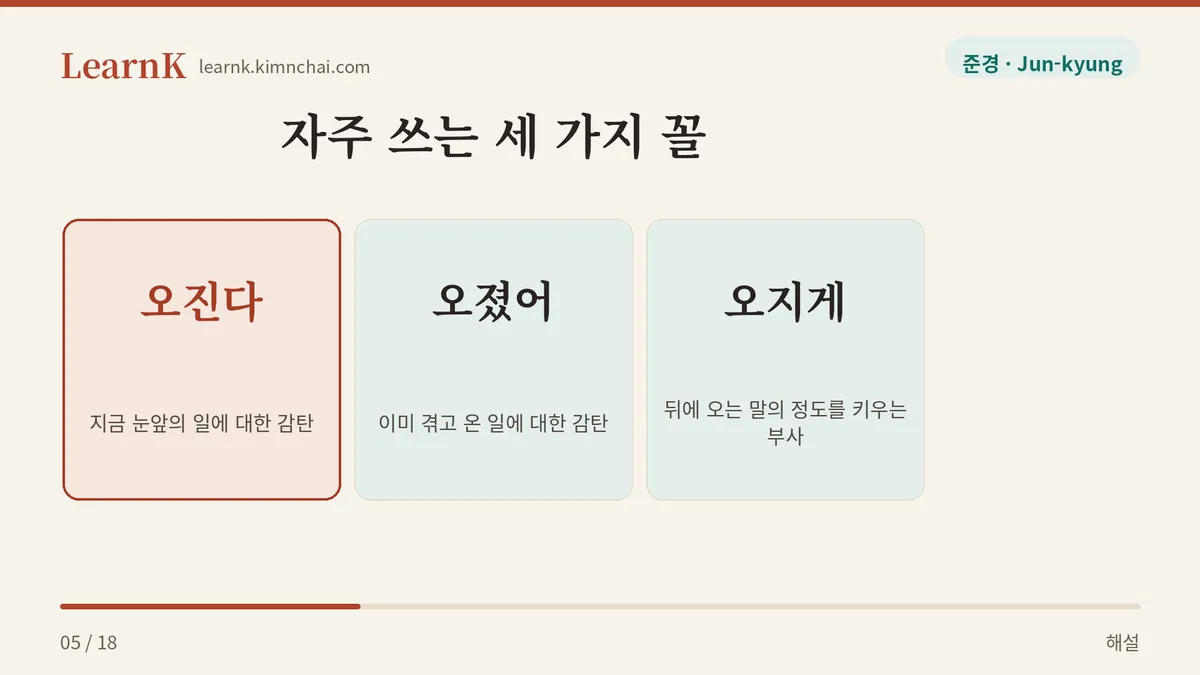
Five forms come up often.
- 오진다 (ojinda) — awe at something unfolding right in front of you.
- 오졌다 (ojyeotda) — awe at something you’ve already been through. “어제 공연 오졌다.” (Yesterday’s concert was insane.)
- 오지네 (ojine) — a quieter, lower-voiced version, close to talking to yourself.
- 오지게 (ojige) — the adverb. It cranks up whatever follows. “오지게 맵다” (insanely spicy), “오지게 춥다” (insanely cold).
- 개오진다 (gaeojinda) — the prefix 개- (gae-) makes it stronger still. It’s crude, so it’s very picky about where it fits.
The one to watch here is 오지게 (ojige). “오진다” only attaches to good things, but the adverb “오지게” just raises the degree, so it can attach to bad things too. Miss that distinction and you’ll walk straight into the mistake we cover below.
A real conversation
Scene: the first Saturday of October, Yeouido Hangang Park. They’ve had their picnic mat spread out since three in the afternoon, waiting for the fireworks festival.
Jun-kyung: 자, 여기 앉아. 앞에 나무 안 걸리는 자리 이거 하나 남았더라. Here, sit. This was the only spot left without a tree blocking the view.
Emily: 세 시간 기다린 보람 있다. 근데 나 다리 저려. Three hours of waiting finally paid off. My legs are numb, though.
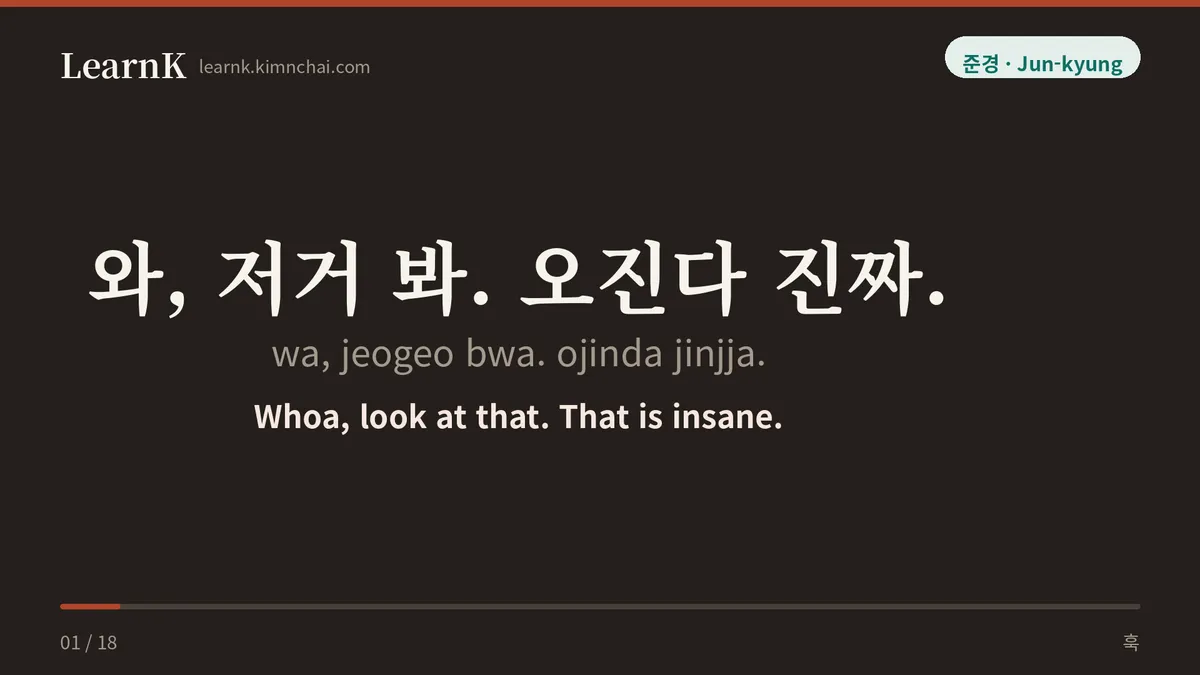
Jun-kyung: 어어, 시작한다 시작한다. …와, 저거 봐. 오진다 진짜. Oh, it’s starting, it’s starting. …Whoa, look at that. That is insane.
Emily: 헐, 소리가 배에 울려. 사진으로 보던 거랑 완전 다르네. Whoa, I can feel the boom in my stomach. Totally different from the photos.
Jun-kyung: 이건 몸풀기야. 마지막 십 분이 더 오져. This is just the warm-up. The last ten minutes are even crazier.
Emily: 나 목 아픈데 눈을 못 떼겠어. 아, 저거 오지게 크다! My neck hurts but I can’t look away. Oh, that one’s insanely big!
Saying it this way sounds off
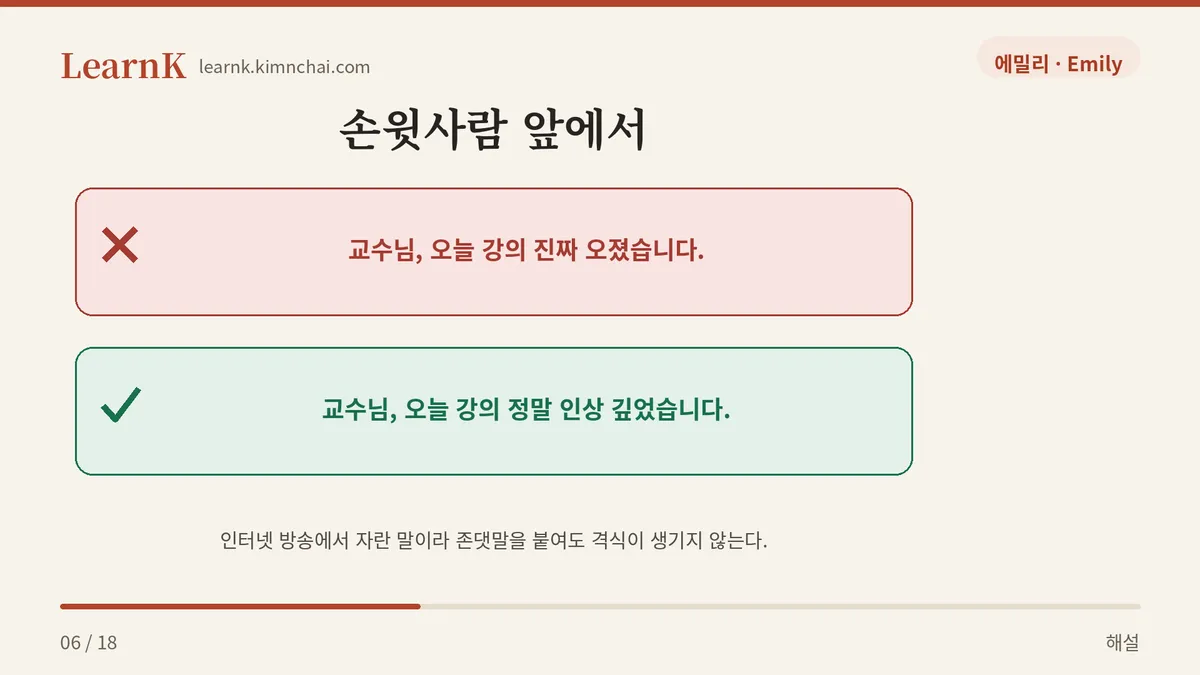
✗ (to your professor) 교수님, 오늘 강의 진짜 오졌습니다 (ojyeotseumnida). ✓ (to your professor) 교수님, 오늘 강의 정말 인상 깊었습니다. (Professor, today’s lecture really made an impression on me.) → This word grew up on internet broadcasts, so tacking a polite ending onto it doesn’t make it formal. In front of someone older or senior to you, it lands as a joke rather than a compliment.
✗ (to a friend who just lost their wallet) 헐, 오진다 (ojinda)! ✓ (to a friend who just lost their wallet) 야, 너 오늘 오지게 (ojige) 재수 없었네. 어떡해. (Man, you had insanely bad luck today. What are you going to do?) → Used on its own like an interjection, “오진다” is fundamentally a positive exclamation, so aimed at someone else’s misfortune it comes out sounding like you’re enjoying it. For bad news, use the adverb “오지게,” which only raises the degree.
Example sentences by situation
1. The day after a concert, when a friend asks how it was
어제 앙코르 세 곡 했는데, 마지막 곡 조명이 진짜 오졌어. (eoje angkoreu se gok haenneunde, majimak gok jomyeongi jinjja ojyeosseo.) “Yesterday they did three encore songs, and the lighting on the last one was insane.”
It’s already over, so you use 오졌어 (ojyeosseo). And notice that what 오지다 is describing here isn’t the whole concert — it’s one thing, the lighting. Narrowing the focus of your awe to a single detail like this makes the sentence far more vivid.
2. At a 떡볶이 place you’re trying for the first time, right after the first bite
여기 진짜 오지게 맵다. 물 한 병만 더 시키자. (yeogi jinjja ojige maepda. mul han byeong man deo sikija.) “This place is insanely spicy. Let’s order one more bottle of water.”
The adverb 오지게 (ojige) slots into the same position as “아주 (aju)” or “엄청 (eomcheong).” But where “아주 맵다” is a description, “오지게 맵다” is what someone says while already sweating. It isn’t only the intensity that differs — the speaker’s own state is baked into the word.
3. On the commute home, summing up your day for a friend
오늘 팀장님한테 오지게 깨졌어. 말도 마. (oneul timjangnimhante ojige kkaejyeosseo. maldo ma.) “I got chewed out badly by my team lead today. Don’t even ask.”
Nothing good happened, and yet it sounds perfectly natural — because, as noted above, “오지게” has no direction of its own; it only enlarges. This is exactly the sentence that makes learners ask, “Wait, didn’t 오지다 mean something good?”
Polite forms, casual forms, and similar expressions
It’s not that polite conjugations don’t exist. “오지네요 (ojineyo)” and “오집니다 (ojimnida)” can both be built, form-wise. But almost no Korean actually says “오집니다.” The closest you’ll get in the wild is “오지네요” tossed out half-jokingly between friendly seniors and juniors who aren’t far apart in age. In a meeting, an interview, or in front of an adult you’ve just met, the very fact that you attached a polite ending makes it sound like a joke — so in those settings, it’s safer to switch to one of the expressions lower down in the table.
| Expression | Temperature & intensity | Where it’s used |
|---|---|---|
| 오지다 (ojida) | Very strong. The reaction comes out of the body before the head | Peers, social media, livestreams. Not with anyone senior to you |
| 지리다 (jirida) | Similar to 오지다 or stronger. Rough-edged | Only among very close peers. Off-limits in public or formal settings |
| 쩐다 (jjeonda) | Strong. Mixes in a faint note of being worn down by it | Peers. Not with anyone senior to you |
| 대박이다 (daebagida) | Strong, tilted toward surprise | Peers generally. In casual settings it works broadly |
| 굉장하다 (goengjanghada) | Strong in a neutral way | Anywhere. Safe even with people senior to you |
Read the table top to bottom and one rule shows up: the higher you go, the stronger the word gets — and the narrower the range of places you can use it. Most Korean slang sits somewhere on this same trade-off.
Cultural background — how a dialect word went nationwide
It looks like slang that popped out of the internet overnight, but 오지다 is an old native Korean word. Its original sense was closer to “packed solid inside, with nothing flimsy about it” — picture something whose core is densely, sturdily filled. Today’s “amazing” usage came about as that sturdiness tilted toward awe.
The route it took across the country is a little unusual. In the Jeolla region it was widely used to mean “really good, exciting,” and in the late 2010s it rode personal internet broadcasts and YouTube out past its home region. It was a sound that sat easily in the mouths of streamers yelling their reactions, and once catchphrases like “오지고 지리고” — stacking near-synonyms and shouting them together — caught on, it became basic vocabulary for teens and twenty-somethings. Today people born and raised in Seoul use it without the slightest sense of it being foreign.
If you run into this word in a drama, there’s a good chance you’re in a scene that’s sketching a character’s personality at the same time. It doesn’t appear in formal courtroom dramas or historical pieces; it appears in high school classrooms, tiny studio apartments, PC bangs, and the second round of a company dinner. In other words, the word doesn’t just carry a meaning — it also carries the signal “I’m with people I’m comfortable with, in a place where I can relax.” Once you can read that signal, the temperature of a drama you watch without subtitles changes quite a bit.
Today’s quiz
Your friend fires up a game on their brand-new laptop, and the picture is astonishingly smooth. Watching from beside them, what’s the most natural thing for you to say?
“와, 이거 그래픽 ______!”
① 오집니다 (ojimnida) ② 오진다 (ojinda) ③ 오지겠습니다 (ojigetseumnida) ④ 오지세요 (ojiseyo)
The answer is ②, 오진다 (ojinda). You’re with a friend, so it’s a casual-speech setting, and you’re reacting to something happening right in front of you — that’s exactly what “오진다” is for. Attaching polite endings as in ① and ③ gives you forms that are grammatically constructible but awkward and essentially unused in real life, and ④ is an imperative, so it doesn’t even make sense.
Definitions and example sentences are from the National Institute of Korean Language’s Basic Korean Dictionary (krdict.korean.go.kr); that portion of this post, including our translations, is licensed under CC BY-SA 2.0 KR.