오지랖 (ojirap) — How Did the Front of a Jacket Ever Come to Mean Meddling?
오지랖
오지랖 (ojirap) originally refers to the front panel of a jacket or upper garment, but in everyday conversation today it means the attitude of butting into other people’s business more than you need to. Open a dictionary and you get a story about clothing — yet Koreans use this word in situations that have nothing to do with clothes at all. That gap is what this post is about.
There’s a scene that almost every learner newly arrived in Korea runs into. An elderly stranger on the subway comes up to you and says, “그렇게 얇게 입고 다니면 감기 걸려 (geureoke yalge ipgo danimyeon gamgi geollyeo)” — “Dress that lightly and you’ll catch a cold.” At the convenience store counter, the clerk lets you know, “이거 말고 저게 더 싸요 (igeo malgo jeoge deo ssayo)” — “That one’s cheaper than this one.” The owner of the hair salon asks about your marriage plans when nobody asked her. Pack all of those moments into a single Korean word, and you get 오지랖.
What matters is the temperature. 오지랖 is a negative word at heart. But it isn’t ice-cold either. When a friend keeps getting into every last thing you do and you say “너 진짜 오지랖 넓다 (neo jinjja ojirap neolda),” it’s half annoyance, half affection. Flip it around: if you’ve decided the meddling crossed a line, that exact same sentence lands pretty sharply. So with this word, who you say it to and with what expression decides half the meaning.
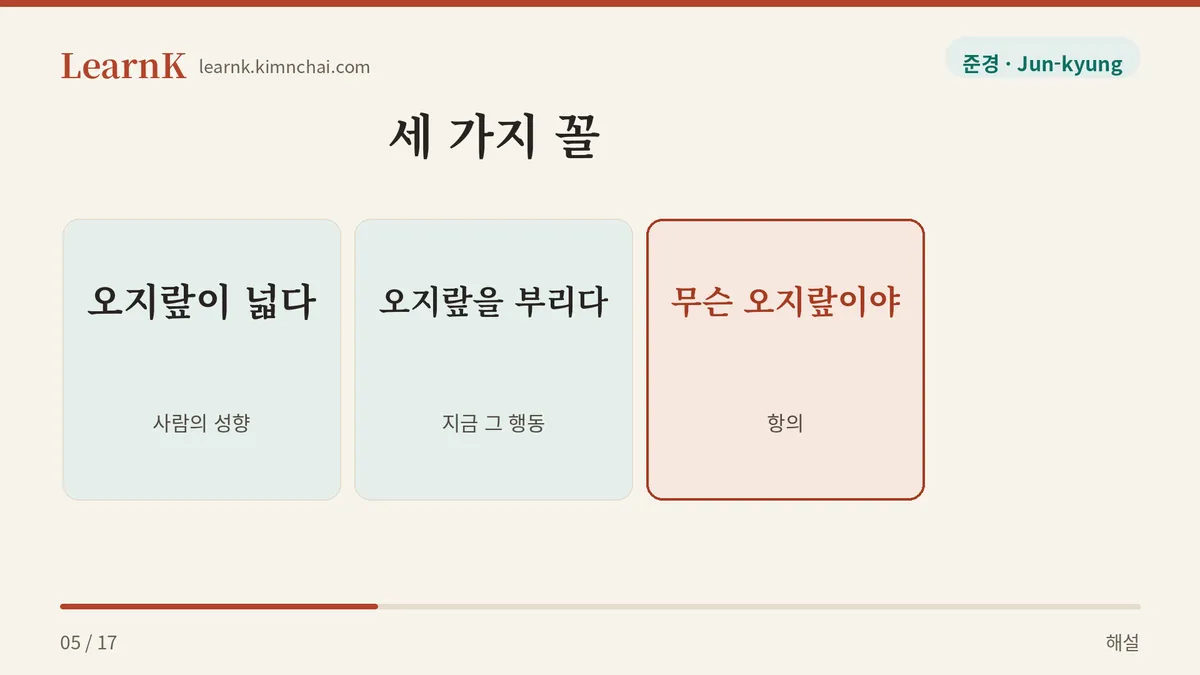
Three forms come up most often. 오지랖이 넓다 (ojirabi neolda) describes a person’s disposition; 오지랖을 부리다 (ojirabeul burida) points at the behavior happening right now; and tossing out just the noun, as in 무슨 오지랖이야 (museun ojirabiya), is closer to a protest. Online, there’s even a coinage that tacks an English suffix onto it: 오지라퍼 (ojiraper). It’s slang you won’t find in any dictionary, but it shows up constantly in conversation between peers.
Checking It in the National Institute of Korean Language Dictionary
The National Institute of Korean Language’s Basic Korean Dictionary defines the word this way.
오지랖 「noun」 웃옷이나 윗도리의 앞자락. (useosina witdori-ui apjarak.) — the front panel of an outer or upper garment. [en] front part — The front part of an outer or upper garment. [ja] 上着の前裾。 [es] parte delantera de una prenda de vestir superior — Parte delantera de una prenda de vestir superior. [zh] 衣襟,前襟 — 上衣的前面部分。 — National Institute of Korean Language, Basic Korean Dictionary (krdict.korean.go.kr)
The dictionary doesn’t carry a Portuguese definition. For reference, it would come out to roughly a parte da frente de uma peça de roupa superior — but that one line is our own translation, not dictionary material.
Notice that the dictionary talks only about clothing. In other words, the “meddling” sense isn’t the meaning of the word itself — it’s a meaning produced by the idiom 오지랖이 넓다 (ojirabi neolda). And yet the actual usage examples the dictionary gives contain both strands, sitting right next to each other.
오지랖 넓게 간여하다. (Ojirap neolge ganyeohada.) 그는 오지랖이 넓어서 여기저기 끼이지 않는 데가 없다. (Geuneun ojirabi neolbeoseo yeogijeogi kkiiji anneun dega eopda.) 오지랖을 여미다. (Ojirabeul yeomida.) 적삼의 오지랖. (Jeoksam-ui ojirap.) 얘, 너 오지랖 좀 여며라. 가슴이 다 보인다. (Yae, neo ojirap jom yeomyeora. Gaseumi da boinda.) — National Institute of Korean Language, Basic Korean Dictionary (krdict.korean.go.kr)
Let’s walk through where each of these sentences comes from.
- 오지랖 넓게 간여하다. (Ojirap neolge ganyeohada.) — “To meddle broadly in something.” 간여 (ganyeo, 干與) is a Sino-Korean word meaning to get mixed up in someone else’s affairs. This is exactly the usage we still have today, and the adverb 넓게 (neolge, “widely”) sketches out just how far the meddling goes.
- 그는 오지랖이 넓어서 여기저기 끼이지 않는 데가 없다. (Geuneun ojirabi neolbeoseo yeogijeogi kkiiji anneun dega eopda.) — “He’s such a busybody that there’s nowhere he doesn’t stick his nose into.” This sentence describes a person’s entire personality in one go. Picture the person who has a foot in every single matter, at the office or around the neighborhood. A great sentence for learners to memorize whole.
- 오지랖을 여미다. (Ojirabeul yeomida.) — “To pull the front of one’s jacket closed.” Here the word is used in its completely original sense. 여미다 (yeomida) is the motion of gathering the front of a garment neatly together — that hand gesture of pulling your coat shut on a cold day.
- 적삼의 오지랖. (Jeoksam-ui ojirap.) — “The front panel of a jeoksam.” A 적삼 (jeoksam) is a single-layer hanbok top. This example shows that the word was originally a clothing term from the era when people wore hanbok.
- 얘, 너 오지랖 좀 여며라. 가슴이 다 보인다. (Yae, neo ojirap jom yeomyeora. Gaseumi da boinda.) — “Hey, close up your jacket. Your chest is showing.” It’s a slice of daily life: an adult correcting a child’s appearance. Almost no Korean actually says this sentence today, but in one line it shows you where the word’s roots lie.
Seeing It in a Real Conversation
Scene: Saturday morning at an apartment building’s recycling area. Emily is flattening delivery boxes when Jun-kyung comes out carrying the food-waste bin.
Jun-kyung: 어, 에밀리. 아침부터 표정이 왜 그래? Oh, Emily. Why the face this early in the morning?
Emily: 방금 502호 아주머니가 나 붙잡고 십 분을 얘기하셨어. 그렇게 얇게 입고 다니면 안 된다고. The lady in 502 just held me up for ten minutes. Said I shouldn’t dress so lightly.
Jun-kyung: 아, 그분 원래 좀 오지랖이 넓으셔. 근데 나쁜 마음은 아니야. Ah, she’s always been a bit of a busybody. But she doesn’t mean any harm.
Emily: 나도 알아. 근데 처음 보는 사람 옷차림까지 왜 참견하는지는 아직도 모르겠어. I know. But I still don’t get why people comment on a stranger’s clothes.
Jun-kyung: 옛날엔 그게 정이었거든. 요즘 젊은 사람한테 그러면 오지랖 부린다고 싫어하지만. It used to count as warmth. Though if you do that to young people now, they call it meddling and hate it.
Emily: 아, 그럼 나도 아까 아주머니한테 무릎 조심하시라고 한 거, 그것도 오지랖이야? Oh — so when I told her to be careful with her knees, was that meddling too?
Jun-kyung: 야, 그건 걱정이지. 한마디는 정이고 십 분은 오지랖이야. Hey, that’s concern. One sentence is warmth; ten minutes is meddling.
Emily: 기준이 시간이었네. 이제 알겠다. So the line is time. Now I get it.
This Is Where It Sounds Off
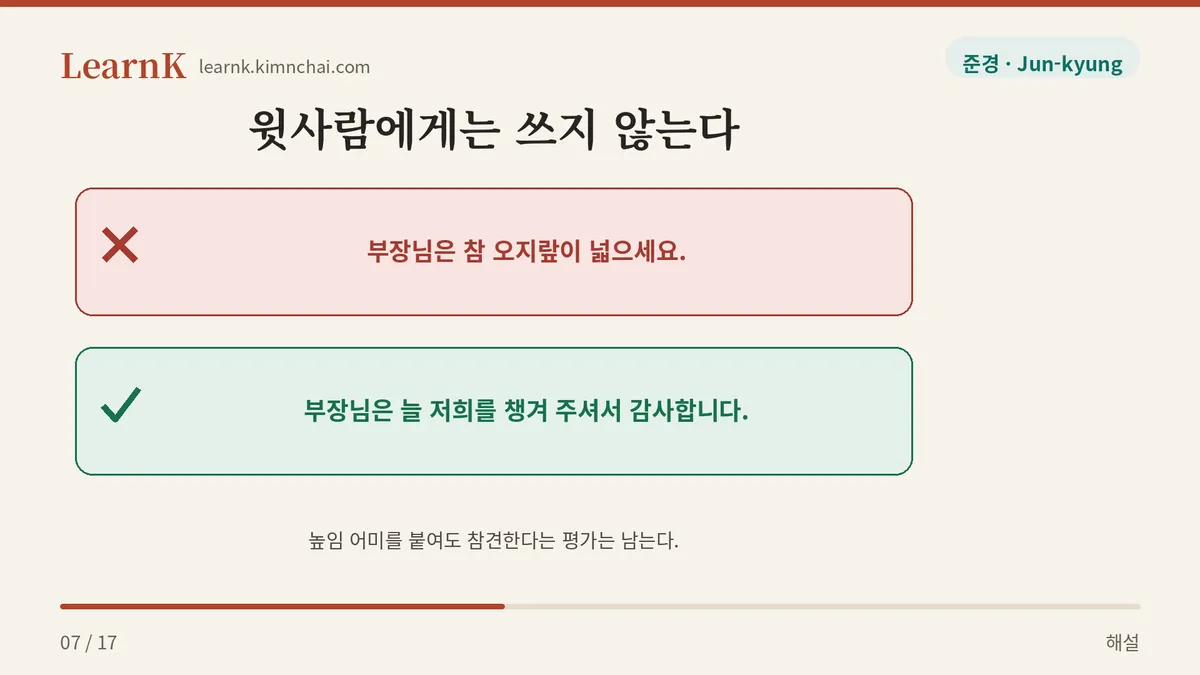
✗ (to your manager) 부장님은 참 오지랖이 넓으세요. (Bujangnim-eun cham ojirabi neolbeuseyo.) ✓ (to your manager) 부장님은 늘 저희를 챙겨 주셔서 감사합니다. (Bujangnim-eun neul jeohuireul chaenggyeo jusyeoseo gamsahamnida.) → The grammar is perfectly fine. The problem is the content. No matter how high you pitch the ending, 오지랖 keeps its verdict of “you butt into other people’s business for no good reason.” Wrapping it in an honorific shell doesn’t turn it into a compliment. To speak well of a superior’s attention, go with 챙기다 (chaenggida) or 신경 써 주시다 (singyeong sseo jusida) instead.
✗ (in a clothing store) 이 셔츠는 오지랖이 참 예쁘네요. (I syeocheuneun ojirabi cham yeppeuneyo.) ✓ (in a clothing store) 이 셔츠는 앞자락이 참 예쁘네요. (I syeocheuneun apjaragi cham yeppeuneyo.) → By the dictionary definition, this sentence isn’t wrong. But Koreans today don’t use this word when talking about clothes, so the listener pauses for a second and thinks, “Wait, the shirt is meddling?” It’s a classic case of a word whose dictionary-alive meaning and its actually-alive meaning are two different things.
Example Sentences by Situation
① Venting about someone to a friend — a senior colleague has butted into someone’s love life again. 김 선배 진짜 못 말려. 오지랖도 정도가 있지. (Kim seonbae jinjja mot mallyeo. Ojirapdo jeongdoga itji.) Kim really is too much. There’s a limit to butting in. → ~도 정도가 있지 (~do jeongdoga itji) is a set phrase meaning “that crossed the line.” Worth memorizing as a chunk.
② Laying the groundwork before you meddle — you spot a strange clause in a friend’s contract. 내 오지랖인 건 아는데, 이건 말해 줘야 할 것 같아서. (Nae ojirabin geon aneunde, igeon marhae jwoya hal geot gataseo.) I know this is none of my business, but I felt I had to say it. → This is the form you’ll hear most often in real life. Lowering yourself first makes the other person take the advice far more gracefully.
③ Flipping it around to say thank you — a friend’s meddling is what solved your problem. 네 오지랖 덕분에 살았다. 진짜 고마워. (Ne ojirap deokbune saratda. Jinjja gomawo.) Your nosiness saved me. Thanks a lot. → This is deliberately grabbing a negative word and twisting it into praise. It only works between close friends.
Polite vs. Casual Speech, and Similar Expressions
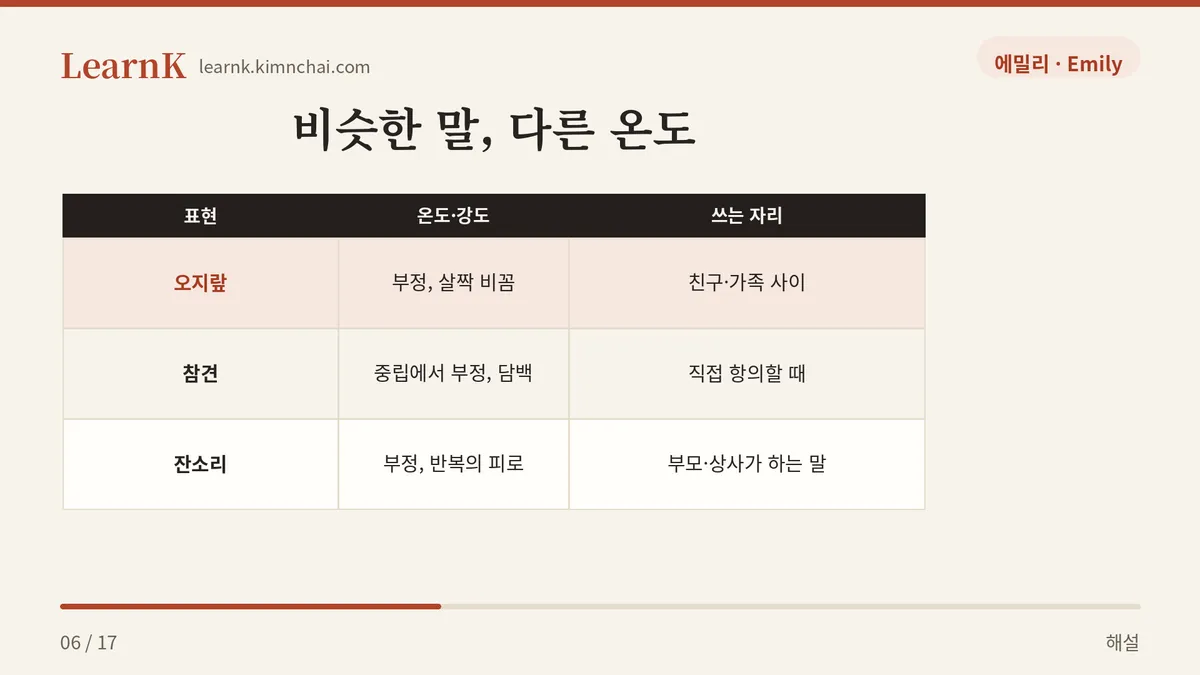
| Expression | Temperature / Intensity | Where it’s used |
|---|---|---|
| 오지랖 (ojirap) | Negative, with a faintly sarcastic edge | Between friends and family. Said to someone’s face, it lands hard |
| 참견 (chamgyeon) | Neutral to negative, matter-of-fact | Also used for direct protest, as in 참견하지 마 (chamgyeonhaji ma) |
| 잔소리 (jansori) | Negative, the fatigue of repetition | What parents and bosses do. Means “even if you’re right, I’m sick of it” |
| 챙기다 (chaenggida) | Positive, warm | For when the very same behavior is seen kindly. Safe to use about superiors |
| 오지라퍼 (ojiraper) | Light, teasing | Internet and peer conversation. Not for formal settings |
The polite form 오지랖이 넓으시네요 (ojirabi neolbeusineyo) is grammatically possible, but you’ll almost never hear it in practice — adding an honorific ending doesn’t strip away the fact that it’s a criticism. The casual 오지랖 넓다 (ojirap neolda) is extremely common between friends, and here, saying it with a smile makes it teasing while saying it with a straight face makes it a warning.
Cultural Background — From the Back Alley to the Apartment Block
The picture this word paints is simple. If the front panel of your jacket is wide, it covers not just your own body but whatever happens to be next to you. That image — my clothing spilling over into someone else’s space — is what carried over into “spilling over into someone else’s business.” Because the dictionary has held on to the original meaning of “front panel,” learners can see with their own eyes where this idiom came from.
Behind how the meaning hardened this way lies the old alleyway community. In an era when you knew how many spoons the family next door owned, stepping into someone else’s affairs wasn’t rudeness — it was an expression of 정 (jeong, 情), that sense of warm attachment. A child falls down and a passing adult picks them up; the neighbors’ kimchi ripens and a whole container comes over the wall. The Ssangmun-dong alley portrayed in the drama 《응답하라 1988》 (Eungdaphara 1988, Reply 1988, tvN, 2015) is exactly that world. In the show, neighbors know each other’s report cards and household finances inside out and freely butt in — and what viewers were nostalgic for while watching those scenes was precisely the sense of distance we now call 오지랖.
Things are different now. As apartments and single-person households have multiplied, protecting one’s private sphere has become the polite thing to do, and the name attached to the same behavior has shifted from 정 (jeong) to 오지랖. The “nagging price list” that makes the rounds online every holiday — a joke that puts a price tag on relatives’ meddling, so much for the job question, so much for the marriage question — captures that change better than anything. So learning this word isn’t a matter of picking up one more vocabulary item; it’s a way of reading how the distance between people in Korean society is being redrawn.
Today’s Quiz
Which of the following uses 오지랖 most naturally?
① 사장님, 저희를 챙겨 주시는 그 오지랖에 늘 감사드립니다. (Sajangnim, jeohuireul chaenggyeo jusineun geu ojirabe neul gamsadeurimnida.) ② 어제 산 코트의 오지랖이 마음에 쏙 들어요. (Eoje san koteu-ui ojirabi ma-eume ssok deureoyo.) ③ 내 오지랖인 건 아는데, 그 사람 조심하는 게 좋을 것 같아. (Nae ojirabin geon aneunde, geu saram josimhaneun ge joeul geot gata.)
Show the answer
The answer is ③. Lowering your own behavior first and then offering advice is the most common, most natural usage there is.
① only raises the ending — the content still says “you meddle needlessly,” so using it with a superior is rude. It needs to be changed to 챙겨 주셔서 감사합니다 (chaenggyeo jusyeoseo gamsahamnida). ② fits the dictionary’s original meaning (the front panel of a garment), but it isn’t used in Korean today, so it sounds off. 앞자락 (apjarak) is the natural choice.
Definitions and example sentences are from the National Institute of Korean Language’s Basic Korean Dictionary (krdict.korean.go.kr); that portion of this post, including our translations, is licensed under CC BY-SA 2.0 KR.