오운완 (o-un-wan) — A Little Brag That You Did It Again Today: The Korean One-Liner for Proving You Worked Out
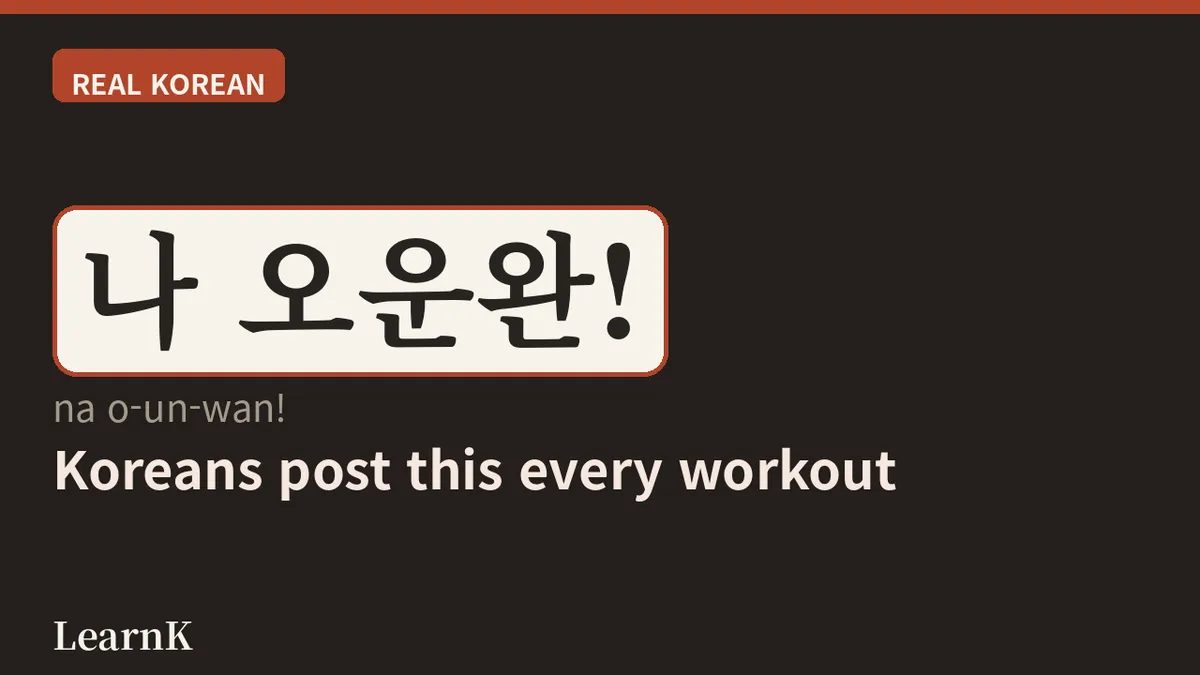
오운완
As you scroll through Instagram or X (formerly Twitter), you’ll often spot a short hashtag — #오운완 (#o-un-wan) — tucked under a sweaty gym selfie. If you’re a learner seeing it for the first time, you might wonder, “Is this someone’s name? A brand?” But it’s actually a super-popular piece of slang that young Koreans use to show off — and prove — their self-discipline. Today, let’s take a deep dive into this one little phrase, 오운완 (o-un-wan).
What does it mean?
오운완 (o-un-wan) is a shortened form of 오늘 운동 완료 (oneul undong wallyo). It’s made by taking just the first syllable of each word.
- 오늘 (oneul) — today
- 운동 (undong) — exercise / workout
- 완료 (wallyo) — completion / done
So it means “I finished all of today’s workout.” But it’s more than just reporting a fact — it carries a sense of accomplishment and pride, as if to say, “I kept my promise to myself again today!” That’s why it usually shows up alongside a post-workout photo as proof. Keep in mind that it isn’t an official dictionary word — it’s a shortened slang term that spread naturally online.
Example sentences by situation
1. Posting a workout photo on social media (a caption to yourself)
40 minutes at the gym, 오운완! (owanwan!) Giving myself some credit again today.
This is a caption you’ll commonly see under a mirror selfie. It pairs well with self-encouraging phrases like “giving myself some credit again today.”
2. In casual conversation between friends
A: Did you go for a run yesterday? B: Yeah, 오운완 했지 (owanwan haetji). I ran 5km!
Here, it’s totally natural to add ‘하다’ after it — as in 오운완 하다 (owanwan hada) — to use it like a verb.
3. Politely, in a workout community
Made it through 오운완 했습니다 (owanwan haesseumnida) again today. Let’s keep it up, everyone!
The abbreviation itself is casual, but adding ‘했습니다’ lets you share your proof politely in an online group.
Comparing formal and casual versions
오운완 on its own is neither formal nor informal — it’s a noun-like abbreviation, so the words that follow it determine the tone.
- Casual: 오운완! (owanwan!) / 오운완 했어 (owanwan haesseo).
- Formal: 오운완 했어요 (owanwan haesseoyo). / 오운완 했습니다 (owanwan haesseumnida).
In settings that call for formality (a work report, an official piece of writing), it’s more natural to spell it out instead of using the slang — for example, “오늘 운동을 마쳤습니다 (oneul undongeul machyeotseumnida)” (“I finished my workout today”).
It’s also worth knowing a related piece of slang with a similar vibe. 갓생 (gatsaeng) comes from ‘god (갓) + life (생, from 인생)’ and means a diligent, fulfilling life — and 오운완 is basically one of the small daily proofs that add up to that 갓생.
Cultural background — why “prove” it?
Korean social media has a strong “proof” culture (인증 문화). People capture goals like studying, dieting, or working out in photos to motivate themselves and to cheer each other on. As the “living the 갓생 (a diligent life)” trend has taken off over the past few years, 오운완 — a quick daily record of your workout — has become its symbolic catchphrase.
You can even spot it in dramas, where it’s not hard to find a character finishing an early-morning workout and beaming, “Today’s done too!” Think of 오운완 as that exact feeling, compressed into a single word.
Closing quiz
Which of the following sentences is 오운완 (o-un-wan) short for?
- 오늘 운동 완료 (oneul undong wallyo)
- 오래 운전 완주 (orae unjeon wanju)
- 오후 운세 완성 (ohu unse wanseong)
The answer is number 1! Now it’s your turn to proudly shout #오운완 after you finish your workout. Today’s little win is absolutely worth bragging about!