팩폭 — The Truth That Hurts: Mastering Koreans' 'Fact Attack'
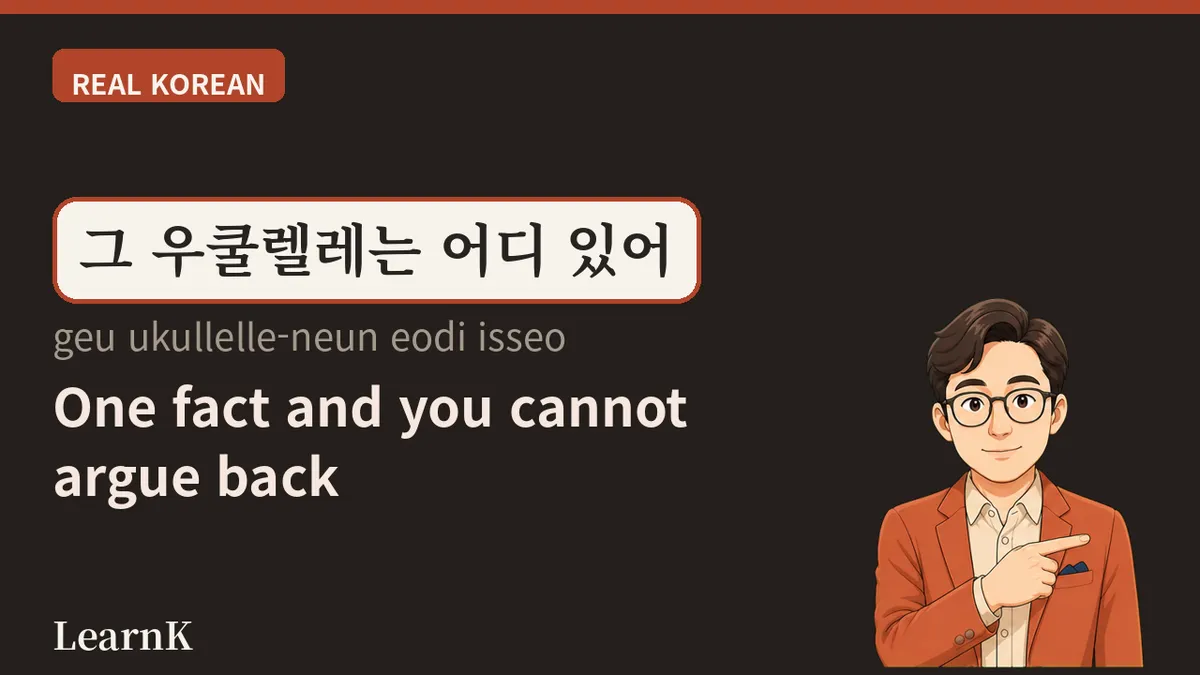
팩폭
Imagine you tell a friend, “I think I bombed this exam,” hoping for a little comfort — and instead they hit you with, “Well, you didn’t study at all last week.” It’s true, so you can’t even argue back; it just stings. This is exactly the moment Koreans call getting “팩폭 당했다 (paekpok danghaetda)” — “getting hit with a fact attack.” Today, let’s take a deep dive into 팩폭 (paekpok), a slang term that pops up several times a day in social media, YouTube comments, and variety-show captions.
Meaning and Nuance
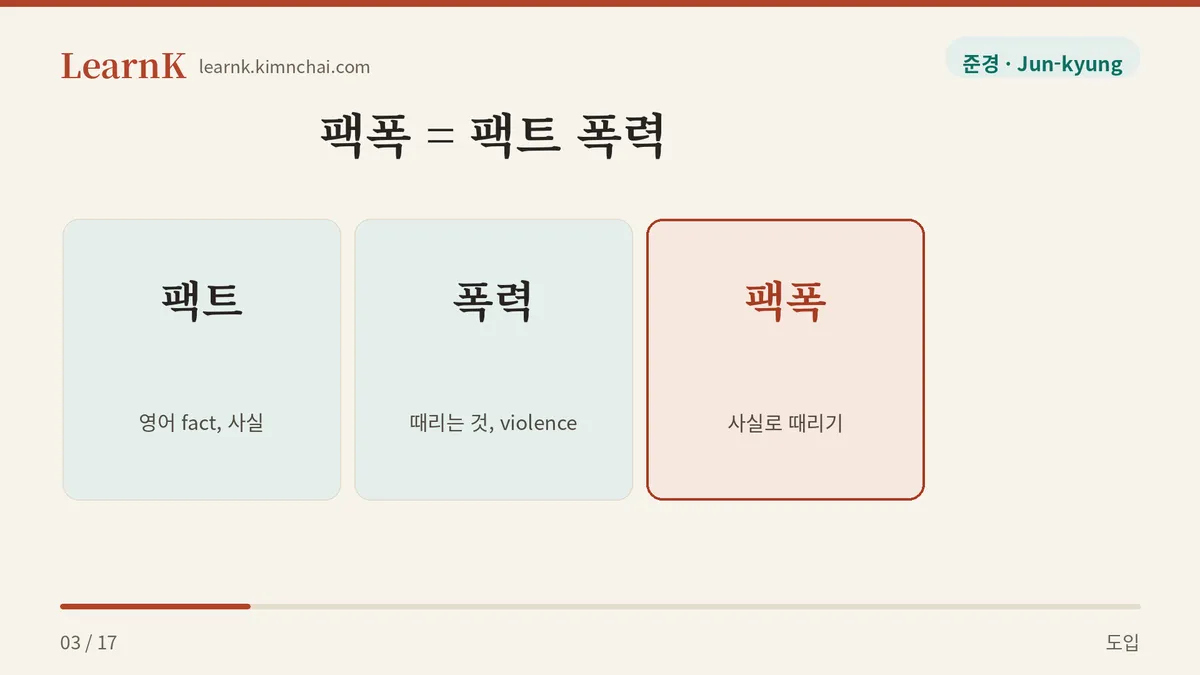
팩폭 (paekpok) is short for “팩트 폭력 (paekteu pongnyeok).” It combines the English word fact (팩트, meaning “fact”) with the Korean word 폭력 (pongnyeok, meaning “violence”). Translated literally, it’s “fact violence” — in other words, shutting someone up by hitting them with an undeniable fact.
There are two key nuances. First, what was said isn’t wrong at all — it’s actually spot-on accurate. Second, that fact hits the nail so squarely on the head that it hurts like you just took a punch. So 팩폭 carries a bittersweet “it’s true, but why does it hurt so much?” feeling, mixed with a 웃픈 (funny-and-sad) sense of “I have no choice but to admit it.”
Example Sentences by Situation
① To a friend who’s decided to go on a diet
A: “나 내일부터 진짜 운동할 거야! (na naeil-buteo jinjja undonghal geoya!)” — “Starting tomorrow, I’m really going to work out!” B: “너 그 말 지난달에도 했어. (neo geu mal jinandal-edo haesseo.)” — “You said that last month too.”
Here, B’s remark is a perfect 팩폭 (paekpok). It’s not a lie — it points to something that actually happened, so A can’t say a word. In a moment like this, A can laugh and fire back with “아, 팩폭 그만해 (a, paekpok geumanhae)” — “Ugh, quit attacking me with facts.”
② When you get a cold, hard analysis in a meeting
A coworker looks at your proposal and says, “This idea was already tried by a competitor last year, and it failed.” If you have no grounds to argue back, that’s a 팩폭 (paekpok). In this case, you can acknowledge it politely in formal speech, like “팩폭 인정합니다 (paekpok injeonghamnida)” — “I admit that painful fact.”
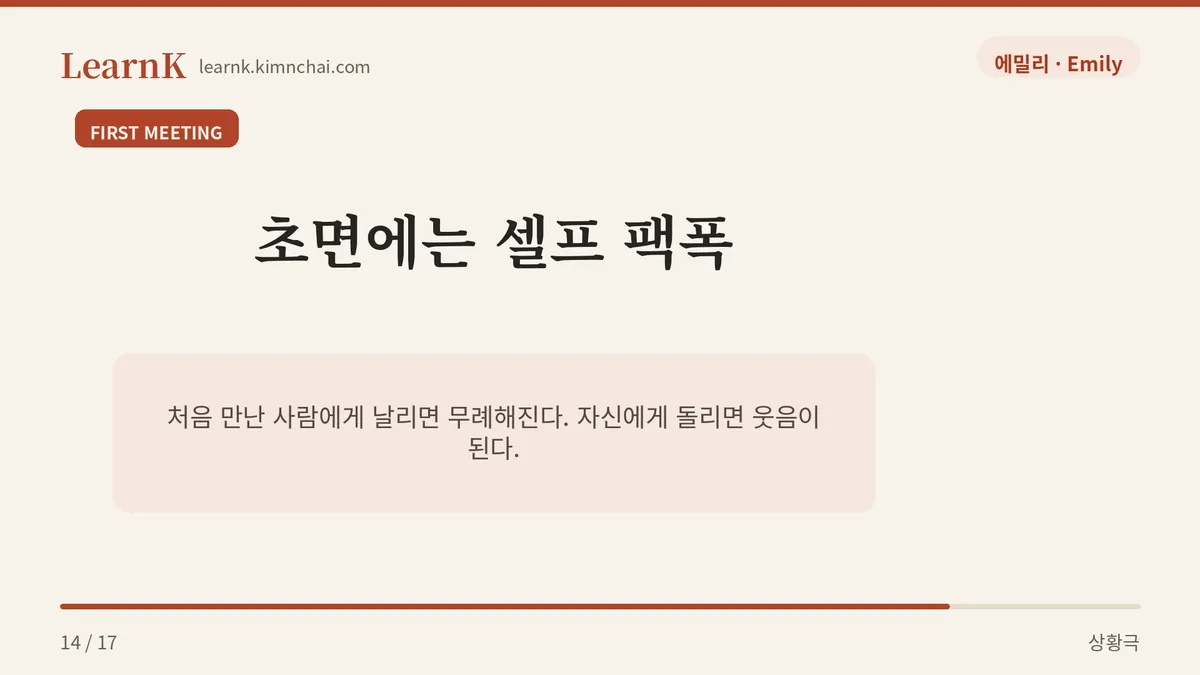
③ Self-팩폭 — hitting yourself with the facts
These days, people also use it when they say a cold, hard truth not about someone else, but about themselves. For example: “셀프 팩폭이지만 나 통장에 돈 없어 (selpeu paekpok-ijiman na tongjang-e don eopseo)” — “This is a fact attack on myself, but there’s no money in my bank account.”
Comparing Formal/Casual Speech and Similar Expressions
Since 팩폭 is slang, you can use it freely in all kinds of sentence forms.
- Casual: “완전 팩폭이네 (wanjeon paekpok-ine)” — “That’s a total fact attack.”
- Formal: “팩폭 하지 마세요 (paekpok haji maseyo)” — “Please don’t attack me with facts.”
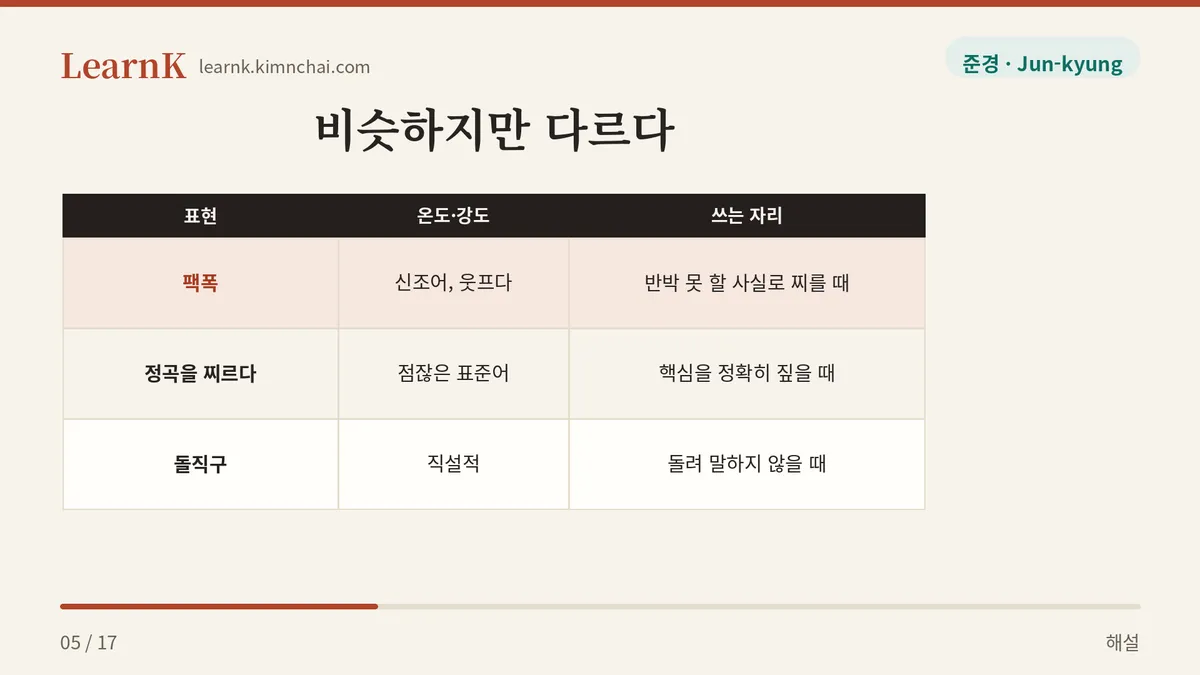
Want to learn some similar expressions too? “정곡을 찌르다 (jeonggogeul jjireuda)” — “to strike at the heart of the matter” — is the more refined, standard-language version of 팩폭. On the other hand, “돌직구 (doljikgu)” — from 돌 (stone) + 직구 (straight pitch), meaning blunt, straight talk — means “saying something directly without beating around the bush.” It overlaps with 팩폭, but a 돌직구 doesn’t necessarily have to be a painful truth. The difference is that with 팩폭, the weapon of ‘fact’ is what’s essential.
Cultural Background
Korean variety shows and dramas often feature scenes where a character demolishes someone’s weak point with a single accurate fact. Especially when a cool-headed, clever character calmly tells the truth to someone swept up in their emotions, viewers feel a rush of satisfaction along with the word ‘팩폭’ flashing across the caption. As scenes like these piled up, 팩폭 became a cultural code for ‘a painful but satisfying truth.’
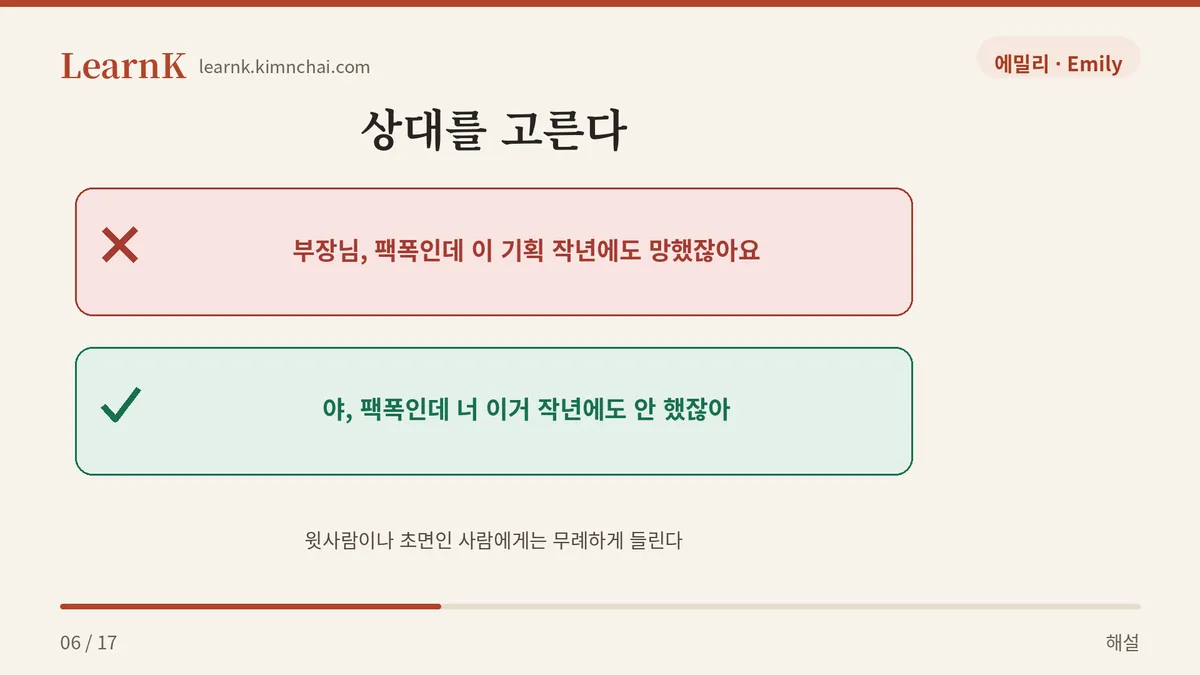
In everyday life, 팩폭 can even become an expression of affection — the closer you are, the more it happens. After all, complete strangers wouldn’t bother telling you a painful truth in the first place. So even when you get hit with a 팩폭, you may feel bad but still end up thinking, “Still, thanks for being honest with me.” That said, throwing a 팩폭 at someone you’ve just met or at a superior can come across as rude, so it’s important to choose your target wisely.
Closing Quiz
A friend says, “나 이번엔 꼭 일찍 일어날 거야 (na ibeon-en kkok iljjik ireonal geoya)” — “This time I’m definitely going to get up early.” Another friend replies, “너 알람 다섯 개 맞춰 놓고도 매일 지각하잖아 (neo allam daseot gae matchwo noko-do maeil jigakhajanha)” — “You set five alarms and still show up late every day.” What’s the one word to describe this reply?
See the answer
The answer is 팩폭 (paekpok) — because it struck right at the heart of the matter with an undeniable fact!