팬미팅 (paenmiting) — Where the Person on Stage Comes Down for a Moment
팬미팅
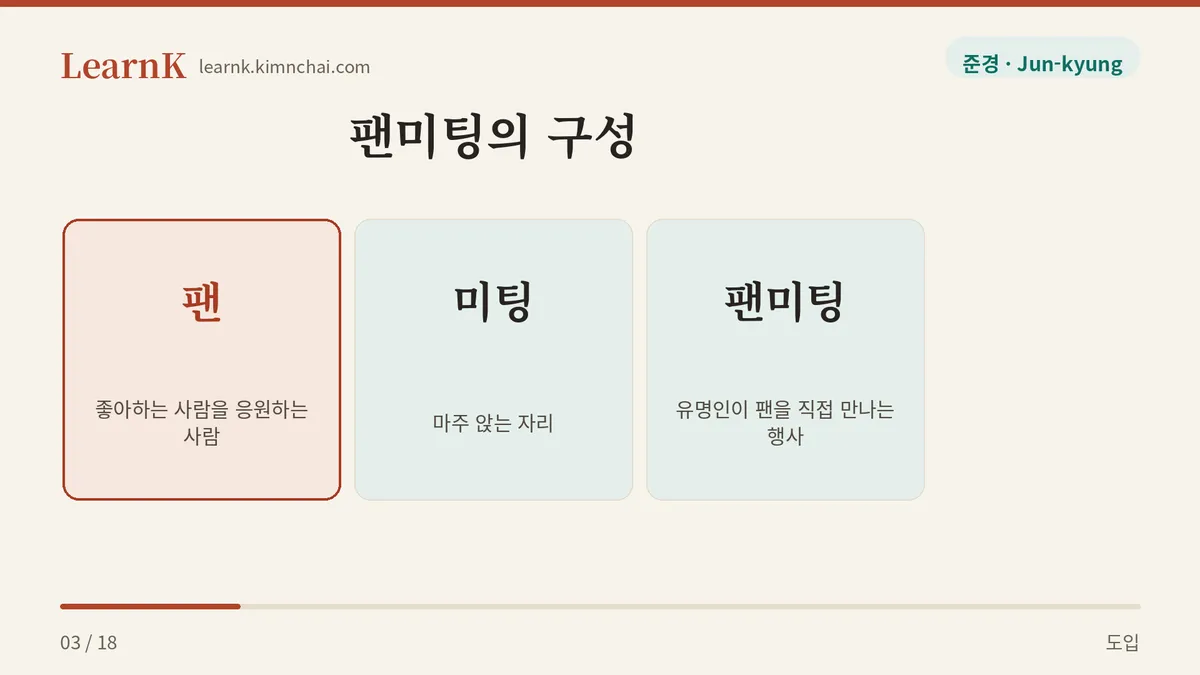
팬미팅 (paenmiting) means an official event that a celebrity — a singer, an actor — holds in order to meet their fans in person. Unlike a concert, where the star goes up on stage, sings, and comes back down, the thing at the center of a 팬미팅 is talking. They pull out and read questions collected in advance, play games with fans drawn from the audience, and go on at length about every little thing they’ve been up to lately. It’s the kind of event where your hands shake the second the ticket window opens, and you walk out afterward with your voice gone hoarse.
In Korea you hear this word surprisingly often. A one-year debut anniversary, the week a drama wraps, a comeback after military service, a birthday — whenever there’s an excuse to meet, a 팬미팅 happens. Which means that for fans of Korean culture who start learning the language, this is a word they often run into on a ticketing site before they ever see it in a textbook.
팬미팅 is neither honorific nor casual speech — it’s simply a noun. The word itself carries no layer of politeness; the predicate that follows it sets the temperature. What does split in two, though, is direction. From the side putting on the event, it’s 팬미팅을 열다 (paenmiting-eul yeolda) or 팬미팅을 하다 (paenmiting-eul hada); from the side going to see it, it’s 팬미팅에 가다 (paenmiting-e gada). Agency announcements use the first kind; fan conversations use the second, overwhelmingly.
The scale ranges wildly, from a 300-seat small theater to a 10,000-seat gymnasium, and fan club members are often the only ones given early access to tickets. That’s why, in real conversation, the word 팬미팅 almost always travels together with 티켓팅 (tiketing), “ticketing.” Among fans it also gets shortened to 팬미 (paenmi) — though that’s light, inside-the-fandom talk, so you won’t find it in news articles or official notices.
Seeing It in Real Conversation
Scene: Saturday evening, 7:59 p.m. Emily’s living room. Two laptops and three phones are up and running, waiting for ticket sales to open.
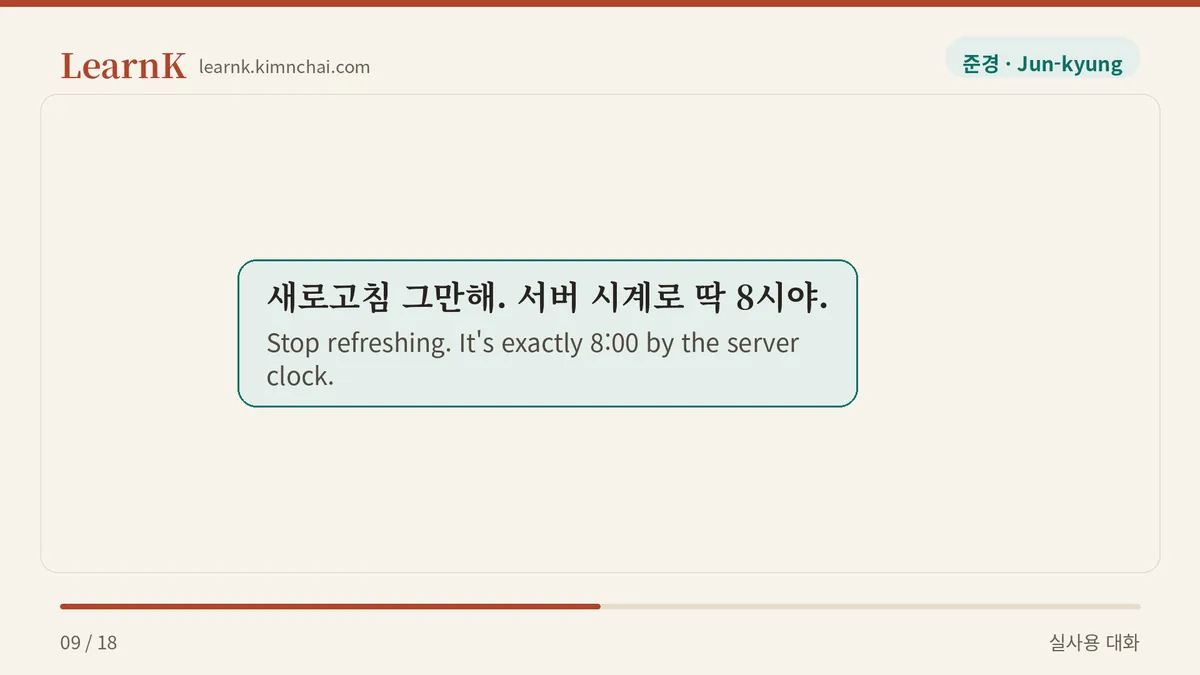
Jun-kyung: 새로고침 그만해. 서버 시계로 딱 8시야. Stop refreshing. It’s exactly 8:00 by the server clock.
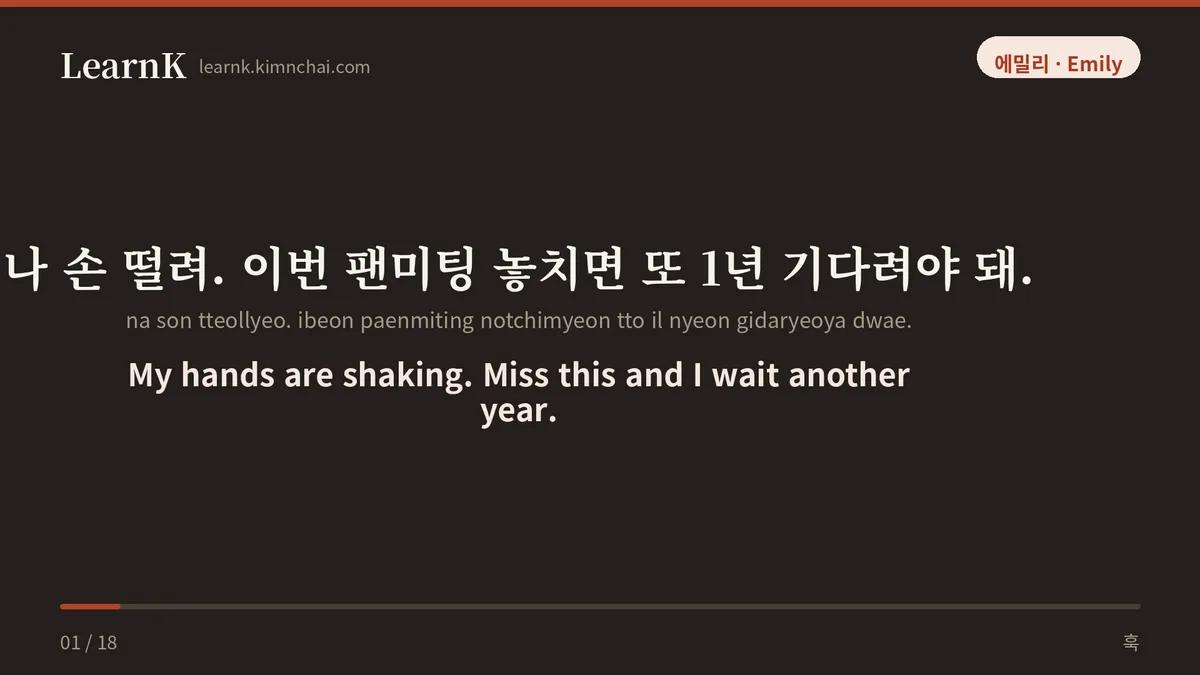
Emily: 나 손 떨려. 이번 팬미팅 놓치면 또 1년 기다려야 돼. My hands are shaking. If I miss this fan meeting, I’ll have to wait another whole year.
Jun-kyung: 야, 떴다 떴어! …아, 대기 3천 번. Hey, it’s up, it’s up! …Ugh, queue number three thousand.
Emily: 나 됐어! 나 됐어!! 2층 맨 끝자린데 상관없어! I got one! I got one!! It’s the very last row of the second floor, but I don’t care!
Jun-kyung: 대박… 내 것도 좀 잡아 주지 그랬어. Wow… you could’ve grabbed one for me too.
Emily: 미안. 대신 팬미팅 끝나고 후기 세 시간 들려줄게. Sorry. To make up for it, I’ll give you a three-hour recap after the fan meeting.
This Would Sound Off
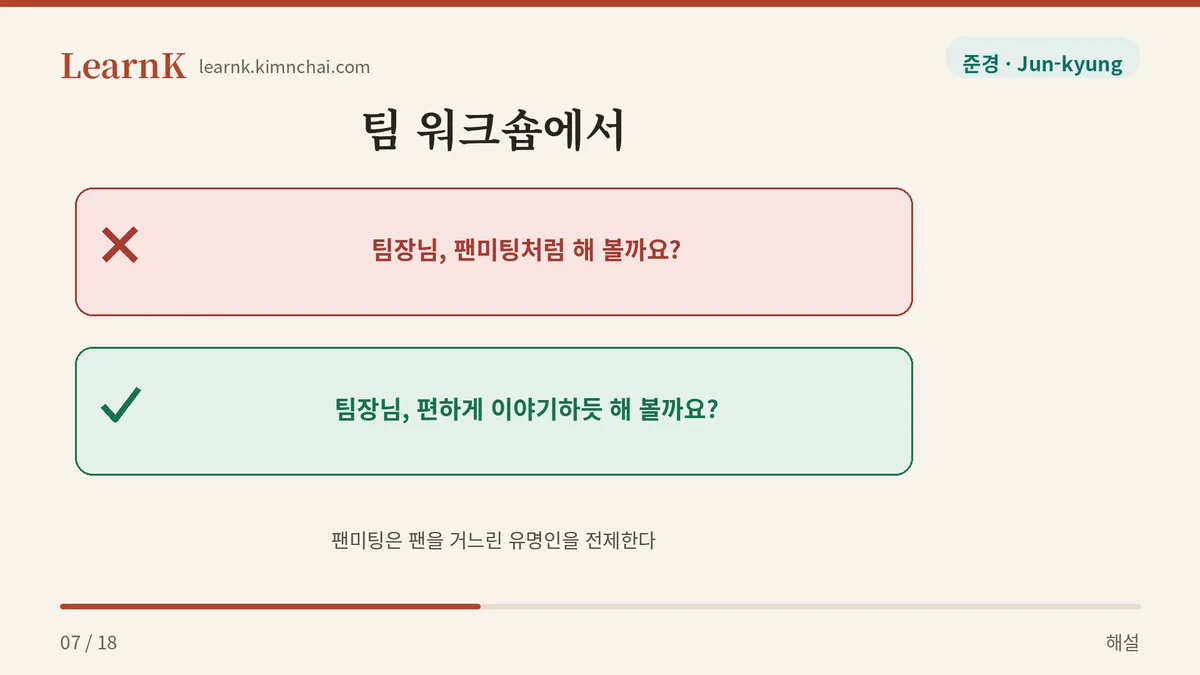
✗ (At a team workshop, to your team leader) 팀장님, 오늘 소감 나누는 시간은 팬미팅처럼 해 볼까요? ✓ (At a team workshop, to your team leader) 팀장님, 오늘 소감 나누는 시간은 편하게 이야기하듯 해 볼까요? Team leader, how about we do today’s sharing session like a relaxed chat? → 팬미팅 comes with a built-in assumption: a celebrity who has fans. Attach it to your boss and it turns into flattery dressed up as a joke — and depending on the room, it can read as sarcasm.
✗ 어제 팬미팅 가서 사인만 받고 30초 만에 나왔어. ✓ 어제 팬사인회 (paensainhoe) 가서 사인만 받고 30초 만에 나왔어. Yesterday I went to a fan signing, just got an autograph, and was out in thirty seconds. → An event where people line up one by one, get an autograph, and exchange a quick hello is a 팬사인회. A 팬미팅 refers to an event with a stage program that runs for an hour or two. Korean fans keep these two quite strictly apart.
Example Sentences by Situation
1. Griping to a friend after ticketing goes wrong
이번 팬미팅 티켓팅 또 망했어. (ibeon paenmiting tiketing tto manghaesseo.) This time the fan meeting ticketing flopped again.
Popular 팬미팅 in Korea routinely sell out in a matter of seconds. 망하다 (manghada) originally means “to fail,” but in ticketing talk it has hardened into an idiomatic groan meaning “I couldn’t get one.” Even though it announces a failure, the tone is surprisingly bright and self-mocking.
2. Explaining to your workplace why you’re taking time off
팬미팅 때문에 휴가 냈어요. (paenmiting ttaemune hyuga naesseoyo.) I took the day off because of a fan meeting.
When an overseas fan travels all the way to Korea, a 팬미팅 isn’t a one-day outing — it’s a big plan with flights and lodging attached. 때문에 (ttaemune) states a reason matter-of-factly, so putting it this way sounds less like an excuse and more like a declaration: this one matters to me.
3. Asking a staff member once you reach the venue
저기요, 팬미팅 입장 줄이 여기 맞나요? (jeogiyo, paenmiting ipjang juri yeogi matnayo?) Excuse me, is this the entry line for the fan meeting?
This is the sentence you’ll actually use most on the ground. 저기요 (jeogiyo) is how you call out to someone you don’t know, and 맞나요? (matnayo?) is softer than 맞습니까? (matseumnikka?). There are always several lines outside a venue, so this one sentence can save you thirty minutes.
Polite and Casual Forms, and Similar Expressions
팬미팅 itself never changes shape; only the predicate used with it does.
- Casual (반말): 팬미팅 가? (paenmiting ga?)
- Polite (존댓말): 팬미팅 가세요? (paenmiting gaseyo?)
Here’s how it lines up against words that look similar but belong in different places.
| Expression | Tone / intensity | Where it’s used |
|---|---|---|
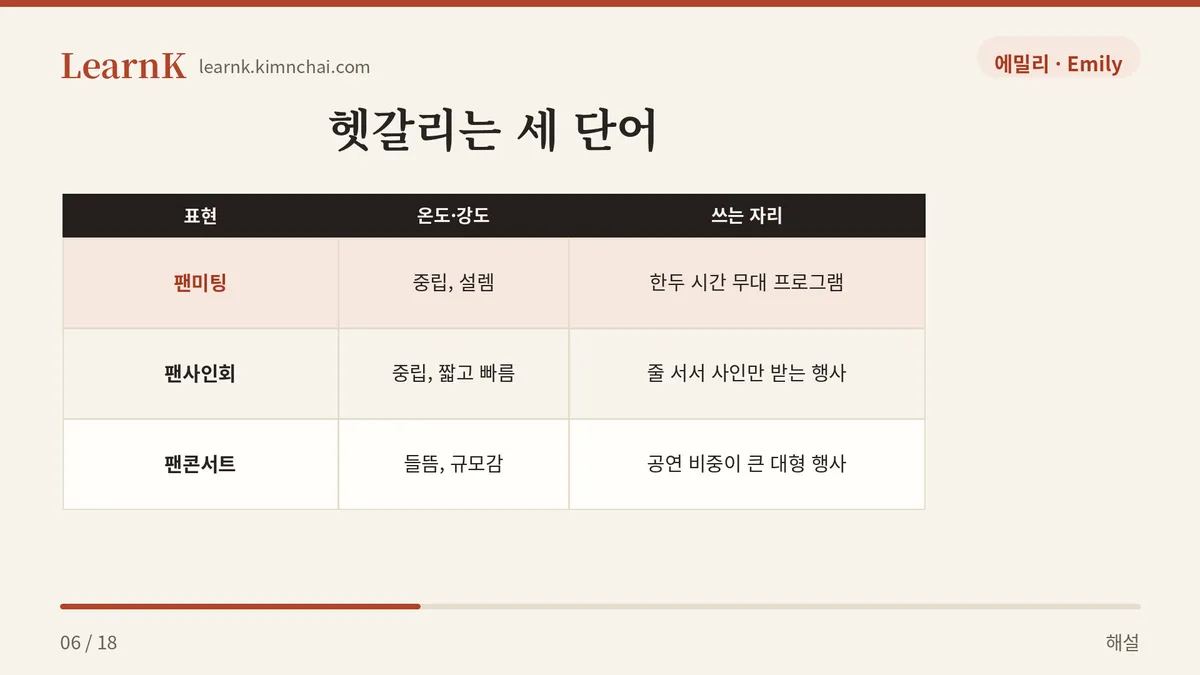
| 팬미팅 (paenmiting) | Neutral, with a flutter of excitement | Anywhere — articles, official notices, everyday conversation |
| 팬미 (paenmi) | Light and intimate | Between fans, on social media. Not in official documents |
| 팬사인회 (paensainhoe) | Neutral, short and quick | Only for brief autograph events |
| 팬콘서트 (paenkonseoteu) | Buzzy, big in scale | Large events where the performance is the main draw |
Cultural Background — the Strange English of “미팅”
팬미팅 is a Korean-made word, stitched together from the English fan and meeting. In English-speaking countries, though, people rarely say “fan meeting” — fan event or meet-and-greet sounds more natural. There’s a reason the combination feels so natural in Korean. 미팅 (miting) in Korean doesn’t only mean a business meeting; for a long time it has also referred to a group get-together where several people go out hoping to pair off. Say 미팅 나가다 (miting nagada) and what comes to mind isn’t a conference room but a bar in a college neighborhood. Once 미팅 had acquired that broader sense — “an occasion where people sit down face to face” — 팬 was attached to the front of it.
The funny part is that the word is now flowing in the opposite direction. As K-pop has spread, fandoms around the world have started using “fan meeting” with exactly its Korean meaning. English made in Korea has made its way back into English.
The texture of the event is distinctive too. At a 팬미팅, the celebrity steps down from being a figure on a stage for a little while. They read handwritten letters in a shaky voice, lose at games and take the penalty, show off something they bought recently. The same goes for the fans. They come with light sticks and slogans prepared, yet what stays with them longest is often some small, offhand thing the person said. That’s exactly why 팬미팅 scenes are a fixture in Korean dramas set around idols and the entertainment industry. More than the dazzling stage, it’s a good setting for showing the moment someone comes back, offstage, to being just a person.
Today’s Quiz
Idol A held an event to celebrate the release of a new album. Fans line up in a single row, get an autograph in turn, exchange a short greeting of about twenty seconds each, and then leave. What is this event called in Korean?
① 팬미팅 (paenmiting) ② 팬사인회 (paensainhoe) ③ 팬콘서트 (paenkonseoteu)
Show the answer
② 팬사인회 (paensainhoe)
An event where you get an autograph and exchange a quick greeting is a 팬사인회. Call it a 팬미팅 and it becomes an event where you sit in an assigned seat and watch an hour or two of stage program; call it a 팬콘서트 and it becomes a large, performance-driven event. Three words, three completely different pictures — just knowing that will get you through half of any Korean fandom conversation.