팬서비스 (paenseobiseu) — The Three Seconds of Walking All the Way to the Edge of the Stage
팬서비스 (paenseobiseu)
팬서비스 (paenseobiseu) is the word for the small gestures and courtesies that a person with fans — a celebrity, an athlete — deliberately does for those fans. Making a finger heart toward the camera on stage. Turning around for one more wave right before getting into the van. Tossing a ball into the stands after an inning ends at the ballpark. None of it is written into a contract, and nobody gets fined for skipping it. And yet some people do it and some people don’t. Korean fans have one word for that difference: 팬서비스.
The place this word flies around most feverishly is the moment right after a show ends. In the corridor where the lights have gone down and the crowd is pouring out, still hoarse, people turn to each other and ask: 오늘 그거 봤어? 마지막에 무대 끝까지 걸어 나왔잖아. (Did you see that today? At the end he walked all the way to the edge of the stage.) 팬서비스 is the word they reach for to explain those three seconds.
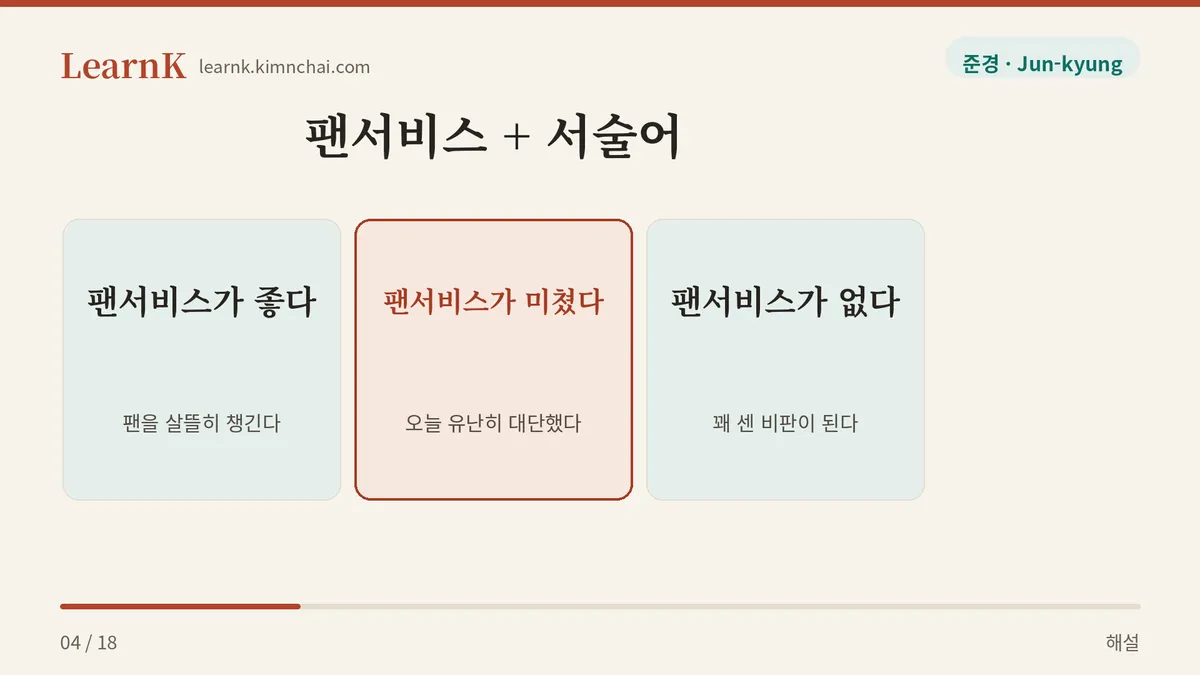
In Korean this word almost always travels with a partner predicate: 팬서비스가 좋다 (paenseobiseuga jota), 팬서비스가 많다 (paenseobiseuga manta), 팬서비스가 없다 (paenseobiseuga eopda). What’s distinctive is that it gets used the way you’d assess someone’s personality — 저 사람 팬서비스 좋아 (jeo saram paenseobiseu joa) means just about the same thing as “that person really looks after their fans.” When people are more worked up, they reach for exaggerated forms like 팬서비스가 미쳤다 (paenseobiseuga michyeotda) or 팬서비스 대박 (paenseobiseu daebak). To talk about the act itself, you use 팬서비스를 하다 (paenseobiseureul hada).
There’s one nuance you shouldn’t miss. Because ‘서비스’ is sitting on the end of it, this word carries a very faint shadow of stagecraft. It might be sincere, it might be calculated — the word itself leaves room for both. So two people can watch the exact same moment, and one says gratefully “팬서비스 진짜 좋다” while the other says flatly “저거 다 팬서비스지” (that’s all just fan service). It works as praise, and it works as a light jab. Tone of voice decides which.
See It in a Real Conversation
Setting: walking from Jamsil Sports Complex to the subway station after a concert. They’re being carried along by the crowd, and both of them are still holding their lightsticks.
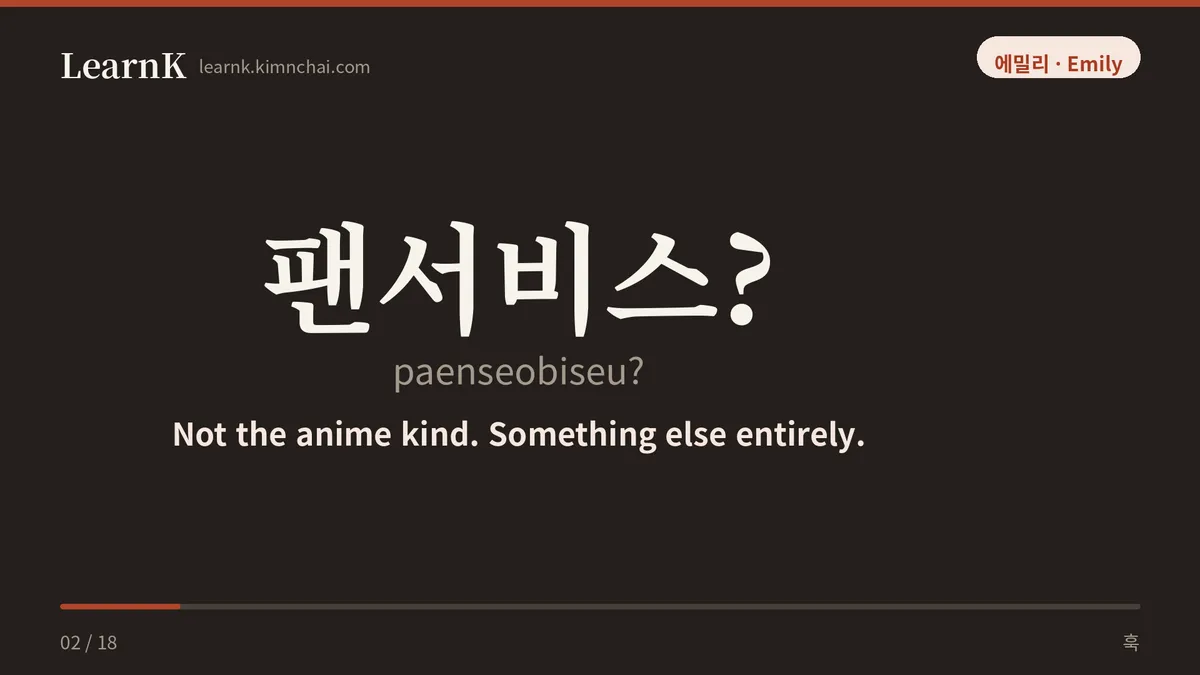
Emily: 아, 다리 아파 죽겠어. 근데 너 아까 앙코르 때 봤어? 나랑 눈 마주쳤어, 진짜로. Ugh, my legs are killing me. But did you see during the encore? He made eye contact with me, for real.
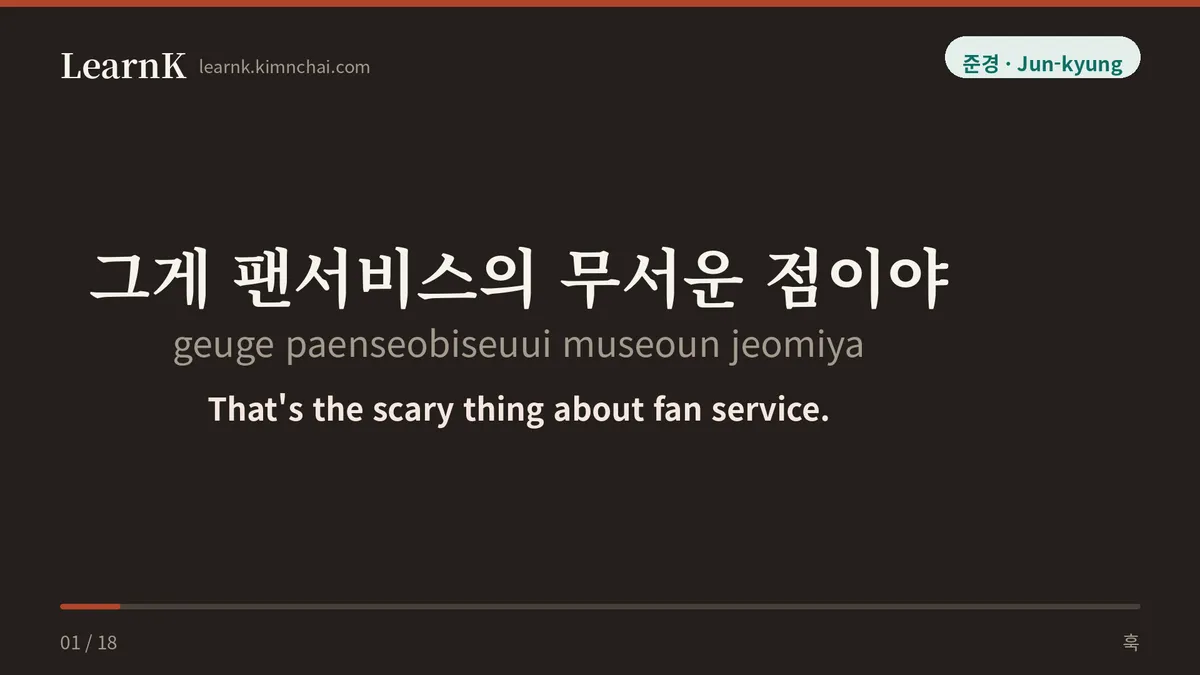
Jun-kyung: 야, 그 구역 사람들 전부 다 그렇게 느껴. 그게 팬서비스의 무서운 점이야. Come on, everybody in that section feels the exact same way. That’s the scary thing about fan service.
Emily: 아니거든? 손도 흔들어 줬거든? Nope. He waved at me too.
Jun-kyung: 알았어, 알았어. 근데 인정. 오늘 진짜 팬서비스 미쳤긴 했다. 무대 끝까지 세 번이나 걸어 나왔잖아. Okay, okay. But I’ll admit it — the fan service really was insane today. He walked all the way to the edge of the stage three times.
Emily: 그치? 나 그거 보고 울 뻔했어. 응원봉 흔들다가 팔 빠지는 줄 알았다니까. Right? I almost cried. I thought my arm was going to fall off from waving the lightstick.
Jun-kyung: 팔은 됐고, 저녁이나 먹으러 가자. 나 아까부터 배고파 죽겠어. Forget your arm, let’s go get dinner. I’ve been starving this whole time.
This Is Where It Sounds Off
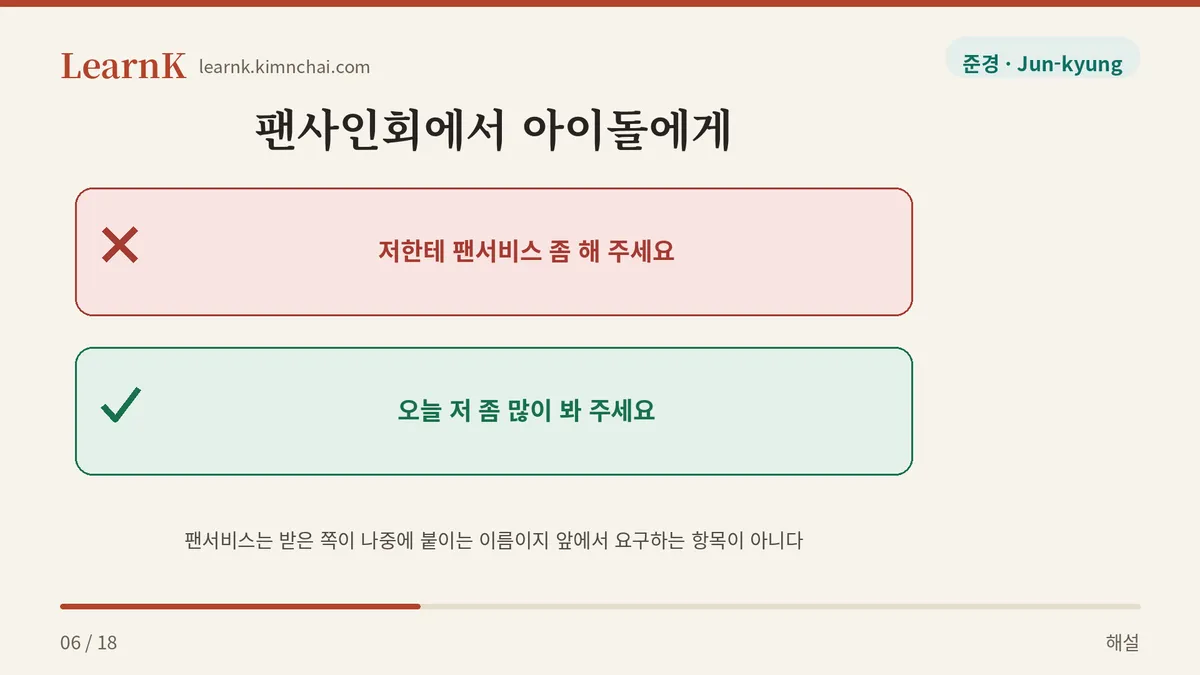
✗ (to the idol himself at a fan signing) 오빠, 저한테 팬서비스 좀 해 주세요. Oppa, give me a little fan service. ✓ (to the idol himself at a fan signing) 오빠, 오늘 저 좀 많이 봐 주세요! Oppa, look at me a lot today! → 팬서비스 is a name the receiving side attaches afterward, gratefully — it’s not a line item you invoice for in front of the person. Demanding it to someone’s face sounds like “please calculate that out and deliver it right now,” and it’s awkward for everyone.
✗ (to a contact at a partner company) 이번 건은 저희 쪽에 팬서비스 좀 해 주시죠. How about a little fan service for our side on this one. ✓ (to a contact at a partner company) 이번 건은 저희 쪽 사정도 좀 봐주시죠. How about taking our situation into account on this one. → This word presupposes a relationship where someone with a following is bestowing something. Drag it into a relationship between equals at work and you either come off as flattering the other person by treating them like a star, or — read the other way — as sniping, “oh, and who exactly are you.”
Example Sentences by Situation
1. The day after a show, posting a review
어제 콘서트 팬서비스 진짜 대박이었다. 3층까지 손 흔들어 줌. (eoje konseoteu paenseobiseu jinjja daebagieotda. samcheungkkaji son heundeureo jum.) Yesterday’s concert had insane fan service. He waved all the way up to the third tier.
This is the most common shape it takes in a short social media review. Dropping the particle ‘가’ and running it together as “팬서비스 대박” is closer to how people actually talk. And by convention you tack on one concrete moment as evidence — if you don’t say what was good, it reads like empty praise.
2. Explaining a player to a friend at their first baseball game
저 선수 팬서비스 좋기로 유명해요. 경기 끝나면 사인 다 해 주고 가요. (jeo seonsu paenseobiseu joki-ro yumyeonghaeyo. gyeonggi kkeutnamyeon sain da hae jugo gayo.) That player is famous for his fan service. After the game he signs every last autograph before he leaves.
팬서비스 is not an idol-only word. Baseball and soccer players, actors, YouTubers — anyone whose job puts them face to face with fans. This sentence is in polite speech, but the word itself doesn’t change; the politeness is carried by the predicate.
3. Gently criticizing a show that fell short
무대는 완벽했는데 팬서비스는 좀 아쉬웠어. (mudaeneun wanbyeokhaenneunde paenseobiseuneun jom aswiwosseo.) The performance was perfect, but the fan service was a little disappointing.
Fans use this structure — separating skill from 팬서비스 — all the time. “팬서비스가 없다” is fairly harsh criticism, so people usually soften it down to “좀 아쉬웠다” (a bit of a letdown). For learners, that cushioned version is the more useful one.
Polite vs. Casual Speech, and Similar Expressions
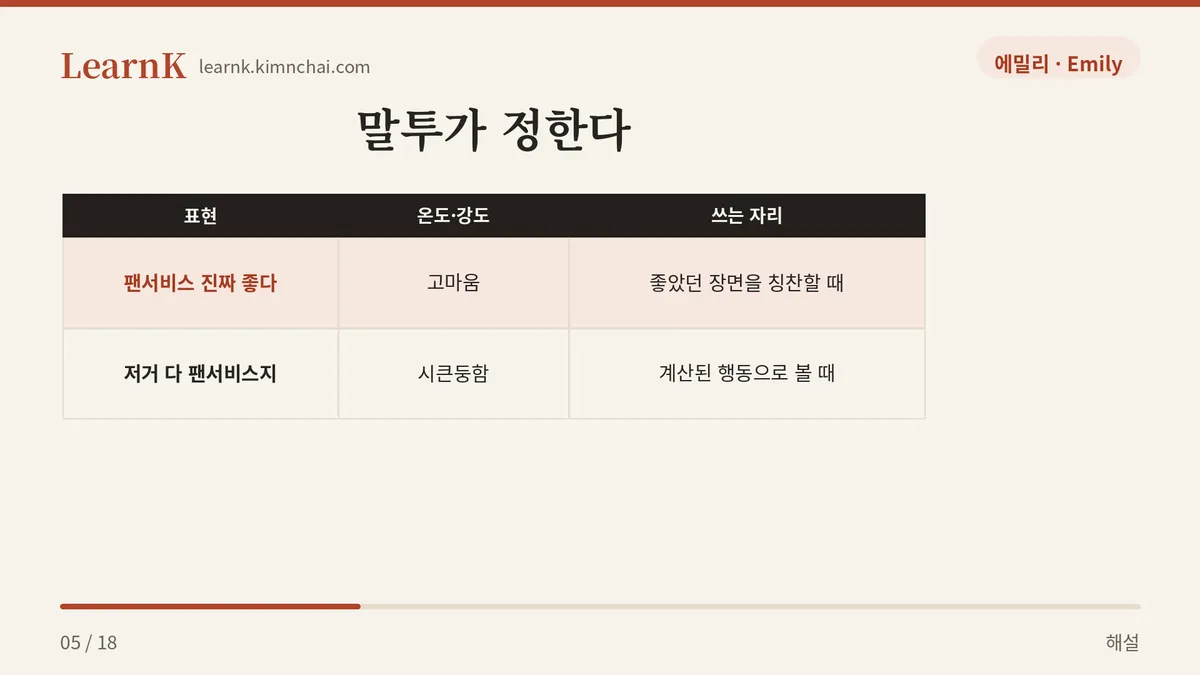
팬서비스 is a noun, so there’s no honorific level baked into the word itself. Polite and casual split at the predicate that follows — 팬서비스가 좋으시더라고요 (paenseobiseuga joeusideoragoyo) / 팬서비스 좋더라 (paenseobiseu joteora). That said, the word’s texture is casual enough that in formal settings or news writing, it often changes clothes into the ‘팬 사랑’ row of the table below.
| Expression | Temperature / intensity | Where it’s used |
|---|---|---|
| 팬서비스 (paenseobiseu) | Half gratitude, half giddy teasing. Light and excited | Among fans, on social media, in concert reviews. Rarely said to the person’s face |
| 팬 사랑 (paen sarang) | Serious and warm. A judgment of character | News articles, awards speeches. “팬 사랑이 각별한 배우” (an actor whose love for his fans is exceptional) |
| 소통 (sotong) | Neutral and steady | Live streams, fan cafés. Ongoing exchange rather than a one-off moment |
| 서비스 (seobiseu) | Practical. The feeling of something thrown in for free | Restaurants and shops. “이건 서비스예요” (this one’s on the house) |
It matters that even though the last row contains the same ‘서비스’, it is a completely different word. The 서비스 you get at a Korean BBQ place is a free steamed egg; the 팬서비스 you get at a concert is one second of eye contact. What’s attached to the front of it splits the world in two.
Cultural Background — The Three Seconds of Walking to the Edge of the Stage
The word formation itself is simple: English fan and service, glued together as a loanword. But in English, “fan service” usually refers to deliberately inserting crowd-pleasing moments into a manga or anime, which doesn’t overlap with the Korean usage. In Korean it points not to something staged on screen, but to something a real person did in front of real fans. Which means the better your English is, the more likely you are to trip over this word once. Inside fandoms it also gets shortened to “팬서 (paenseo).”
There’s a reason this word developed with such density in Korea. Korean fan culture doesn’t stop at watching a star from a distance. Fan signings, high-touch events, the 퇴근길 (“commute home”) send-offs outside broadcast stations, airport arrivals and departures — the occasions where stars and fans physically cross paths are woven in as tightly as institutions. When the encounters pile up, what someone did and didn’t do in those moments accumulates like a record. 팬서비스 is the label attached to that record.
So the word often lands in the middle of an argument. Is 팬서비스 an obligation or a kindness? If the performance was flawless, isn’t that enough? Or, the other way around: without fans, would there be a stage at all? Korean dramas return again and again to the scene where a top star, exhausted, climbs into the car, sees the fans who’ve been waiting, and rolls the window back down — and that scene is moving precisely because of the ambiguity. We count it because it didn’t have to be done. If it had been an obligation, nobody would be counting.
That’s the real reason this word is useful to a learner. Knowing how to use 팬서비스 accurately means knowing what Korean fandom is grateful for and what leaves it hurt. Put this word in its proper place in one line of a concert review, one line of a supportive comment, and the temperature of your sentence shifts completely away from something run through a translation app.
Today’s Quiz
Which of the following uses 팬서비스 most naturally?
- 어제 무대 인사 왔던 그 배우, 팬서비스 진짜 좋더라. That actor who came out for the stage greeting yesterday — his fan service was really great.
- 부장님, 이번 회식 팬서비스 감사합니다. Boss, thank you for the fan service at this staff dinner.
- 이 카페는 원두 팬서비스가 훌륭해요. This café’s coffee-bean fan service is excellent.
Show the answer
Answer: 1
Number 2 is addressed to a boss who paid for the company dinner, but 팬서비스 presupposes someone with fans bestowing something on those fans — used on a workplace superior, it either flatters them by treating them like a star or comes out as sarcasm. Number 3 is trying to describe something a café throws in for free, so it needs plain 서비스 (seobiseu), not 팬서비스. The structure in number 1 — someone whose job puts them in front of fans + 팬서비스가 좋다 — is this word’s most basic home.
Definitions and example sentences are from the National Institute of Korean Language’s Basic Korean Dictionary (krdict.korean.go.kr); that portion of this post, including our translations, is licensed under CC BY-SA 2.0 KR.