팥빙수 (Patbingsu) — One Bowl to Get Through Midsummer
Korea’s summer is humid and sticky. When the midday temperature in August climbs well past 30°C, air conditioning alone isn’t enough, so people go looking for something that cools them down ‘all the way inside their mouths.’ At the very end of that search sits today’s expression: 팥빙수 (patbingsu). This dessert—finely shaved ice topped with boiled red beans and condensed milk—is more than just a snack to Koreans; it’s closer to a signal that ‘summer has arrived.’ When 팥빙수 shows up on café menus again, people feel the season with an ‘Ah, it’s summer now.‘
팥빙수
Meaning and Nuance
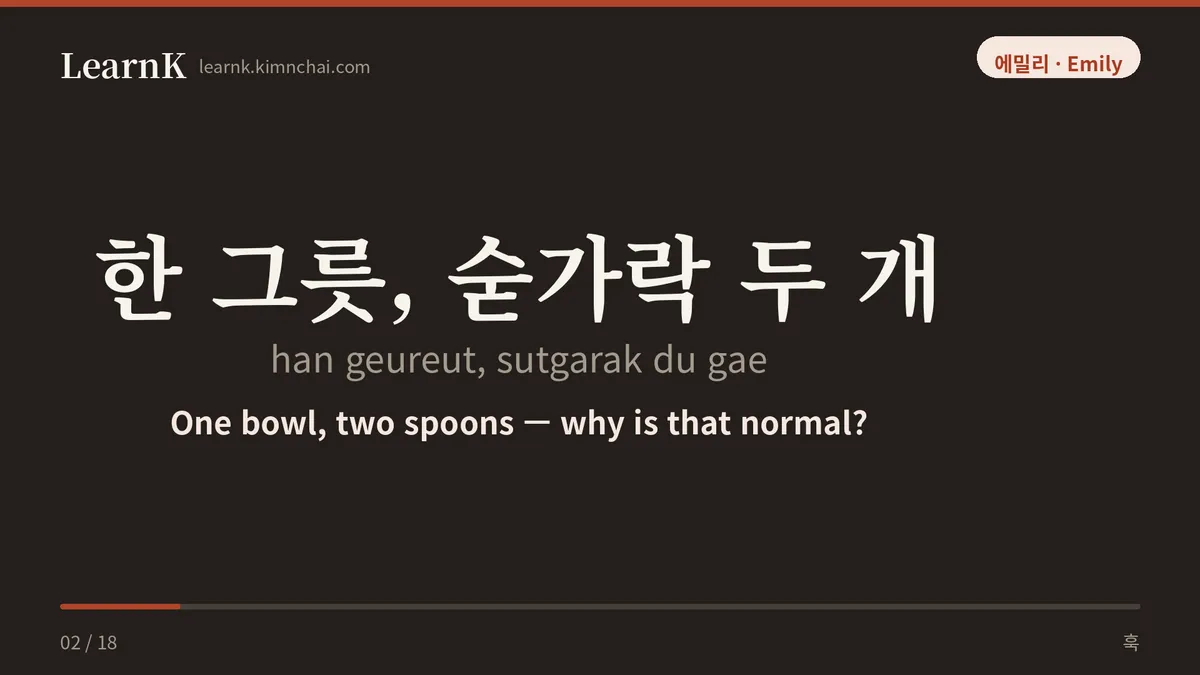
팥빙수 (patbingsu) is a compound of two words. 팥 (pat) means red bean, and 빙수 (bingsu) comes from the Chinese characters ‘얼음 빙 (氷, ice)’ and ‘물 수 (水, water)’ and refers to a ‘finely shaved ice’ dessert. So taken literally, it means ‘shaved ice topped with red beans.’
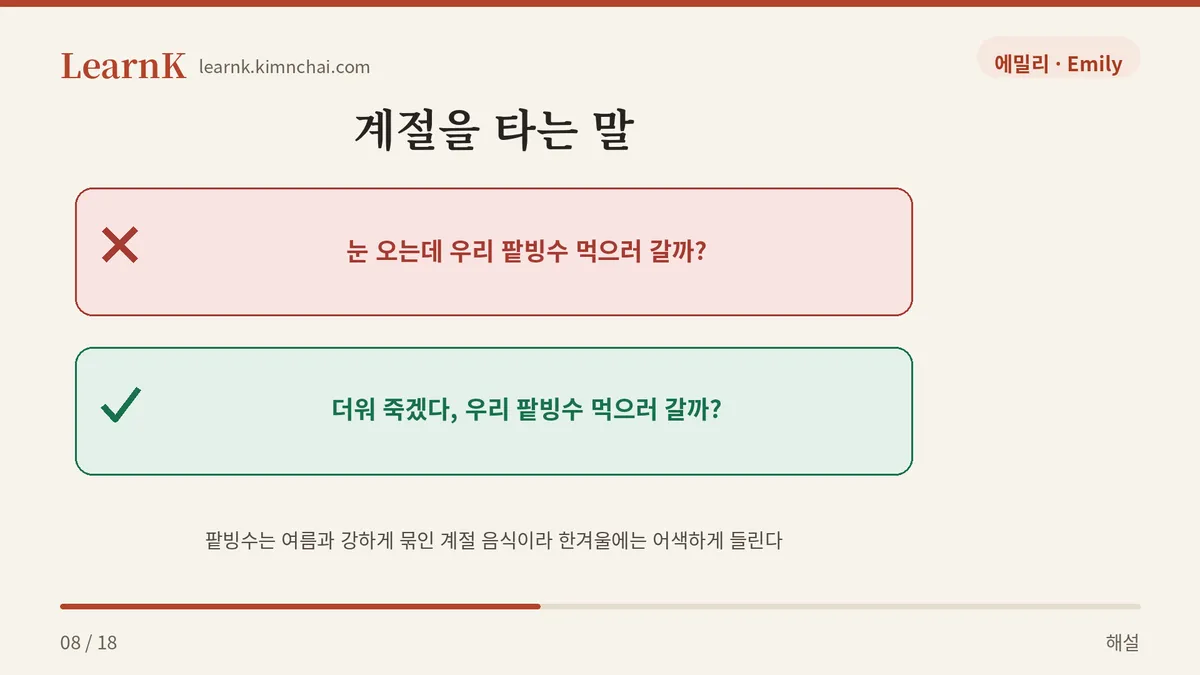
There are two key nuances. First, 팥빙수 is a seasonal food strongly tied to summer. Suggesting you eat 팥빙수 in winter would even sound a little odd. Second, 팥빙수 is usually a food you share rather than eat alone. Because the portion is large and the bowl is big, “우리 팥빙수 하나 시켜서 같이 먹자 (let’s order one 팥빙수 and share it)” is a completely natural sentence. That’s why this word carries a warm, slightly affectionate feeling of getting through the heat together.
For reference, the National Institute of Korean Language’s dictionary has no Portuguese translation, so if we render it ourselves it comes out roughly as “raspadinha de gelo com feijão vermelho” (shaved ice topped with red beans). (Note that this Portuguese is our own translation, not from the dictionary.)
Checking with the National Institute of Korean Language’s Dictionary
First, let’s look exactly at how the national institution’s dictionary defines this word.
팥빙수 (noun): A food made by finely shaving ice and adding boiled red beans, condensed milk, milk, and so on. [en] patbingsu; shaved ice with red bean topping [ja] あずきかきごおり(小豆かき氷) [es] patbingsu, postre glacé de judía [zh] 红豆刨冰,红豆沙冰 — National Institute of Korean Language, Basic Korean Dictionary (krdict.korean.go.kr)
The definition is very specific. Keep in mind that the ingredients ‘ice, boiled red beans, condensed milk, milk’ are listed right there. Now let’s look at the actual usage examples the dictionary provides, exactly as they appear in the original.
- 어머니는 얼음을 잘게 깨부수어 팥빙수를 만들어 주셨다.
- 이거 한번 드셔 보세요. 우리 가게에서 새로 개발한 팥빙수예요.
- 오늘같이 더운 날에는 팥빙수가 억수로 잘 팔린다.
- 뭔가 허전하다 했더니 역시 팥빙수에는 젤리가 들어가야 해.
- 새로 생긴 팥빙수 가게에서는 직접 삶은 팥을 재료로 쓴다. — National Institute of Korean Language, Basic Korean Dictionary (krdict.korean.go.kr)
Let’s walk through what situation each example describes.
- Sentence 1 is a scene of a mother making it by hand at home. The part about crushing the ice by hand, without a machine, gives an old-fashioned, heartwarming feel. (어머니는 얼음을 잘게 깨부수어 팥빙수를 만들어 주셨다 — Mother crushed the ice into little pieces and made me 팥빙수.)
- Sentence 2 is a shop owner recommending a new menu item to a customer. The honorific ‘드셔 보세요 (please try it)’ paints a picture of treating a guest politely.
- The ‘억수로’ in Sentence 3 is a Gyeongsang dialect word meaning ‘a lot, very.’ It means 팥빙수 sells like hotcakes on a hot day, nicely showing its character as a seasonal food.
- Sentence 4 expresses the disappointment when 팥빙수 is missing its jelly. It’s fun because it captures Koreans’ taste for—and insistence on—toppings.
- Sentence 5 shows exactly the marketing point of today’s dessert shops, emphasizing ‘red beans boiled in-house (직접 삶은 팥)’ rather than instant ones.
Seeing It in a Real Conversation
Situation: An August afternoon with a heat-wave warning in effect. Jun-kyung and Emily, worn out by the heat, duck into a bingsu shop at the end of an alley as if escaping.
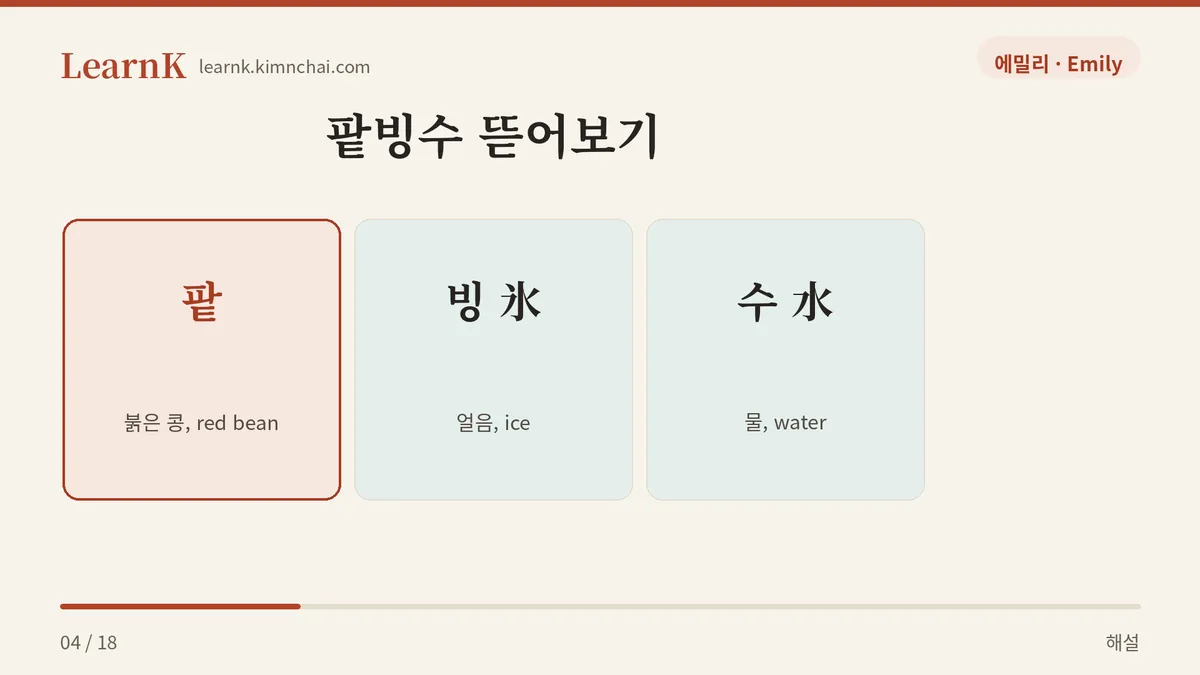
준경: 아, 살 것 같다. 밖은 완전 찜통이야. 우리 팥빙수 하나 시켜서 같이 먹을까? Ah, I feel alive again. It’s a total sauna out there. Should we order one patbingsu and share it?
에밀리: 좋아. 근데 하나로 되겠어? 너 저번에 혼자 세 그릇 먹었잖아. Sounds good. But is one enough? Last time you ate three bowls by yourself.
준경: 야, 그날은 진짜 더웠어! 그리고 여기 팥을 직접 삶는대. 소문났어. Hey, that day was really hot! And they boil their own red beans here. It’s famous for that.
에밀리: 오, 그럼 기대되네. 아, 근데 젤리는 꼭 넣어 달라 하자. 팥빙수엔 젤리가 있어야 해. Oh, then I’m excited. Oh, but let’s make sure to ask for jelly. Patbingsu has to have jelly.
준경: 완전 동의. 젤리 없으면 뭔가 허전하지. Totally agree. Without jelly it feels like something’s missing.
에밀리: 그치? 사장님~ 여기 팥빙수 하나요, 젤리 많이요! Right? Excuse me! One patbingsu here, extra jelly please!
Example Sentences by Situation
Let’s broaden its use with three sentences of our own.
- Situation ① Treating guests at a housewarming — Serving a cool dessert to guests who’ve come over on a hot day: “디저트로 팥빙수 만들어 놨는데, 좀 드셔 보세요. (Dijeoteuro patbingsu mandeureo nwatneunde, jom deusyeo boseyo.)” — ‘I’ve made 팥빙수 for dessert, so please have some.’ This is a polite offer in honorific speech.
- Situation ② Making plans with a friend — Casually, in informal speech: “이따 시험 끝나고 팥빙수 먹으러 가자! (Itta siheom kkeutnago patbingsu meogeureo gaja!)” — ‘Let’s go get 팥빙수 after the exam later!’ The nuance is rewarding yourselves with something cool after a hard time.
- Situation ③ Talking about a seasonal business — Like a dictionary example: “팥빙수 장사는 아무래도 계절을 많이 타요. (Patbingsu jangsaneun amuraedo gyejeoreul mani tayo.)” — ‘The 팥빙수 business is really affected by the season.’ ‘계절을 타다’ means that sales rise and fall greatly depending on the season.
Honorific vs. Informal Speech and Similar Expressions
팥빙수 itself is a noun, so it has no honorific or humble form. Instead, the verb used with it changes. Among friends you’d say “팥빙수 먹을래? (patbingsu meogeullae?)”, while to an elder or a guest you’d raise ‘먹다’ to ‘드시다,’ as in “팥빙수 드시겠어요? (patbingsu deusigesseoyo?)”
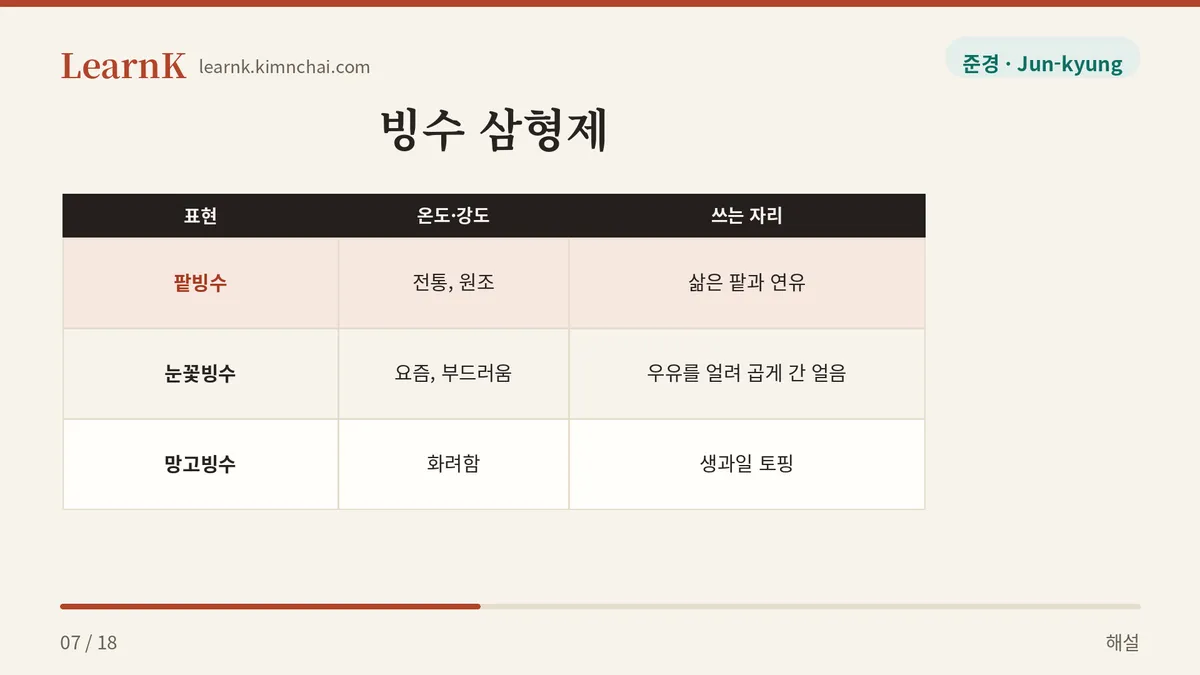
It’s good to know some related expressions too. The broad umbrella term is 빙수 (bingsu), and these days the names vary by topping: 눈꽃빙수 (nunkkot-bingsu, bingsu made by freezing milk and shaving it as finely as snow), 망고빙수 (mango-bingsu), 인절미빙수 (injeolmi-bingsu), and more. Among them, 팥빙수 is the oldest and most traditional—the original one.
Cultural Background
팥빙수 is a symbol of Korea’s summer culture. In the old days it came out in a big stainless-steel bowl at neighborhood snack shops or tearooms, and these days it has evolved lavishly into a summer-only menu item at every café. In dramas, whenever a sweltering-heat scene comes up, you often see characters put a bowl of 팥빙수 in the middle and share it with two spoons. This very picture of ‘digging into one bowl together’ is a warm bit of staging that shows how close two people are. So you could say 팥빙수 is a food that holds not just flavor but also the sentiment of ‘togetherness.‘
Closing Quiz
You asked a friend in informal speech, “우리 팥빙수 같이 먹을래? (Shall we eat 팥빙수 together?)” How would you change this into polite honorific speech for a guest or an elder?
See the answer
“팥빙수 같이 드시겠어요? (Patbingsu gachi deusigesseoyo?)” — Just change ‘먹다’ to the honorific ‘드시다,’ and make the ending politely into ‘-겠어요?’
Definitions and example sentences are from the National Institute of Korean Language’s Basic Korean Dictionary (krdict.korean.go.kr); that portion of this post, including our translations, is licensed under CC BY-SA 2.0 KR.