폭풍눈물 (pokpungnunmul) — Falling Apart at 2 A.M. Over a Drama Finale
폭풍눈물 (pokpungnunmul)
폭풍눈물 (pokpungnunmul) means tears that come down like a storm — so many, and so fast, that there’s no stopping them. It’s the crying that pours out no matter how hard you try to hold it in. Picture it: 2 a.m., the last episode of a 12-episode drama has just ended, and the closing credits are rolling. The screen has already gone black, but the person on the sofa still can’t get up. The tissue box beside them is half empty, and their group chat won’t stop buzzing with messages from friends who just finished the same episode. And the line that shows up most in that moment is exactly this one: 저 지금 폭풍눈물 흘리는 중이에요 (jeo jigeum pokpungnunmul heullineun jungieyo) — I’m ugly-crying right now.
This isn’t a word you’ll find in a Korean dictionary. It grew up on internet forums and in drama-viewer communities, and by now it has worked its way into everyday conversation. So to pin down exactly what it means, you need to look at three things at once.
First, the amount. This isn’t misty eyes — this is a wrecked face and a wet sleeve. That’s why 폭풍 (pokpung), storm, is stuck on the front.
Second, you can’t control it. These are the tears that keep coming even while you’re fighting them back. It’s less crying you started and more crying that jumped you.
Third — and this is the most important one — the tone is light. The feeling being described is huge, but the voice describing it is cheerful and over-the-top. This isn’t a word for real tragedy. It’s for dramas, movies, an idol’s retirement broadcast, pet videos — places where it’s perfectly fine to cry as much as you want, and you’re basically filing a report on your own feelings with a grin. Miss that difference in temperature and you’ll end up using it in exactly the wrong place.
Here are the forms you’ll see most often: 폭풍눈물을 흘리다 (pokpungnunmureul heullida), 폭풍눈물을 쏟다 (pokpungnunmureul ssotda), 폭풍눈물이 나다 (pokpungnunmuri nada), and the bare noun form 폭풍눈물 중 (pokpungnunmul jung) — in the middle of ugly-crying. That last one, just tossing out the noun with no verb at all, is especially common in chat.
A Real Conversation
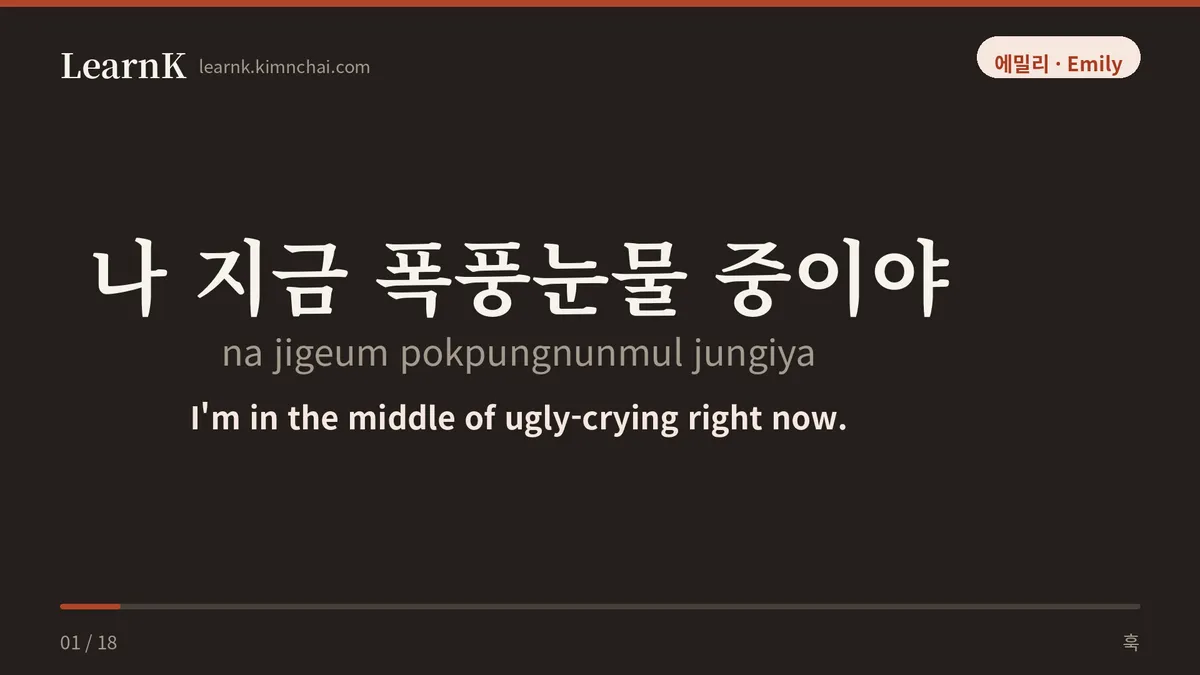
The scene: 2 a.m. on a Saturday, the living room of Jun-kyung’s place. The final episode of the 12-episode drama they’ve been binging together just ended. The tissue box is already half empty.
준경: 야… 너 괜찮아? 티슈 여기 있어. Hey… you okay? Here, tissues.
에밀리: 나 지금 폭풍눈물 중이야. 말 시키지 마. I’m in the middle of ugly-crying right now. Don’t talk to me.
준경: 아니 근데 저 결말 뻔했잖아. 난 별로 안 슬프던데. I mean, that ending was predictable. I didn’t find it that sad.
에밀리: 뻔한데 너는 왜 눈이 빨개? If it was so predictable, why are your eyes red?
준경: 어… 하품해서 그래. 졸려서. Uh… it’s from yawning. I’m sleepy.
에밀리: 됐고. 다음 주에 감독판 나온대. 그때 또 폭풍눈물 흘릴 준비나 해 놔. Sure. Anyway, the director’s cut drops next week. Get ready to bawl your eyes out again.
When It Sounds Off
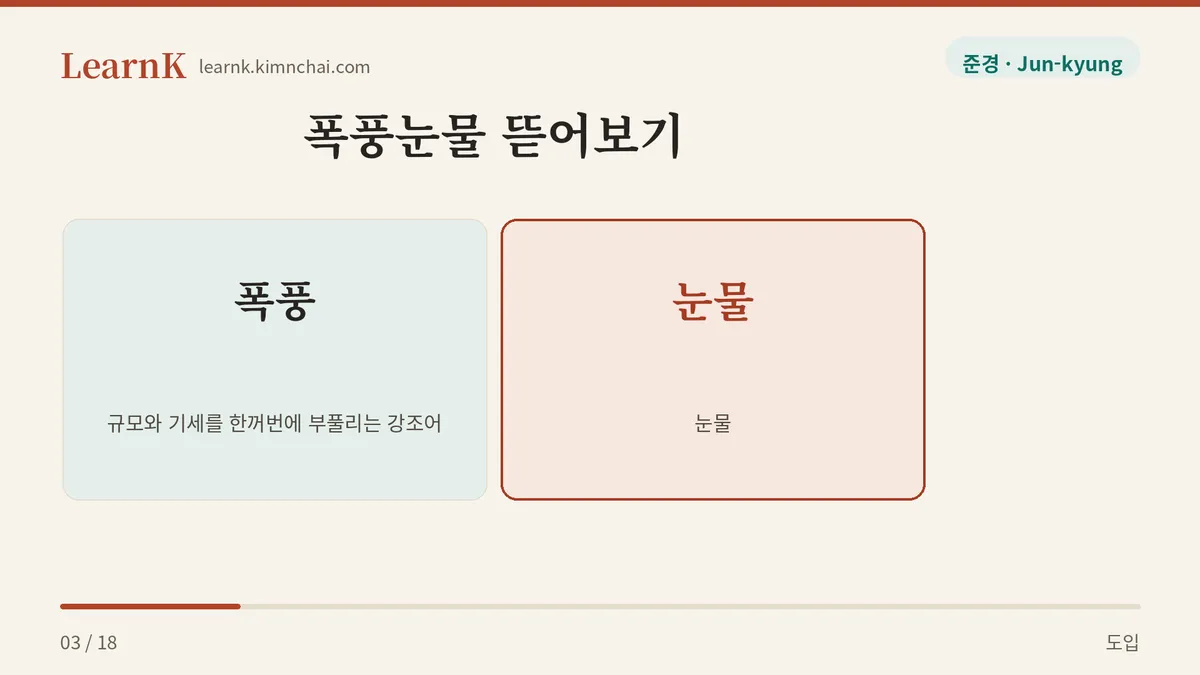
✗ (to the chief mourner at a funeral) 아까 영정 사진 보고 저 폭풍눈물 흘렸어요. (akka yeongjeong sajin bogo jeo pokpungnunmul heullyeosseoyo.) — I totally bawled my eyes out when I saw the memorial photo earlier. ✓ (to the chief mourner at a funeral) 사진 뵙고 마음이 너무 아팠습니다. (sajin boepgo maeumi neomu apatseumnida.) — Seeing the photo, my heart ached so much. → In the face of real loss, this word turns grief into a spectacle. At an actual wake, a plain, quiet sentence lands with far more weight than an exaggerated slang term.
✗ (with your eyes only slightly misty) 나 아까 그 장면에서 폭풍눈물 났어. (na akka geu jangmyeoneseo pokpungnunmul nasseo.) — I cried a storm at that scene. ✓ (with your eyes only slightly misty) 나 아까 그 장면에서 눈물 핑 돌았어. (na akka geu jangmyeoneseo nunmul ping dorasseo.) — My eyes welled up at that scene. → 폭풍 (pokpung) is a question of quantity. Attach it to a slight lump in your throat and the exaggeration is obvious immediately — and then you’ve got nothing left to say on the day you genuinely fall apart.
Example Sentences by Situation
① The day after the drama finale, in the elevator with a coworker
Between two people who watched last night’s broadcast, no explanation is needed. One line and you both know exactly what’s meant.
어제 마지막 회 보셨어요? 저는 마지막 십 분에서 폭풍눈물 흘렸어요. eoje majimak hoe boseyosseoyo? jeoneun majimak sip bune pokpungnunmul heullyeosseoyo. Did you watch the finale yesterday? I completely lost it during the last ten minutes.
② A parent rewatching a video of their kid’s graduation
The emotion is big, but the mood isn’t heavy. A tone that gently makes fun of your own crying fits perfectly here.
애 졸업식 영상 다시 보다가 혼자 폭풍눈물 쏟았잖아. 나 왜 이러니. ae joreopsik yeongsang dasi bodaga honja pokpungnunmul ssodatjana. na wae ireoni. I rewatched my kid’s graduation video and bawled my eyes out alone. What’s wrong with me.
③ Eating spicy food — tears that have nothing to do with sadness
Amusingly, this expression also gets attached, as a joke, to purely physical tears. That extension works because the heart of the word is quantity, not sadness.
이 집 불닭 진짜 맵다. 나 지금 슬퍼서가 아니라 매워서 폭풍눈물 나. i jip buldak jinjja maepda. na jigeum seulpeoseoga anira maewoseo pokpungnunmul na. This place’s fire chicken is no joke. I’m crying buckets — not from sadness, from the spice.
Polite vs. Casual, and Similar Expressions
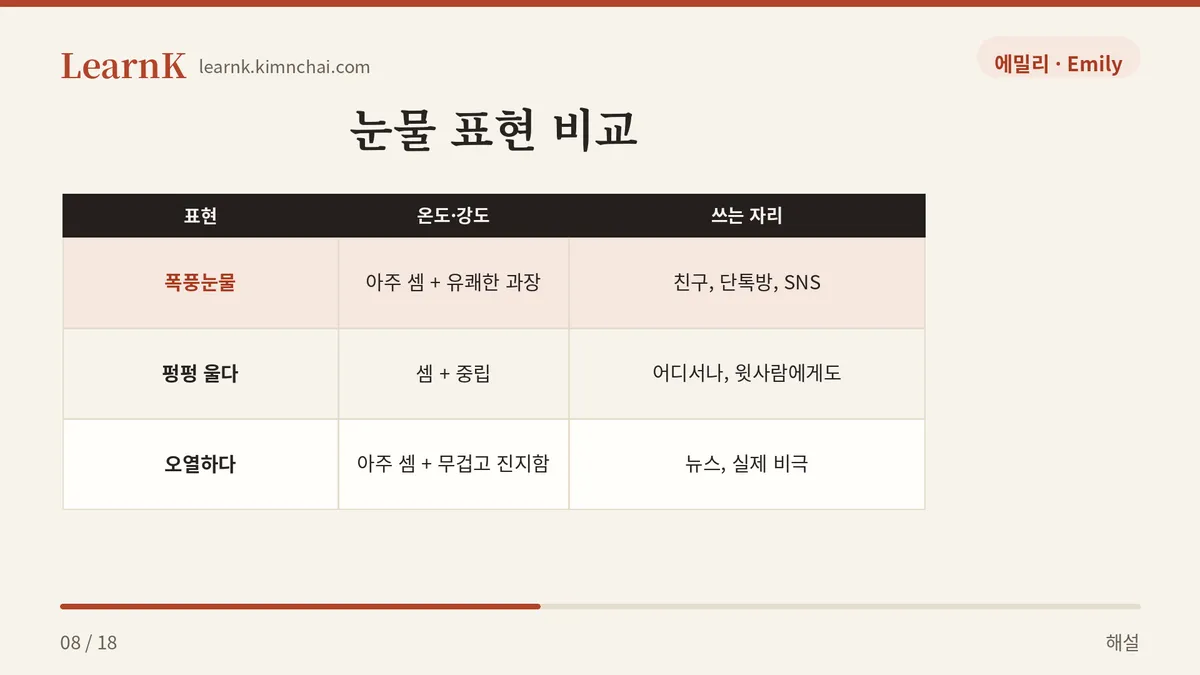
Switching between casual and polite speech is just a matter of changing the verb that follows: 폭풍눈물 흘렸어 (pokpungnunmul heullyeosseo) → 폭풍눈물 흘렸어요 (pokpungnunmul heullyeosseoyo). That’s about as far as it goes naturally. Push it into stiff formal speech like 폭풍눈물을 흘렸습니다 (pokpungnunmureul heullyeotseumnida) and it starts to sound awkward, because formal register and playful slang push each other away. With a boss or an elder, you’re safer switching to one of the other expressions in the table below.
| Expression | Tone & Intensity | Where to Use It |
|---|---|---|
| 폭풍눈물 (pokpungnunmul) | Very strong + exaggerated, playful tone | Friends, group chats, social media. Not for formal settings or real tragedy |
| 펑펑 울다 (peongpeong ulda) | Strong + neutral | Anywhere, spoken or written. Fine with people above you, too |
| 오열하다 (oyeolhada) | Very strong + heavy and serious | News, articles, real tragedy. Using it jokingly misses the mark |
| 눈물이 핑 돌다 (nunmuri ping dolda) | Weak + momentary | When you tear up just a little. Works anywhere |
As the table shows, 폭풍눈물 (pokpungnunmul) and 오열하다 (oyeolhada) describe a similar volume of tears but belong in completely opposite settings. The news will say a bereaved family 오열했다 (oyeolhaetda), never that they 폭풍눈물을 흘렸다 (pokpungnunmureul heullyeotda). Flip it around, and telling a friend you 오열했다 (oyeolhaetda) over a drama comes off as far too grave.
Cultural Background — Words That Take 폭풍 (pokpung)
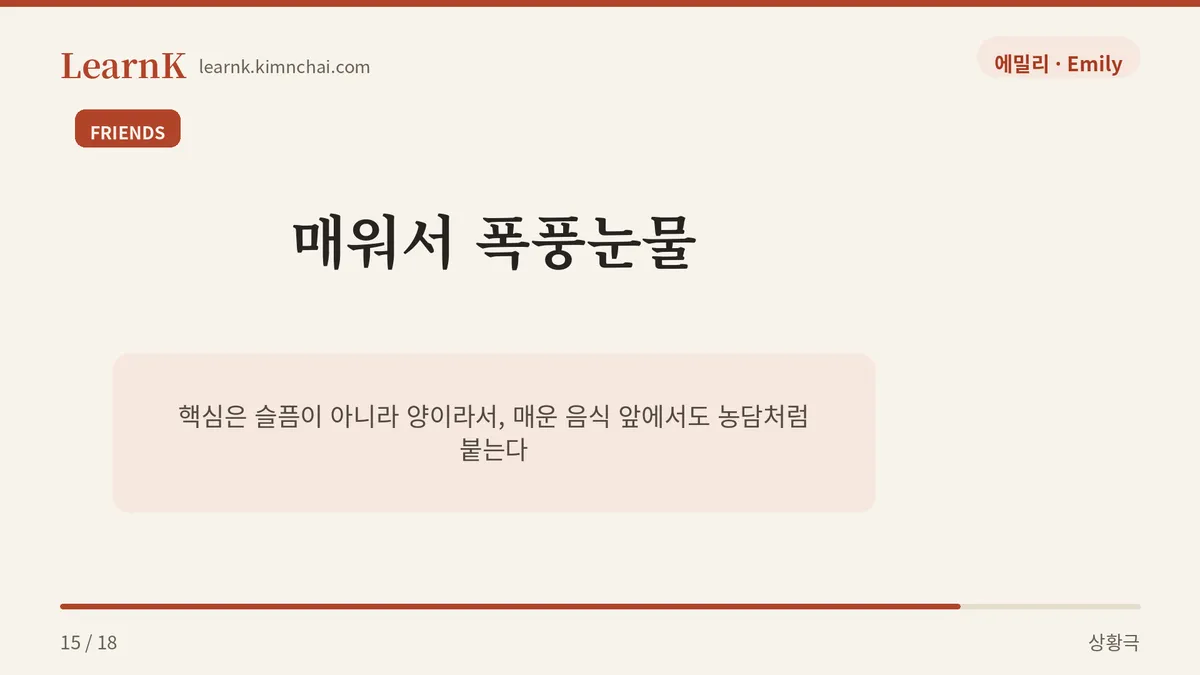
The fastest way to understand this word is to know that 폭풍 (pokpung) functions as a kind of intensifier prefix. In internet Korean, 폭풍 inflates both the scale and the momentum of whatever noun follows it. A sudden growth spurt is 폭풍성장 (pokpungseongjang). Inhaling food at incredible speed is 폭풍흡입 (pokpungheubip). Hammering away at the search bar like a maniac is 폭풍검색 (pokpunggeomsaek). 폭풍눈물 (pokpungnunmul) was born from the same mold — which is why a little exaggeration and mischief have been baked into it from birth.
The other piece of background is Korea’s drama-watching culture. People watch live, at broadcast time; they post reactions to group chats and social media as they watch; and the moment it ends, they check in on each other’s emotional state. In that environment, crying isn’t something shameful to hide — it’s closer to a game everyone plays together. The very fact that you cried becomes the highest possible compliment to the show. 폭풍눈물 (pokpungnunmul) is the fastest, loudest way to deliver that compliment.
It comes out in particular bursts at the emotional climaxes Korean dramas return to again and again: a family reunion, the moment a long misunderstanding is finally cleared up, the scene where someone fails to recognize the person they lost. If you’re learning Korean, a day will come when you’re watching a drama and this word comes out of you on its own. When that day arrives, it means Korean emotional expression has settled into your body.
Today’s Quiz
Which of the following is the most inappropriate situation for using 폭풍눈물 (pokpungnunmul)?
- Texting a friend on KakaoTalk after watching a drama finale
- Joking around while eating spicy tteokbokki
- Offering words of comfort to the chief mourner at an actual funeral
- Talking to yourself while rewatching a video of your kid’s graduation
The answer is number 3. 폭풍눈물 (pokpungnunmul) describes a huge quantity of feeling but carries a light, playful slang tone, so in a place where real grief sits, it makes the other person’s loss seem trivial. In a setting like that, one quiet sentence reaches much deeper.
Definitions and example sentences are from the National Institute of Korean Language’s Basic Korean Dictionary (krdict.korean.go.kr); that portion of this post, including our translations, is licensed under CC BY-SA 2.0 KR.