포토존 (potojon) — A Spot Made Just for Taking Pictures
When you’re out walking around a travel spot with a Korean friend, there’s one word you’re guaranteed to hear at least once. 포토존 (potojon) means “a place set aside so people can get a good photo.” The wooden picture frame standing at the entrance to a tourist site, the flower display on a café wall, the giant sculpture planted in the middle of a festival ground, the two footprints painted on the floor in front of an observatory window — every one of those places where people line up and wait their turn is a 포토존 (potojon). Travel around Korea and you’ll hear this word three or four times a day.
There are two main ways it gets used. The first is a spot someone built on purpose. There’s a sign that literally reads 포토존 (potojon), a backdrop has been put up, and the floor is even marked to show you where to stand. The second is a prime spot people have settled on themselves. No sign, no announcement, but everyone shoots there. For this kind, people often tack 진짜 (jinjja, “real”) or 숨은 (sumeun, “hidden”) onto the front, as in 여기가 진짜 포토존이야 (yeogiga jinjja potojon-iya, “This is the real photo spot”). The official 포토존 (potojon) is crowded and predictable, but whoever digs up a hidden one becomes the hero of the day.
The temperature of the word is light and giddy. It belongs to places you go to have fun, so you end up saying it with a smile. Because it’s a noun, the word itself carries no politeness level — formal and casual are decided by the predicate that follows. A handful of phrases turn up with it again and again: 포토존이 어디예요? (potojon-i eodiyeyo?, “Where’s the photo spot?”), 여기 포토존이래 (yeogi potojon-irae, “I hear this is a photo spot”), 포토존 잡았다 (potojon jabatda, “Got the photo spot”), 숨은 포토존 (sumeun potojon, “hidden photo spot”).
See It in a Real Conversation
Setting: Saturday afternoon, the Jeonju Hanok Village. They’ve just rented hanbok and stepped out into the alleys.
Jun-kyung: 야, 여기 사람 왜 이렇게 많아? 줄이 저기 끝까지 섰네. Hey, why are there so many people here? The line goes all the way down there.
Emily: 저 담벼락이 포토존이잖아. 기와지붕이랑 하늘이 딱 걸려서 예쁘게 나와. That wall is the photo spot, you know. The tiled roof and the sky line up just right.
Jun-kyung: 아, 그래서 그렇구나. 우리도 서야 되나? 삼십 분은 걸리겠는데. Ah, so that’s why. Should we line up too? It’ll take at least thirty minutes.
Emily: 아니, 나 아까 봐 둔 데 있어. 골목 안쪽에 감나무 있는 집, 거기가 진짜 포토존이야. No, I spotted a place earlier. The house with the persimmon tree down the alley — that’s the real photo spot.
Jun-kyung: 오, 너 이런 거 진짜 잘 찾는다. 앞장서. Oh, you’re seriously good at finding these. Lead the way.
Emily: 대신 열 장은 찍어 줘야 돼. 한 장 건지려면 그 정도는 찍어야지. But you’ve got to take at least ten shots. That’s what it takes to get one keeper.
Used This Way, It Sounds Off
✗ (While paying respects at the National Cemetery) 여기 포토존 어디예요? (yeogi potojon eodiyeyo? — “Where’s the photo spot here?”) ✓ (While paying respects at the National Cemetery) 여기서 사진 찍어도 괜찮을까요? (yeogiseo sajin jjigeodo gwaenchanheulkkayo? — “Would it be all right to take a photo here?”) → 포토존 (potojon) is an excited word for places you go to enjoy yourself. In places that ask you to lower your voice — memorial halls, funerals, accident sites — that excitement lands as plain rudeness. There’s nothing wrong with the grammar, and the listener’s face still goes stiff.
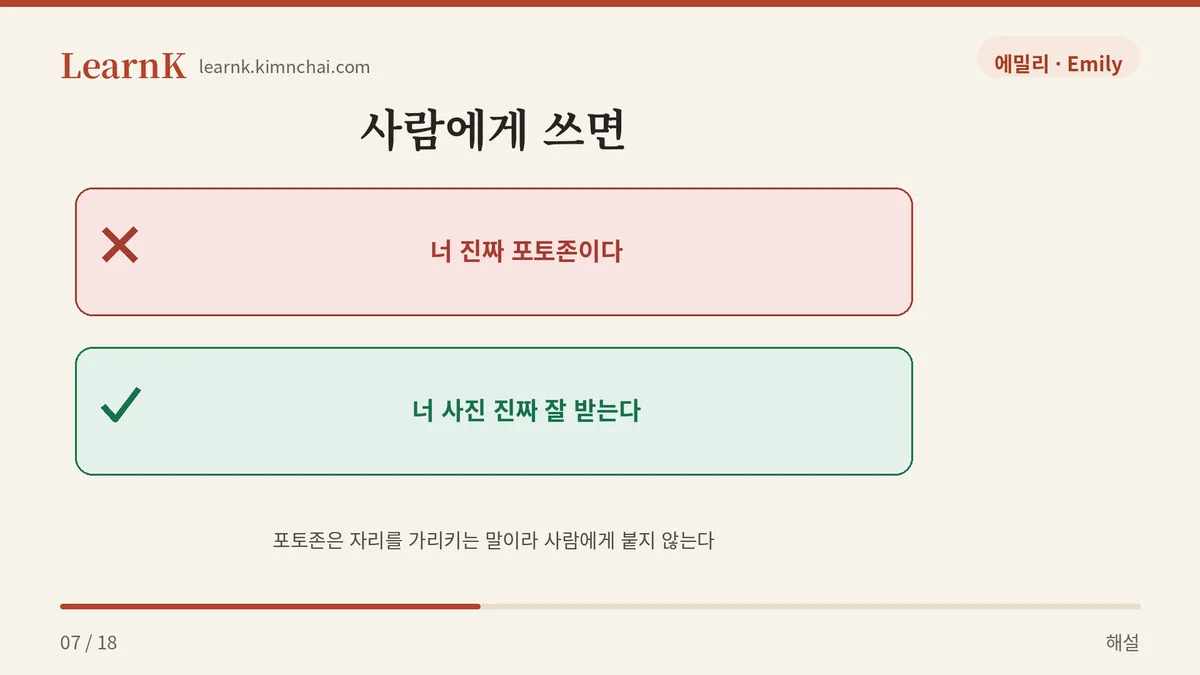
✗ (Looking at a friend’s face) 너 진짜 포토존이다. (neo jinjja potojon-ida — “You’re a real photo spot.”) ✓ (Looking at a friend’s face) 너 사진 진짜 잘 받는다. (neo sajin jinjja jal batneunda — “You’re really photogenic.”) → One common misunderstanding. 포토존 (potojon) points at a place; it isn’t a compliment for a person. For people, use 사진 잘 받는다 (sajin jal batneunda). If you insist on calling someone a 포토존 (potojon), it comes out sounding like “your face is a backdrop” — it doesn’t even land as a joke.
Example Sentences by Situation
1. Picking a seat at a café you’re visiting for the first time. The window seats are open, but you can’t tell which one photographs best. Ask a staff member and they’ll usually tell you with a smile.
여기 포토존이 어디예요? (yeogi potojon-i eodiyeyo?) Where’s the photo spot here?
2. Deciding on your next destination with a friend. The name of the temple alone doesn’t tell you much, so you add a reason to go and make your case.
그 절, 포토존만 세 군데래. 가을에 가면 단풍이랑 같이 나온대. (geu jeol, potojon-man se gunde-rae.) They say that temple has three photo spots alone. In autumn you get the fall leaves in the shot too.
3. After dropping your bags at your lodging. You went up to the rooftop expecting nothing and it turned out to be lovely. Adding -더라 (-deora) brings out the nuance of “I saw it for myself, and that’s how it was.”
우리 숙소 옥상이 숨은 포토존이더라. (uri suksso okssang-i sumeun potojon-ideora.) Turns out our guesthouse rooftop is a hidden photo spot.
Formal and Casual Speech, and Similar Expressions
포토존 (potojon) is a noun, so the word itself never changes. The politeness level is decided by what comes after it. With staff or someone you’ve just met: 포토존이 어디예요? (potojon-i eodiyeyo?) / 여기가 포토존이에요 (yeogiga potojon-ieyo). With a friend: 포토존 어디야? (potojon eodiya?) / 여기가 포토존이야 (yeogiga potojon-iya). On signs and in news articles, a stiffer predicate gets attached, as in 포토존이 조성되어 있습니다 (potojon-i joseongdoeeo itseumnida, “A photo zone has been set up”).
There are several similar words, and what decides which one you reach for is temperature more than meaning.
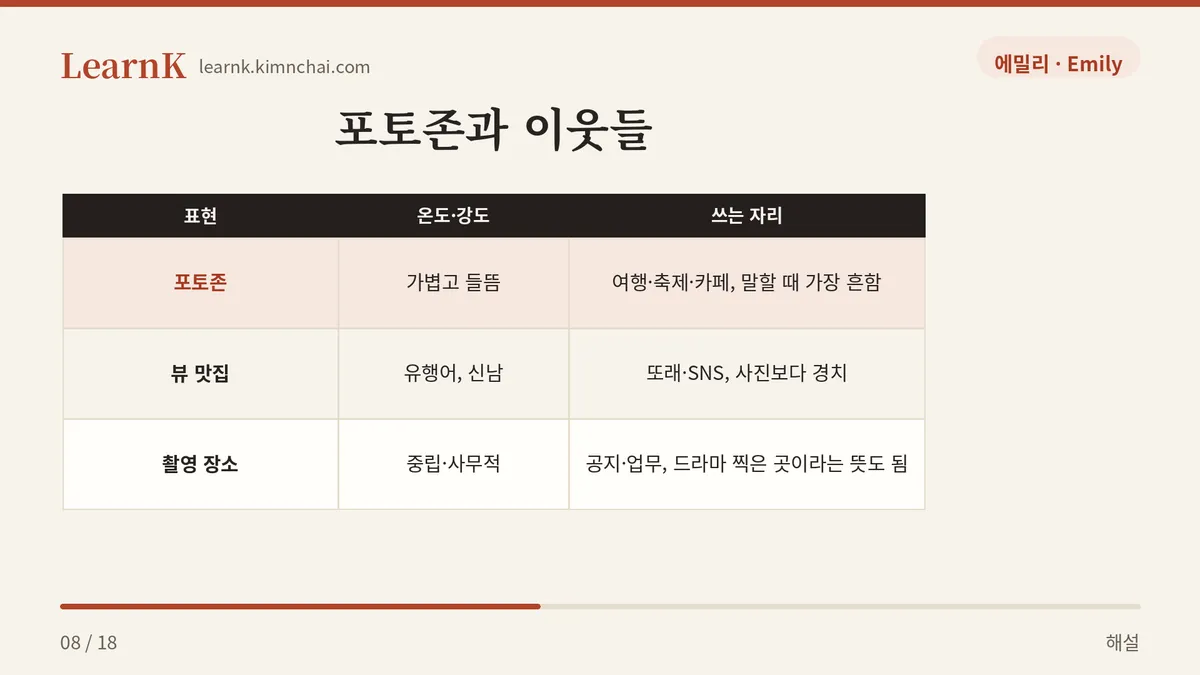
| Expression | Temperature / Intensity | Where it’s used |
|---|---|---|
| 포토존 (potojon) | light and giddy | travel, festivals, cafés; the most common one in speech |
| 포토스팟 (potoseupat) | similar, but a little more written | travel articles, blogs, signage |
| 인생샷 명소 (insaengsyat myeongso) | the giddiest, with some exaggeration mixed in | among peers, on social media; never in official documents |
| 뷰 맛집 (byu matjip) | trendy, excitable | peers and social media; weighted toward the view, not the photo |
| 촬영 장소 (chwaryeong jangso) | neutral, businesslike | notices, work; can also mean a filming location |
The easy ones to mix up are the bottom two rows. 뷰 맛집 (byu matjip) says the scenery itself is great rather than the photo, and 촬영 장소 (chwaryeong jangso) is more often used to mean a place where a drama was shot. Ask 여기 촬영 장소예요? (yeogi chwaryeong jangso-yeyo?) at a tourist site and most people will hear it as “Which drama was filmed here?”
Cultural Background — The Country Where the Sign Goes Up First
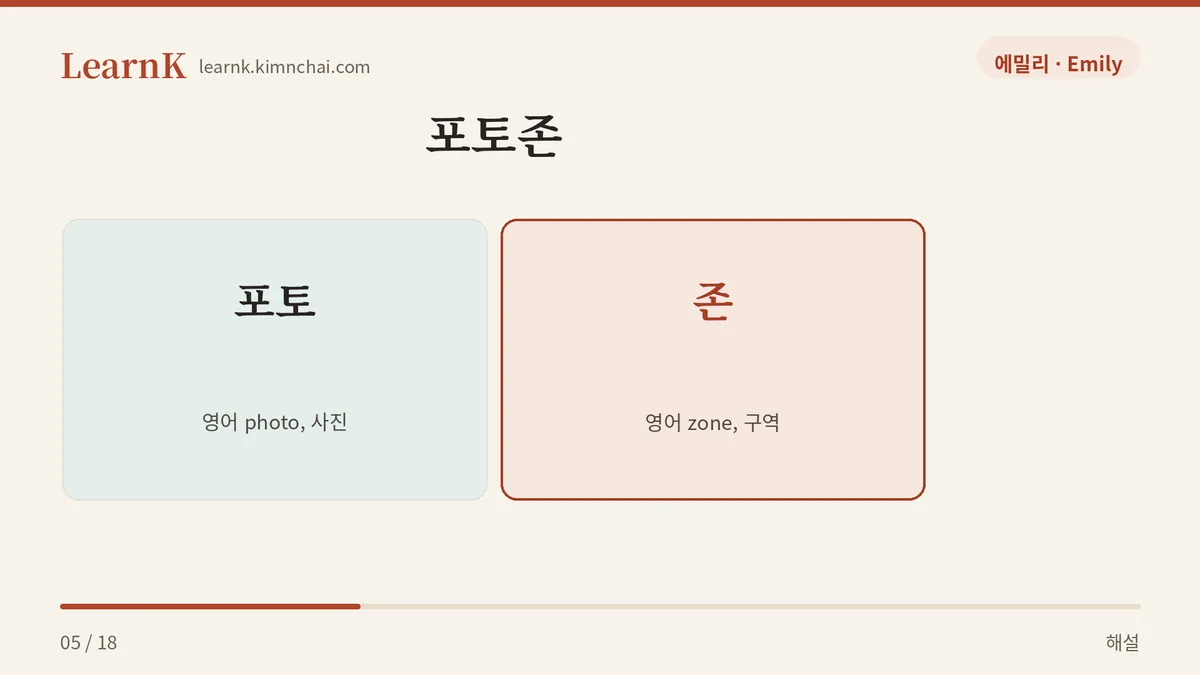
The word is put together simply: the English photo and zone, glued into Konglish. In English-speaking countries people don’t really say “photo zone” — they say “photo spot” or “photo op.” So it’s a word made in Korea and set in Korea, one that may not get through if you carry it straight over into English.
What’s interesting is that in Korea these places don’t “come about” — they get “put up.” A local government spends budget on a sculpture, drives in a sign reading 포토존 (potojon) in front of it, and even paints two footprints on the ground to mark where you should stand. There’s one at the cherry blossom festival, one at the tiny country train station, one in the lobby of a newly opened library. Instead of leaving photos to chance, the spot gets designed first.
At the root of it is 인증샷 (injeungsyat) culture — the proof shot. Having gone matters less than having evidence you went, and the evidence has to be pretty. It’s the same impulse behind that scene that keeps repeating in travel variety shows, where the cast arrive somewhere famous and start taking each other’s photos before they’ve even set their bags down. It’s also why, in Korea, when someone stands around with a camera looking uncertain, the person next to them will often speak up first: 찍어 드릴까요? (jjigeo deurilkkayo?, “Shall I take it for you?”).
For learners, this word turns out to be a surprisingly good conversation key. Ask 여기 포토존이 어디예요? (yeogi potojon-i eodiyeyo?) at a café or a tourist information desk, and it usually doesn’t end with a finger pointed in one direction. Quite a few people will go on to tell you what time of the afternoon the light is best and what angle you should stand at.
Today’s Quiz
You’ve gone up to the Namsan observation deck with a friend. People are crowded along just one stretch of the railing, taking turns snapping photos. What’s the most natural thing to say in this situation?
- 저기가 촬영 장소인가 봐. (jeogiga chwaryeong jangso-inga bwa.)
- 저기가 포토존인가 봐. (jeogiga potojon-inga bwa.)
- 저 사람들이 포토존이네. (jeo saramdeul-i potojon-ine.)
- 저기 포토존 잘 받는다. (jeogi potojon jal batneunda.)
Answer: No. 2. No. 1 is easily heard as “that’s where a drama was filmed.” No. 3 is the mistake of calling people a 포토존 (potojon), and 잘 받는다 (jal batneunda) in No. 4 is used for people, so it doesn’t attach to a place. A spot where people gather and take their turns shooting — even with no sign, that’s a 포토존 (potojon).
The definitions, example sentences, and dialogue in this post are all original work written by the author.