빡치다 (ppakchida) — A Word for the Speed of Anger, Not Its Size
빡치다
빡치다 (ppakchida) means to get so angry that heat surges up inside you all at once. It is not a word you can bring into polite company. It is strong slang used between peers, and if you line the anger words up by intensity, it sits about two steps above 화가 나다 (hwaga nada) and another half step rougher than 열받다 (yeolbatda). The bus door closing right in front of your face. The file you wrestled with for three hours vanishing unsaved. A message that says “I’m heading out now” arriving thirty minutes after you were supposed to meet — this is the word that comes out of a Korean person’s mouth by reflex.
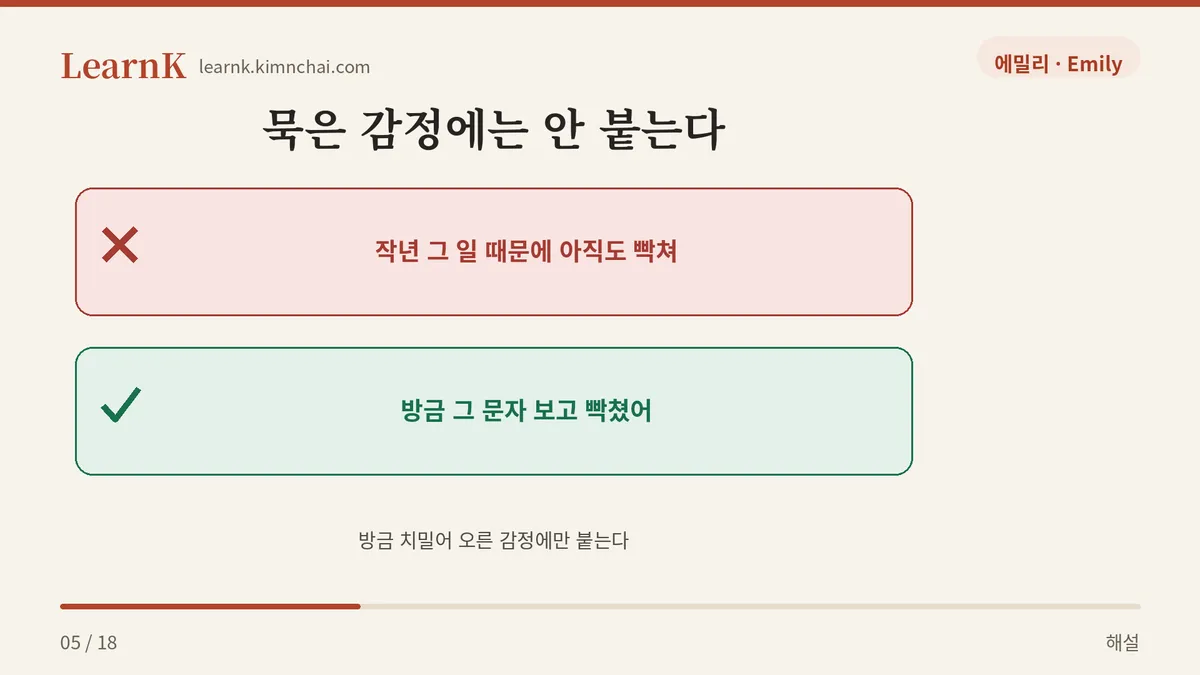
The heart of this word is not the size of the anger but its speed. It doesn’t attach well to resentment or hurt feelings that have been sitting for months. It points to the emotion that shot up to the top of your head because of something that happened just now, a moment ago, one second ago — that instantaneous surge. That’s why 작년 그 일 때문에 아직도 빡쳐 (I’m still pissed about that thing last year) sounds a little off, while 방금 그 문자 보고 빡쳤어 (I got pissed the second I saw that text) sounds perfectly natural.
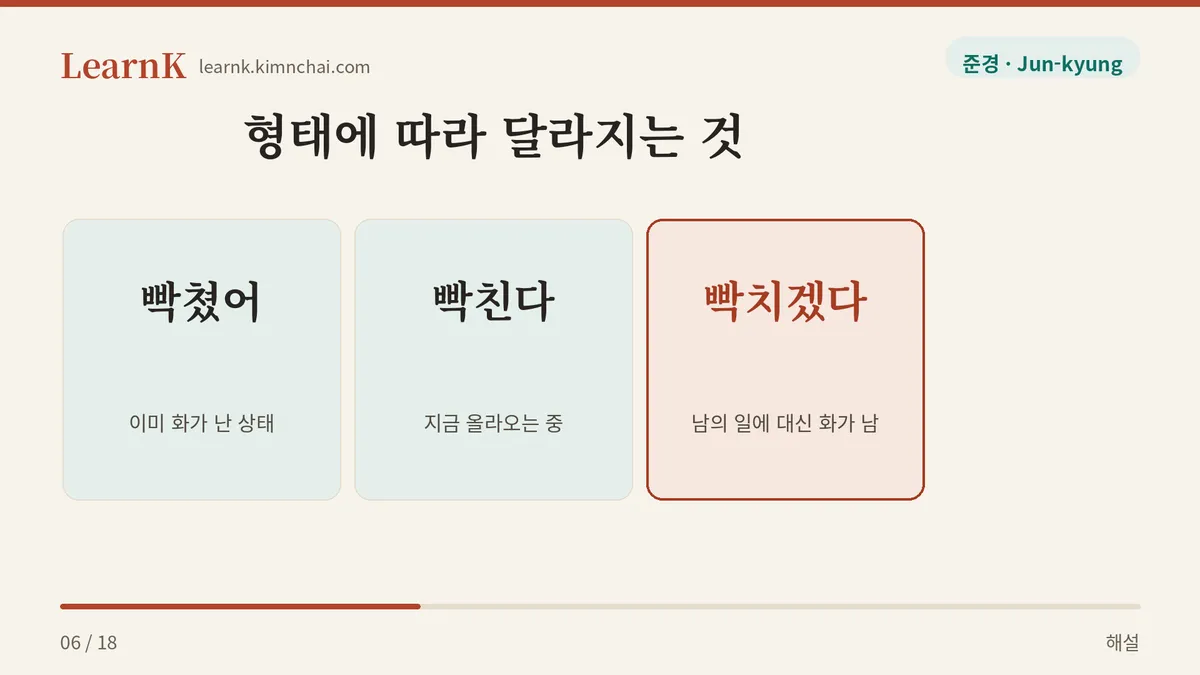
The conjugated forms have spread pretty widely. 빡쳤어 (ppakchyeosseo) is the already-angry state, 빡친다 (ppakchinda) is anger rising right now, and 빡치겠다 (ppakchigetda) means you’re getting angry on someone else’s behalf after hearing their story. These days the noun form 빡침 (ppakchim) is common as well — people give the feeling a name and turn it into a list, as in 오늘의 빡침 포인트 (today’s ppakchim points).
One thing to watch out for. Grammatically, you can attach a polite ending — 빡쳤어요 (ppakchyeosseoyo) — but raising the ending does not make the word polite. The word itself is rough, so dressing it in honorific clothes leaves the roughness exactly where it was. This is the spot where Korean learners slip most often.
Seeing It in Real Conversation
Scene: Saturday afternoon, in front of an apartment building’s main gate. Jun-kyung, who arranged to sell his monitor through a secondhand app, has been standing there for forty minutes. Emily shows up holding two coffees.
Jun-kyung: 40분. 딱 40분 기다렸어. 연락도 없어. Forty minutes. I’ve been waiting exactly forty minutes. Not even a message.
Emily: 헐, 읽고 씹은 거야? 그건 진짜 빡치겠다. Wait, they read it and ignored you? That would honestly piss me off.
Jun-kyung: 아까는 “출발했어요” 해놓고 이래. 진짜 빡쳐서 말이 안 나와. Earlier they said “I’m on my way,” and now this. I’m so pissed I can’t even talk.
Emily: 야, 그냥 취소해. 후기 남기고 집에 가자. Dude, just cancel it. Leave a review and let’s go home.
Jun-kyung: 아, 됐다. 이거 그냥 버릴까 봐. Ugh, forget it. I’m tempted to just toss this thing.
Emily: 버리긴 뭘 버려. 커피나 마셔. 내가 대신 빡쳐 줄게. Don’t you dare. Drink your coffee. I’ll be mad on your behalf.
That last line — 내가 대신 빡쳐 줄게 (I’ll be mad on your behalf) — shows nicely how the word actually gets used. Built into the expression is the sense that anger isn’t something you swallow alone; it’s something the person next to you helps carry. When a friend gets treated unfairly and you say 대신 빡쳐 줄게, it’s less about anger than about taking their side.
It Sounds Off If You Use It Like This
✗ (to your department head) 부장님, 저 오늘 아침에 지하철 때문에 진짜 빡쳤어요. ✓ (to a coworker) 야, 나 아침에 지하철 때문에 진짜 빡쳤어. (Hey, the subway really pissed me off this morning.) → Even with a polite ending attached, the word itself is close to vulgar slang, so it sounds rude in front of someone senior to you. With a superior, 정말 짜증 났어요 (jeongmal jjajeung nasseoyo) or 좀 화가 났습니다 (jom hwaga natseumnida) is the safe choice.
✗ 할머니가 편찮으시다는 소식 듣고 너무 빡쳤어. ✓ 할머니가 편찮으시다는 소식 듣고 너무 속상했어. (I was so upset when I heard my grandmother was ill.) → 빡치다 isn’t just a word with a high intensity setting; it’s a word with a fixed direction. The arrow points outward. It doesn’t attach to feelings that sink inward, like sadness, pity, or worry. In other words, a strong emotion alone doesn’t make this word usable anywhere.
Example Sentences by Situation
1. On your morning commute, you miss your transfer train by one minute
아, 1분 차이로 놓쳤네. 아침부터 진짜 빡친다. a, il-bun chairo nochyeonne. achimbuteo jinjja ppakchinda. Ah, missed it by a minute. Pissed off first thing in the morning.
This is talking to yourself. More than half the uses of this word aren’t addressed to anyone at all — they’re muttered alone. Here, 빡친다 is in the present tense, which gives the feeling that the heat is rising right this second. If the whole thing were already over, it would be 빡쳤다 (ppakchyeotda).
2. The file you worked on all night disappeared unsaved
세 시간 한 게 통째로 날아갔어. 빡쳐서 노트북 그냥 덮었어. se sigan han ge tongjjaero naragasseo. ppakchyeoseo noteubuk geunyang deopeosseo. Three hours of work, gone. I was so pissed I just closed the laptop.
When you use the causal connecting form like 빡쳐서, an action always follows. You close the laptop, you walk away, you hang up the phone. This word doesn’t stop at the emotion — it moves the body — so it sounds most natural when an action comes after it.
3. Something you told only one friend got passed around word for word
걔가 그 말을 그대로 옮겼대. 나 진짜 빡침. gyaega geu mareul geudaero omgyeotdae. na jinjja ppakchim. She passed it on word for word. I’m seriously ticked off.
Ending a sentence with the noun form 빡침 shows up especially often in online posts and messenger chats. It feels like tossing out one lump of emotion instead of finishing the sentence, which is why it appears more in writing than in speech. Out loud, 나 진짜 빡쳤어 (na jinjja ppakchyeosseo) is the natural version.
Politeness Levels and Similar Expressions
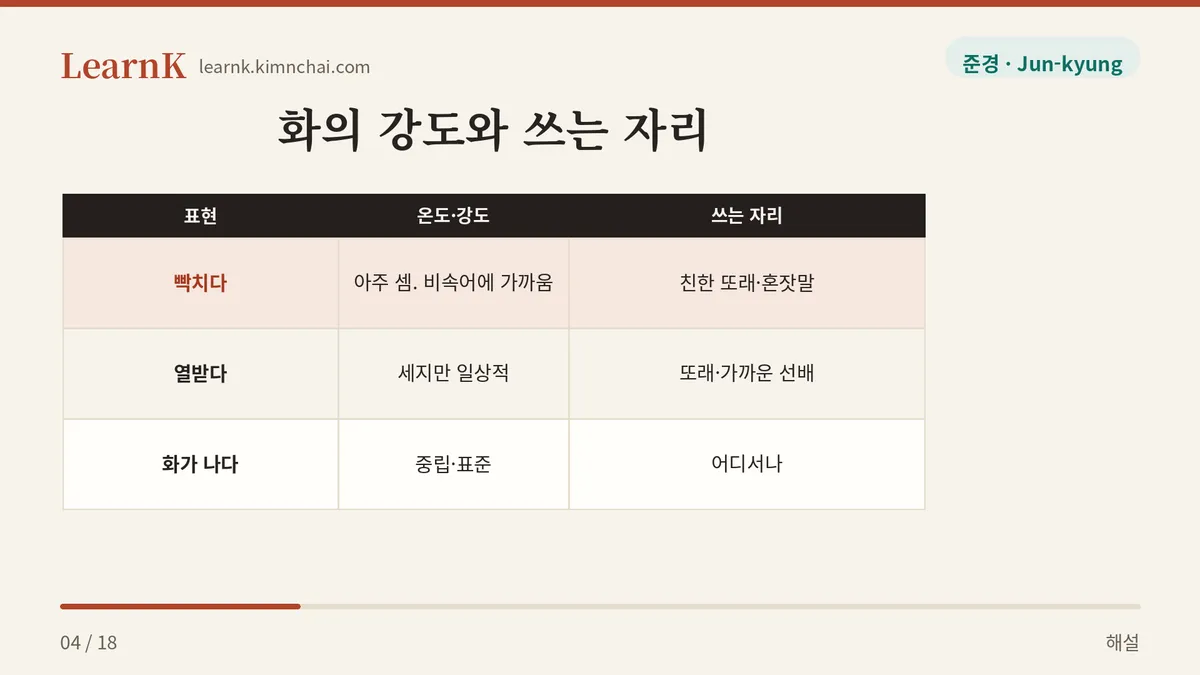
| Expression | Temperature / Intensity | Where it belongs |
|---|---|---|
| 빡치다 (ppakchida) | Very strong. Close to vulgar slang | Close friends your own age, or talking to yourself. Off-limits with superiors and in formal settings |
| 열받다 (yeolbatda) | Strong but everyday | Peers and up to close seniors. Muttering it at work is fine |
| 짜증 나다 (jjajeung nada) | Medium. More irritation than rage | Almost anywhere. Polite forms like 짜증 났어요 (jjajeung nasseoyo) sound natural too |
| 화가 나다 (hwaga nada) | Neutral, standard | Anywhere. Fine in formal settings and in writing |
| 속상하다 (soksanghada) | Not strong. Closer to sadness | Anywhere. The direction points inward |
As the table shows, 빡치다 tops the intensity axis but has the narrowest range of places you can use it. It helps to remember that in Korean, the stronger an emotional expression gets, the fewer places it fits.
The politeness issue here is a bit special. With other emotion words you only have to change the ending — 짜증 나다 → 짜증 났습니다 (jjajeung natseumnida), 화가 나다 → 화가 났습니다 (hwaga natseumnida) — but turning 빡치다 into 빡쳤습니다 (ppakchyeotseumnida) still won’t get it into a formal setting. In fact, that combination sounds even stranger. It’s like wearing slippers with a suit. So it’s fair to treat this word as essentially casual-speech-only, and when you need to raise the register, you have to swap out the word itself.
Cultural Background — A Short Word Made by a Patient Society
The picture this word draws is an upward surge. 빡 belongs to the family of sounds that mimic something striking hard, and you can hear the same sound in words like 빡세다 (ppakseda) and 빡빡하다 (ppakppakhada). The 치다 (chida) attached behind it means an upward movement from below, as in 치밀다 (chimilda). In other words, it compresses into two syllables the scene of heat rushing from your toes to the top of your head in one go. That said, there’s no documented record settling when the word first appeared or who first said it, so treat this as the picture the word paints rather than a confirmed etymology.
In Korean society, anger has long been an emotion you hold in. At work, at school, within the family, showing feelings openly was treated as immaturity, and so the words for expressing anger developed to be short and strong instead. If the structure is hold-it-in-then-burst, you need a word that detonates all at once more than you need gentle intermediate steps. 빡치다 is the word that filled that slot.
You can see this structure clearly in how the word shows up in Korean dramas. In workplace dramas, there’s a scene that repeats: a character bows their head in front of the boss and answers 네, 알겠습니다 (ne, algetseumnida — Yes, understood), then turns away and mutters something short and sharp alone in a stairwell or a bathroom. What the camera captures isn’t the anger itself — it’s the gap between the face that swallowed the anger and the one line that bursts out where nobody can hear. And that gap is exactly what learners should take from this word. The meaning is “to get angry,” but the place this word actually lives is not in front of people; it’s where there are no people, or in front of someone very close.
In variety show subtitles it works a little differently. When a cast member ends up in an unfair situation, the word often appears in big letters across the screen — and there it’s less real rage than exaggeration for laughs. So the same word functions as swallowed emotion in dramas and as comedy material in variety shows. When you run into it while watching Korean content, it’s fun to work out which one it is.
Today’s Quiz
In which of the following situations would 빡치다 be the most awkward choice?
- Telling the friend next to you after someone cut in line
- Muttering to yourself when your secondhand-sale buyer never shows up
- Explaining to an interviewer why you left your last job
- Telling friends your own age in a group chat about your day
Show the answer
Answer: 3
Options 1, 2, and 4 are all natural — they’re either with peers or spoken to yourself. Option 3 is a formal setting that calls for proper manners, and the other person is a senior you’re meeting for the first time. Here, switching to a polite form like 빡쳤습니다 (ppakchyeotseumnida) doesn’t help at all — you have to change the word itself. Something like 업무 방식이 맞지 않아 고민이 많았습니다 (The way the work was done didn’t suit me, and I gave it a lot of thought) is what fits this setting.
Looking at the setting before the strength of the emotion — that’s how you use this word properly.