뻘쭘하다 (ppeoljjumhada) — When You've Done Nothing Wrong, but Standing There Is Still Hard
뻘쭘하다
뻘쭘하다 (ppeoljjumhada) means feeling so awkward and self-conscious that just standing where you are is uncomfortable. You greet someone cheerfully in the elevator and they clearly don’t recognize you. Everyone bursts out laughing and you’re the only one who missed the joke. You finally push open the gym door after a month away — and of course, that’s the moment you make eye contact with your trainer. Koreans handle those one or two seconds of thick air with a single phrase: 아, 뻘쭘해 (a, ppeoljjumhae).
The heart of this word is that it’s a feeling you get even when you’ve done nothing wrong. You’re not ashamed because you messed up. It’s just that the place you should be and the place you’re actually standing have slipped slightly out of alignment — and you can feel that gap in your body. That’s why 뻘쭘함 is usually short. A few seconds, a few minutes at most, and afterward it becomes the kind of thing you laugh about.
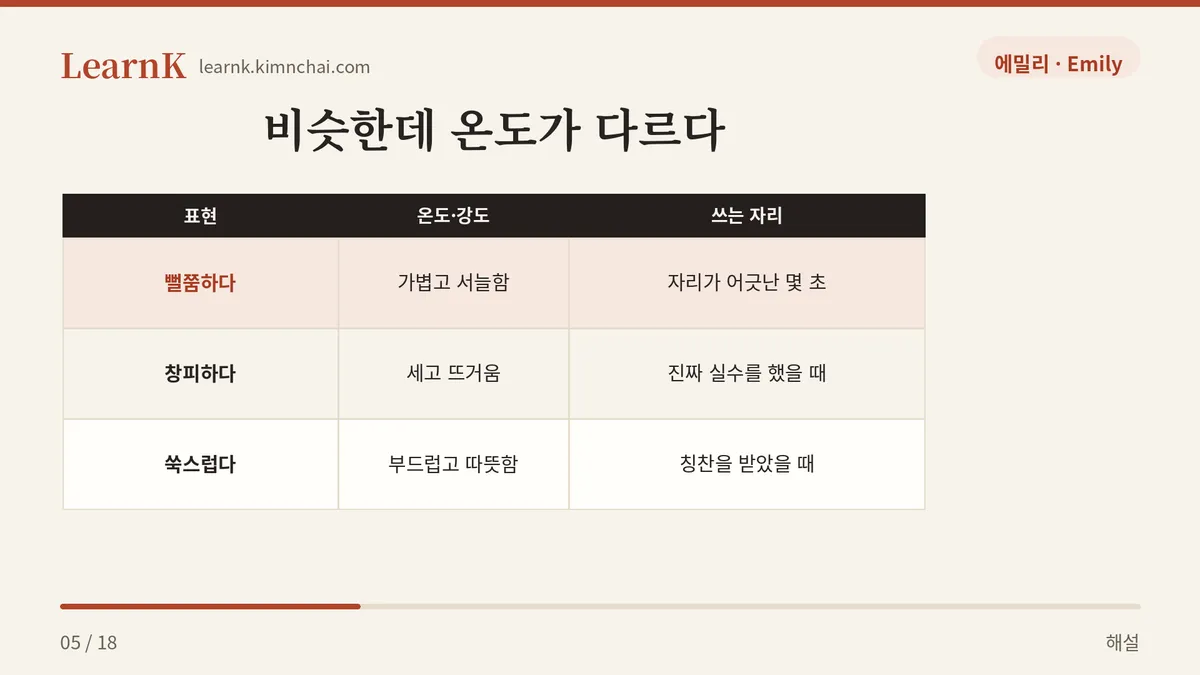
The temperature is low, too. If 창피하다 (changpihada) is the intensity of your face burning, 뻘쭘하다 is more like the back of your neck stiffening a little. So this word almost always comes out with a light expression on your face. Say “뻘쭘합니다” with a serious face and the listener will laugh instead.
One more thing. Remember that the dictionary tags this word as ‘속된 말’ (slang / low-register speech). The meaning is mild, but the register is low. That one line is what decides, later on, exactly “where you must not use it.”
Checking the National Institute of Korean Language dictionary
The National Institute of Korean Language’s Basic Korean Dictionary defines the word like this.
뻘쭘하다 「형용사」 (adjective) (속된 말로) 어색하고 민망하다. (slang) To be awkward and embarrassed. [English] embarrassing — (slang) It’s awkward and embarrassing. [Japanese] きまずい【気まずい】 — ぎこちなくて恥ずかしいことを俗にいう語。 [Spanish] estar avergonzado — (VULGAR) Estar incómodo y avergonzado. [Chinese] 尴尬,不自在 — (粗俗)感到为难和不自在。 — National Institute of Korean Language, Basic Korean Dictionary (krdict.korean.go.kr)
What’s interesting is that all four translations point to the same spot. Japanese きまずい (気まずい) describes the air between two people going stiff; Chinese 尴尬 describes being stuck, unable to go forward or back. Even in translation, you can see that this word names the state of a situation, not the name of an emotion.
The Portuguese translation isn’t included in this dictionary. For reference, sem graça or constrangido would be close — but we should be clear that this is our own rendering, not a dictionary translation.
The dictionary lists two actual example sentences. We’ll quote them exactly as they appear and explain the situation behind each.
그는 혼자서 밥 먹기가 뻘쭘하다며 옆자리에 앉았다. He said it felt awkward to eat alone, so he sat down next to me. — National Institute of Korean Language, Basic Korean Dictionary (krdict.korean.go.kr)
This is the scene of someone about to eat alone at a restaurant, spotting a person they know, and quietly sliding into the seat beside them. What’s worth noticing here is that the awkwardness changed his behavior. He didn’t run away out of shame — he just decided that moving seats beat sitting in an awkward spot. 뻘쭘하다 often drags a next action along behind it, like “so I moved seats” or “so I spoke first.”
말하기가 뻘쭘하다. It feels awkward to say it. — National Institute of Korean Language, Basic Korean Dictionary (krdict.korean.go.kr)
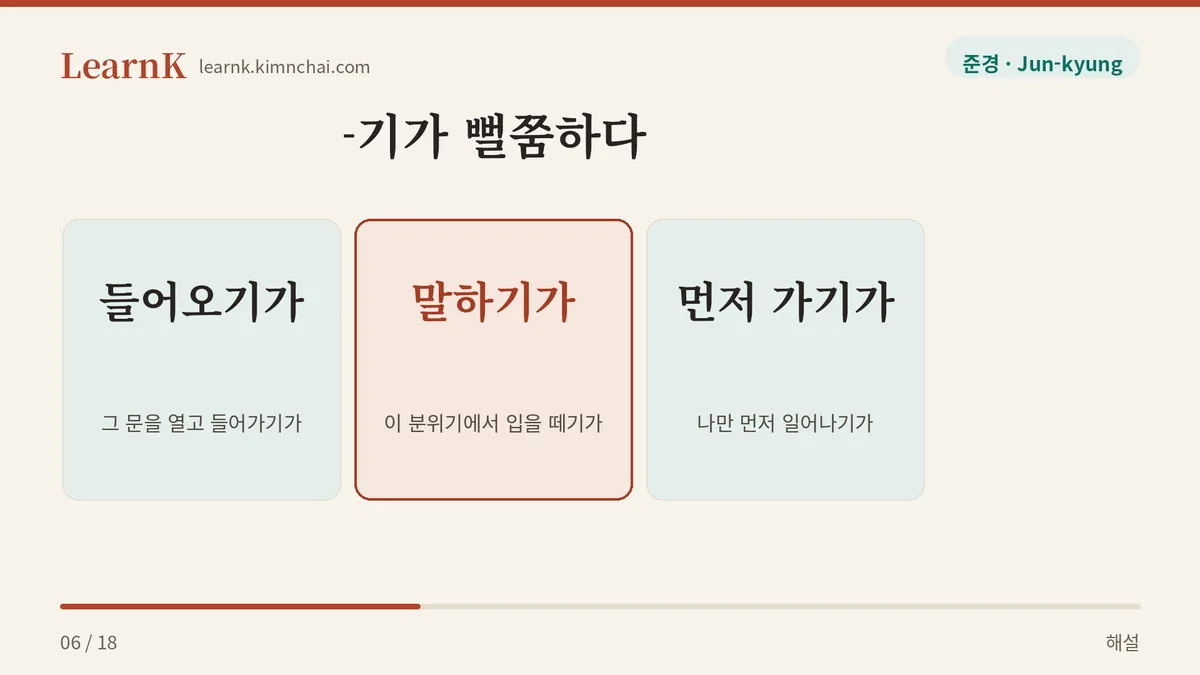
This is the state of having something to say but not being able to get the words out. Not because you’re afraid. Because if you brought it up in this particular atmosphere, you’d be the one left hanging in midair. The pattern -기가 뻘쭘하다 (-giga ppeoljjumhada) is used a lot in real life. 말하기가 뻘쭘하다 (it’s awkward to speak up), 먼저 가기가 뻘쭘하다 (it’s awkward to leave first), 물어보기가 뻘쭘하다 (it’s awkward to ask) — memorize this one frame and your range expands enormously.
That’s the end of the dictionary’s examples. Rather than padding the list with invented sentences and passing them off as the dictionary’s, everything below is written by us.
Seeing it in a real conversation
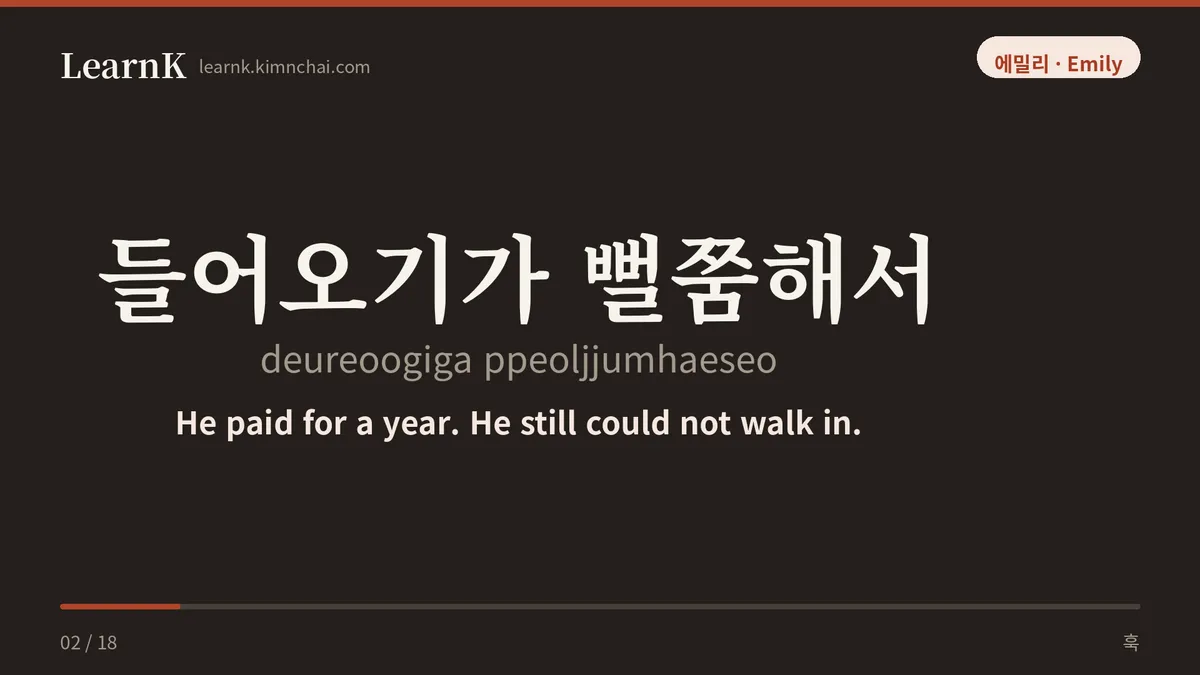
Scene: Saturday morning, the entrance of a neighborhood gym. Jun-kyung, who bought a one-year membership in January and then stopped showing up, has reappeared after a month. Emily is just stepping off the treadmill.
준경: (문 앞에서 작게) 야… 나 왔다. (quietly, at the door) Hey… I’m here.
에밀리: 어? 한 달 만이네? 아까 트레이너쌤이 네 얘기 하시던데. Huh? It’s been a month! The trainer was just talking about you.
준경: 그러니까 지금 좀 뻘쭘하다. 등록만 해 놓고 안 왔잖아. That’s exactly why I feel so awkward right now. I signed up and then never showed.
에밀리: 야, 그런 사람이 너뿐인 줄 알아? 1월에 등록한 사람 절반은 아직도 안 왔어. Come on, you think you’re the only one? Half the people who signed up in January still haven’t come back.
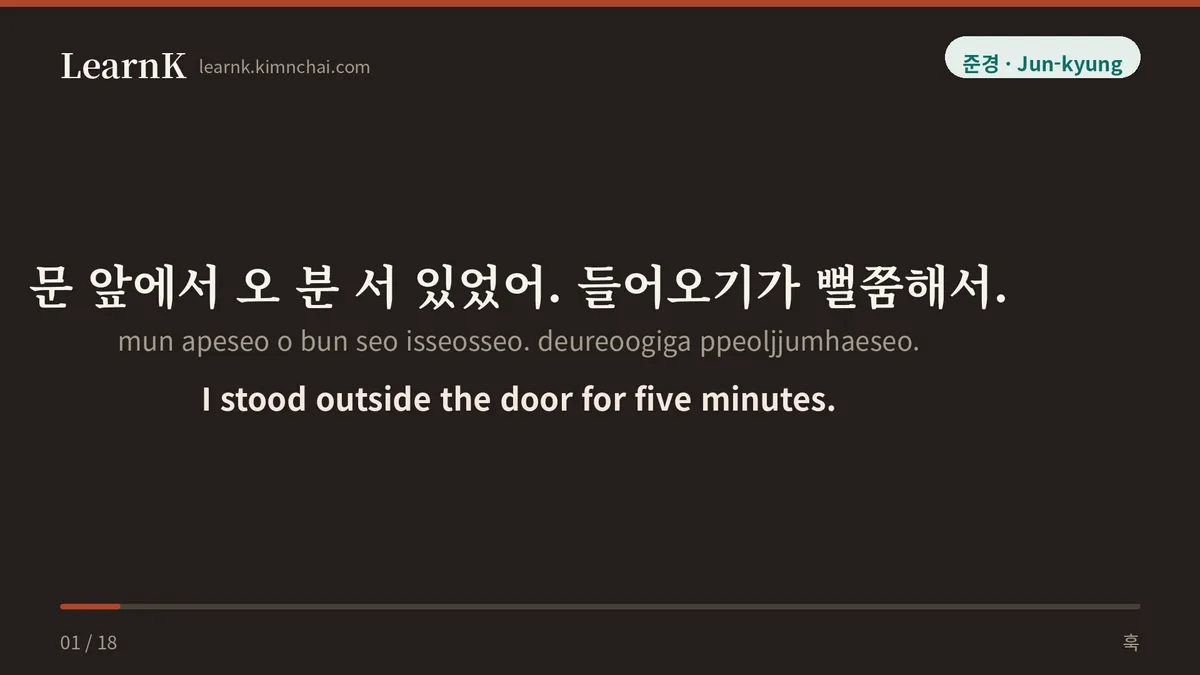
준경: 아니 나 아까 문 앞에서 오 분 서 있었어. 들어오기가 뻘쭘해서. Honestly, I stood outside the door for five minutes. It felt too awkward to walk in.
에밀리: 오 분 서 있는 게 더 뻘쭘한 거 아니야? 얼른 와, 러닝머신 비었어. Isn’t standing there for five minutes even more awkward? Get in here, the treadmill’s free.
In this conversation, Jun-kyung hasn’t done anything wrong. He paid his dues and hasn’t harmed anyone. And yet he stood outside the door for five minutes. That’s exactly what 뻘쭘함 is — nobody is scolding you, but you can’t make yourself walk in.
This is where it sounds off
✗ (after arriving late to an executive-level interview) 죄송합니다, 지금 좀 뻘쭘합니다. (joesonghamnida, jigeum jom ppeoljjumhamnida.) ✓ (same situation) 늦어서 죄송합니다. 면목이 없습니다. (neujeoseo joesonghamnida. myeonmogi eopseumnida.) → The dictionary marks this word as slang. Used where a genuine apology is required, it gives the impression that you’re trying to brush things off lightly. In formal settings, 민망하다 (minmanghada) or 면목이 없다 (myeonmogi eopda) is the safer choice.
✗ (to a friend in real trouble after a serious mistake) 너 지금 완전 뻘쭘하겠다. (neo jigeum wanjeon ppeoljjumhagetda.) ✓ (same situation) 어떡해, 괜찮아? 많이 놀랐겠다. (eotteokhae, gwaenchana? mani nollatgetda.) → 뻘쭘하다 is fundamentally a light word for describing your own state. Laid on someone who is genuinely in trouble, it lands as teasing rather than comfort. When you’re putting a name to someone else’s feelings, you need to pick a word one notch heavier.
Example sentences by situation
Situation 1 — Wrong chat room You sent a message meant for your friends’ group chat to your work team channel. You deleted it within a minute, but three “unread” marks had already disappeared.
아까 그거 오타 아니고 방을 잘못 든 거예요… 하루 종일 뻘쭘하네요. (akka geugeo ota anigo bangeul jalmot deun geoyeyo… haru jongil ppeoljjumhaneyo.) That wasn’t a typo, I just sent it to the wrong chat… I’ve felt awkward about it all day.
Situation 2 — They were waving, but not at me Someone across the street waves at you enthusiastically. You wave back, big. They run right past you to the friend standing behind you.
손 다 흔들고 나서 알았어. 그 자리에서 그냥 머리 긁었잖아, 뻘쭘해서. (son da heundeulgo naseo arasseo. geu jarieseo geunyang meori geulgeotjanha, ppeoljjumhaeseo.) I only realized after I’d already waved back. I just stood there scratching my head, it was so awkward.
Situation 3 — The meeting was yesterday You prepared your materials all night, opened the meeting room door, and the lights were off. You check the calendar again: the meeting was yesterday.
빈 회의실에 혼자 서 있는 게 제일 뻘쭘했어요. (bin hoeuisire honja seo inneun ge jeil ppeoljjumhaesseoyo.) Standing alone in that empty meeting room was the most awkward part.
All three situations have something in common: the feeling that someone is watching you. If you trip in an empty room, that isn’t awkward, that’s just painful. 뻘쭘함 requires an audience — a real one, or the one in your head.
Polite and casual forms, and similar expressions
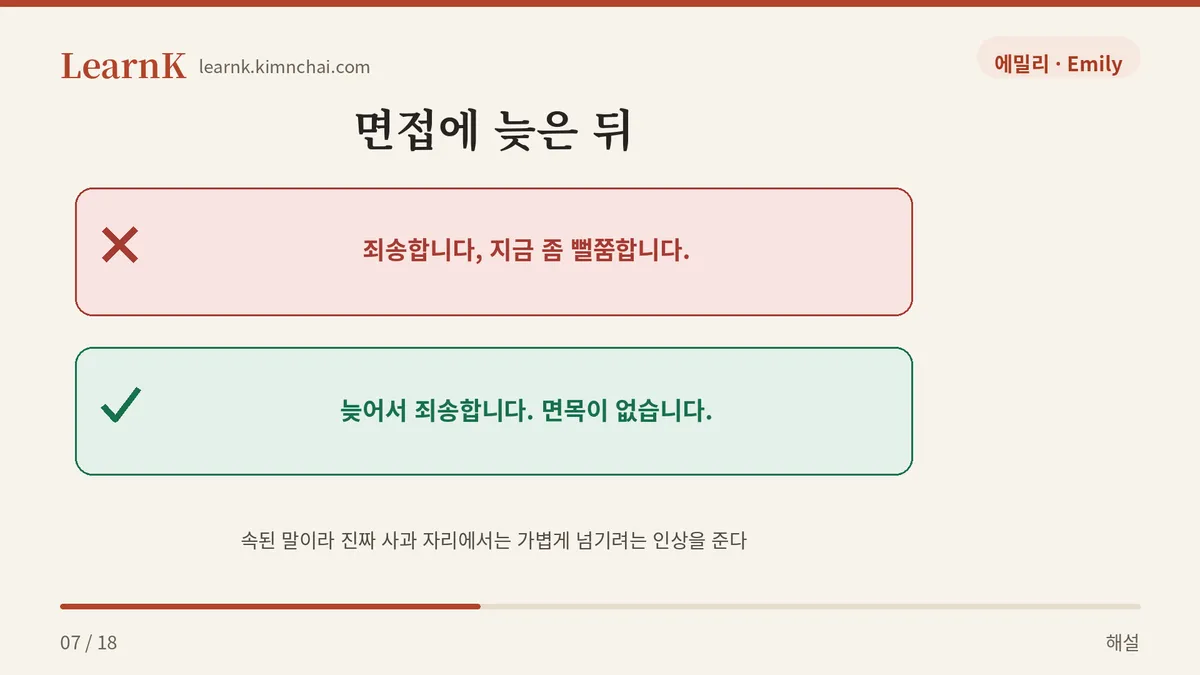
The casual form is 뻘쭘해 (ppeoljjumhae), and the polite form is 뻘쭘해요 (ppeoljjumhaeyo). So far, so natural. The problem is 뻘쭘합니다 (ppeoljjumhamnida) — a formal ending stuck onto a slang word, which usually comes out sounding like a joke. Best not to use it in meetings or written reports.
You also need to be careful about describing the state of someone senior to you. “부장님 뻘쭘하시겠어요” is grammatically correct but sounds rude. Politely not noticing a senior person’s awkwardness is the default setting in Korean.
| Expression | Temperature / intensity | Where to use it |
|---|---|---|
| 뻘쭘하다 (ppeoljjumhada) | Light and brief. Usually said with a smile | Friends and peers. Not for formal settings or seniors |
| 머쓱하다 (meossukhada) | Almost the same strength as 뻘쭘하다, a bit more refined | Anywhere. Fine even in front of seniors |
| 민망하다 (minmanghada) | One notch heavier, mixed with a sense of being sorry | Usable in formal settings. Can be attached to an apology |
| 창피하다 (changpihada) | Strong. The feeling of losing face in front of others | When there really was a mistake or a fault |
| 쑥스럽다 (ssukseureopda) | Soft and warm. For being praised | Compliments, confessions, being in the spotlight |
| 어색하다 (eosaekhada) | Neutral. Points at the atmosphere rather than an emotion | Broad — relationships, situations, clothes, even sentences |
The pair that trips people up most is 뻘쭘하다 and 쑥스럽다. Your face going red because someone praised you is 쑥스럽다. Expecting praise and having nobody notice, so your hands have nowhere to go — that’s 뻘쭘하다. The first one is warm; the second one is cool.
Cultural background — an emotion with an audience
Korean has an unusually dense vocabulary for handling other people’s gaze. If 눈치 (nunchi) is the ability to read that gaze, 뻘쭘함 is the residue left behind when you fail to read it. It’s the feeling you get when you misread the mood and stuck out alone, or when you read it correctly but your body was a beat too slow.
The dictionary example “혼자서 밥 먹기가 뻘쭘하다” captures a particular era of Korean society exactly as it was. In the past, eating alone at a restaurant was itself an attention-drawing act. Now, with single-person households having grown enormously, the word 혼밥 (honbap) — eating alone — has emerged, and restaurants with solo seating are common. The map of emotions has changed. And yet this example still holds, because even outside of eating alone, the moment of “I’m the only one who doesn’t fit here” keeps happening.
The places where Korean dramas use this word are always similar, too. An ex-partner turning up at the same gathering. Being the only one with no news to share among old classmates you haven’t seen in years. Going to a housewarming where everyone knows each other except you — the camera drops the dialogue and shows only the character’s hands. Hands with nowhere to go, fidgeting with a cup: that’s the visual translation of 뻘쭘함. It’s also why this emotion doesn’t need a long line of dialogue.
One more note: various theories circulate about where the form ‘뻘쭘’ came from, but reliable evidence is hard to find. We won’t cover uncertain etymologies here. Instead, hold on to the one fact the dictionary does confirm — the meaning is mild, but the register is low.
Today’s quiz
Which of the following is the most natural situation for using 뻘쭘하다?
① You lost your wallet and dug through your entire bag ② You gathered your materials and went to the meeting room — but the meeting was yesterday ③ You heard that a friend was in a serious accident ④ You came first in the exam and your name was called out
Answer: ②
① is a flustered or difficult situation, not an awkward position. ③ carries far too much weight for 뻘쭘하다 — here you’d use something like 마음이 안 좋다 (maeumi an jota). ④ is standing in front of people with your face going red, so 쑥스럽다 (ssukseureopda) is the right fit. Only ② is a case where you’ve done nothing wrong and the situation has simply slipped out of alignment.
Turned into a sentence, it looks like this.
빈 회의실 불 켜고 혼자 서 있는데 진짜 뻘쭘하더라. (bin hoeuisil bul kyeogo honja seo inneunde jinjja ppeoljjumhadeora.) I turned on the lights in the empty meeting room and just stood there — it was so awkward.
If there was a one- or two-second moment today when you felt awkward all by yourself, try dropping it into this sentence frame: -는데 진짜 뻘쭘하더라 (-neunde jinjja ppeoljjumhadeora). This emotion never needed a long explanation in the first place.
Definitions and example sentences are from the National Institute of Korean Language’s Basic Korean Dictionary (krdict.korean.go.kr); that portion of this post, including our translations, is licensed under CC BY-SA 2.0 KR.