품절남 (pumjeollam) — That Person Is 'Sold Out' Now
품절남 (pumjeollam)
품절남 (pumjeollam) refers to a man who has gotten married or found someone to date, and so is no longer available as a romantic prospect. It’s a joking coinage that takes 품절 (pumjeol, sold out) — the tag a shop slaps on goods once they’ve all been bought — and sticks it straight onto a person. At the gathering where a friend hands out wedding invitations, on the morning the news breaks that your favorite actor is getting married, at a reunion where old classmates trade updates — this word jumps out the moment someone’s relationship status comes up.
The temperature of this word is light. It’s half congratulation, half regret, and neither half is serious. You say “what a shame,” but you aren’t actually sorry — pretending to be sorry is the rule of the game here. That’s why 품절남 (pumjeollam) is generally used about a third party who isn’t in the room, among close friends, with a smile. Unlike 유부남 (yubunam), which states the fact of marriage flatly, this word carries a whole story inside it: “he was on the market once, he was popular, and now somebody has taken him.” For a woman, you use 품절녀 (pumjeollyeo).
There’s one thing to watch out for: this word compares a person to a product. Among friends the exaggeration turns into a laugh, but the moment the setting gets even slightly official, or the other person is your senior, it immediately sounds rude. This is a word where you need to learn the setting before the meaning.
See It in a Real Conversation
Situation: The reception at their friend Taehyun’s wedding. Jun-kyung and Emily have grabbed a corner table with their buffet plates.
Jun-kyung: 야, 저기 봐. 태현이 오늘부로 완전 품절남 됐네. Hey, look over there. As of today Taehyun is officially off the market.
Emily: 그러게. 대학 때 걔 좋아하는 후배들 줄 섰었잖아. Right? Back in college there was a whole line of juniors who liked him.
Jun-kyung: 아 참, 너 다음 달에 내 청첩장도 받아야 돼. Oh right, you’re getting my wedding invitation next month too.
Emily: 뭐?! 야, 너까지 품절남이야? 나 진짜 아무것도 못 들었는데? What?! You’re getting taken too? I haven’t heard a single thing!
Jun-kyung: 미안, 이제 말하는 거야. 놀라라고 아껴뒀지. Sorry, I’m telling you now. I saved it to surprise you.
Emily: 아껴두긴 뭘 아껴둬. 우리 모임 이제 품절남만 남았네, 진짜. Saved it, my foot. Our whole group is nothing but married guys now.
This Is Where It Sounds Off
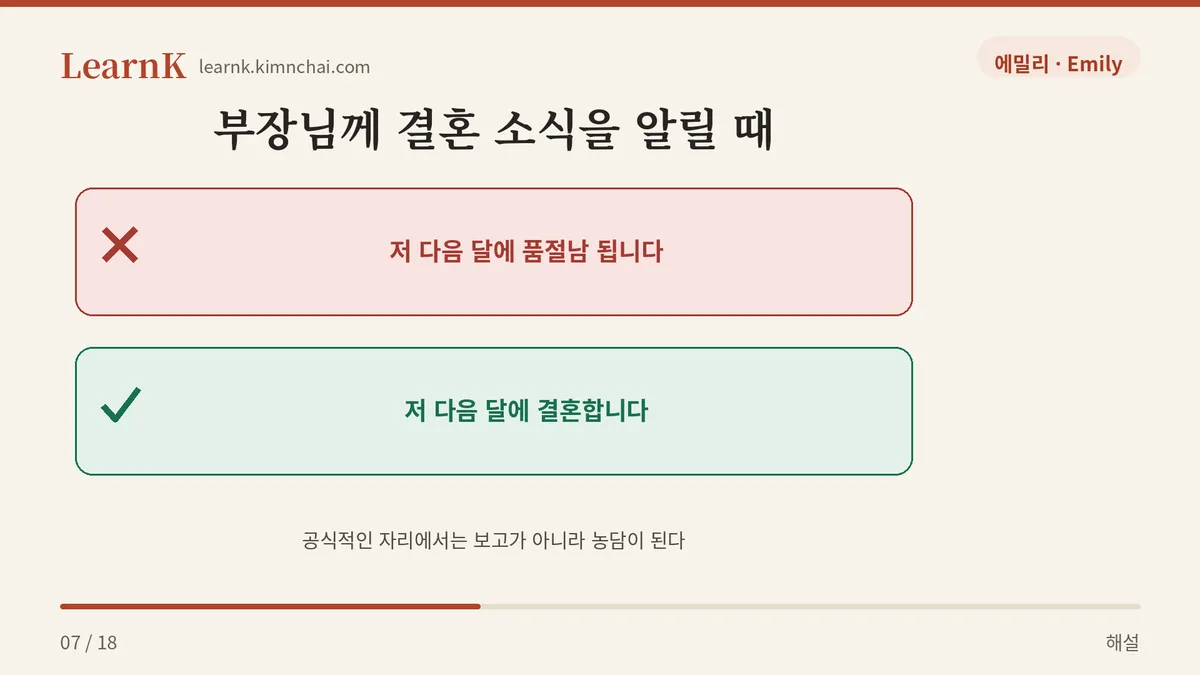
✗ (To your department head) 부장님, 저 다음 달에 품절남 됩니다. (bujangnim, jeo daeum dare pumjeollam doemnida. — “Sir, I’m going off the market next month.”) ✓ (To your department head) 부장님, 저 다음 달에 결혼합니다. (bujangnim, jeo daeum dare gyeolhonhamnida. — “Sir, I’m getting married next month.”) → This is a setting where you’re announcing your marriage officially. Reach for a playful bit of slang and it stops being a report and turns into a joke — and it makes you sound like you’re treating your own wedding lightly. Switching to polite endings doesn’t fix it: the temperature baked into the word itself isn’t covered up by -습니다 (-seumnida).
✗ (To someone you’ve just met through a matchmaker) 혹시 품절남이세요? (hoksi pumjeollamiseyo? — “Are you, by any chance, off the market?”) ✓ (To a friend, about a third party) 그 사람 벌써 품절남이래. (geu saram beolsseo pumjeollamirae. — “Apparently he’s already off the market.”) → This word is meant for someone who isn’t in the room. Throw it at the person directly and you’re bluntly prying into their marital status — and on top of that, you’re sorting them into “sold” or “not sold,” which is plainly rude.
Example Sentences by Situation
1. Trading updates at a class reunion
지훈이 소식 들었어? 작년에 결혼해서 이제 완전 품절남이야. (jihuni sosik deureosseo? jangnyeone gyeolhonhaeseo ije wanjeon pumjeollamiya.) Did you hear about Jihoon? He got married last year, so he’s totally off the market now.
This is friends who haven’t met in ages passing along each other’s marriage and dating news. Adding 완전 (wanjeon, totally) bumps the playfulness up a notch. The tone of voice makes it clear this isn’t teasing — it’s a way of saying how glad you are.
2. The morning you see the news that your favorite actor got married
우리 오빠 품절남 됐대. 나 오늘 아무것도 못 하겠어. (uri oppa pumjeollam dwaetdae. na oneul amugeotdo mot hagesseo.) My favorite actor is off the market. I can’t get anything done today.
Entertainment news is exactly where this word gets its heaviest workout. Nobody is genuinely heartbroken — it’s a game of acting heartbroken, and among fans it reads the same as a note of congratulations. -됐대 (-dwaetdae) is a contraction of 됐다고 한다 (dwaetdago handa), used when you’re relaying news you heard from somewhere else.
3. Turning down a request to set someone up on a blind date
그 선배는 안 돼. 벌써 품절남이야, 작년에 결혼했어. (geu seonbaeneun an dwae. beolsseo pumjeollamiya, jangnyeone gyeolhonhaesseo.) Not that senior — he’s already taken, he got married last year.
This is a handy way to deliver the “why not” without sounding stiff. Saying 그분은 기혼자입니다 (geubuneun gihonjaimnida) is businesslike; using 품절남 (pumjeollam) instead turns it into a tone that shares the disappointment with you.
Polite vs. Casual Speech, and Similar Expressions
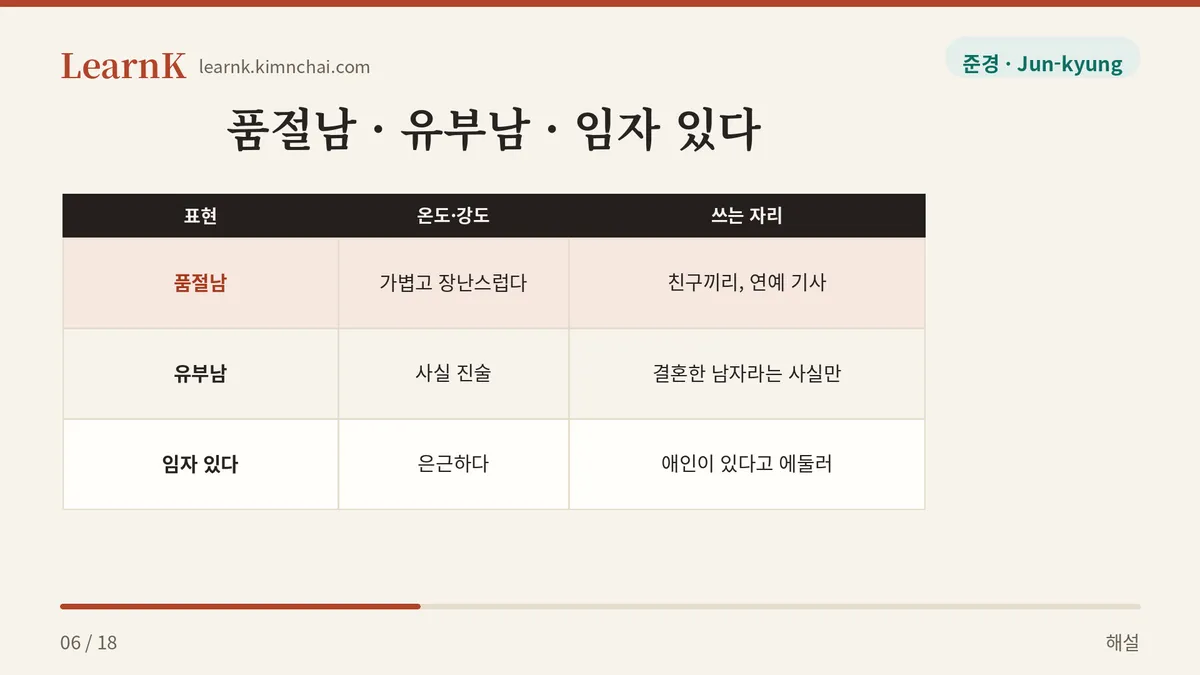
품절남 (pumjeollam) is a noun, so just changing the ending makes it formally polite — 품절남이야 (pumjeollamiya) / 품절남이에요 (pumjeollamieyo). But even when the form turns polite, the playfulness attached to the word stays put. So in serious settings — a report at work, a formal greeting, the wording on a wedding invitation — it still doesn’t fit, no matter how polite an ending you attach. It’s a great illustration of the fact that politeness comes from word choice, not from verb endings.
| Expression | Tone & intensity | Where it’s used |
|---|---|---|
| 품절남 (pumjeollam) | Light and playful. Half congratulation, half regret | Among friends and colleagues, in entertainment news. Not used in formal settings |
| 유부남 (yubunam) | A statement of fact. Slightly negative depending on context | When you just mean “a married man.” Be careful using it in front of the person himself |
| 임자 있다 (imja itda) | Colloquial and indirect | When you want to hint that someone is spoken for |
| 결혼했어요 (gyeolhonhaesseoyo) | Neutral and polite | Anywhere. Safe with seniors or people you’ve just met |
Even when they convey the same fact, these four expressions paint completely different pictures. 유부남 (yubunam) points at a status, 임자 있다 (imja itda) talks around the situation, and 결혼했어요 (gyeolhonhaesseoyo) leaves nothing but the fact. Only 품절남 (pumjeollam) brings along the past — the part where he was popular.
Cultural Background — The Picture Inside the Word 품절 (pumjeol)
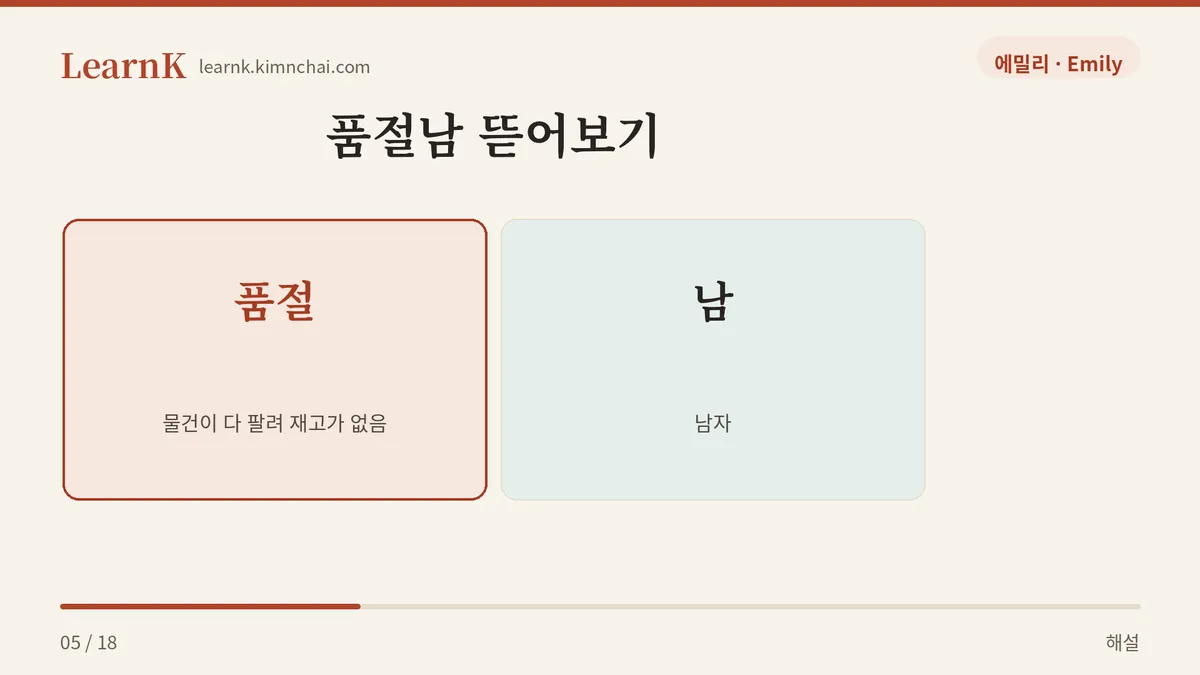
품절 (pumjeol) originally means that an item has sold out and there’s no stock left; attach 남 (nam, 男), meaning “man,” and you get 품절남 (pumjeollam). The word-building is so transparent that even if you don’t know the meaning, pulling the two pieces apart draws the picture instantly — the “SOLD OUT” sticker on the display shelf has been moved onto a person’s name tag. Its counterpart 품절녀 (pumjeollyeo) was built exactly the same way.
Behind the ease with which a word like this circulates lies a long-standing habit of Korean pop culture. A celebrity’s marriage or dating news is always big news, and fans needed a word that could express congratulations and a sense of loss at the same time. 축하합니다 (chukahamnida, congratulations) alone leaves no room for the pang of regret; saying only 아쉽다 (aswipda, what a shame) would be impolite. 품절남 (pumjeollam) sits precisely in between — a detour that goes through a show of disappointment and arrives, in the end, at congratulations.
In dramas, too, this line usually comes out of the mouths of the protagonist’s friends. It’s the deliberately light remark a friend tosses out beside a character who has just learned that the person they’ve quietly loved for years is marrying someone else. It never appears in a serious confession scene — only over coffee or over a glass of soju. Watch where the word gets placed and you’ll absorb its usage whole: this is a joke you pull out to hold sadness down, not a word for talking about the sadness itself.
Today’s Quiz
Which of the following is the most natural place to use 품절남 (pumjeollam)?
- Telling your department head your marriage news in a meeting
- Asking someone you’ve just met through a matchmaker whether they’re married
- Passing along the news that a friend got married to another friend
- Writing the greeting that goes on a wedding invitation
Answer: 3
품절남 (pumjeollam) is a word used about a third party who isn’t present, among close friends, with a smile. Options 1 and 4 are settings where you’re announcing your own marriage officially, so 결혼합니다 (gyeolhonhamnida) is the right choice; option 2 is a question aimed straight at the person concerned, so it comes off as rude. If you only memorize the definition, all four look about the same — but the only place this word is truly alive is number 3.
Definitions and example sentences are from the National Institute of Korean Language’s Basic Korean Dictionary (krdict.korean.go.kr); that portion of this post, including our translations, is licensed under CC BY-SA 2.0 KR.