레게노 (regeno) — How One Misread Word Became an Exclamation
레게노 (regeno)
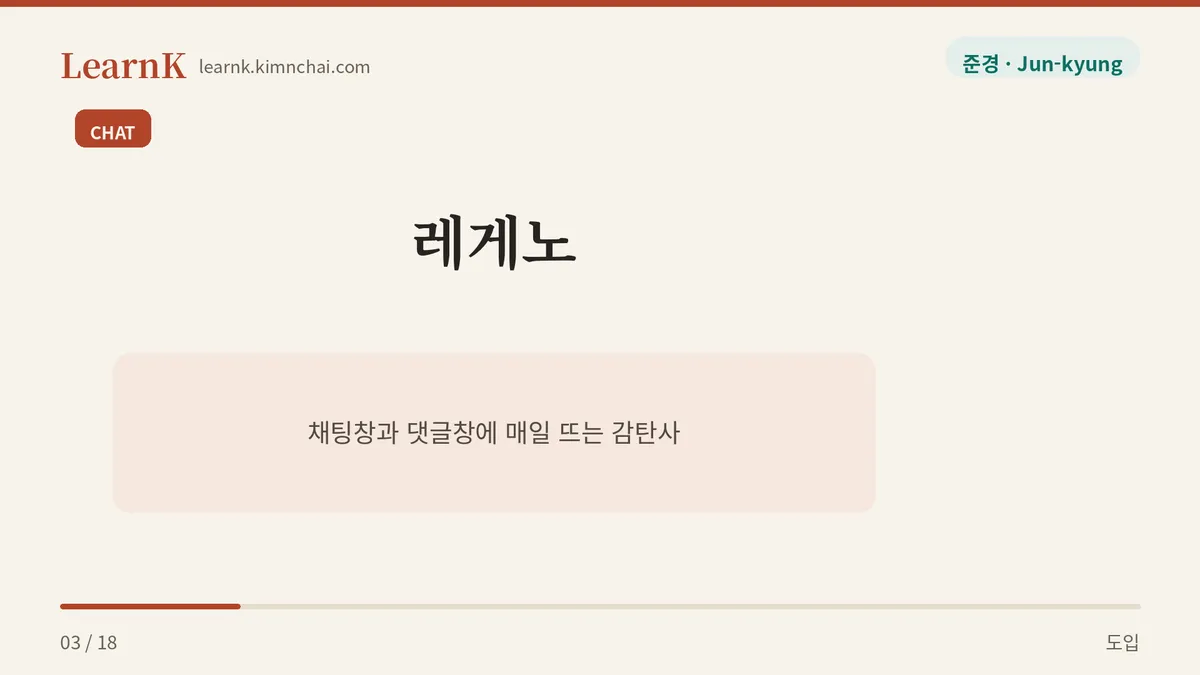
레게노 (regeno) is a deliberate misreading of 레전드 (rejeondeu) — the Korean rendering of “legend.” It’s the exclamation you let out when what’s in front of you is so remarkable that people will still be talking about it years from now. The moment a goalkeeper runs all the way upfield and scores in stoppage time. The moment you spot a friend’s hairstyle in a ten-year-old yearbook. The moment a 1,000-won lottery ticket from the convenience store actually wins. In Korean chat windows and comment sections, all three moments get the same three syllables: 레게노.
The temperature of this word is a little louder than “that’s amazing,” and much lighter than “I respect that.” Think of it as half awe, half laughter. Which is why it gets used for genuinely great things — but also for things that are so bad they’re absurd. It inherited that quality straight from the original word. In Korean, “저 사람 레전드야 (jeo saram rejeondeu-ya)” can mean “that person is the best,” or it can mean “that person was so awful people will talk about it forever.” 레게노 swings both ways too. Tone and context decide which one you mean.
Its part of speech is a bit fuzzy. It wasn’t born in a grammar book — it was born as a game — so the shapes it appears in are fixed by habit. The most common one is tossing it at the end of a sentence: 이거 레게노다 (igeo regeno-da), 완전 레게노네 (wanjeon regeno-ne), 레게노 인정 (regeno injeong). Sometimes it stands alone as a single word: 레게노. What you won’t see are forms like “레게노하다 (regeno-hada)” or “레게노스럽다 (regeno-seureopda).” This word doesn’t describe something — it stamps a seal on a situation.
A Real Conversation
Scene: a neighborhood fried chicken place. The national team’s match has gone into stoppage time at 0–0.
Jun-kyung: 아, 이대로 끝나겠네. 나 먼저 계산하고 나갈게. Ah, it’s going to end like this. I’ll pay and head out first.
Emily: 야 야 야, 앉아. 코너킥이야. Hey hey hey, sit down. It’s a corner kick.
Jun-kyung: 어? 어어어— 들어갔어?! 야, 레게노… Huh? Wha—wha— did it go in?! Man, that’s legendary…
Emily: 골키퍼가 올라와서 넣었어! 이건 레게노 맞지! The goalkeeper came all the way up and scored! This one’s a legend for sure!
Jun-kyung: 나 30초만 빨리 일어났으면 이걸 놓쳤어. If I’d gotten up thirty seconds earlier, I would’ve missed this.
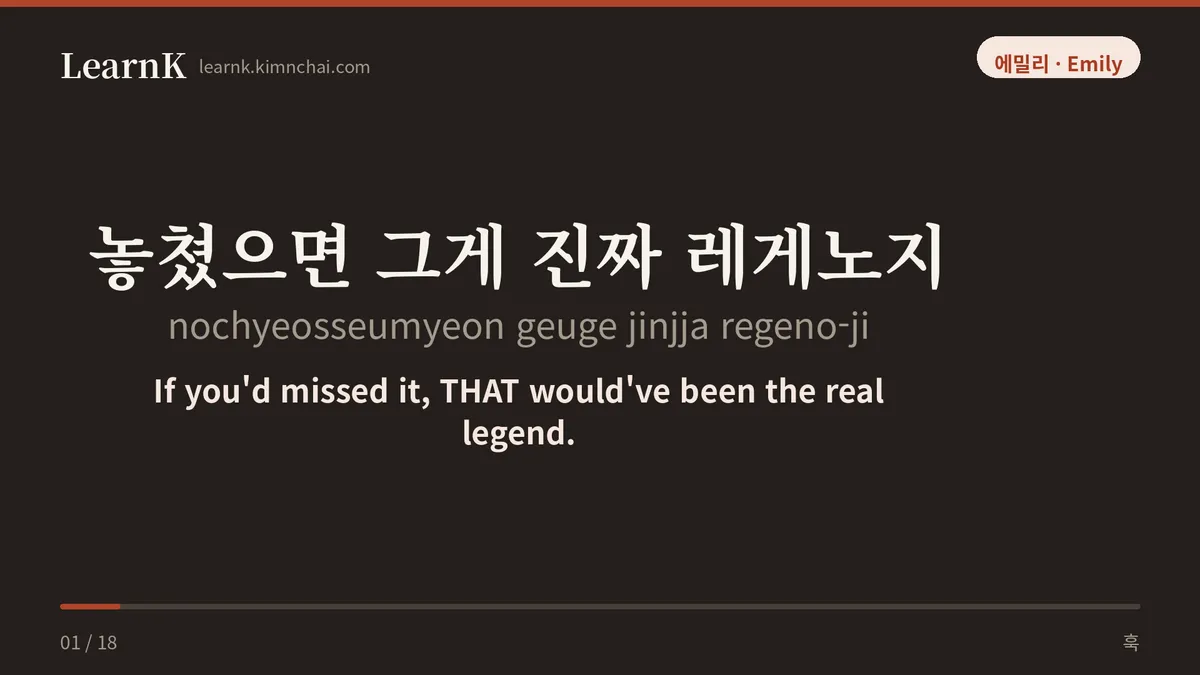
Emily: 놓쳤으면 그게 진짜 레게노지. 평생 놀림받을 뻔했네. If you’d missed it, THAT would’ve been the real legend. You almost got teased for life.
Look closely at that last line. Within a single conversation, 레게노 points in two different directions. Jun-kyung’s is awe — “that was incredible.” Emily’s is teasing — “that would’ve been hilarious forever.” Same word, opposite targets. That flexibility is exactly why this expression has stuck around.
When It Sounds Off
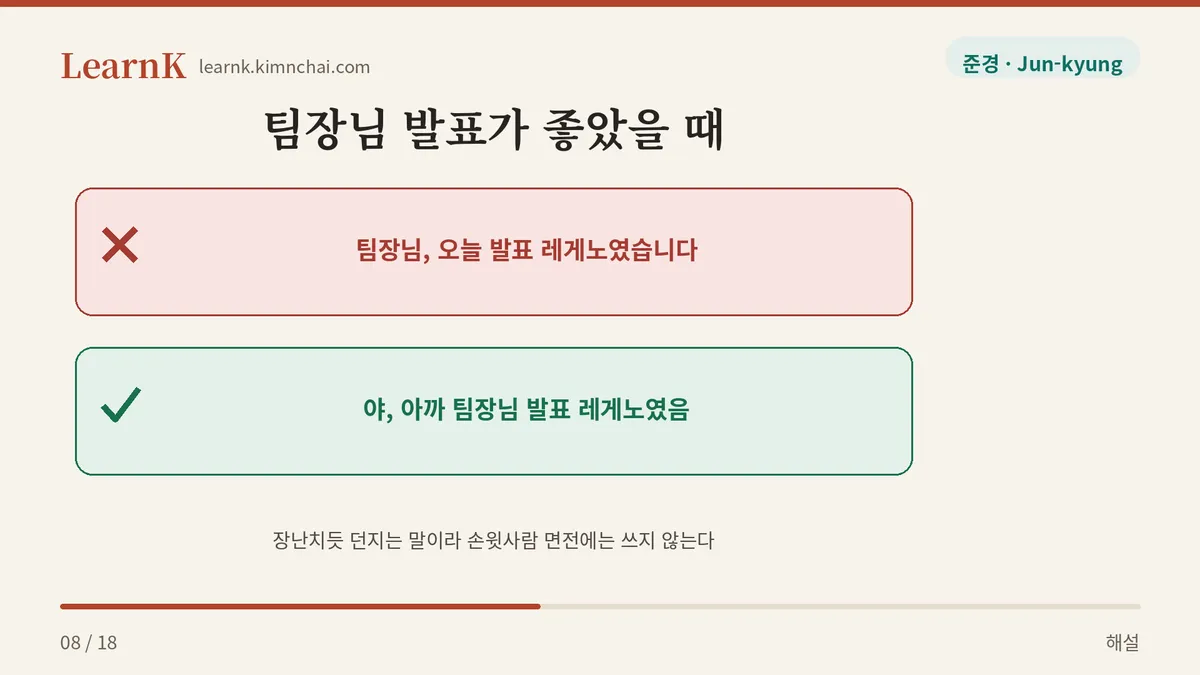
✗ (In the meeting room afterward, to your team lead) 팀장님, 오늘 발표 레게노였습니다. Boss, your presentation today was legendary. ✓ (Texting a coworker your own age) 야, 아까 팀장님 발표 레게노였음ㅋㅋ Dude, the boss’s presentation earlier was legendary lol → Yes, it’s a compliment — but it’s a compliment thrown out playfully, so saying it to someone senior’s face sounds less like praise and more like teasing. To their face, 정말 인상 깊었습니다 (jeongmal insang gipeotseumnida) — “it was really impressive” — is the safe choice.
✗ (When a friend sends a photo of the cast on their arm after falling down the stairs) 헐, 계단에서 굴렀다고? 레게노. Whoa, you fell down the stairs? Legendary. ✓ 헐, 많이 다쳤어? 병원은 갔고? Whoa, are you hurt badly? Did you go to the hospital? → 레게노 only attaches to things the person involved can laugh about too. Stick it on someone’s real injury or real loss, and you’ve turned them into a spectacle.
Example Sentences by Situation
1. Flipping through a yearbook you haven’t opened in years
야, 이 사진 진짜 레게노다. 너 이때 왜 이러고 다녔어? (ya, i sajin jinjja regeno-da. neo ittae wae igeorogo danyeosseo?) Hey, this photo is seriously legendary. Why were you going around looking like that back then?
This is teasing territory. Here 레게노 doesn’t mean “the best” — it’s closer to “funny enough to go down in history.” You say it knowing the other person will laugh along, which is why it doesn’t land as rude.
2. To a friend showing off a bargain from a secondhand marketplace
그걸 만 원에 샀다고? 레게노 인정. (geugeol man wone satdago? regeno injeong.) You got that for 10,000 won? Legendary, I’ll give you that.
인정 (injeong) is a short bit of agreement meaning “true, I acknowledge it.” So 레게노 인정 (regeno injeong) means “I have no choice but to admit that’s legendary” — it’s a way of hyping the other person up. It’s an especially common pairing in chat.
3. Laughing off your own mistake
폰으로 폰 찾고 있었어. 나 오늘 레게노다. (pon-euro pon chatgo isseosseo. na oneul regeno-da.) I was using my phone to look for my phone. I’m a legend today.
레게노 isn’t only for other people. Aimed at yourself, it becomes self-deprecating: “I really outdid myself today.” Pointing it at yourself first also makes it easier for the other person to laugh, so it doubles as a technique for shrugging off a mistake.
Formality Levels and Similar Expressions
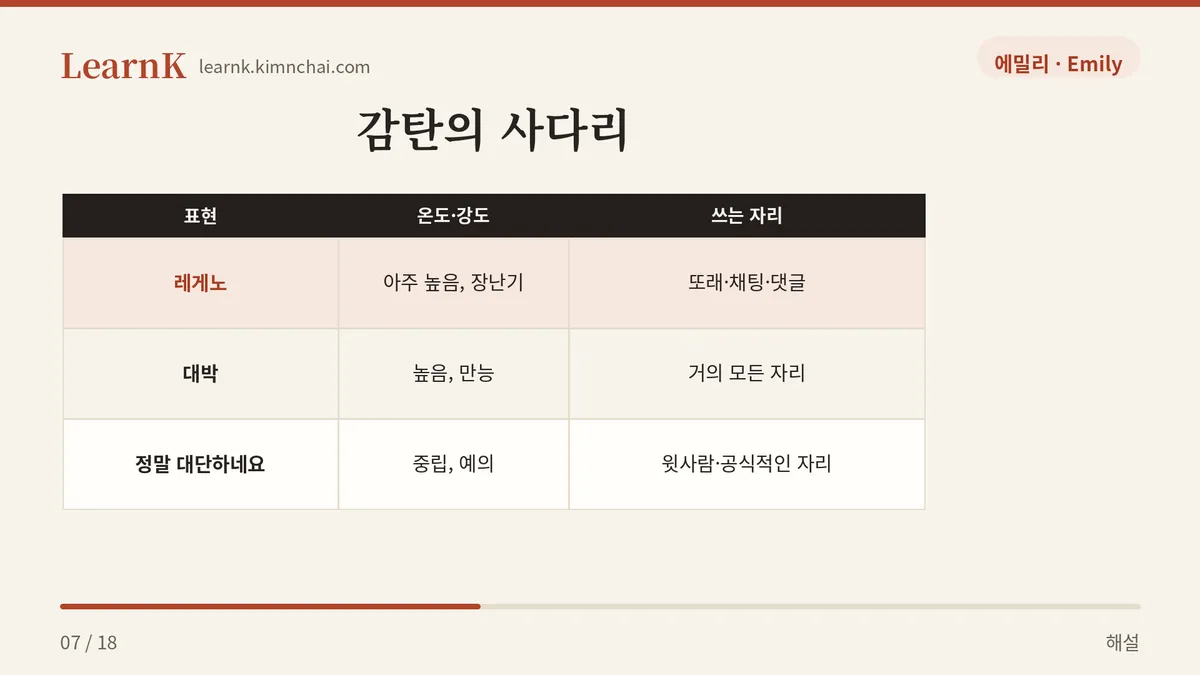
레게노 has essentially no polite form. You can say “레게노입니다 (regeno-imnida),” but that doesn’t read as courteous — it reads as a joke, formal grammar bolted on for comic effect. If the setting calls for politeness, the right move is to swap the word out entirely.
| Expression | Temperature / Intensity | Where it’s used |
|---|---|---|
| 레게노 (regeno) | Very high, playful | Peers, chat, comments. Not to a senior’s face |
| 레전드 (rejeondeu) | High, a bit more respectable | Among peers, and even in article headlines |
| 대박 (daebak) | High, all-purpose | Almost anywhere. Even “대박이네요 (daebak-ineyo)” to a senior is fine |
| 역대급 (yeokdaegeup) | High, descriptive in tone | News, reviews, even presentation slides |
| 정말 대단하네요 (jeongmal daedanhaneyo) | Neutral, polite | Seniors, formal settings |
Read the table top to bottom and you have a ladder of formality. It’s the same feeling of amazement either way — every step up in your listener’s seniority, just step one rung down the word list. 레게노 for friends, 대박 for people you don’t know well, 정말 대단하네요 in front of your boss.
Cultural Background — One Misread Word
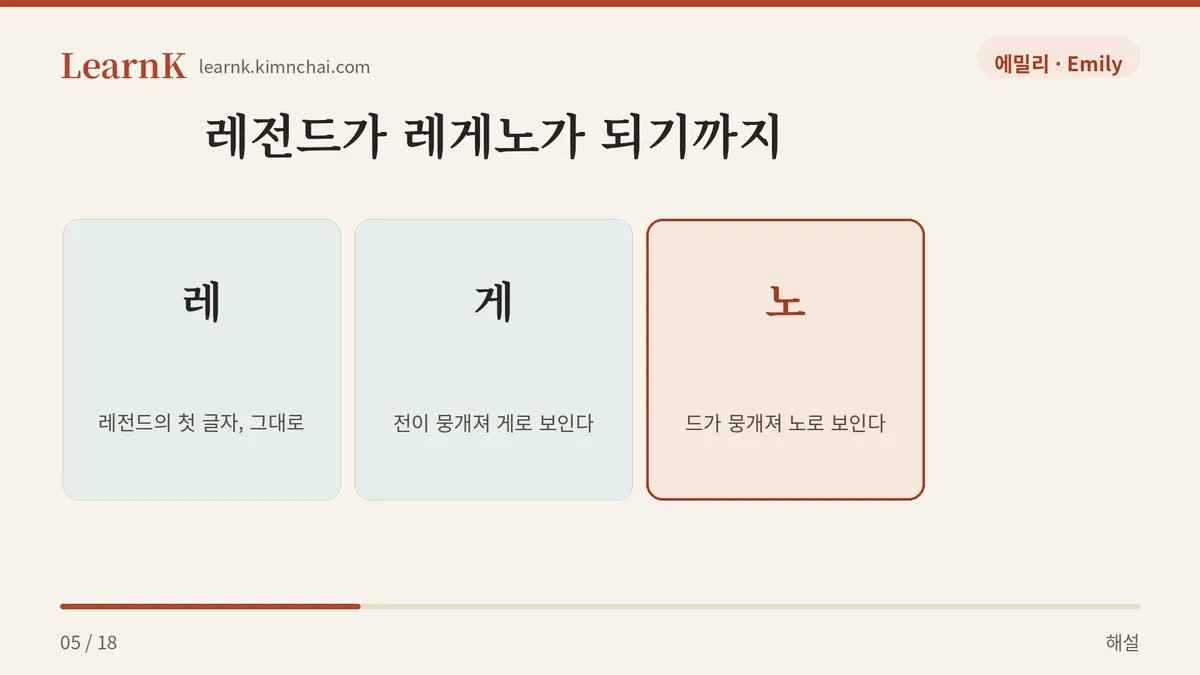
This word didn’t start as a typo or as slang. It started as a misreading (오독, odok). In certain fonts, the syllables ‘전’ and ‘드’ smudge together and end up looking like ‘게’ and ‘노.’ A moment where text that actually said “레전드” got read as “레게노” became a talking point in Korea’s livestreaming communities, and people found the misreading funny enough to start copying it on purpose. By around 2020 it had spread everywhere.
There’s a whole lineage of this kind of play on the Korean internet. Wordplay that swaps syllables for other syllables that look similar is called 야민정음 (yaminjeongeum): writing ‘멍멍이 (meongmeongi)’ as 댕댕이 (daengdaengi), ‘명작 (myeongjak)’ as 띵작 (ttingjak), ‘귀엽다 (gwiyeopda)’ as 커엽다 (keoyeopda). The meaning stays put; only the shape of the letters gets twisted, and the twist is the joke. 레게노 is among the biggest success stories in that lineage.
Here’s the interesting part, though. It began as a joke for the eyes — but people started reading it out loud, and it turned into genuine spoken language. Now it shows up in variety-show subtitles, and someone watching a soccer match will shout it from the couch. A word born in the eyes that moved to the mouth.
For Korean learners, words like this run ahead of the dictionary. Sometimes the trend passes before the entry ever gets written. It’s still worth knowing, though — miss the meaning and you miss the entire punchline of a conversation. But the order of operations with new slang is always the same: understand it first, use it later. If you only use it after the other person has used it, you’ll almost never go wrong.
Today’s Quiz
In which situation would 레게노 be the most out of place?
- In a group chat, reacting to a ten-year-old photo a friend just sent
- At a company workshop, right after your department head’s talent-show performance — said directly to them
- Watching a baseball game, the instant a walk-off home run lands, said to the friend next to you
The answer is 2. 레게노 is a playful exclamation traded between peers, so used to a senior’s face it can sound like mockery rather than praise. In that same moment, 정말 대단하셨습니다 (jeongmal daedanhasyeotseumnida) — “that was truly amazing” — is the safe thing to say to your department head, while 레게노 fits perfectly if you text the exact same reaction to a coworker. The word stays the same, but change who’s receiving it and the meaning flips. That’s the real lesson in learning this one.
Definitions and example sentences are from the National Institute of Korean Language’s Basic Korean Dictionary (krdict.korean.go.kr); that portion of this post, including our translations, is licensed under CC BY-SA 2.0 KR.