4차원 (sachawon) — The Tone Behind Saying "쟤 좀 4차원이야"
4차원
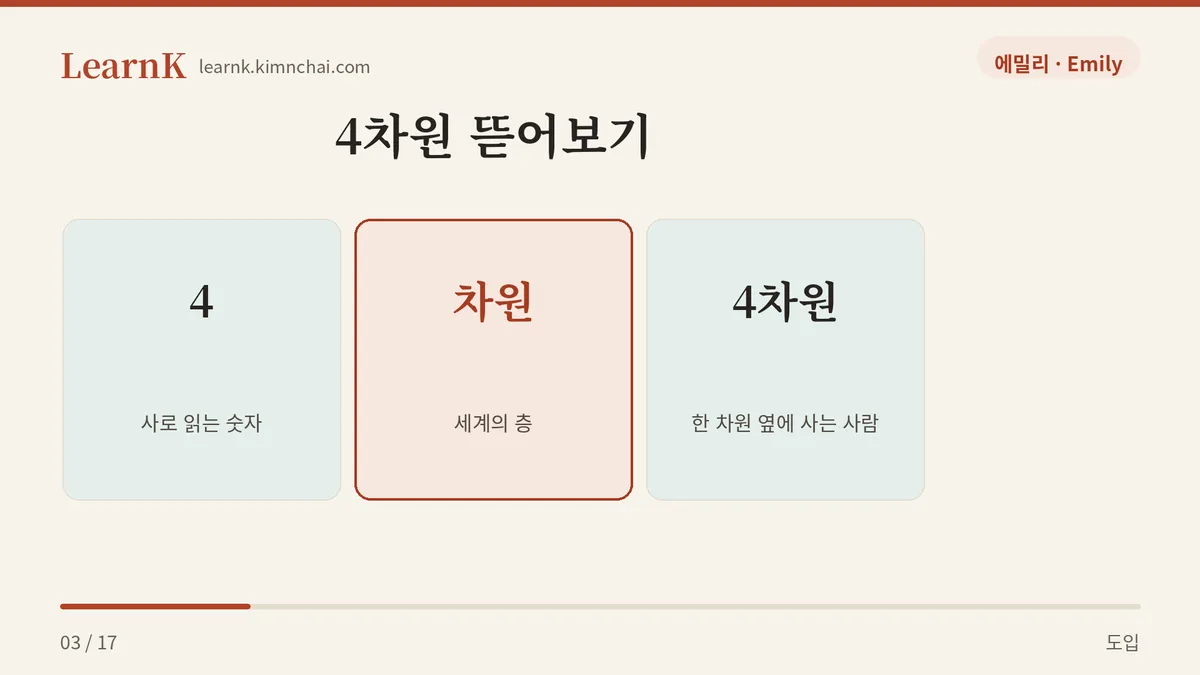
4차원 (sachawon) describes someone whose thoughts or actions are so different from everyone else’s that you can never guess which way they’ll bounce next. Since the number 4 is read as 사 (sa) in Sino-Korean, the word is actually pronounced 사차원 (sachawon). The coworker who tosses out an idea in a meeting that nobody else would have dreamed of, the friend who stops mid-meal to start talking about constellations, the person who answers your question one beat late with something completely unrelated — Koreans smile and say this about people like that: 쟤 좀 4차원이야. (jyae jom sachawon-iya.) “That one’s a bit 4차원.”
The heart of this word isn’t its meaning so much as its temperature. 4차원 doesn’t mean “weird” — it’s much closer to “tuned to a different frequency than mine.” That’s why it almost never carries malice; more often it comes out mixed with admiration, as if to say how cute, or how fun. It’s also why the phrase 4차원 매력 (sachawon maeryeok), “4차원 charm,” sounds perfectly natural in Korean. The fact that the word 매력 (maeryeok, “charm”) can be attached at all tells you this expression stands, fundamentally, on the side of affection.
That said, it isn’t completely safe. If someone hears it in a moment when they’d rather be seen as perfectly ordinary, it can land as “you’re outside our circle.” So 4차원 rolls best when it’s exchanged between close friends, with a smile, in 반말 (banmal, casual speech). Grammatically it works as a noun: you attach a predicate ending, as in 4차원이다 (sachawon-ida) or 4차원이야 (sachawon-iya), or you stack words around it, as in 완전 4차원 (wanjeon sachawon), “totally 4차원,” and 4차원 매력.
In a Real Conversation
Setting: Saturday afternoon, in front of an apartment complex’s main gate — the meetup spot for a secondhand sale. The seller is ten minutes late and still hasn’t appeared.
Jun-kyung: 에밀리, 그 사람 뭐래? 왜 안 와? Emily, what did they say? Why aren’t they here?
Emily: 방금 톡 왔어. 고양이가 무릎에 올라와서 못 일어나고 있대. I just got a message. They said the cat climbed onto their lap so they can’t get up.
Jun-kyung: 뭐? 하하, 완전 4차원이네. What? Haha, they’re totally on another wavelength.
Emily: 난 좋은데? 그런 사람이 재밌잖아. I kind of like it. People like that are fun.
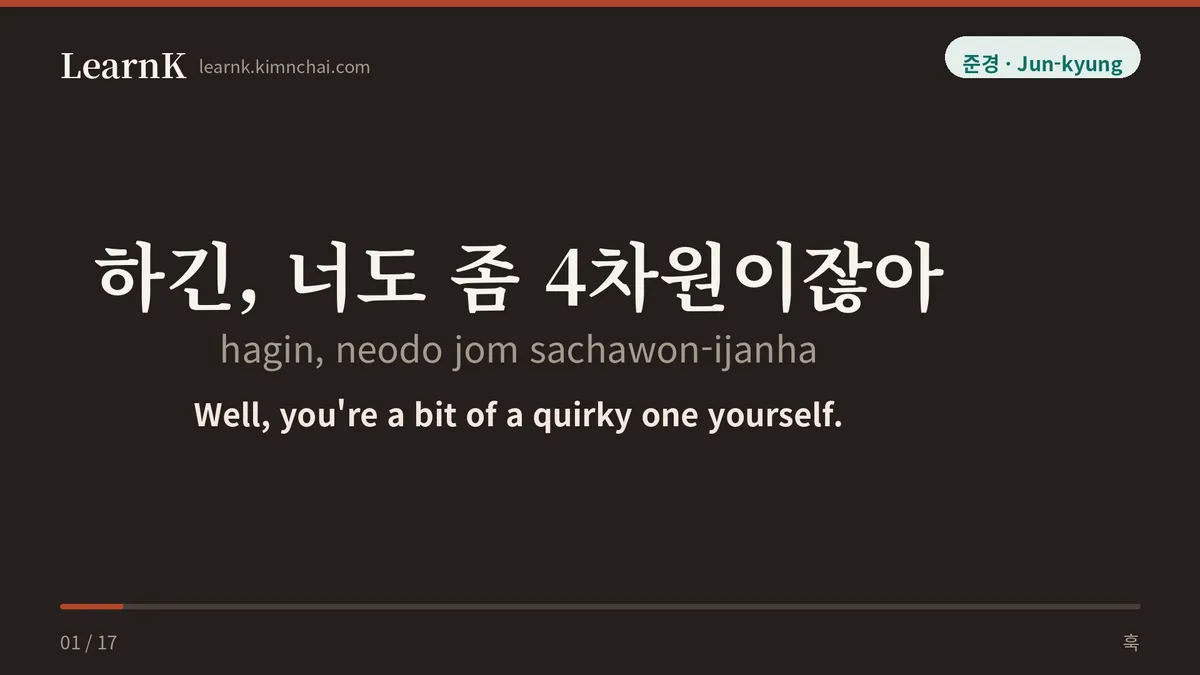
Jun-kyung: 하긴, 너도 좀 4차원이잖아. Well, you’re a bit of a quirky one yourself.
Emily: 야! 나는 그냥 솔직한 거거든? Hey! I’m just being honest, okay?
When It Sounds Off
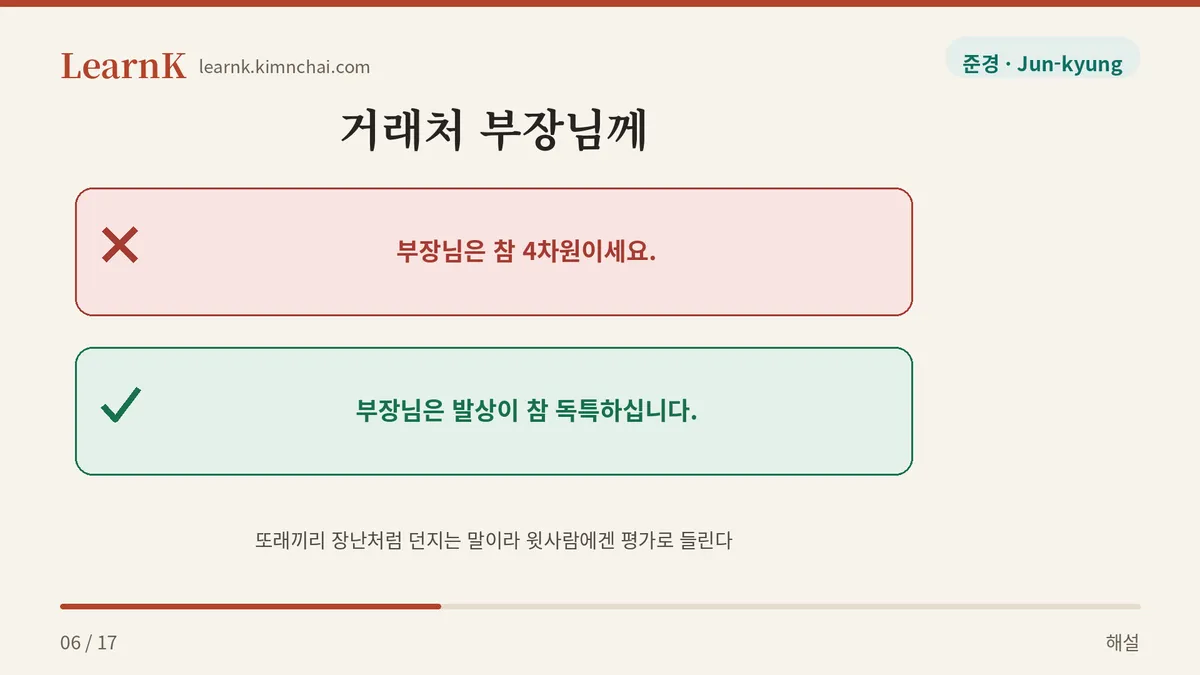
✗ (to a department head at a client company) 부장님은 참 4차원이세요. ✓ (to a department head at a client company) 부장님은 발상이 참 독특하십니다. → 4차원 is something you toss around playfully among peers, so even dressed in polite endings it sounds like you’re passing judgment on someone senior to you. With people above you, 독특하다 (dokteukhada), “to be distinctive,” or 발상이 남다르다 (balsang-i namdareuda), “to think in an unusual way,” is the safer choice.
✗ (watching someone cut in line) 저 사람 줄도 안 서네. 완전 4차원이야. ✓ (watching someone cut in line) 저 사람 줄도 안 서네. 완전 진상이야. → 4차원 is harmless quirkiness, not rudeness. Use it for behavior that actually hurts other people and you end up sounding like you find that behavior cute.
Example Sentences by Situation
1. Introducing one friend to another
우리 형은 좀 4차원인데, 알고 보면 진짜 착해. uri hyeong-eun jom sachawon-inde, algo bomyeon jinjja chakhae. My older brother’s a bit 4차원, but once you get to know him he’s genuinely kind.
This is how you shield someone in advance when their first impression is unusual enough to be misread. The -ㄴ데 (-nde) in 4차원인데 signals that a turn is coming, so the sentence isn’t a criticism — it’s an introduction and a defense at the same time.
2. Watching a drama or variety show together
저 캐릭터 4차원 매력이 진짜 있다. jeo kaerikteo sachawon maeryeog-i jinjja itda. That character really has that 4차원 charm.
Use this for a character who’s loved for their offbeat lines and unpredictable behavior. Here it’s 100 percent a compliment. The moment 매력 (maeryeok) is attached, any negative edge disappears.
3. Talking about yourself
나 4차원이라는 말 좀 들어. 근데 나쁜 뜻은 아니래. na sachawon-iraneun mal jom deureo. geunde nappeun tteus-eun anirae. People call me 4차원 sometimes. But apparently they don’t mean it in a bad way.
In Korea it’s common to describe yourself as 4차원 when you introduce yourself or meet a group for the first time. Saying it up front means people will take your quirks as personality rather than mistakes.
Polite vs. Casual Speech, and Similar Expressions
The polite form 4차원이세요 (sachawon-iseyo) is grammatically possible but almost never used in practice — as the misuse example above shows, it turns into a verdict on the listener. The casual forms 4차원이야 (sachawon-iya) and 4차원이지 (sachawon-iji) are where this expression really lives.
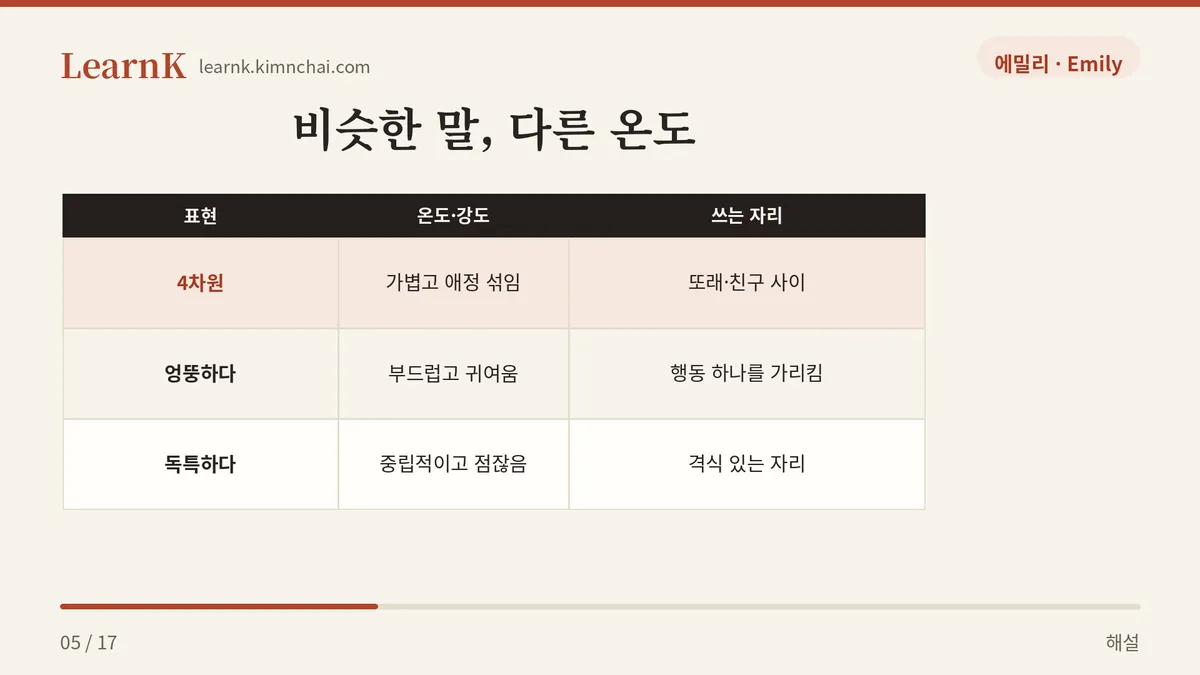
| Expression | Temperature / intensity | Where it’s used |
|---|---|---|
| 4차원 (sachawon) | Light, laced with affection. Emphasis on unpredictability | Among peers, friends, and fans. Not for people senior to you |
| 엉뚱하다 (eongttunghada) | Soft and endearing. Points to a single action | Anywhere. Even used about children |
| 독특하다 (dokteukhada) | Neutral and well-mannered | Formal settings; fine with people senior to you |
| 특이하다 (teugihada) | Neutral but slightly distancing | For people and objects alike. Not a compliment |
The difference in one line: 엉뚱하다 points at a single act, while 4차원 points at the whole person. If your friend said something strange in a meeting once, that’s 엉뚱하다. If it happens every week, that’s 4차원.
Cultural Background — Someone Living Outside the Third Dimension
The word 4차원 itself comes from physics and science fiction. We call the world we live in the third dimension, so the fourth dimension is somewhere just outside it. The moment the word gets attached to a person, the picture snaps into focus — that person is sitting in the same room as us, but they’re actually living one dimension over. Korean has plenty of coinages where the metaphor draws itself as an image, and 4차원 is one of the most successful of the bunch.
The stage that spread this expression far and wide was variety shows and idol culture. When a group is introduced on TV, there’s a convention of assigning each member a role, and “the 4차원 one” frequently makes the list. The sense that every team needs at least one unpredictable person to keep things interesting is what pushed this word firmly onto the positive side. The same character type shows up steadily in Korean dramas: the supporting role who’s off in their own head at the exact moment everyone else has turned serious, and who then, at the decisive moment, points out the one thing nobody else noticed. Viewers don’t dislike those characters, because their oddness never hurts anyone.
So for Korean learners, 4차원 offers more information than a single word usually does. People often hear that Korean society places great weight on the grain of the group — but it’s much less widely known that, inside that society, the word for “someone whose grain runs differently” is this affectionate. 4차원 isn’t a word that pushes people away. It’s closer to a word that acknowledges the difference and still pulls up a chair.
Today’s Quiz
Which of the following is the most awkward place to use 4차원?
① When your friend suddenly starts talking about constellations at three in the morning ② When you’re sizing up your department head’s speaking style at a company dinner ③ When you’ve just watched an offbeat interview with your favorite idol member
Answer: ②
① and ③ are exactly where 4차원 belongs. It’s a word tossed out with a smile between people who are close, about quirkiness that harms no one. ②, on the other hand, means passing judgment on someone senior to you. There, it’s safer to switch to a more decorous expression like 부장님은 발상이 참 독특하십니다 (bujangnim-eun balsang-i cham dokteukhasimnida), “You really do think in a distinctive way, sir.” Here’s today’s lesson in a single sentence: 4차원 isn’t a hard word to understand — it’s a word that’s picky about where it’s used.
Definitions and example sentences are from the National Institute of Korean Language’s Basic Korean Dictionary (krdict.korean.go.kr); that portion of this post, including our translations, is licensed under CC BY-SA 2.0 KR.