Death Flag — Why “Once This Job Is Over” Is a Dangerous Line in K-Dramas
사망 플래그 (samang peullaegeu)
사망 플래그 (samang peullaegeu), literally “death flag,” is the expression Koreans use for a line or an action in a drama or film that tips you off in advance that a character is about to die — or that things are about to go very wrong for them. Nothing has happened on screen yet, but somehow the viewers already know how it ends. A soldier three days from discharge who suddenly starts telling long stories about his hometown. A detective who says, “이번 사건만 끝나면 그만둘 거야 (ibeon sageonman kkeutnamyeon geumandul geoya)” — “Once this case is over, I’m quitting.” Someone who pulls a family photo out of their coat and looks at it a beat too long. When a scene like that comes on, Korean drama fans immediately type “저거 사망 플래그다 (jeogeo samang peullaegeu-da)” — “that’s a death flag” — into the live chat and the comment section. He hasn’t died yet, but he might as well have.
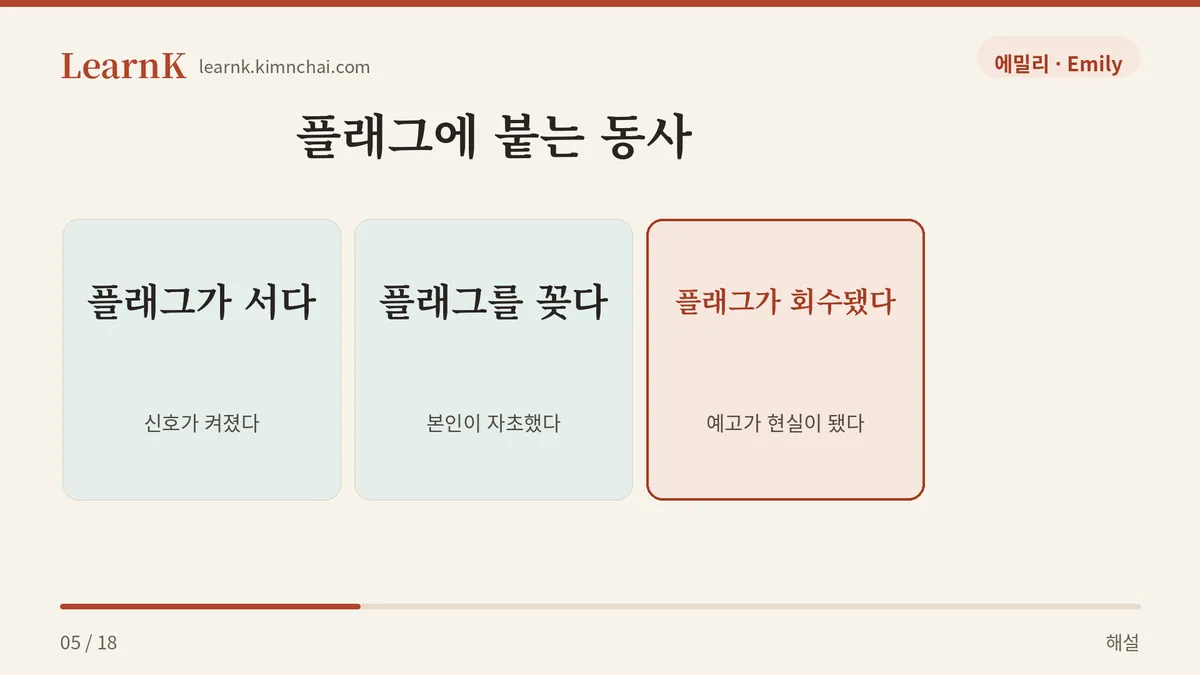
A “flag” is, originally, 깃발 (gitbal) — a banner on a pole. So in Korean the verbs that go with actual flags stuck to the expression: 사망 플래그가 서다 (samang peullaegeu-ga seoda), “a death flag goes up,” and 사망 플래그를 꽂다 (samang peullaegeu-reul kkotda), “to plant a death flag.” And when the character really does die, people say 플래그가 회수됐다 (peullaegeu-ga hoesudwaetda) — “the flag has been collected,” meaning what was foretold actually came to pass. When a character everyone had written off survives just fine, on the other hand, they say 플래그를 꺾었다 (peullaegeu-reul kkeokkeotda) — “he snapped the flag.”
Tone is everything here. This is not a phrase of sincere mourning — it is half a joke. It’s closer to a game: viewers spotting a drama’s predictable grammar and cackling about it together. It’s internet slang that grew up in online communities, so it isn’t in the dictionary yet, and its range is correspondingly narrow. Use it about a real person’s health or a real accident and it turns rude in an instant.
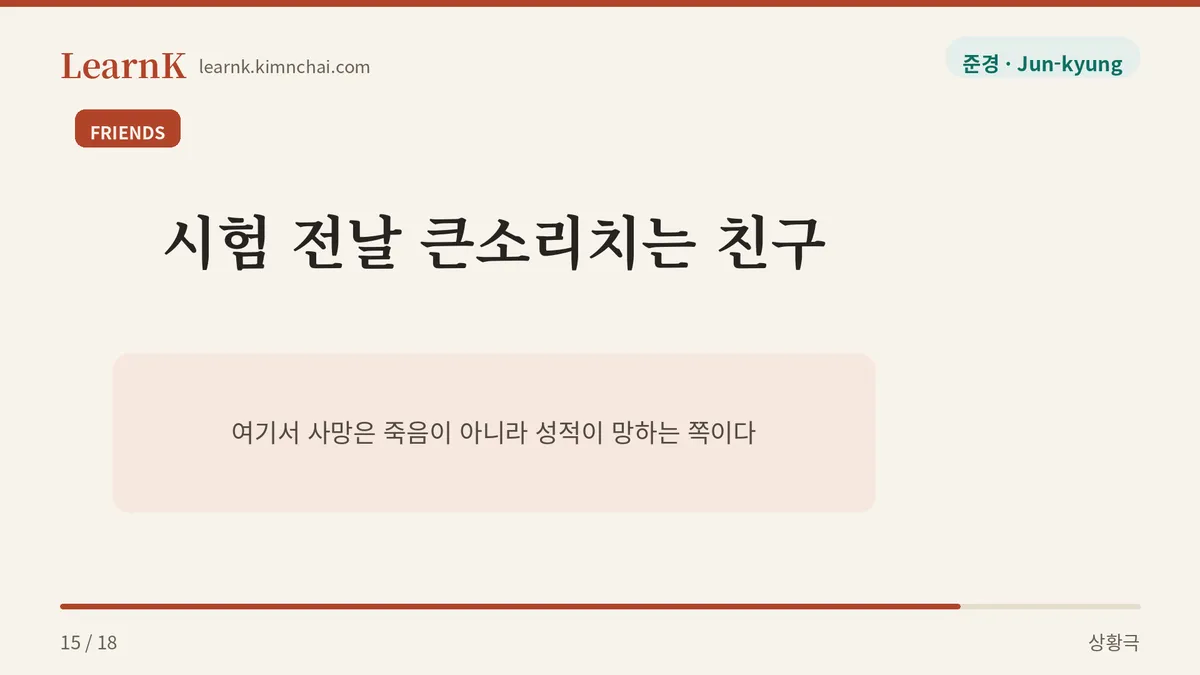
The meaning has also stretched a little beyond the screen. Here, “사망 (samang)” doesn’t have to mean death — it can just mean failing, bombing, going down in flames. If a friend brags the night before an exam, “나 이번엔 진짜 자신 있어 (na ibeonen jinjja jasin isseo)” — “I’ve genuinely got this one” — and you answer “그거 사망 플래그야 (geugeo samang peullaegeu-ya),” you’re joking that the confidence is about to collapse.
A Real Conversation
Setting: Saturday night, Emily’s living room. Two bowls of ramyeon are cooked and they’re watching episode 15 of a historical drama. Two episodes to go.
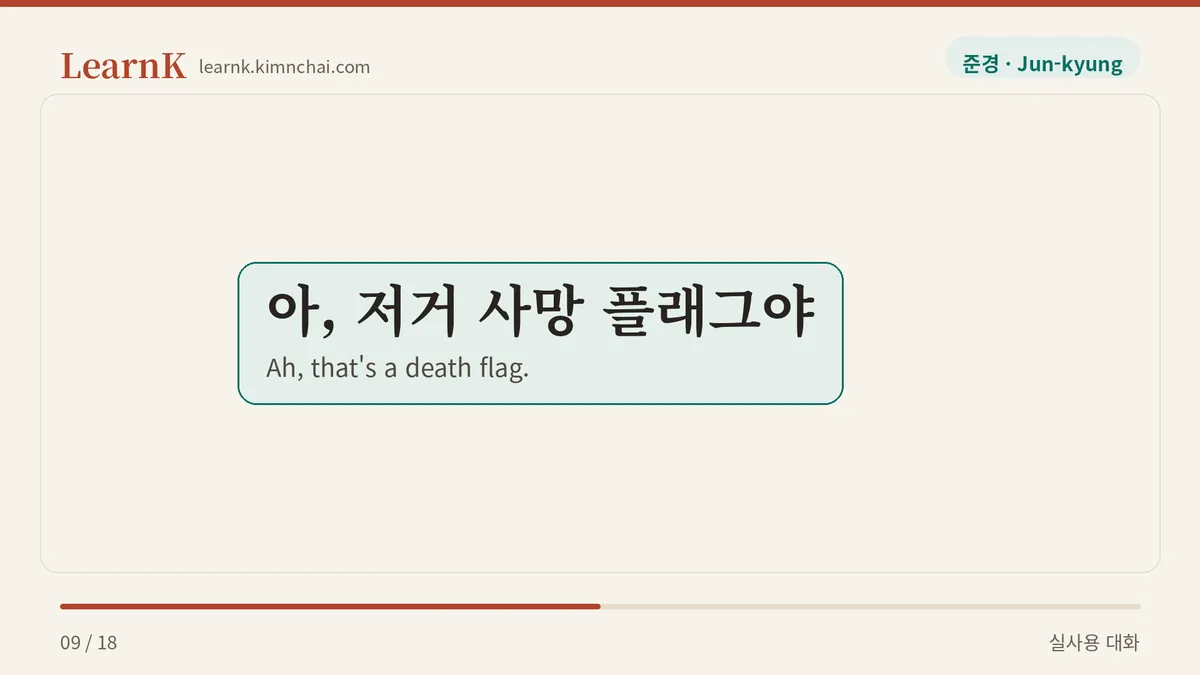
준경: 어? 저 아저씨 방금 딸 사진 꺼냈지? 아, 저거 사망 플래그야. Huh? That guy just pulled out a photo of his daughter, right? Ah, that’s a death flag.
에밀리: 에이, 설마. 두 회밖에 안 남았는데 지금 죽으면 어떡해. Come on, no way. There are only two episodes left—what happens if he dies now?
준경: 딸 사진에다가 “이번 일만 끝나면 고향 내려간다”까지 했잖아. 이건 뭐 플래그를 두 개 꽂았네. A photo of his daughter, plus “once this job’s done I’m going back home.” That’s two flags planted.
에밀리: 아 진짜, 너 그렇게 말하니까 나까지 불안해지잖아. 스포하지 마. Ugh, seriously—now you’re making me nervous too. Don’t spoil it.
준경: 스포 아니야, 나도 처음 봐. 근데 딱 봐도 사망 플래그잖아. It’s not a spoiler, I’m watching it for the first time too. But it’s obviously a death flag.
에밀리: …맞네. 아 몰라, 나 저 아저씨 좋단 말이야. …You’re right. Ugh, whatever—I actually like that guy.
When It Sounds Wrong
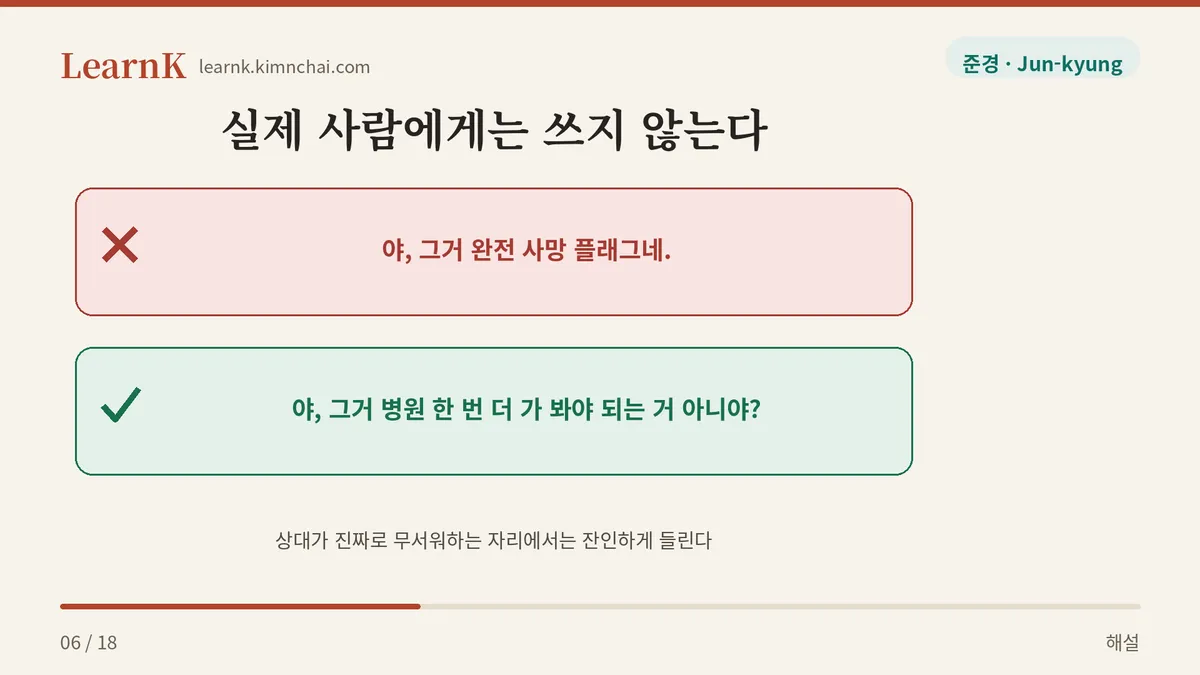
✗ (to a friend who is worried after being called back for follow-up medical tests) 야, 그거 완전 사망 플래그네. (Ya, geugeo wanjeon samang peullaegeu-ne.) Hey, that’s a total death flag. ✓ (to the same friend) 야, 그거 병원 한 번 더 가 봐야 되는 거 아니야? (Ya, geugeo byeongwon han beon deo ga bwaya doeneun geo aniya?) Hey, shouldn’t you go back to the hospital and get it looked at again? → Used about a real person’s body and a real possibility of death, it stops being a joke. This phrase belongs to characters on a screen; thrown into a moment when the other person is genuinely frightened, it just sounds cruel.
✗ (to a department head nearing retirement) 부장님, 이번 프로젝트만 끝내고 나가신다면서요? 그거 사망 플래그인데요. (Bujangnim, ibeon peurojekteu-man kkeutnaego nagasindamyeonseoyo? Geugeo samang peullaegeu-indeyo.) Sir, I hear you’re leaving right after this project? That’s a death flag. ✓ (between coworkers) 야, 부장님 저 말씀 드라마였으면 딱 사망 플래그다. (Ya, bujangnim jeo malsseum deuramayeosseumyeon ttak samang peullaegeu-da.) Dude, if the boss said that in a drama, that’d be a textbook death flag. → Because it’s slang born and raised on the internet, it lands as flippant and disrespectful with someone older than you or in a formal setting. The very same joke is only funny when it’s traded between peers, in a low voice.
Example Sentences by Situation
1. Watching a drama with someone In a zombie show, a character suddenly brings up his upcoming wedding. The screen is peaceful; only the viewers are uneasy. 아, 저 대사 완전 사망 플래그인데. (A, jeo daesa wanjeon samang peullaegeu-inde.) Ah, that line is a total death flag. The ending -인데 (-inde) at the end of the sentence trails off, as in “~인데 말이야 (~inde mariya).” It leaves the thought hanging instead of stating it flatly, which is exactly why it pairs so well with this expression.
2. Teasing a friend for talking big A friend with an exam coming up declares, “나 이번엔 벼락치기 안 해 (na ibeonen byeorakchigi an hae)” — “I’m not cramming this time.” 너 방금 사망 플래그 꽂은 거 알지? (Neo bangeum samang peullaegeu kkojeun geo alji?) You know you just planted a death flag, right? Here “사망 (samang)” isn’t death — it’s the grade going down in flames. The joke only works when nothing is actually at stake.
3. After the results are in Just as predicted, the character died in the final episode. 결국 플래그 회수됐어. 내가 그럴 줄 알았다니까. (Gyeolguk peullaegeu hoesudwaesseo. Naega geureol jul aratdanikka.) The flag got collected in the end. I told you so. 회수 (hoesu) is a Sino-Korean word meaning “gathering back in.” Originally it referred to picking back up a piece of foreshadowing that had been scattered earlier in the story. Among fans it has hardened into “the prophecy came true.”
Polite Speech, Casual Speech, and Similar Expressions
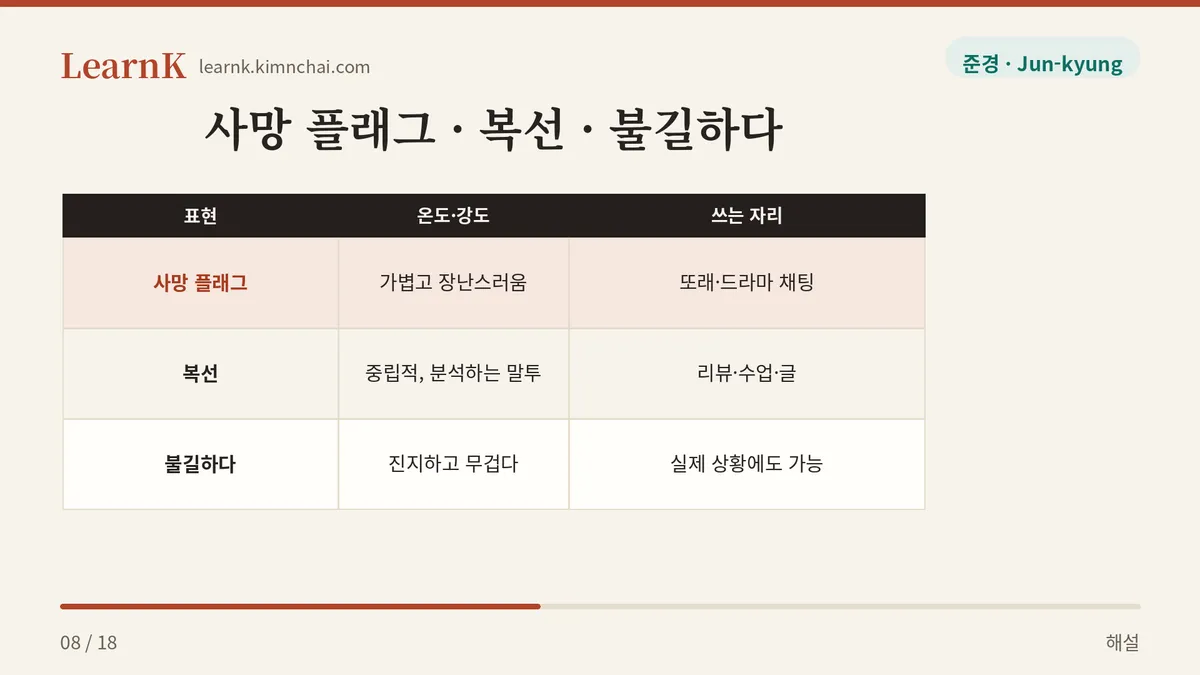
This expression has, in practice, no separate polite form. You can attach a polite ending — “저건 사망 플래그예요 (jeogeon samang peullaegeu-yeyo)” — but only as the soft politeness you use with peers or people you’re comfortable with. With someone older than you or in a formal setting, it’s safer to switch to one of the other words in the table below.
| Expression | Tone & intensity | Where it belongs |
|---|---|---|
| 사망 플래그 (samang peullaegeu) | Light and playful, half a joke | Peers, online communities, drama chatrooms. Never in the face of real death |
| 복선 (bokseon) | Neutral, analytical | Reviews, classrooms, writing. Not limited to death — any kind of foreshadowing |
| 떡밥 (tteokbap) | Light and excited | Fan communities. Any clue to be paid off later. The payoff needn’t be a death |
| 불길하다 (bulgilhada) | Serious and heavy | Anywhere. The only one of these you can use about a real situation |
About the very same scene, you say “저거 사망 플래그야 (jeogeo samang peullaegeu-ya)” to a friend, and “이 장면은 인물의 죽음을 암시하는 복선입니다 (i jangmyeoneun inmurui jugeumeul amsihaneun bokseon-imnida)” — “this scene is foreshadowing that hints at the character’s death” — in a class presentation. The meanings overlap; the settings don’t.
Cultural Background — Where Did the Flag Come From?
“Flag” comes from programming, specifically from making games. A value that switches on when some condition is met is called a flag, and when it switches on, a predetermined event fires. The word hardened into a joke about story mechanics in Japanese subculture (死亡フラグ, shibō furagu), and entered Korean as a direct translation: 사망 플래그 (samang peullaegeu). The mental picture — “the flag goes up → the event triggers” — is still sitting right there inside the expression.
These flags are unusually easy to spot in Korean dramas. The general in a historical epic who promises, “이 싸움만 이기면 자네와 술 한잔하겠네 (i ssaumman igimyeon janewa sul hanjanhagenne)” — “once we win this battle, I’ll have a drink with you.” The supporting character in a disaster film who confesses, “나 사실 다음 달에 결혼해 (na sasil daeum dare gyeolhonhae)” — “actually, I’m getting married next month.” The squad chief in a cop show who tucks his retirement papers into a desk drawer. Because it hurts most to take a character away right after the audience has grown attached to them, writers always place one warm scene just before a death. Viewers have memorized that grammar completely, and by now guessing correctly has become the game itself.
So there’s a strange kind of affection mixed into the phrase. The person saying “저 사람 사망 플래그다 (jeo saram samang peullaegeu-da)” is usually a person who likes that character. They say it because calling it in advance might make it hurt less — or because they’re hoping that just this once, they’ll be wrong. If you’re learning Korean and you drop this one line into a drama chatroom at exactly the right moment, you’ve blended completely into that room.
Today’s Quiz
In which of the following situations would 사망 플래그 (samang peullaegeu) be the most inappropriate?
① When a character in a zombie drama says, “나 사실 다음 달에 결혼해 (na sasil daeum dare gyeolhonhae)” — “Actually, I’m getting married next month.” ② When a close friend brags, “나 이번 시험은 진짜 자신 있어 (na ibeon siheomeun jinjja jasin isseo)” — “I’ve genuinely got this exam.” ③ When a friend who’s been called back for follow-up medical tests is sitting there worrying. ④ When a commentator on a soccer broadcast says, “이 팀은 오늘 절대 지지 않습니다 (i timeun oneul jeoldae jiji anseumnida)” — “This team absolutely will not lose today.”
Answer: ③
①, ②, and ④ are all places where “failure foretold” is fair game for laughs, so the expression fits nicely. ④ in particular — the situation flipping right after someone talks big — is the classic use of this phrase. But ③ is a moment when the other person is genuinely afraid. What’s needed there isn’t a joke but something like “괜찮을 거야, 같이 가 줄까? (gwaenchaneul geoya, gachi ga julkka?)” — “It’ll be fine. Want me to go with you?” The line that decides where this expression works isn’t grammar. It’s one single question: is the death real or not?