삼계탕 (samgyetang) — Why the Hottest Day of the Year Comes With the Hottest Bowl
삼계탕
삼계탕 (samgyetang) means a dish made by simmering a young chicken stuffed with ginseng, sweet rice, jujubes and the like until it’s meltingly tender. If you’ve ever seen an entire Seoul alleyway turn into one long queue on a day in July, nine times out of ten it was outside a samgyetang restaurant. At 33°C in the middle of the afternoon, with no air conditioning in sight, people wipe the sweat off their faces and wait for a bubbling-hot earthenware pot. For someone learning Korean, this scene raises a question much bigger than a single vocabulary word. Why eat the hottest thing on the hottest day?
삼계탕 is not simply “chicken soup.” For Koreans, the word is fused to a season. It carries the sense of food you eat in summer — and above all on 복날 (boknal) — to look after your body, so the moment someone brings up 삼계탕, the listener automatically thinks, “ah, is it boknal already?” and pictures the calendar. That’s why 삼계탕 먹으러 갈까? (samgyetang meogeureo galkka?) is both a lunch suggestion and something close to a greeting that means “go get your strength back today.”
In terms of nuance, the word is warm and a little grown-up. It’s the language of care. Not light like a trendy slang phrase, not formal either. A department head at a company uses it with the team; a friend uses it with a friend who’s looking rough. Either way, the meaning underneath is the same — I’m worried about your health.
Checking the National Institute of Korean Language dictionary
First, let’s look at exactly how the national institute’s dictionary defines the word.
삼계탕 「명사」 (noun) 어린 닭에 인삼, 찹쌀, 대추 등을 넣고 푹 삶은 음식. [en] samgyetang; ginseng chicken soup — A dish made by boiling down a young chicken stuffed with ginseng, sticky rice, jujubes, etc. [ja] サムゲタン — 若鶏に人参、もち米、ナツメなどを入れて煮込んだ料理。 [es] samgyetang, sopa de pollo — Comida que se prepara hirviendo el pollo con ginseng, arroz glutinoso y dátiles, entre otros ingredientes. [zh] 参鸡汤 — 童子鸡里放进人参、糯米、大枣等而煮得烂熟的食物。 — National Institute of Korean Language, Basic Korean Dictionary (krdict.korean.go.kr)
The phrase to notice in the definition is 어린 닭 — a young chicken. Not a big bird, but one small chicken used whole. That single condition explains the cultural rule we’ll get to later: you don’t share it. For reference, the dictionary carries no Portuguese translation, so we’ve supplied our own here: canja de galinha com ginseng (our own translation).
Now let’s look at the real usage examples listed in the dictionary. An example sentence packs a whole situation into one line, so it gives you a feel for the word far faster than a definition does.
한국에서는 여름철에 건강식으로 주로 삼계탕을 먹는다. In Korea, people mainly eat samgyetang in the summer as a health food. — National Institute of Korean Language, Basic Korean Dictionary (krdict.korean.go.kr)
This is the kind of explanatory sentence you’d meet in a piece introducing Korean culture, or in a classroom. It shows how 여름철 (yeoreumcheol), “the summer season,” and 건강식 (geongangsik), “health food,” travel around as a set with 삼계탕.
우리는 복날을 맞아 국물이 걸쭉한 삼계탕을 먹었다. For boknal, we had samgyetang with a thick, rich broth. — National Institute of Korean Language, Basic Korean Dictionary (krdict.korean.go.kr)
The moment 복날 (boknal) appears, this stops being just lunch and becomes an annual event. 걸쭉한 describes the state of the broth once the sweet rice has dissolved into it and turned it milky and thick — it’s the adjective you’ll hear most often used for samgyetang broth.
어머니는 인삼과 감초, 대추를 가득 넣고 삼계탕을 끓여 주셨다. Mother made samgyetang for us, packed full of ginseng, licorice root and jujubes. — National Institute of Korean Language, Basic Korean Dictionary (krdict.korean.go.kr)
This is a scene at home, not at a restaurant. 끓여 주셨다 (kkeuryeo jusyeotda) — the ‘-어 주다’ pattern meaning “do something for someone,” with the honorific ‘-시-’ attached, so who did it for whom stays written right into the sentence. This one line shows you exactly why samgyetang is a food of caring.
삼계탕이 간판 메뉴이니 꼭 드셔 보세요. Samgyetang is our signature dish, so please do try it. — National Institute of Korean Language, Basic Korean Dictionary (krdict.korean.go.kr)
This is how a restaurant recommends something to a customer. 간판 메뉴 (ganpan menyu), literally “signboard menu,” means the dish a place is proudest of — an expression you’ll hear a lot while traveling.
삼계탕은 영양가도 높고 맛도 있고 해서 인기가 많다. Samgyetang is popular because it’s both nutritious and delicious. — National Institute of Korean Language, Basic Korean Dictionary (krdict.korean.go.kr)
The frame ‘-도 ~고 -도 ~고 해서’ is a very Korean way of stacking up several reasons at once. If you ever have to explain samgyetang to someone, memorizing this whole sentence will serve you well.
Seeing it in real conversation
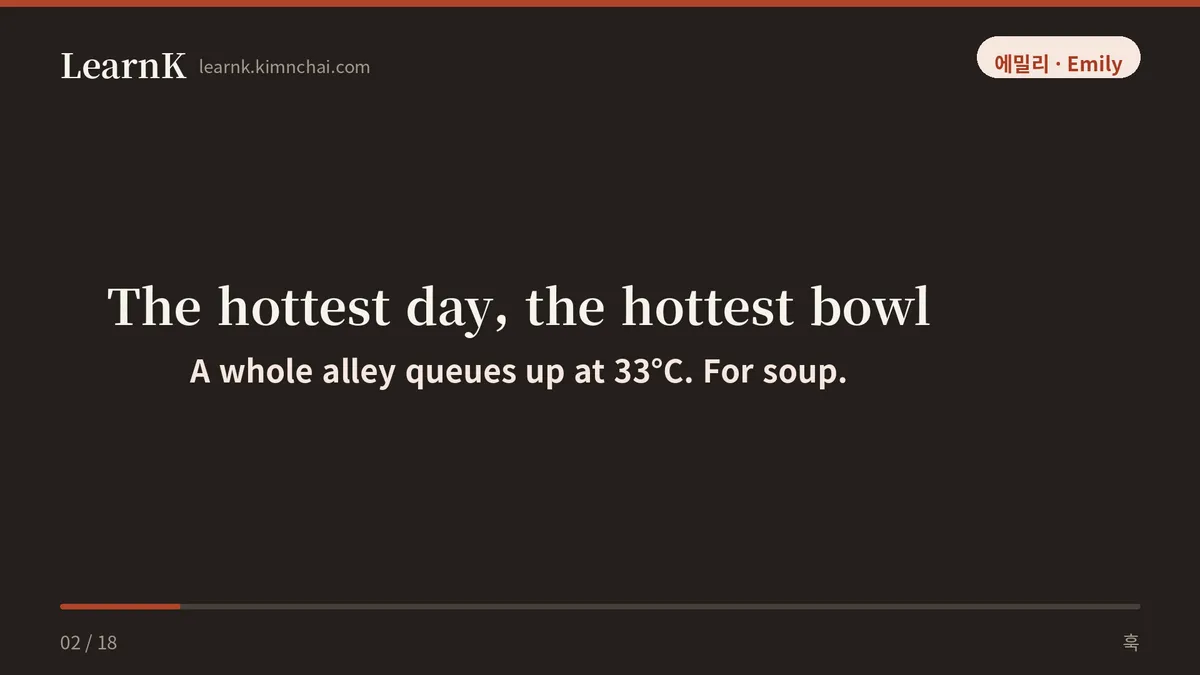
Situation: 12:10 p.m. on chobok, the first of the dog days. Outside a famous samgyetang restaurant, the line stretches all the way to the end of the alley.
Jun-kyung: 야, 줄 봐라. 이거 최소 30분인데? Hey, look at this line. This is gonna be at least 30 minutes.
Emily: 그래도 기다려야지. 오늘 초복인데 삼계탕 못 먹으면 여름 내내 억울할 것 같아. Still, we’ve gotta wait. It’s chobok today — if I don’t get samgyetang I think I’ll feel cheated all summer.
Jun-kyung: 너 진짜 한국 사람 다 됐다. 예전엔 더운데 왜 뜨거운 걸 먹냐고 했잖아. You’ve turned totally Korean. You used to ask why we eat hot food in this heat.
Emily: 그땐 몰랐지. 땀 쫙 빼고 나면 오히려 시원해지더라고. I didn’t get it back then. Turns out you feel cooler after sweating it all out.
Jun-kyung: 그치. 그리고 삼계탕은 국물부터 떠먹어야 돼. 인삼 향 확 올라올 때. Right. And with samgyetang you have to start with the broth — right when the ginseng smell hits.
Emily: 알지. 나 이제 대추도 안 남겨. I know. I don’t even leave the jujubes anymore.
Using it this way sounds off
Since 삼계탕 is the name of a thing, there’s almost no way to be rude with it. Instead, here are the two misunderstandings learners actually run into.
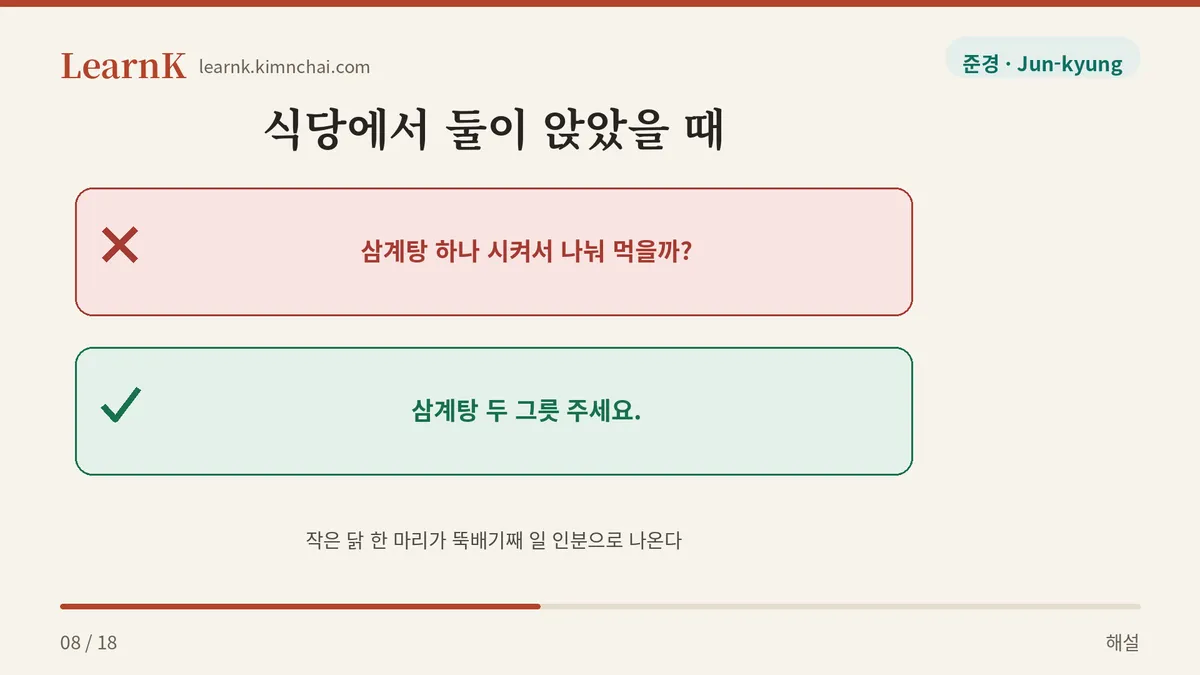
✗ (seated at a restaurant, two of you) 삼계탕 하나 시켜서 나눠 먹을까? ✓ (seated at a restaurant, two of you) 삼계탕 두 그릇 주세요. → Samgyetang comes as one small whole chicken in its own earthenware pot, as a single serving. The picture isn’t sharing from a common pot — it’s each person receiving their own bowl. “Let’s order one and split it” is language that fits 찌개 (stew) or 전골 (hot pot).
✗ (in the dead of winter) 오늘 진짜 춥다. 몸 녹이게 삼계탕 먹으러 갈까? ✓ (in midsummer) 오늘 초복이래. 몸보신하게 삼계탕 먹으러 갈까? → Nobody will scold you for eating it in winter. But in a Korean’s head, samgyetang is “the thing you queue up for on a summer boknal,” so bringing it up in January makes the other person tilt their head for a second. The soups you eat to warm up on a cold day are usually 국밥 (gukbap) or 설렁탕 (seolleongtang).
Example sentences by situation
① Making a boknal lunch plan (to a coworker)
내일 초복인데 점심에 삼계탕 어때요? (naeil choboginde jeomsime samgyetang eottaeyo?)
At Korean companies, boknal lunch is practically an annual ritual. This one line also carries the meaning “let’s all head out together today.”
② To a friend who looks run-down (casual speech)
너 요즘 얼굴이 반쪽인데, 삼계탕이라도 한 그릇 먹자. (neo yojeum eolguri banjjoginde, samgyetang-irado han geureut meokja.)
얼굴이 반쪽이다 (eolguri banjjogida), literally “your face is half of what it was,” is an idiom for looking thin and worn out. The ‘-이라도’ carries a feeling of “I can’t do anything grand for you, but at least this much” — a way to hand over your concern without making it heavy.
③ Recommending it to a foreign friend coming to Korea (polite speech)
여름에 한국 오시면 삼계탕은 꼭 한 그릇 드셔 보세요. (yeoreume hanguk osimyeon samgyetang-eun kkok han geureut deusyeo boseyo.)
Watch the counter word. In its served state, sitting in the earthenware pot, it’s 한 그릇 (han geureut), “one bowl”; when you’re counting the chicken itself, it’s 한 마리 (han mari).
Polite and casual forms, and neighboring expressions
삼계탕 is a noun, so the word itself doesn’t get elevated. Honorifics always attach to the verb instead. Casual: 삼계탕 먹었어? (samgyetang meogeosseo?). Polite: 삼계탕 드셨어요? (samgyetang deusyeosseoyo?). And when offering it to someone senior to you, 삼계탕 한 그릇 하시죠. (samgyetang han geureut hasijyo.) sounds most natural. The 하다 in that last one is an older, roundabout way adults use to say 먹다, “eat.”
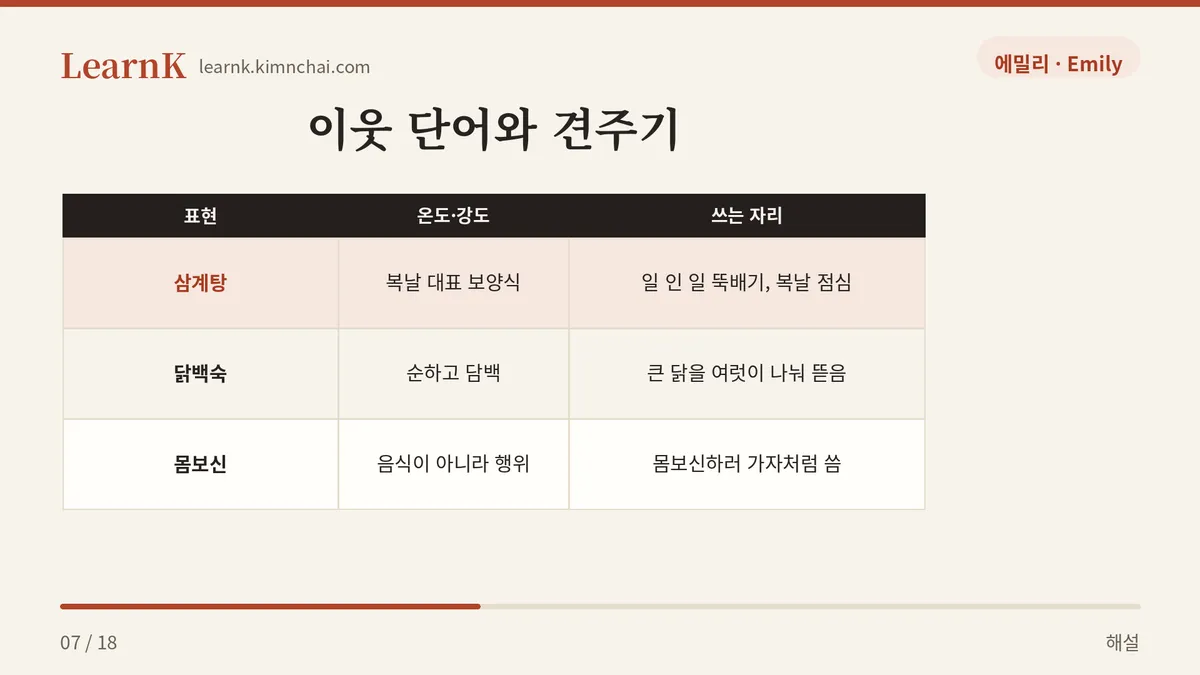
Set it beside its look-alike neighbors and its place gets much clearer.
| Expression | Temperature / intensity | Where it’s used |
|---|---|---|
| 삼계탕 (samgyetang) | The signature restorative dish of the summer dog days; one pot per person | Boknal lunch, hosting guests, restaurant menus |
| 닭백숙 (dak-baeksuk) | Milder and plainer; a big chicken pulled apart by several people | Family gatherings, valley trips and country stays, a big pot at home |
| 보양식 (boyangsik) | The umbrella term — any food eaten to build up your body | When grouping samgyetang, eel and abalone porridge together |
| 몸보신 (mombosin) | Not the food but the act itself | Used verb-like, as in 몸보신하러 가자 (“let’s go get our strength back”) |
Cultural background — the hottest day, the hottest bowl
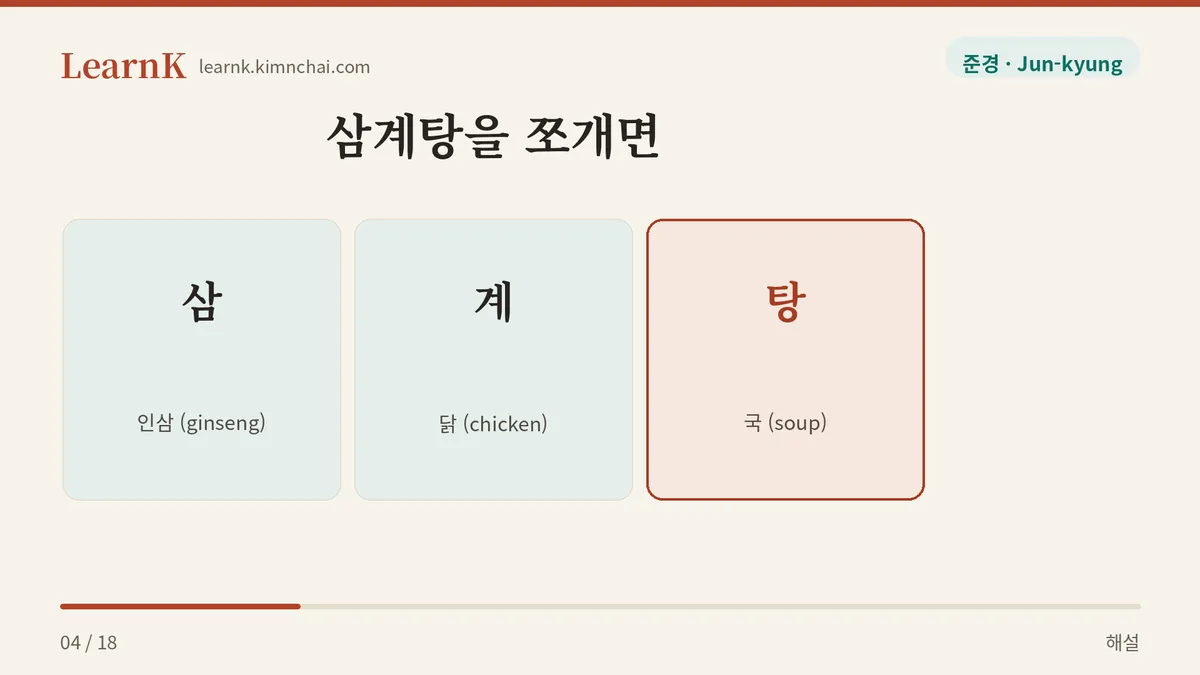
Start with the name. 삼계탕 is built from the Chinese characters 삼 (蔘, ginseng) + 계 (鷄, chicken) + 탕 (湯, soup). It’s two ingredients and one cooking method strung together, so even people who don’t read hanja never forget the meaning once they’ve heard it. Older records also show the name in reversed order, 계삼탕 (鷄蔘湯).
Samgyetang became a summer food because of 삼복 (sambok). 초복, 중복 and 말목 — sorry, 초복, 중복 and 말복 — are the three midsummer marker days that fall roughly ten days apart, and taking care of your body on those three days is a long-standing custom. The idea underneath it is 이열치열 (iyeolchiyeol, 以熱治熱) — fight heat with heat. The heat drains you through sweat, so the logic goes that eating something hot warms you from the inside, makes you sweat it all out at once, and leaves you feeling refreshed instead. Exactly what Emily said in the dialogue.
So Seoul on boknal looks a little strange. The high hits 35°C and yet lines form outside the old samgyetang restaurants, and “it’s boknal today, shall we all go together?” pops up in the company group chat. In Korean dramas, too, samgyetang tends to appear as a scene rather than a line of dialogue. A mother who’s had a big pot on the stove since dawn, pushing the earthenware bowl across the table to a child who’s finally come home, looking at them silently with eyes that say you’ve lost weight — a scene that lands without a word spoken, the classic Korean expression of love.
There’s one more thing that often surprises fans of Korean culture. Western chicken soup is what you eat when you’re sick; samgyetang is what you eat before you get sick. It isn’t repairing a body that’s broken down — it’s topping you up before the breakdown. Which is why an offer of samgyetang always has a bit of future-tense worry mixed into it.
Today’s quiz
You and a friend walk into a samgyetang restaurant and sit down. Which order sounds most natural?
① 삼계탕 하나 시켜서 나눠 먹을까? (Shall we order one samgyetang and share it?) ② 삼계탕 두 그릇 주세요. (Two bowls of samgyetang, please.) ③ 삼계탕 한 마리 주세요, 접시 두 개랑요. (One chicken of samgyetang, please, with two plates.)
Answer: ②
Samgyetang is served as a whole small chicken in an earthenware pot as one portion, so the basic move is to order as many as there are people. ① is language that fits 찌개 or 전골, and counting with 마리 as in ③ is for live chickens or chicken at the butcher’s. Once it arrives at your table in its pot, you count it with 한 그릇 (han geureut).
Definitions and example sentences are from the National Institute of Korean Language’s Basic Korean Dictionary (krdict.korean.go.kr); that portion of this post, including our translations, is licensed under CC BY-SA 2.0 KR.