상남자 (sangnamja) — The Compliment You Get for Never Hesitating
상남자 (sangnamja)
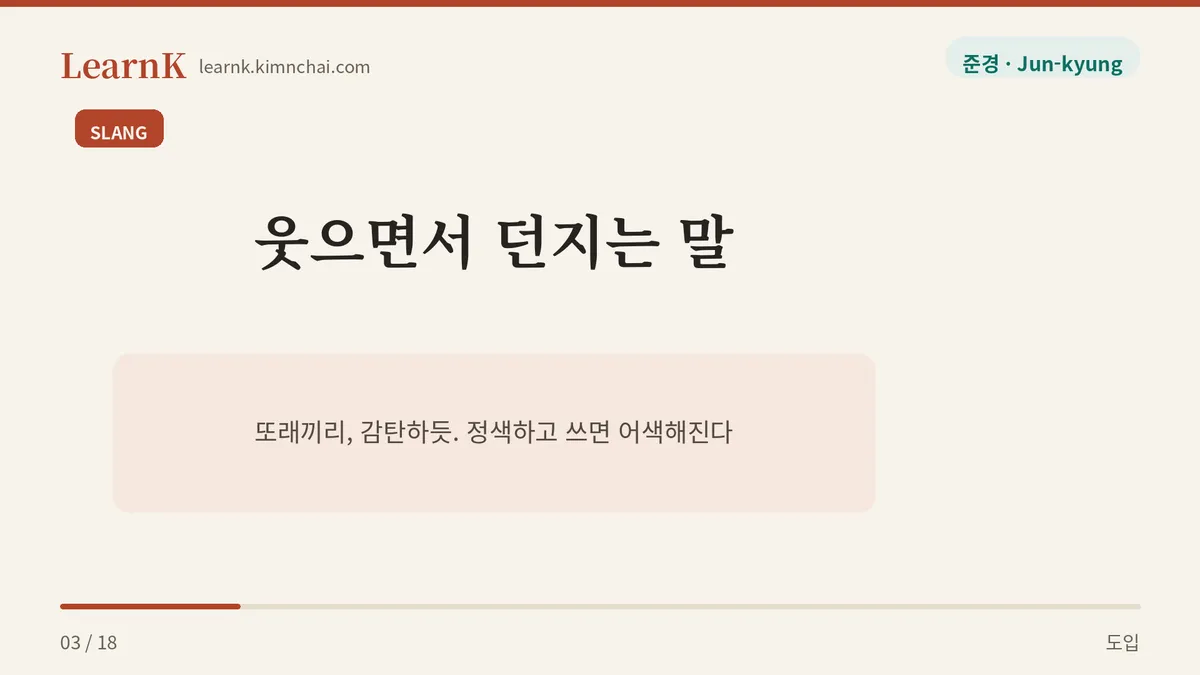
상남자 (sangnamja) describes a so-called “manly man” — someone who decides without hesitating and pushes ahead without fuss. It isn’t an old word. It spread after the 2010s among internet users, variety-show watchers, and drama fans, so it sits light. It’s less a serious judgment of someone’s character than something you toss out with a laugh while watching from the side: “Ooh, that’s kind of cool.”
The places this word pops up most often are, surprisingly, not grand moments. The person who ends it in three seconds with 저 이거요 (jeo igeoyo), “I’ll take this one,” while everyone else stares at the menu for three minutes. The person who buys a secondhand item at the listed price without haggling even once. The person at the hair salon who says 알아서 짧게 잘라 주세요 (araseo jjalge jalla juseyo), “Just cut it short, however you think is best,” and closes their eyes. Everyone around them laughs and says 와, 상남자다 (wa, sangnamjada). The condition for this word isn’t the size of the action — it’s the absence of hesitation.
So the heart of 상남자 (sangnamja) isn’t strength, it’s decisiveness. It’s not lifting the heavy bag that earns the word; it’s not agonizing over whether to lift it. Reaching for your card first at the register counts. Making the phone call you’ve been dreading right then instead of putting it off counts. On the flip side, no matter how strong you are, if you’ve been stuck on a decision for five minutes, nobody is calling you this.
There’s one more thing you can’t miss about the nuance: this word is almost always used with a smile. Say “당신은 상남자입니다 (dangsineun sangnamjaimnida)” with a completely straight face and the listener will just feel awkward. A joke wearing the clothes of a compliment, or a compliment wearing the clothes of a joke — somewhere between those two is where this word lives. That’s also why people now use it freely for women. Tell a female friend who eats spicy food without blinking, or who says what she means without dancing around it, 너 완전 상남자야 (neo wanjeon sangnamjaya) — “You’re a total sangnamja” — and it lands perfectly well as praise. A word that used to point at a gender has moved on to pointing at an attitude.
See It in a Real Conversation
Setting: A tteokbokki place in Sindang-dong. They’re picking a spice level.
Emily: 사장님한테 제일 매운 걸로 말할까? Should I tell the owner we’ll take the spiciest one?
Jun-kyung: 어… 나 중간 맛도 겨우 먹는데. Uh… I can barely handle the medium one.
Emily: 야, 너 지난주에 팀장님한테 혼자 다 따졌다며. 그땐 완전 상남자였잖아. Hey, I heard you took on the team lead all by yourself last week. You were a total sangnamja then.
Jun-kyung: 그건 그거고 이건 이거지. 매운 건 다르다니까. That’s that and this is this. Spicy food is a whole different story.
Emily: 알겠어. 그럼 내가 제일 매운 거 시킨다? Fine. Then I’m ordering the spiciest, okay?
Jun-kyung: …진짜 상남자는 너다. …You’re the real sangnamja here.
This Would Sound Off
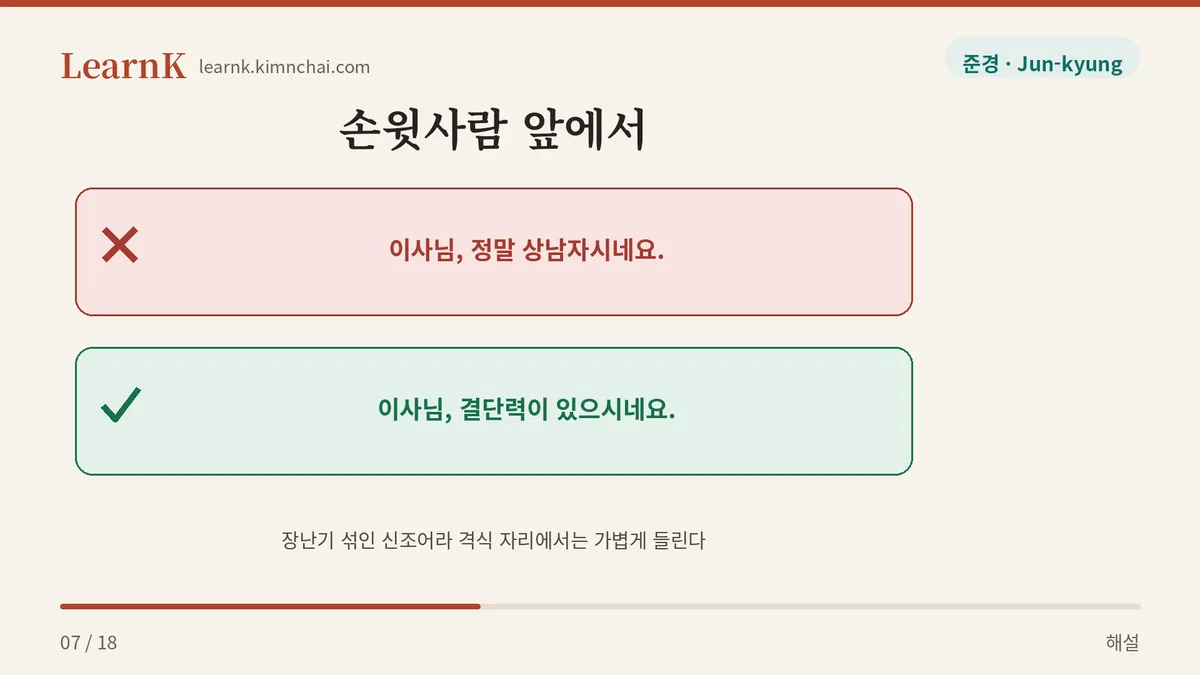
✗ (To an interviewer, in a job interview) 이사님, 정말 상남자시네요. (isanim, jeongmal sangnamjasineyo — “Director, you really are a sangnamja.”) ✓ (To a friend) 야, 그 회사 이사님 완전 상남자더라. (ya, geu hoesa isanim wanjeon sangnamjadeora — “Dude, that company’s director is a total sangnamja.”) → It’s a playful word that spread online, so in formal settings or in front of someone senior to you it sounds too light. With a superior, 결단력이 있으시네요 (gyeoldallyeogi isseusineyo), “You’re very decisive,” is the safe choice.
✗ (To a friend back from a funeral) 끝까지 안 울더라. 너 진짜 상남자다. (kkeutkkaji an uldeora. neo jinjja sangnamjada — “You didn’t cry the whole time. You’re a real sangnamja.”) ✓ (To a friend back from a funeral) 끝까지 잘 버티더라. 고생 많았어. (kkeutkkaji jal beotideora. gosaeng manasseo — “You held up all the way through. That must have been hard.”) → Praising someone for holding back grief as “manliness” turns comfort into judgment. In heavy moments, a word with a joke in it only makes the other person feel more alone.
Example Sentences by Situation
1. At a secondhand-sale meetup
Someone showed up willing to pay the listed price. You met, they checked the item, and it was over in five minutes. On the way home you tell a friend:
깎아 달란 말도 없이 그냥 사 가더라. 완전 상남자야. (kkakka dallan maldo eopsi geunyang saga deora. wanjeon sangnamjaya.) “They didn’t even ask for a discount, just bought it. Total sangnamja.”
The compliment isn’t really “they didn’t haggle” — it’s “they didn’t drag it out with negotiating.”
2. When you see a friend fresh from the hair salon
Hair that used to reach their shoulders is now half as long. You ask in surprise, and the answer is, “I just felt like cutting it.”
한 번에 그렇게 자른 거야? 야, 상남자다. (han beone geureoke jareun geoya? ya, sangnamjada.) “You cut it all off in one go? Wow, sangnamja.”
Here it’s completely natural even if the person is a woman, because what it means is that she didn’t put the decision off.
3. At a company dinner
Everyone is reading the room about who pays, and one person quietly gets up, settles the bill, and comes back.
선배 언제 계산했어요? 상남자 인정. (seonbae eonje gyesanhaesseoyo? sangnamja injeong.) “When did you pay?! Certified sangnamja.”
The 인정 (injeong) tacked on the end is young-speak short for “인정한다 (injeonghanda)” — “I acknowledge it” — and it pairs with 상남자 (sangnamja) all the time.
Politeness Levels and Similar Expressions
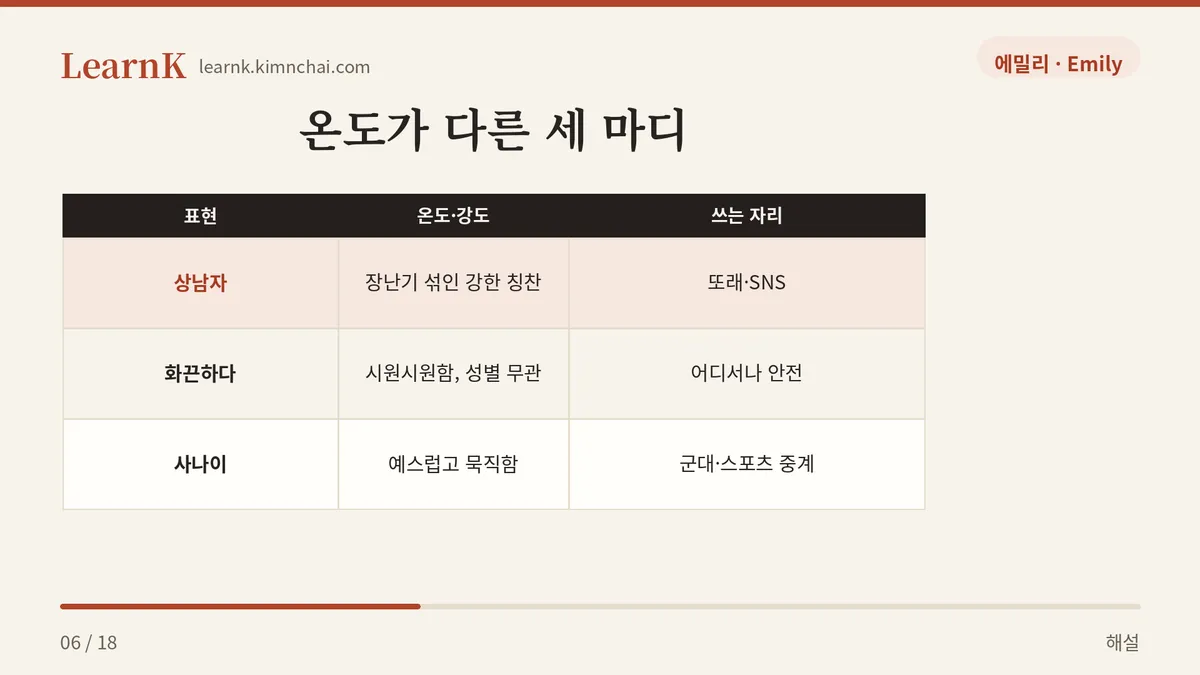
상남자 (sangnamja) is a noun, not an adjective, so it doesn’t take polite endings smoothly. 상남자시네요 (sangnamjasineyo) is grammatically possible, but since the word is casual joking speech to begin with, dressing it in honorifics makes it stick out awkwardly. If you want to convey the same idea to someone senior, you’re better off swapping in one of the expressions in the right-hand column below.
| Expression | Warmth · Intensity | Where it’s used |
|---|---|---|
| 상남자 (sangnamja) | Strong praise with a playful edge | Peers, social media. Not for formal settings |
| 남자답다 (namjadapda) | Neutral to serious | Everyday speech generally. Still carries gender-role baggage |
| 사나이 (sanai) | Old-fashioned, weighty | Military, sports commentary, old song titles |
| 화끈하다 (hwakkeunhada) | Bold and no-nonsense, gender-neutral | Anywhere. The safest substitute for 상남자 |
| 쿨하다 (kulhada) | Light and stylish | Peers. Used for not dragging emotions out |
The same scene calls for different words depending on who’s listening. When a junior colleague decides without hesitating, among peers you’d say 상남자네 (sangnamjane), in front of the department head 화끈하시네요 (hwakkeunhasineyo), and in a written report 과감한 추진력 (gwagamhan chujinnyeok), “bold drive.” All three point at the same behavior, but all three have different temperatures.
Cultural Background — The Temperature of Manliness, Shaped by K-Dramas
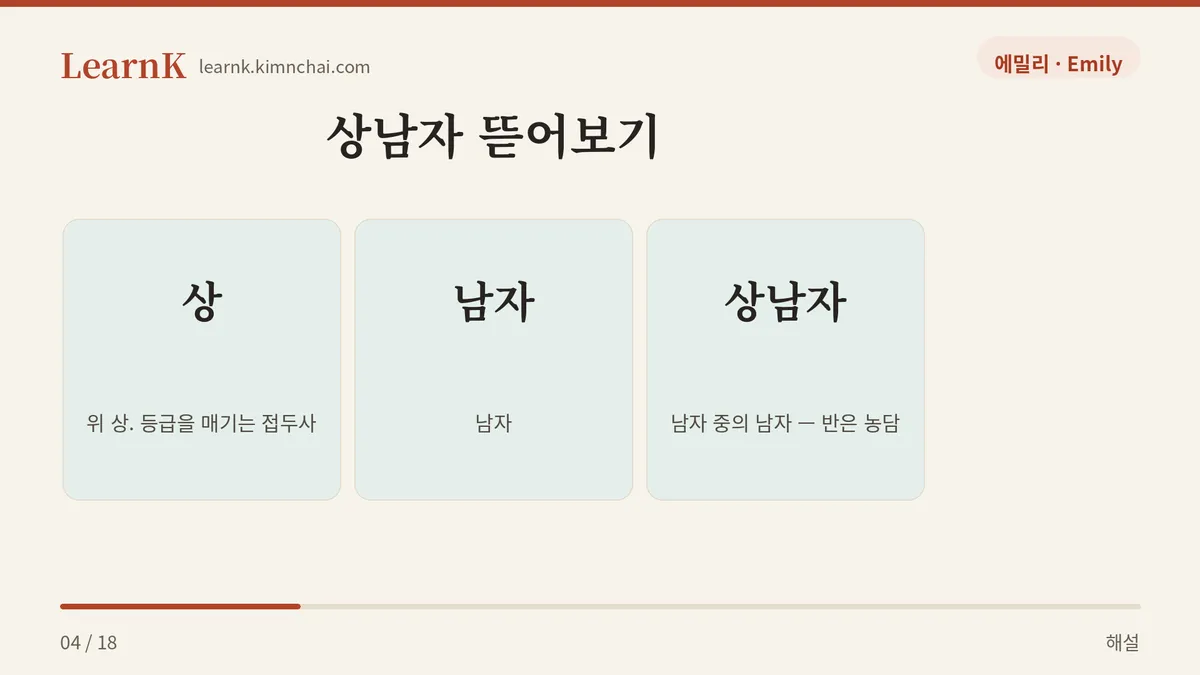
The usual reading is that the Chinese character 上 (상, “upper”) plus “남자 (namja),” man, gives you “upper-tier man” — a man among men. The fact that a ranking prefix like 上 got playfully stuck onto a person tells you this word was half a joke from birth.
Behind the word’s rise is the Korean drama male lead. In 2000s dramas it was common to see a hero who barely spoke, seemed blunt, and then at the decisive moment moved with his body before his mouth. A character who answered with action instead of explanation — 상남자 (sangnamja) was basically that character’s name tag.
What’s interesting is the present. These days the popular male lead is more likely to be warm, talkative, and good at explaining his feelings. As the kind of manliness viewers want has shifted, 상남자 (sangnamja) has stepped back from being serious praise and taken a seat in the joke section. And in doing so, its range actually widened. A word that once pointed at a gender now points at “an attitude of not hesitating,” regardless of gender. That’s why nobody bats an eye if you tell a Canadian friend who eats spicy tteokbokki without flinching 너 상남자다 (neo sangnamjada).
Still, it’s worth knowing that the word carries gender-role assumptions to this day. It ties courage and boldness to masculinity, so used seriously in a serious setting it can sound dated. Said with a smile it’s a compliment; said with a straight face it’s a prejudice — the safe line for this word runs somewhere in between.
Today’s Quiz
In which of the following situations is 상남자 (sangnamja) the most natural thing to say?
- Writing praise for a junior colleague’s drive on their new-employee evaluation
- When a friend takes one look at the menu and finishes ordering in three seconds
- Comforting a friend who has just come back from a funeral
See the answer
Answer: 2
상남자 (sangnamja) is colloquial slang used among peers, with a smile. In an official document like option 1, the register doesn’t match — you’d want 과감한 추진력 (gwagamhan chujinnyeok), “bold drive,” instead. In a heavy moment like option 3, it comes across as judgment rather than comfort. The hesitation-free decision in option 2 is exactly the moment this word shines brightest.
The definition, example sentences, and dialogue in this post are all our own original writing. 상남자 (sangnamja) is new slang that has not yet been entered as a headword in the National Institute of Korean Language’s Basic Korean Dictionary (krdict.korean.go.kr), so this installment was put together by observing how the word is actually used, without citing the dictionary.