사생팬 (sasaengpaen) — Between Fan and Stalker, the Word That Is Never a Compliment
사생팬
사생팬 (sasaengpaen) means an obsessive fan who follows a celebrity to their home, their dorm, even along their travel routes, invading their private life. It is not a word for someone who screams themselves hoarse cheering at a concert. People who stay up all night in front of an airport gate, who chase an idol’s van by taxi, who ring the doorbell at the dorm, who buy and sell personal phone numbers — only the ones who have crossed a line that should not be crossed get called 사생팬.
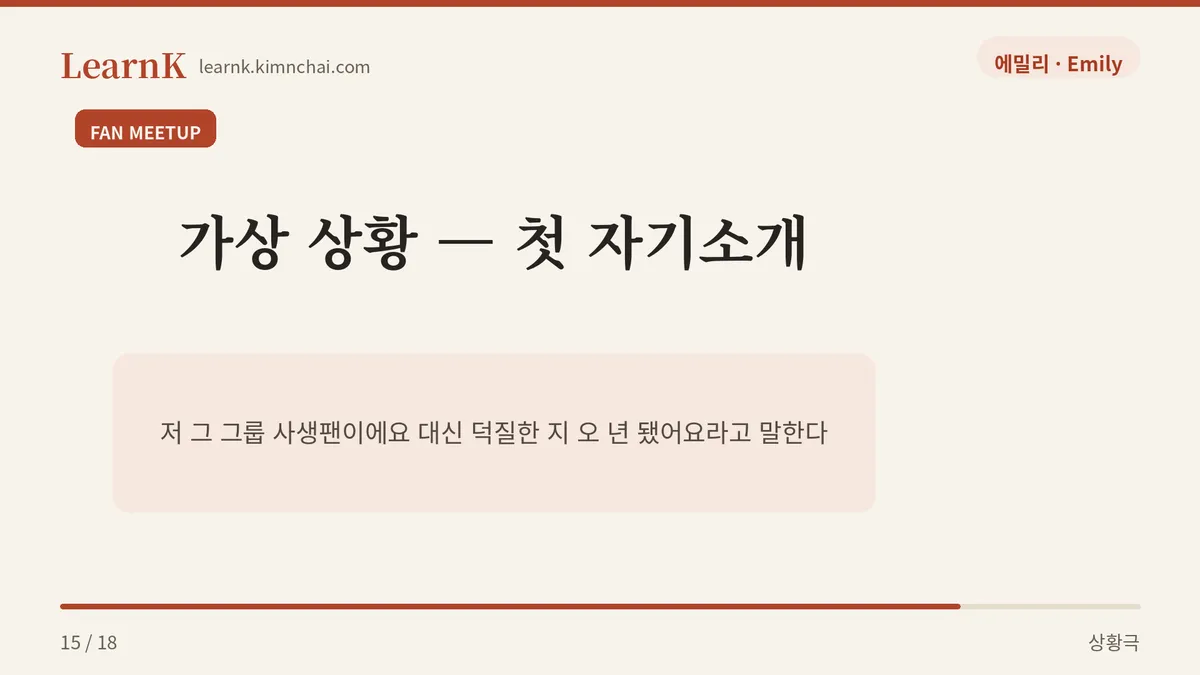
If you started learning Korean because of K-pop, you will meet this word in fan communities long before you meet it in a textbook. It shows up in agency statements, it shows up when fans police each other, and it shows up in news headlines. So if you know the meaning but not the temperature, accidents happen. It really does happen that a foreign fan learning Korean introduces themselves with “저는 그 그룹 사생팬이에요” and the mood in the room freezes over. They meant “I’m a really passionate fan,” but to Korean ears it lands as “I stalk that person.”
The nature of this word comes down to three things. First, it is 100% negative. It is not a word that measures the size of your affection — it accuses someone of behavior that borders on criminal. Second, you do not use it about yourself. It is what others call you, not how you introduce yourself. Third, it draws a line inside the fandom. The people fans dislike most are 사생팬. It gets used to deny someone’s status as a fan at all: “쟤넨 팬 아니야, 사생이야” (“They’re not fans, they’re sasaeng”). It is often shortened to just 사생 (sasaeng).
A real conversation
Scene: Eleven at night, after a concert. At the taxi stand behind the venue, a strangely large crowd has gathered.
Jun-kyung: 저기 택시 줄 왜 저래? 다들 한쪽만 쳐다보고 있는데. Why is that taxi line like that? Everyone’s staring in the same direction.
Emily: 아, 저거 사생팬들이야. 멤버들 차 나오면 바로 따라붙으려고 대기 타는 거지. Ah, those are sasaeng fans. They’re waiting to tail the members’ van the second it pulls out.
Jun-kyung: 진짜? 팬이면 그냥 공연 보고 응원하면 되는 거 아니야? Seriously? If you’re a fan, isn’t watching the show and cheering enough?
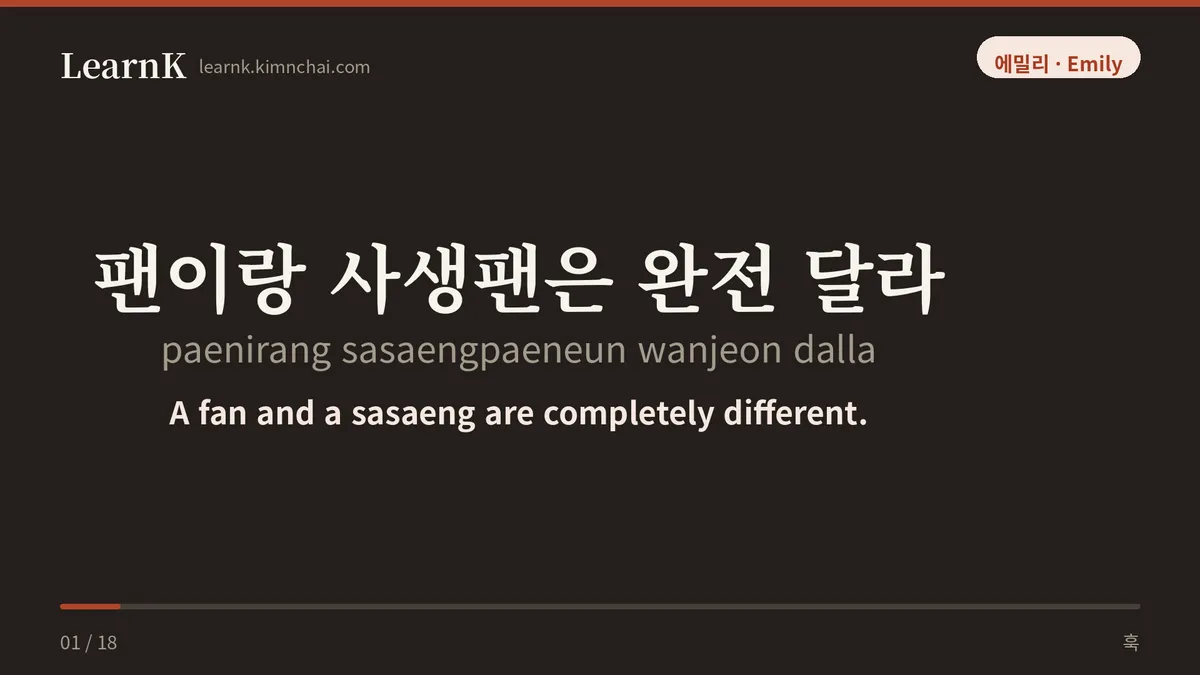
Emily: 그러니까. 팬이랑 사생팬은 완전 달라. 저건 그냥 스토킹이야. Right? A fan and a sasaeng are completely different. That’s just stalking.
Jun-kyung: 하긴, 숙소까지 따라가는 건 좀 무섭다. True, following them all the way home is kind of scary.
Emily: 무섭지. 나도 팬이지만 저 줄엔 절대 안 서. It is. I’m a fan too, but I’d never stand in that line.
This sounds unnatural
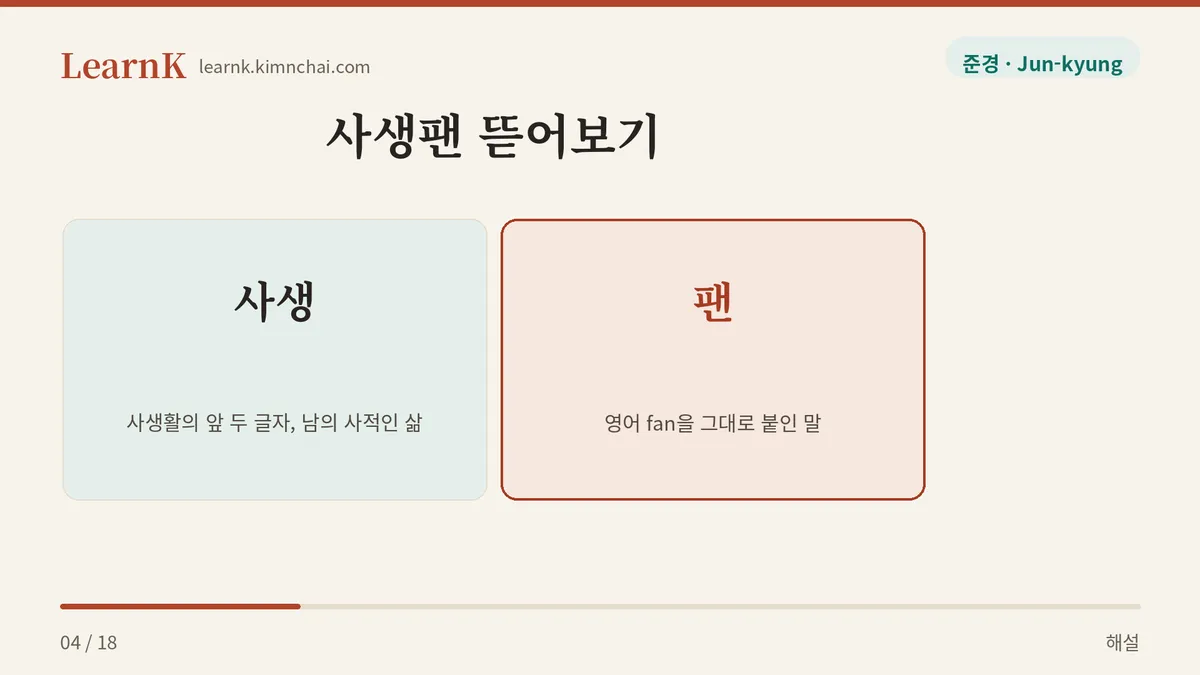
✗ (to a friend who is deep into their fandom) 너 그 배우 완전 사생팬이구나! ✓ (to a friend who is deep into their fandom) 너 그 배우 완전 찐팬이구나! → 사생팬 points at an invasion of privacy, not at the size of someone’s affection, so using it as praise means treating your friend like a criminal. To compliment a devoted fan, use 찐팬 (jjinpaen) or “오래된 팬” (a longtime fan).
✗ (introducing yourself) 안녕하세요, 저 그 그룹 사생팬이에요! ✓ (introducing yourself) 안녕하세요, 저 그 그룹 덕질한 지 5년 됐어요. → Nobody introduces themselves as a 사생팬. It carries the same weight as “I’m a stalker,” so even as a joke, very few people will laugh along.
Example sentences by situation
① When an agency issues an official statement — this is a company warning the entire fandom, so stiff written-style Korean is used.
최근 일부 사생팬의 도를 넘은 행위에 대해 법적 대응을 검토하고 있습니다. (Choegeun ilbu sasaengpaenui doreul neomeun haengwie daehae beopjeok daeeungeul geomtohago itseumnida.) We are reviewing legal action regarding the recent conduct of certain sasaeng fans, which has gone beyond acceptable limits.
The expression worth noting here is 도를 넘다 (doreul neomda), an idiom meaning “to cross the line.” It follows conversations about 사생팬 almost every single time.
② When fans police each other — this is the most common use, on fan community boards and in group chats.
우리 팬덤에 사생팬 있는 거 진짜 창피해. 제발 좀 조용히 응원만 하자. (Uri paendeome sasaengpaen inneun geo jinjja changpihae. Jebal jom joyonghi eungwonman haja.) It’s genuinely embarrassing that our fandom has sasaeng fans. Please, let’s just cheer quietly.
As the word “창피해” (embarrassing) shows, from a fan’s point of view a 사생팬 isn’t an outsider — they’re someone dragging your own name through the mud.
③ When joking with a close friend — only between very close friends, and only lightly. The other person may still take offense, so this isn’t recommended for beginners.
너 매일 그 사람 SNS 확인하는 거, 그러다 사생팬 되겠다. (Neo maeil geu saram SNS hwaginhaneun geo, geureoda sasaengpaen doegetda.) Checking their social media every single day — keep that up and you’ll turn into a sasaeng fan.
Adding 되겠다 builds the tease as “you’re not one yet, but you’re heading that way.” The key is that it does not declare the person a 사생팬 right now.
Formal vs. casual speech, and similar expressions
사생팬 is a noun, so it has no formal or casual form of its own. The difference appears at the end of the sentence — 사생팬이야 (sasaengpaeniya) is casual, 사생팬이에요 (sasaengpaenieyo) is polite. But there’s a trap here. Speaking politely does not soften this word. No matter how courteously you say “저분은 사생팬이세요,” the content is still an accusation. Some words cannot be covered up with politeness — realizing that is the real intuition you gain from learning this expression.
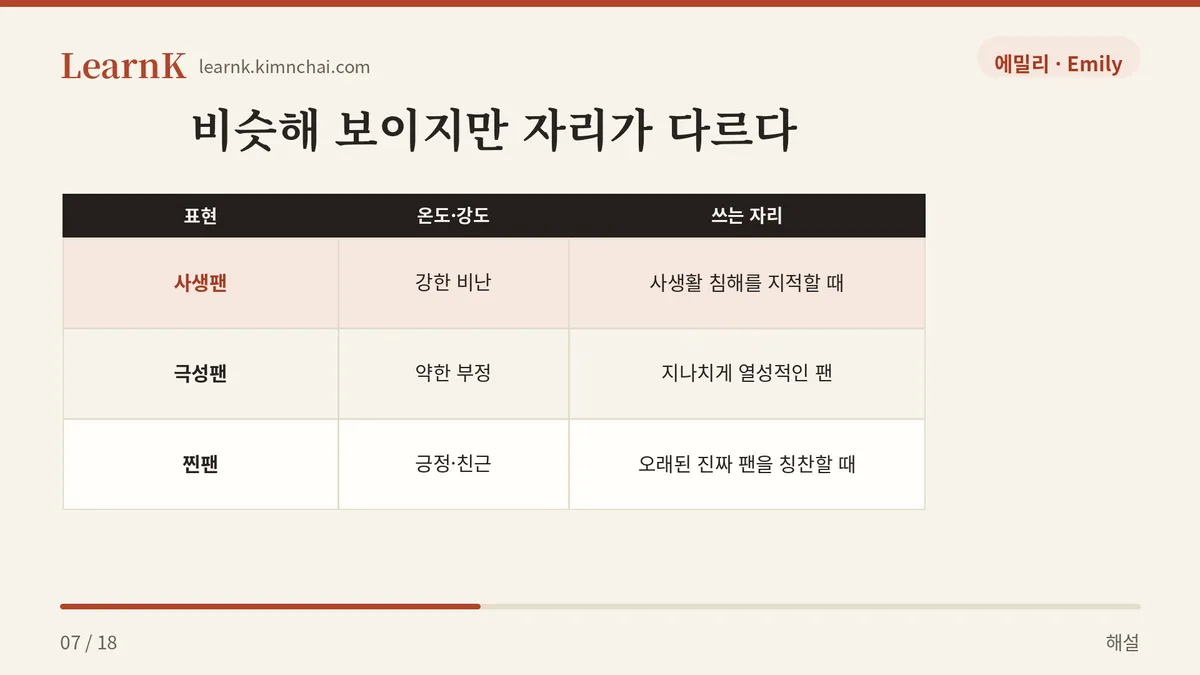
Here are the words that look similar but sit in different places, side by side.
| Expression | Tone / intensity | Where it’s used |
|---|---|---|
| 사생팬 (sasaengpaen) | Harsh condemnation | Calling out invasion of privacy. Never a compliment |
| 극성팬 (geukseongpaen) | Negative but milder | Excessively zealous fans in general, short of invasion |
| 찐팬 (jjinpaen) | Positive, friendly | Among peers, on social media. Praising a true longtime fan |
| 덕후 (deokhu) | Neutral to friendly | Used about yourself too. Any field, not just entertainment |
| 스토커 (seutokeo) | Names a crime | Includes ordinary people, not just celebrities. Legal contexts |
덕후 and 찐팬 are fine in a self-introduction, 극성팬 needs care, and 사생팬 and 스토커 are only for calling out someone else — remember that order and you won’t slip up.
Cultural background — why this word was born in Korea
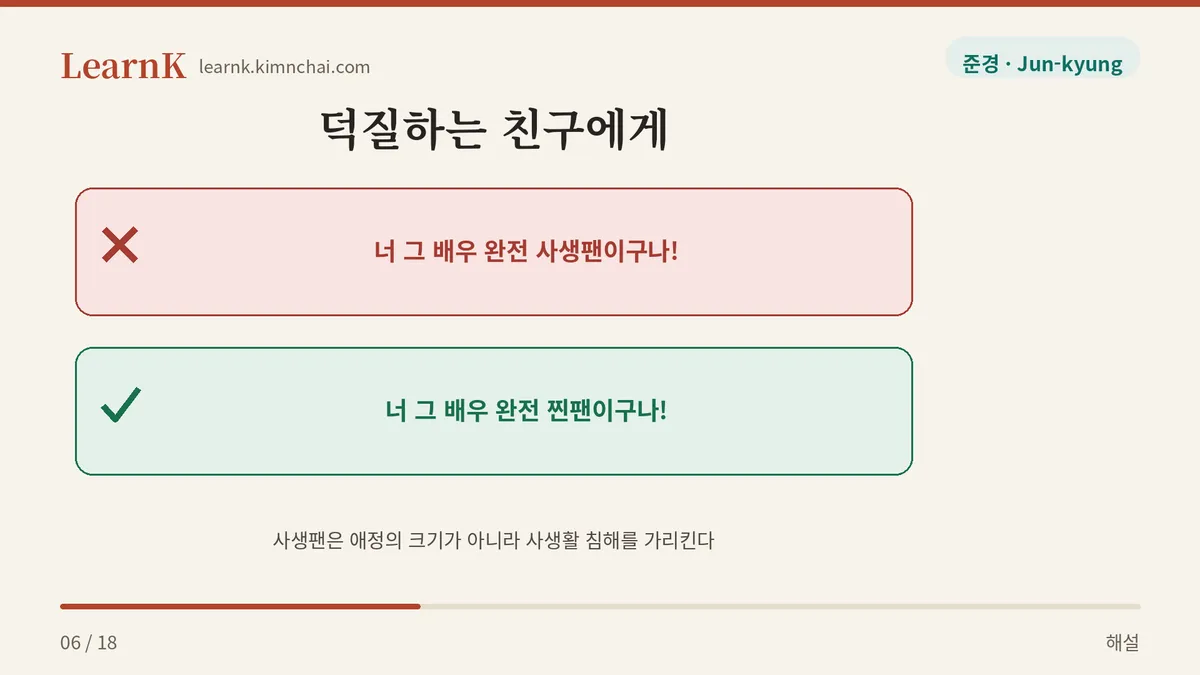
사생 (私生) takes the first two syllables of 사생활 (私生活, sasaenghwal), meaning “private life,” and attaches the English word fan. Splicing the front of a Sino-Korean word onto a loanword is an extremely common way of coining new Korean slang. The meaning is built right into the structure: private life + fan = a fan who invades your private life.
There’s a reason this word became so widespread specifically in Korea. In the K-pop industry, the distance between fans and artists is unusually short. Fans talk face to face at fan signings, the walk to and from music shows is public, and seeing artists off at the airport has become an established culture. That closeness works warmly most of the time, but for a few people it creates the illusion of “surely I can get just a little closer.” 사생팬 is the name attached to the point where that illusion turns into actual behavior.
There are derived terms too. 사생택시 (sasaengtaeksi) refers to a taxi that carries 사생팬 and chases an artist’s car. These drivers are known to negotiate a fare for a whole night of following, and they are among the most fiercely condemned targets in any fandom.
Korean dramas with idols or actors as protagonists show this situation often: someone loitering outside the lead’s apartment, a manager hurriedly yanking the curtains shut, the agency meeting to discuss a response. The fact that these scenes are familiar enough to picture without hearing a single line of dialogue is itself proof of how long this problem has been around. Recently, several agencies have actually begun legal proceedings over sasaeng behavior, and fandoms themselves draw the line by sharing the sentence “사생은 팬이 아니다” — sasaeng are not fans.
Today’s quiz
Which of the following sentences uses 사생팬 (sasaengpaen) naturally?
- 저는 그 그룹 데뷔 때부터 좋아한 사생팬이에요.
- 어제 사생팬들이 숙소 앞까지 따라와서 소속사가 공지를 올렸대.
- 네가 그 배우 사생팬이라니, 정말 대단한 애정이다!
The answer is number 2. 사생팬 points out behavior that invades someone’s private life, so it fits perfectly with a situation where people “followed them all the way to the dorm.” Number 1 amounts to introducing yourself as a stalker, and number 3 puts a word of condemnation where praise belongs, twisting the whole sentence. Change number 1 to “데뷔 때부터 좋아한 찐팬이에요” and number 3 to “정말 찐팬이구나!” and both become natural.
If you compress today’s lesson into one line, it’s this: when you’re talking about the size of someone’s love, say 찐팬; when you’re talking about a line that was crossed, say 사생팬. Just keeping those two straight is enough to have misunderstanding-free conversations inside a Korean fandom.
Definitions and example sentences are from the National Institute of Korean Language’s Basic Korean Dictionary (krdict.korean.go.kr); that portion of this post, including our translations, is licensed under CC BY-SA 2.0 KR.