스불재 (seubuljae) — What Someone Says After Turning Off All Three Alarms and Going Back to Sleep
스불재 (seubuljae)
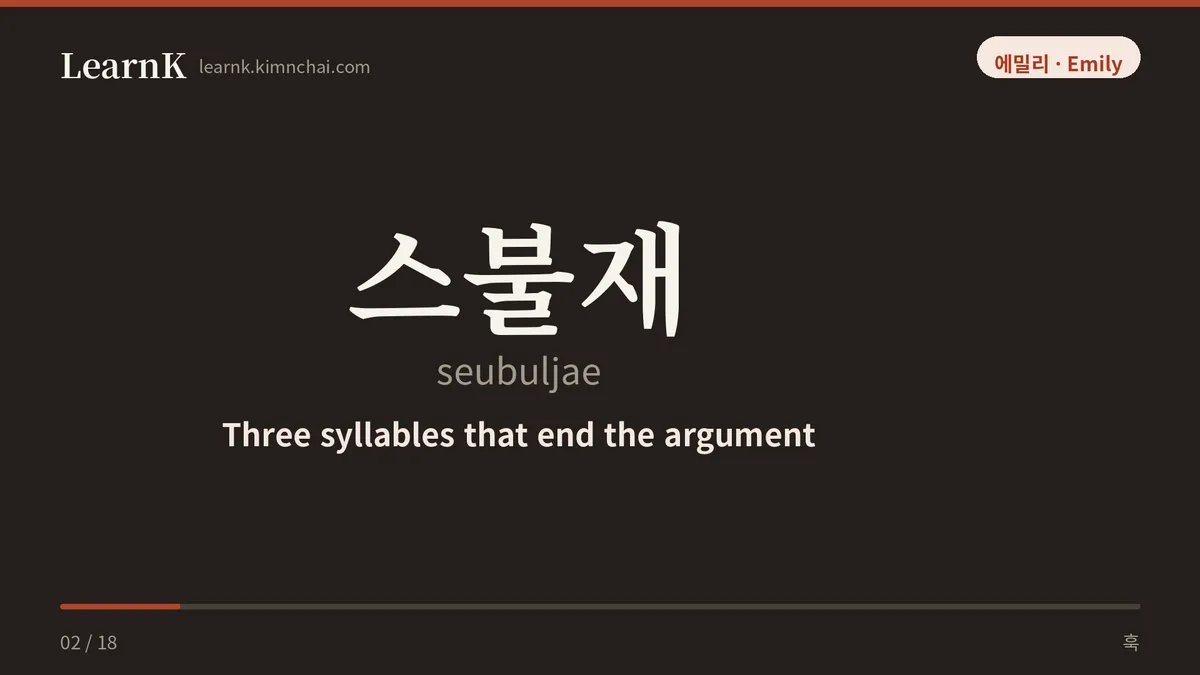
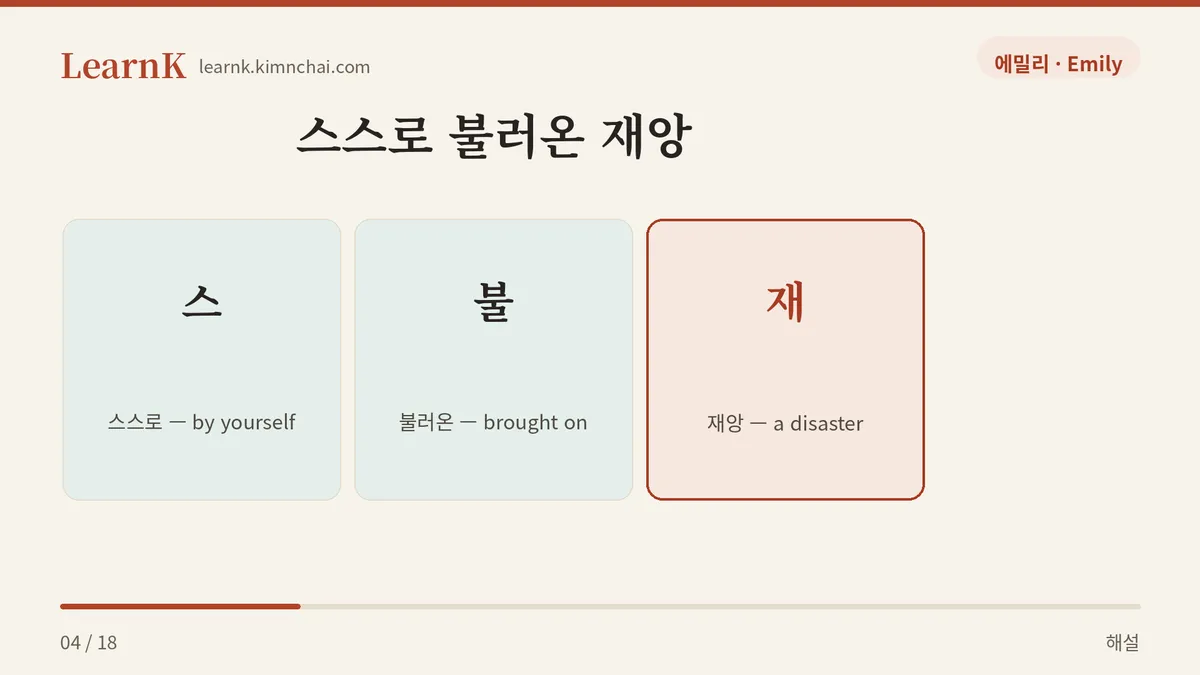
스불재 (seubuljae) is an abbreviation built from the first letter of each word in “스스로 불러온 재앙 (seuseuro bulleoon jaeang)” — “a disaster you brought on yourself.” It describes a situation where you’re the one paying for a choice you made, with nobody else to blame. The person who says “just one more episode” three times on a Friday night and then has to make an eight a.m. appointment on Saturday; the person who would have been perfectly fine with spice level 3 but ordered level 5 anyway and is now sprinting to the convenience store for milk — what those people say about themselves is exactly 스불재.
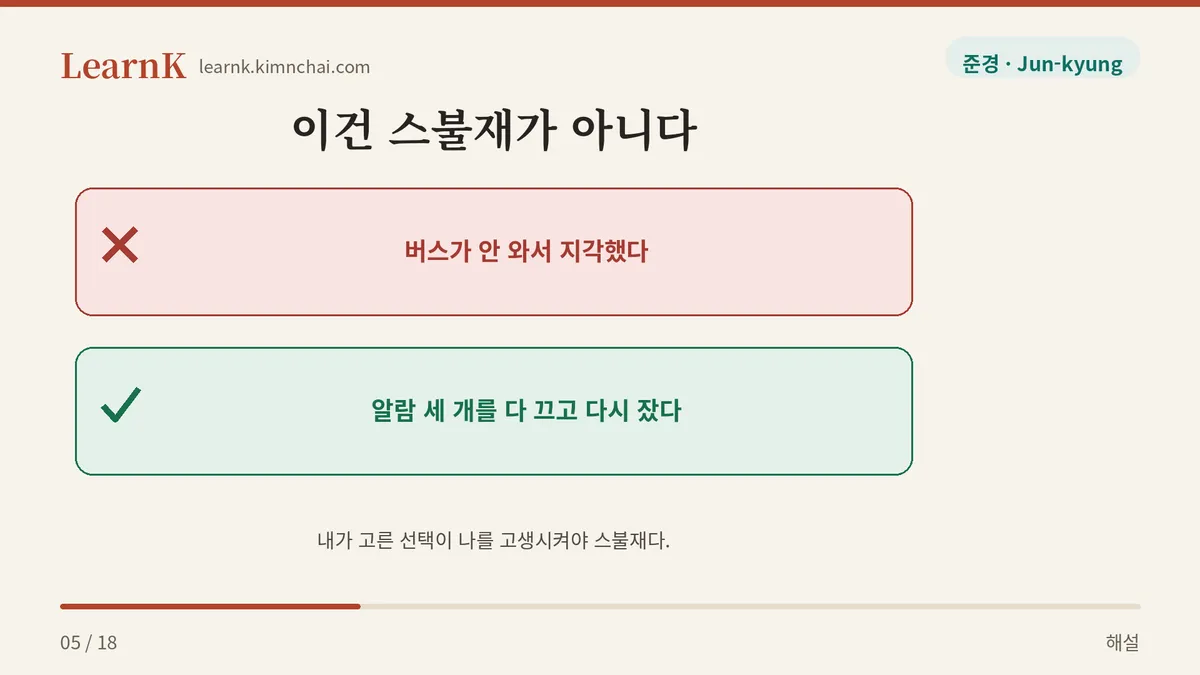
The heart of it is that the cause is you. Being late because the bus never came is not 스불재. Setting three alarms, turning off all three, and falling back asleep is 스불재. Getting your clothes soaked because it rained is not 스불재; seeing the forecast and leaving the umbrella at home because it felt heavy is. That’s why there’s almost no sense of grievance in this word. You’ve already sealed off every spot where a grievance could stand.
The temperature is lighter than you’d expect. It isn’t describing an actual catastrophe — it deliberately drops the big word “disaster” onto a small mistake, and that mismatch is the joke. So 스불재 is usually used about yourself. It’s closer to a rueful admission: you sigh, but the corners of your mouth lift a little. You can use it about someone else, but only with people you’re on easy terms with, and never when the other person has genuinely lost something.
Inside a sentence it behaves like a noun. The most common shapes attach the copula ‘-이다 (-ida)’ — 스불재다 (seubuljae-da), 스불재네 (seubuljae-ne), 스불재였다 (seubuljae-yeotda) — or place an adverb like ‘완전 (wanjeon)’, ‘진짜 (jinjja)’, or ‘역대급 (yeokdaegeup)’ in front, as in 완전 스불재 (wanjeon seubuljae). It doesn’t conjugate as a verb, so ‘스불재하다 (seubuljae-hada)’ sounds unnatural.
Seeing It in a Real Conversation
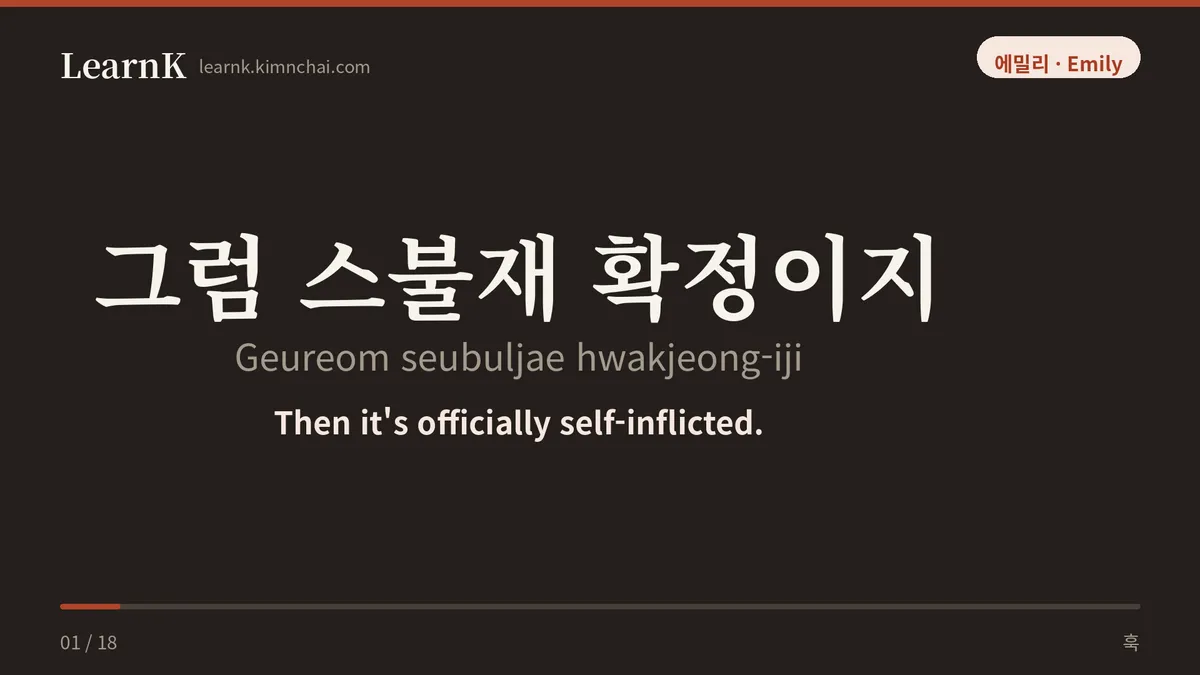
Scene: A midsummer afternoon, on the stairs halfway up a mountain. Emily wanted to take the cable car, but Jun-kyung talked her out of it — “a mountain is only worth it on foot.” Forty minutes later.
준경: (헉헉) 야… 물… 물 좀 남았어? (panting) Hey… water… do you have any water left?
에밀리: 아까 케이블카 타자니까 걸어야 제맛이라며. 이거 완전 스불재 아니야? You’re the one who said walking is the real deal when I suggested the cable car. Isn’t this totally a disaster you brought on yourself?
준경: 말도 마. 등산화까지 새로 사 왔는데 발 다 까졌어. Don’t even. I bought new hiking boots for this and my feet are all blistered.
에밀리: 어제 산 신발을 오늘 바로 신고 왔다고? 그럼 스불재 확정이지. You bought them yesterday and wore them straight here? Then it’s officially self-inflicted.
준경: …인정. 내려갈 땐 케이블카 타자, 응? …Fair enough. Let’s take the cable car down, okay?
에밀리: 그건 되지. 대신 표는 네가 끊어. That works. But you’re buying the tickets.
This Sounds Off
✗ (To a coworker who got hurt in an accident) 선배, 그렇게 급하게 뛰어가시더니 스불재네요. You ran off in such a hurry — guess that one’s on you.
✓ (Muttering to yourself) 아, 뛰다가 넘어졌네. 스불재다 진짜. Ugh, I tripped while running. Classic 스불재.
→ Used in a moment when the other person has actually been injured or has really lost out, it isn’t comfort — it’s mockery. At its core this phrase is a joke you aim at yourself.
✗ (To your department head) 부장님, 그 계약 건은 좀 스불재 아니셨어요? Sir, wasn’t that contract kind of a self-inflicted mess?
✓ (To a colleague of the same rank) 야, 나 그 계약 건 완전 스불재였어. Man, that contract was a total 스불재 on my part.
→ Because it’s slang born online, using it toward someone senior sounds flippant and rude. In front of a superior, something like “제 판단 착오였습니다 (je pandan chagoyeotseumnida)” — “that was an error in my judgment” — is the safe choice.
Example Sentences by Situation
1) The day after payday, the moment you open your credit card statement
Reassured by the words “interest-free installments,” you bought a laptop, a chair, and a monitor all at once. The payments were split over twelve months, but the regret arrived in one day.
12개월 무이자라길래 질렀는데, 명세서 보니까 이건 그냥 스불재다. Sipi-gaewol muija-rageulle jilleonneunde, myeongsaeseo boni-kka igeon geunyang seubuljae-da. (They said twelve months interest-free so I splurged, but looking at the statement, this is just a disaster I brought on myself.)
2) The night before the exam, when the library’s closing announcement comes on
A month ago you even made a study schedule and taped it to the wall. The schedule stayed up just fine. Only the studying didn’t happen.
계획표 만드는 데 이틀 쓰고 공부는 오늘 시작했어. 스불재 인정. Gyehoekpyo mandeuneun de iteul sseugo gongbu-neun oneul sijakhaesseo. Seubuljae injeong. (I spent two days making the schedule and started studying today. Yeah, this one’s on me.)
3) Moving day, halfway through unloading, with a hand pressed to your lower back
The quote for a full-service move looked expensive, so you called two friends and rented just the truck. The pain patches are going to cost more than you saved.
돈 아끼겠다고 반포장으로 했는데 이거 역대급 스불재야. Don akkigetdago banpojang-euro haenneunde igeo yeokdaegeup seubuljae-ya. (I went half-service to save money, and this is an all-time-great self-inflicted disaster.)
Polite and Casual Forms, and Similar Expressions
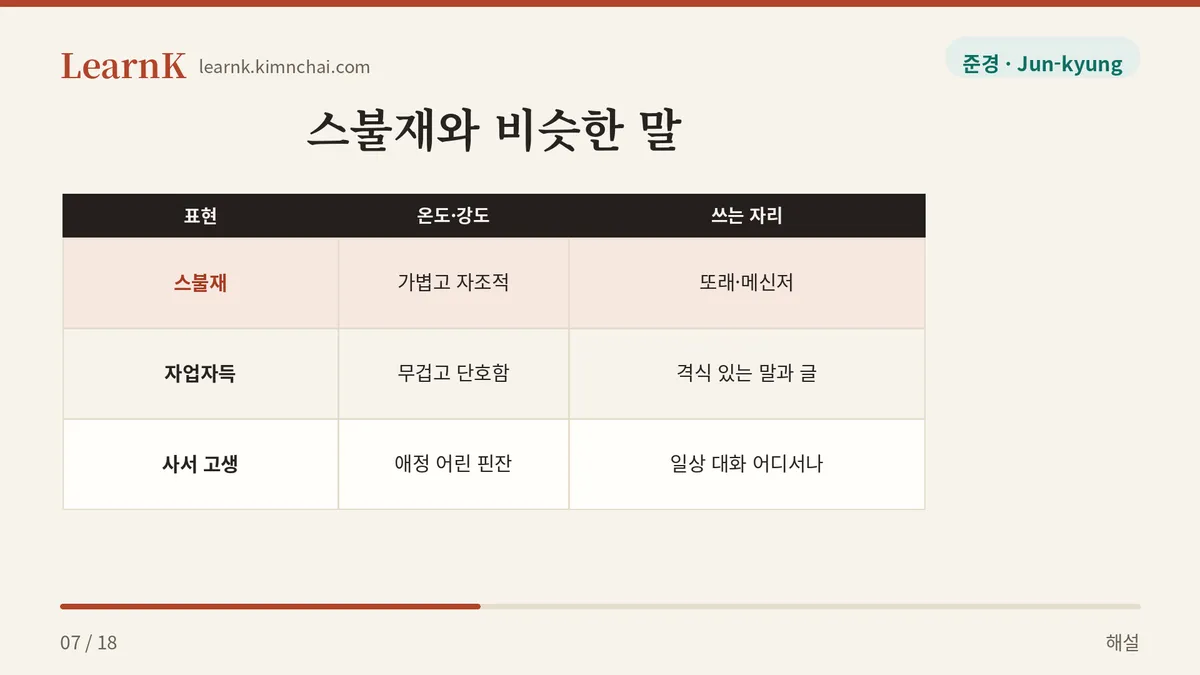
스불재 effectively has no polite form. If you forced one it would be “스불재입니다 (seubuljae-imnida),” but in any setting that calls for formality, the natural move is not to use the word at all. Compared with expressions that sit at a similar temperature, it breaks down like this.
| Expression | Temperature & Force | Where It’s Used |
|---|---|---|
| 스불재 (seubuljae) | Light and self-mocking, with a laugh mixed in | Among peers, in messaging apps and on social media. Not used toward seniors |
| 자업자득 (jaeopjadeuk) | Heavy and firm, close to a reprimand | Formal speech and writing. Aimed at someone else, it stings |
| 사서 고생 (saseo gosaeng) | Neutral to affectionately chiding | Anywhere in everyday conversation. Fine toward seniors too |
| 자승자박 (jaseungjabak) | Heavy and literary | Mostly written language — news, commentary |
Looking at the same situation, a friend says “스불재네 (seubuljae-ne),” your mother says “사서 고생이지 (saseo gosaeng-iji),” and the headline says “자승자박 (jaseungjabak).” The meanings overlap, but the speaker and the setting are different.
Cultural Background — How an Abbreviation Bears Self-Mockery
스불재 comes from 스스로 불러온 재앙 (seuseuro bulleoon jaeang), one syllable plucked from the front of each word and stuck together. This is an extremely common way of coining new words in Korean — the same family as 소확행 (sohwakhaeng), from ‘작지만 확실한 행복 (jakjiman hwaksilhan haengbok)’ (“small but certain happiness”), and 많관부 (mangwanbu), from ‘많은 관심 부탁드립니다 (maneun gwansim butakdeurimnida)’ (“please give it lots of attention”). Words like these were born from the speed of chats and comment threads, where everything has to be over in a few keystrokes, so most of them spread in writing first and only later crossed over into speech.
The interesting part is that Korean already had several words meaning the same thing. 자업자득 (jaeopjadeuk), 자승자박 (jaseungjabak), 인과응보 (ingwa-eungbo) — all of them four-character Sino-Korean idioms, and all of them heavy. These words carry a whiff of moral judgment. When someone says “인과응보지 (ingwa-eungbo-ji),” they’re talking about paying the price for a wrong, not about the soles of a guy who climbed a mountain in brand-new hiking boots. There was an empty slot for a light word you could use for the small self-reproaches of daily life, and 스불재 filled it.
Korean romantic comedies are full of scenes where the lead tells a pointless lie to test how the other person feels, then gets tied to that lie and suffers for three straight days. The viewers don’t need any dialogue to explain it — they know nobody made him do that. 스불재 is the word that sums up that entire scene in three syllables, and in summing it up it leaves room to laugh it off. In that it makes admitting your own mistake hurt a little less, this word belongs on the kind side.
Today’s Quiz
In which of the following situations could you use 스불재 (seubuljae) most naturally?
- The subway stopped for twenty minutes due to a signal failure and you were late to your interview.
- You wanted new earbuds, so you sold your perfectly good ones secondhand — and now the new ones are out of stock and you’ve gone two weeks without music.
- The coworker next to you accidentally threw out your documents.
See the answer
Answer: 2
In 1 and 3, the cause lies outside you. Neither the subway breakdown nor your coworker’s mistake was something you chose, so that’s not 스불재 — that’s just bad luck. In 2, nobody told you to do anything: you’re the one who sold off a perfectly good pair of earbuds first, and now you’re the one living with the result. “멀쩡한 거 왜 팔았지… 스불재다 진짜.” (“Why did I sell a perfectly good pair… this is so on me.”) That sentence fits this spot exactly.